Showing posts with label Peter Cushing. Show all posts

April 28, 2026

The Great Hammer-Amicus Antiques Expo

Regular readers of Films From Beyond are no doubt aware of the bizarre universe that parallels our own, where monsters are the norm (and not just members of the ruling class). Every once in awhile, yours truly is privileged to see through the fragile membrane that separates our universes and report back via this blog -- see my previous reports here and here.

Graphic image: Logo for The Hammer-Amicus Antiques Expo
Recently I scored a sensational exclusive: the transcript from the pilot episode of the Hammer-Amicus Antiques Expo, which unfortunately was not picked up by the network in its alternate universe and never saw any further development.

Inspired by this universe’s Antiques Roadshow from PBS, the Expo (or HAAE) invited select participants caught up in the frightful events documented by various Hammer and Amicus films to share their antique finds with the co-hosts, who were uniquely qualified to assess the cultural significance and value of the items. Collectors in-the-know have searched far and wide for a copy of the show’s tape, the original of which is thought to have been reused for an episode of Hammer's This Old House of Horror.

The videotape itself is likely lost to the ages, but after countless hours scouring eBoo, Eeksy and the darkest corners of the Dark Web, I finally secured a transcript of the episode, dog-eared and dusty, but nonetheless complete. Judge for yourself whether or not the monsterverse is immeasurably poorer because the Expo failed to become a full-fledged series.

Jimmy Sanguinarius: Welcome to this debut episode of the Hammer-Amicus Antiques Expo! I'm your host, Jimmy Sanguinarius, and please give a round of applause to my co-host, Robert Black!

Bob: Just call me Bob, Jimmy.

Jimmy: Okay Bob Jimmy! [Winks at Bob] Before we get rolling with our first frightful find, a bit of background. Bob and I are certified MADD - that's Macabre Antiques Dealers and Distributors for the uninitiated. We're here to help our guests uncover the bone-chilling back stories of their finds, and assess their meaning and worth on the open market.

Bob: I'd like to add that I'm excited to be here, and...

Jimmy: First up we have Mr. Van Helsing...

Van Helsing: Doctor Van Helsing.

Jimmy: Doctor Van Helsing. So Doc, what's your specialty?

Van Helsing: I am a doctor of vampirology. I study the scourge of the unholy undead who drink the blood of the living to sustain their infernal existence, and I use that knowledge to eradicate them and their hideous evil from the face of the earth!

Jimmy: Okaaaay... So Doc, what did you bring us?

Van Helsing: These silver candlesticks literally saved my life. I recently tracked down the most cunning and evil vampire of them all, Count Dracula, to his remote castle. We faced off in the Ballroom, and it was not going well for me until I seized upon the idea to tear open the window curtains to let in the dawn's light. Then I picked up the candlesticks, forming a cross -- vampires hate the symbol of our lord and savior -- which repelled him, backing him up into the cleansing light, whereupon he promptly disintegrated. So to me, these are priceless.

Jimmy: [Picking up one of the candlesticks] Okaaaay... first off Doc, these aren't silver, they're pewter, and fairly crude at that. Top grade silver candlesticks will usually have the initials of the silver smith etched into the underside of the base. [Turning one of the candlesticks over] This one says "Made in China," and there's a tag here reading "Property of Hammer Studios."  But all is not lost. These might fetch upwards of 10 bucks at a movie memorabilia auction. But I understand how they might be priceless to you. [Van Helsing's face falls].

Screenshot - Climactic scene from Horror of Dracula (1958)
"Careful Van Helsing, you're going to scratch that priceless set of candlesticks!" (Horror of Dracula, 1958)

Pewter prop candlesticks: $10

Jimmy: Okay then Bob, who's our next guest?

Bob: Well Jimmy...

Jimmy: Oh, I see someone has brought a human skull for us to examine -- cool! Let's have the owner of this fine specimen introduce himself.

Maitland: I'm Doctor Christopher Maitland...

Jimmy: Whoa, another doctor! Well Bob, I guess we don't have to ask if there's a doctor in the house if somebody faints at the sight of that skull! [Audience laughter]

Maitland: Actually, I'm a doctor of anthropology, as well as a connoisseur of the macabre and esoteric like yourselves.

Jimmy: I don't suppose you're an expert on vampires like our last guest..., wait a second this couldn't be the skull of that Count Dracula fellow, could it?

Maitland: Er, no, but someone just as notorious! This is the skull of none other than Donatien Alphonse François de Sade, the Marquis de Sade!

Jimmy: Oh wait, that's that French guy who invented sadism, am I right?

Bob: To be precise Jimmy, the term "sadism" comes from...

Jimmy: [Picking up the skull] So Doc, how did you come by this bad boy?

Bob: Careful there Jimmy, that skull is reputed to be possessed by the foul spirit of the Marquis de Sade, and is said to haunt and terrify anyone who comes in contact with it, to the point of madness... or even death!

Jimmy [carefully examining the skull]: He seems pretty harmless now... [Grinning] They say the eye sockets are the windows to the soul. So, what's up Doc?

Maitland: Er, uh, one of my associates took it off the hands of a collector who, shall we say, was ready to part with it.

Jimmy: How convenient! But Doc, you're looking a bit run down. I don't suppose you're anxious for someone else to take it off your hands?

Maitland: Well, I have been troubled by persistent nightmares that seem very real. And it doesn't help that some people I know have been dying recently...

Jimmy: Well, maybe we can turn that frown upside down. I don't see any "Made in China" tags on it, so that's a positive. I know quite a few collectors who would give their right arms, and maybe a few other body parts, to own the legit skull of the notorious Marquis, even with its cursed reputation. It could even be worth a cool million...

[Maitland breaks into a broad smile]

Jimmy: ... provided you came into possession of it legally, and you have all the documents proving its authenticity. [Maitland's face falls. Jimmy holds up the skull again.] Alas, poor Maitland, I knew he might be disappointed! 

Screenshot - Peter Cushing in The Skull (1965)
"Here's looking at you kid!" (The Skull, 1965)

Skull of the Marquis de Sade: $0 - $1 million

Jimmy: Okay, Bob, we have time for one more guest -- who's it gonna be?

Bob: Jimmy, next up is Edward Charlton, and he's brought an item for us to reflect upon.

Jimmy: Ho ho, good one Bob! I see a cloudy antique mirror that looks like it could have come from a haunted house.

Charlton [sniffing contemptuously]: This piece is quite old and unique, a magnificent example of the Rococo style. I got it for a literal steal at a local curio shop. [Smiling wanly] But you're right about its appearance. Some friends and I were inspired to perform a seance after I acquired it.

Jimmy [sizing himself up in the mirror]: And how did that go?

Charlton: Well, er, we tried but couldn't summon up any interesting spirits. Some at the seance were a bit jumpy though.

Jimmy [staring into the mirror]: Either I've gotten a lot paler and have developed deep circles under my eyes, or there's some sort of entity living in this thing.

Bob [looking at he mirror over Jimmy's shoulder]: You're right Jimmy, there's a very agitated, malevolent spirit inside the mirror. It seems to be saying something... [Pauses] Uh oh, it says it wants to be freed from the mirror, and needs sacrifices -- human sacrifices -- to rejoin the world of the living.

Jimmy: Oh, that's a bummer Ed! That's gonna bring down the price at auction, and on top of that, you'll probably have to divvy up the proceeds with the entity. [Charlton's face falls] But you still might get a hundred bucks from a collector who doesn't believe in murderous ghosts that live in mirrors.

Screenshot - "The Gatecrasher" segment of From Beyond the Grave (1974)
"So, if you buy the mirror I'll throw in this cool ceremonial knife..." ("The Gatecrasher" segment of From Beyond the Grave, 1974)

Antique mirror: $100

Jimmy: Well, that's all the time we have today. On behalf of Bob Black and myself, thanks to everyone for coming, and keep an eye out for those frightful antique finds -- you never know when we might roll into your town in the dead of the night!

This post was originally going to be part of the fifth Hammer-Amicus Blogathon hosted by Gill at Realweegiemidget Reviews and Barry at Cinematic Catharis, but I couldn't get my act together in time. Check out their sites and the blogathon from last year (click the image below):

Banner image - The Hammer-Amicus Blogathon V

September 21, 2023

Science has its risks: Island of Terror

Poster - Island of Terror (1966)
Now Playing:
Island of Terror (1966)


Pros: Effectively builds tension through to a nail-biting climax; Clever, unexpected ending; Stars Peter Cushing (enough said)
Cons: Set-up of a completely isolated island requires a big suspension of disbelief; In the light of day, the creatures are underwhelming

This is my contribution to the 10th annual Rule, Britannia blogathon hosted by Terence at A Shroud of Thoughts. Once you’re done exploring the Island of Terror, head over to Terence’s site to check out posts on a fascinatingly wide range of British films spanning the decades.

Please bear with me while I do my pretend-to-know-it-all-when-all-I-do-is-paraphrase-from-Wikipedia thing. The British Isles, situated in the North Atlantic a relative stone’s throw northwest of continental Europe, consist of the big a** island we all know and love, Great Britain, along with Ireland, the Isle of Man, the Inner and Outer Hebrides, the Northern Isles of Orkney and Shetland, and over 6,000 (!!) smaller islands (Ireland is not too keen on being included in the group, but that’s a story for another day).

When we’re talking about thousands of remote, windswept islands dotting the coasts in the frigid North Atlantic, you know that at least a representative few are going to turn up in folklore, mystery stories, and of course, horror films.

In the current British crime drama Shetland, the Northern Isles have overtaken Cabot Cove, Maine as the murder capital of the world.

Movies haven’t been far behind in exploiting the remote British island mystique. In Tower of Evil (aka Horror on Snape Island, 1972), treasure hunters encounter murder and mayhem on a desolate island dominated by an abandoned lighthouse.

And who can forget Summerisle, the quietly eerie setting for the greatest island horror story of them all, The Wicker Man (1973)?

Publicity photo - Christopher Lee in The Wicker Man (1973)
There's nothing like balmy island breezes rustling through
your hair as you prepare for your next sacrifice.

The ‘60s also saw its share of British island horror. Britain’s Planet Film Productions, which made a mere handful of low-budget films in the ‘50s and ‘60s, is responsible for two notable entries in the sub-subgenre.

Back in May 2021, I reviewed Planet Films’ Night of the Big Heat (aka Island of the Burning Damned, 1967) for a Christopher Lee blogathon. Island of Terror and Night were the last two films that Planet Films made before folding. Planet’s producers seemed to have islands on the brain, but it’s not as if they were trying to maximize an ideal exotic location - both films were mostly shot at Pinewood Studios on the mainland.

For these final two efforts, Planet managed to secure the services of director Terence Fisher and Peter Cushing, who had teamed up to make the iconic horror films that propelled Hammer Studios to world notoriety; the addition of Christopher Lee to the 1967 film completed the Hammer horror alum trifecta.

Boomer fans could be forgiven for mixing these two up in their remembrances of things (and creature features) past. Let’s look at the similarities:

  • Both star Peter Cushing with Terence Fisher directing
  • Both are set on remote islands off the coast of Great Britain
  • Both islands are the home to research installations (civilian in Island, military in Night) that are the targets of local gossip
  • The islands are menaced by mysterious creatures that are first heard before they are seen
  • The first unfortunate victim dies in a cave
  • The islanders are trapped with no boat or air service scheduled for days, and no way to contact the mainland
  • The protagonists use the island’s inn as a makeshift headquarters for planning how to deal with the menace
  • When the creatures are finally revealed, they’re decidedly underwhelming

Night of the Big Heat adds an additional element of suspense by featuring an unusual heat wave that blankets the island in the middle of winter (unusual, since the island is located off the chilly northern coast of Scotland). Along with the temperature, tension rises as an attractive former flame of the married innkeeper's arrives on the island to try to pick up where they left off.

Screenshot - Christopher Lee and Peter Cushing in Night of the Big Heat (1967)
Christopher and Peter consider giving their island B&B a scathing review on Tripadvisor.

But hey, I’m supposed to be writing about Island of Terror here. Island forgoes the torrid love triangle, choosing instead to give one of its protagonists a beautiful girlfriend who, while insisting on getting in on the excitement, is unfortunately not much help when the chips are down (more on that later).

In a pre-titles sequence, we learn that a mad doctor (er, make that enthusiastic Dr. Phillips, played by Peter Forbes-Robertson) has set up a fancy laboratory on Petrie’s island (between Ireland and Great Britain) in order to experiment with cell cultures as a cure for cancer.

Right on cue, one of the local farmers, out doing farmer-type things, hears a weird trilling sound and innocently follows the sound into a dark cave, whereupon he screams bloody murder. When the man is reported missing, Constable Harris (Sam Kydd) starts searching and soon discovers a body that is **GULP** nothing but a boneless bag of flesh.

The local physician, Doc Landers (Eddie Byrne), astonished that all the bones in the body appear to have dissolved, nonetheless confirms from a tattoo that it’s the remnants of the missing farmer.

To say the least this is way beyond Landers’ paygrade, so he travels to London to enlist the aid of two medical experts, Drs. Brian Stanley and David West (Peter Cushing and Edward Judd). West, a ‘60s swinging playboy-type, has a young woman, Toni Merrill (Carole Gray) with him, who is fascinated by the story of the boneless man.

Screenshot - Carole Gray and Edward Judd in Island of Terror (1966)
Taking a break from monster hunting, Toni and David decide
to brush up on their knowledge of nautical flags.

When the three men start discussing how to get back to the island forthwith, Toni, a wealthy heiress, offers them the use of her father’s helicopter on one condition: that she ride along. After some half-hearted paternalistic demurrals that it’s too dangerous (cue eye roll), the doctors accept Toni’s offer.

As they’re preparing to board, Toni apologizes that her father needs the helicopter for a business trip, so after they’re dropped off it won’t be available for several days (cue the ominous music…).

Back at Landers’ surgery, Stanley and West notice tiny puncture marks all over the boneless body, suggesting that, after the bones were dissolved, the remnant calcium phosphate was **GULP** sucked out of the body.

Being smart people, the doctors suspect that there may be a connection between the biomedical research being conducted on the island and the boneless body, so they head over to Phillips’ laboratory. To their horror, they find the place littered with the dessicated bodies of Phillips and his staff.

The doctors collect all the lab notes they can find and take them back to the inn, where they can quaff a pint or two while trying to figure out what’s going on. (For more insight on the traditional inn/pub as a refuge in British horror and sci-fi films, see my post on The Earth Dies Screaming.)

Screenshot - Edward Judd, Peter Cushing and Eddie Byrne in Island of Terror (1966)
The three doctors confer over the mystery of the boneless bodies.

Meanwhile, another local finds one of his horses dead, minus its bones. Before you can say “bloody bone-liquefying mutants,” the intrepid investigators discover that Phillips’ experiments in creating living cells to combat cancer had gone horribly wrong, instead creating nightmarish tortoise-sized silicate-based creatures with tentacles that allow them to seize their prey and drain them of their calcium.

To add insult to bone-putrefying injury, after feeding, the things split in two. As the calcium phosphate starts to hit the fan, West estimates that at their current rate of reproduction, within a week Petrie’s island will become a gigantic petri dish with a million or more silicates slithering around.

With the casualty rate mounting, Stanley and West convince the surviving islanders to hole up in the town hall, and Toni is tasked with holding down the fort while the men, with the help of the island’s mayor (Niall MacGinnis), battle the creatures with Molotov cocktails and dynamite.

When that fails, it’s back to the drawing board to try and figure out how to poison the nasty armor-plated things. Phillips’ laboratory might just hold the key, but getting there and back is not going to be easy.

Screenshot - A silicate creature bars the way in Island of Terror (1966)
If you can handle it, click on the image to see the hideous thing this tentacle belongs to!

With a limited budget for creature effects, Island of Terror compensates with a slow, steady building of tension as the protagonists investigate the mystery, then ramps up the claustrophobia and desperation as the silicates surround the villagers trapped in the town hall.

In the first half, the writers seed the script with a minefield of circumstances that all converge at the climax: the island is inaccessible except by a ferry boat that comes once a week; once the helicopter drops off the protagonists, it’s unavailable for several days; there’s only one generator for the whole island; and most head-scratching of all, nobody seems to own a two-way radio or a boat of their own.

Even acknowledging that island living in the ‘60s lacked many of today’s amenities, it’s hard to imagine a populated island with medical facilities, a general store, livestock, a town hall, and an advanced research lab having no way to get to or contact the mainland, even under the worst of circumstances.

So, to enjoy your visit to the Island of Terror, it’s necessary to suspend a sizable amount of disbelief and immerse yourself in an alternate universe that looks a lot like ours, but has rules of its own.

There’s plenty to enjoy if you’re up for it. The silicates are pretty simple creatures, looking like a headless tortoise with a single squid-like tentacle for feeling out and grabbing prey. What they lack in speed, they make up for in stealth and reproductive ability.

The real gross-out moments come when the remains of the silicates’ meals are discovered. It’s easy to get a little queasy the first time around, when Constable Harris uses his nightstick to prod at the corpse of his neighbor, which squishes flat. Later kills are supplemented with sucking and slurping sounds that poke at the imagination in disturbing ways.

Screenshot - Victim of the silicate creatures in Island of Terror (1966)
Doc Phillips' wife wanted him to lose weight, but not like this.

Effective too is the growing claustrophobia and panic as the islanders cram into the town hall to wait out the silicates' assault. The faltering generator adds to the tension as the doctors and the mayor try to calm everyone down. (Fans of strong female characters will be disappointed that Toni isn’t given more to do;  she is supposed to organize the makeshift shelter and help maintain clam, but she herself is an emotional mess -- understandably so -- and by the end is passively awaiting her fate as the silicates break into the hall.)

Under all the pressure, the vaunted British stiff upper lip starts to quaver, to the point that the mayor has to threaten to shoot anyone who tries to make a run for it. Predictably, the characters who can’t handle the pressure-cooker become the architects of their own grisly demise.

Screenshot - Tense scene at the Town Hall in Island of Terror (1966)
"I'll shoot the next person who makes fun of the special effects!"

In his study of Terence Fisher, film scholar Peter Hutchings drew comparisons between the locals in Island and those in Fisher’s Gothic Hammer horrors:

“Some of the attitudes on display in Island of Terror are recognizable from Fisher’s other work. Most notably, the community under threat turns out to be incapable of organising its own defence and consequently is in desperate need of leadership. This becomes strikingly apparent in the climactic scene when the community is trapped in a building where the power supply might fail. One of the community leaders, worried about the prospect of such a failure, comments on his charges, ‘They’re frightened without a light.’ We are not a million miles away here from the fearful peasants in Dracula, The Brides of Dracula and The Gorgon.” [Peter Hutchings, Terence Fisher (British Film Makers series), Manchester University Press, 2001, p. 130]

As for the heroes who take charge, Peter Cushing is there, but almost a decade out from his debut as the energetic vampire hunter Van Helsing, Cushing’s stint on the Island of Terror is all cerebral problem solving, and by the end, even he has been reduced to recuperating and passively observing due to a close encounter with a silicate.

Screenshot - Peter Cushing attacked by a silicate in Island of Terror (1966)
After his close brush with bone-liquefying death, Peter
begins to believe vampires aren't so bad after all.

The last hero standing is the playboy, Dr. West, but in spite of his relative youth and good looks, there’s no real physical derring-do for his character either -- just dry science, educated guesses and tiptoeing around the slow-moving monsters. At the end, It’s up to West to voice a sort of “whistling in the dark” epitaph: “Science has its risks, but the risks aren’t enough to hinder progress.” Cleverly, the film completely undercuts West’s guarded optimism with an epilogue that, without going into too much detail, is eerily prescient of the Covid age.

I won’t go into Peter Cushing’s resume here, as it is well-known (or at least should be) to even casual fans. Edward Judd has been profiled on the blog before, playing a harried investigative reporter in the frighteningly realistic end-of-the-world saga The Day the Earth Caught Fire (1961; see the review here). Other notable sci-fi and horror stints include First Men in the Moon (1964), The Vengeance of She (1968) and Amicus’ portmanteau horror film The Vault of Horror (1973).

Carole Gray and Eddie Byrne have also graced these web pages before; see my review of Planet Film’ Devils of Darkness (1965), which pays very effective homage to Hammer’s Gothic horrors (Gray plays a seductive vampire and Byrne is a Van Helsing-type doctor).

Unfortunately, veteran Niall MacGinnis, who was so diabolically good as the modern-day warlock Karswell in Curse of the Demon (1957), is comparatively colorless and subdued in Island, at least until the fateful climax when he has to train his shotgun on his neighbors to keep them in line.

I have a confession to make. While Island of Terror is better known than Night of the Big Heat and is more highly rated by fans/audiences on IMDb and Rotten Tomatoes, I like Night a little bit more. The love triangle adds some figurative heat to the drama, the lead women characters are more three-dimensional (and in one case especially, more heroic), there are some surprises regarding who survives and who doesn’t, and lastly, there’s the added presence of Christopher Lee.

But don’t take that as advice to skip Island. It builds the tension up nicely to the climactic scene in the town hall, and once you finish guffawing at the silicates, their eating habits are entertainingly loathsome.

Where to find it: Streaming | DVD/Blu-ray

April 23, 2022

Will the real monster please stand up? The Flesh and the Fiends

Now Playing:
The Flesh and the Fiends (1960)


Pros: Atmospheric direction and cinematography; Masterful acting
Cons: A false note somewhat spoils the ending

The Flesh and the Fiends tells the grim but true tale of two Irish immigrants living in early 19th century Edinburgh, Scotland who discover that there’s good money to be had supplying the local medical academy with cadavers, but can’t be bothered to dig up the bodies from graveyards like other body snatchers. So they decide to hurry up the dying process in still-breathing neighbors in order to get top dollar (make that guineas) for the freshest possible corpses.

After watching the movie, I Googled to see if cadavers are still being used in medical schools (although I’m visiting the doctor more often as I get older, I’m not exactly well-informed on current medical science ). Surely in 2022, with access to the kind of computing power and virtual reality programs that we have, there’s no more need for actual cadavers?

Well, yes and no (and don’t call me Shirley). According to an article published by the Advisory Board (an organization that provides research and insights to the healthcare industry), the use of cadavers in medical education has been going on for nearly a thousand years. They’re still being used today, but the cost of acquiring, maintaining and ultimately burying donated or unclaimed bodies is becoming prohibitive, and like many things these days, there’s a shortage.

Many schools are switching to virtual reality, which gives students “a more realistic view of living organs,” and allows them to examine the organs from every angle. On the downside, “it can be difficult to develop a depth perception of a virtual body, and students [aren’t] able to see the natural anatomical variations that occur in bodies.” Nevertheless, the article quotes one expert as predicting that cadaver use will be history within ten years. [“Will cadavers in medical schools soon be a thing of the past?” Advisory Board website, https://www.advisory.com/daily-briefing/2019/10/03/cadavers, Oct. 3, 2019]

Back in 1820s Edinburgh where The Flesh and the Fiends is set, the nearest thing to virtual reality was the Magic Lantern, an early forerunner of the slide projector. Anatomy lessons were conducted with real-dead corpses, a lot of them not-so-fresh, and the less said about how they were obtained, the better.

Vintage Visible Man model kit
If only they'd had The Visible Man back then...

The murderous William Burke and William Hare were well-placed to take advantage of a situation in which the medical sciences were beginning to flourish, but resources like fresh cadavers for the training of doctors were in short supply.

The Flesh and the Fiends is faithful to the main facts of the notorious case (and even to some small details). It was a sort of passion project for John Gilling, who provided the story, co-wrote the screenplay and directed. In the late ‘40s, Gilling wrote the screenplay for The Greed of William Hart (aka Horror Maniacs: 1948), based on Burke and Hare and played for maximum melodrama by lead actor Tod Slaughter.

Censors at the time wouldn’t allow the guilty parties' names to be used, but for some reason did allow a couple of their victims their real names. By 1960, Gilling was able to use the names of all the principal historical figures, but Burke and Hare still couldn’t appear in the film’s title.

While The Greed of William Hart was a melodramatic vehicle for a corny old stage actor and movie villain, Gilling turned the remake into a dark examination of British working class ghettos and rigid class differences in an age that was also characterized by rapid industrialization and progress in the sciences.

One of the stars of the era’s scientific progress was Dr. Robert Knox, who by the time of the Burke and Hare murders was an esteemed member of the Royal Society of Edinburgh who had helped set up a major school of anatomy at the College of Surgeons. He was famous for his frequent and lively lectures and dissection demonstrations.

Peter Cushing as Dr. Knox lecturing in The Flesh and the Fiends, 1960
Dr. Knox (Peter Cushing) and his assistant "Bones" McCoy lecture
to a rapt audience of medical students.

But the supply of cadavers for his demonstrations was never a sure thing. The law at the time stipulated that only the bodies of those who had died in prison, committed suicide, or were orphans (and presumably dead) could legally be used for such purposes. With such limitations, demand outstripped supply, so Knox and his fellow anatomists turned to body snatchers, also known as resurrection men (or resurrectionists), who took advantage of a loophole in the law: although disturbing a grave or stealing from a body were illegal, actually making off with the body itself was not a crime, since the dead don’t belong to anyone. (Huh.)

The times being what they were, with good, living wages rarer than hen’s teeth, body snatchers nonetheless dug up many a fresh grave, the law be damned. And of course, Dr. Knox and many of his colleagues turned a blind eye to the means by which cadavers ended up on their dissection tables.

Speaking of blind eyes, one of the details of the historical case that The Flesh and the Fiends pays particular attention to is the scarred left eye of Dr. Knox. The real Knox had contracted smallpox as an infant, resulting in a damaged eye and facial scarring. Beyond the obvious symbolism of turning a literal blind eye to what was going on, the disfigurement, which affects only half of the doctor’s face, also reinforces the doctor’s dual, “two-faced” nature; on the one hand, passionately wanting to advance the cause of medical science presumably for the good of all, but at the same time not seeming to care if members of the “lower classes” get hurt in the process.

The Flesh and the Fiend’s Dr. Knox is portrayed by Peter Cushing, who was fresh off of starring roles in Hammer’s game-changing technicolor Gothic horrors The Curse of Frankenstein (1957), Horror of Dracula (1958), and Revenge of Frankenstein (1958). Cushing must have felt a blast of deja vu: with Knox’s tunnel-visioned passion for science, proclivity for cutting up bodies, and blithe indifference to the human costs of his work, the esteemed doctor is a close cousin to Baron Frankenstein.

The similarities between Knox and Dr. “Stein” in The Revenge of Frankenstein are particularly striking. Both are brilliant and charismatic. Knox’s lectures are standing-room only, where the students hang on his every word. Frankenstein, who has reinvented himself as Dr. Stein, is one of his adopted town’s leading citizens, operating a clinic for the poor while simultaneously entertaining the town’s upper crust matrons, who practically swoon over the handsome, urbane doctor.

Both doctors are envied and resented by their parochial colleagues, and in turn, both are openly contemptuous of the small-minded mediocrities who are afraid of change and unwilling to pay the price of progress.

Dr. Knox (Peter Cushing) discusses the merits of body-snatching with his colleages, The Flesh and the Fiends, 1960
Dr. Knox schools his unimaginative colleagues on the costs of scientific progress.

If anything, Knox is more aggressively dismissive of prevailing morality than Revenge’s Frankenstein. In an early scene, Knox defends the practice of body snatching in a debate with a a group of his staid colleagues, including a minister:

Knox: “I tell you gentleman, medicine is being driven underground. The law yields to us the body of a criminal when he is caught and hanged. [W]e have to wait a very long time for justice to unravel itself. Meanwhile, the resurrectionist plies a very useful trade.”
Minister: “I agree you doctors need bodies for dissection, but to condone the violation of graves by these ghouls…”
Knox: “I neither condone or condemn… I accept. Is the feeding of worms more sacred than the pursuit of truth?”

Cushing himself remarked on the similarity of the two characters: “Now it seemed to me that Knox and 'Frankenstein' had a lot in common. The minds of these exceptional men were driven by a single desire: to inquire into the unknown. Ahead of their time, like most great scientists, their work and motives were misunderstood." [Christopher Gullo, In All Sincerity, Peter Cushing, Xlibris, 2016, p. 139]

While The Flesh and the Fiends was not a Hammer production (more on that later), the distributors were not above exploiting Cushing’s new status as a Hammer horror icon and putative monster. In a couple of the film’s posters, Cushing’s/Knox’s face with its deformed left-eye completely dominates the other images. In one (illustrated at the top of the page), his good eye is voyeuristically turned toward an inset image of a woman in working-class attire who is either being menaced or helped -- it’s not clear which -- by a wealthy looking man dressed in a black. In another (below), the face stares menacingly out from the poster, as if sizing up the viewer for possible use on his dissection table.

Half-sheet poster - The Flesh and the Fiends, 1960

One could easily be excused for thinking that this is the face of a ghoul for whom (to paraphrase the movie’s tagline) murder is a business. In contrast, the real ghouls, Burke and Hare (played by George Rose and Donald Pleasence respectively), are scarily ordinary, and not given much prominence in the posters.

They start out the movie as a couple of work-averse layabouts with nothing more pressing to think about than the next meal. Burke has middle class pretensions -- he and his wife run a boarding house -- but he’s worried that the meager income may not be enough to stave off the need to do actual **GULP!** work. Hare seems to have no other occupation than to be attached at the hip to Burke, and to proudly sport the latest fashions from the 1820s equivalent of Goodwill.

When an elderly resident at Burke’s boarding house dies on him still owing rent, Hare comes up with the bright idea of selling the body to Knox, which they rationalize as a posthumous way for the old man to settle his debts. The payout is more than the debt, and pretty soon the lure of easy money spurs them to be more proactive and not wait for people to expire naturally.

The real horror is in the casualness with which they dispatch their meal tickets. After they smother a drunk old woman in one of the boarding rooms, Hare doffs his hat in mock mourning: “I’m sure the old girl’s better off. She had nowhere to go… it must be a terrible thing when you’re old…” Burke’s wife (Renee Houston) is no better, keeping watch while the men go about their evil business, and expressing more concern about the tidiness of her house than the murders being committed in it.

Peter Cushing, George Rose and Donald Pleasence in The Flesh and the Fiends, 1960
Knox can barely contain his revulsion at having to deal with Burke and Hare.

The section of Edinburgh in which they live is a rabbit-warren of dark, narrow alleyways and dingy tenements. As the men work their murderous trade, their surroundings become increasingly dark and gloomy, and the shadows the two cast seem like representations of their black souls. With each murder, Hare becomes more animated and boisterous, his eyes positively shining. He is a dancing imp at the side of the slow-witted, ponderous Burke, urging him on. It’s a great performance.

The only relief from the gloom and squalor on the poor side of town is the tavern, which is brightly lit and teeming with people desperately laughing, drinking and carousing. Knox sends his assistant, struggling medical student Chris Jackson (John Cairny), to the tavern to pay Burke and Hare the balance owed from one of their deliveries.

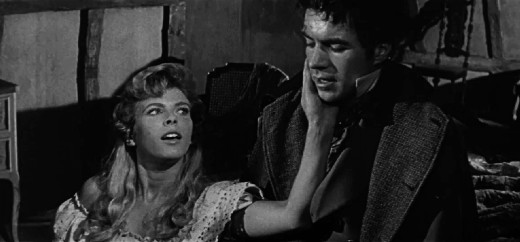
A proverbial fish out of water, Jackson gets himself beaten up trying to defend the honor of one of the tavern girls, beautiful Mary Patterson (Billie Whitelaw). The two are from completely different worlds. Jackson, who is despairing of ever finishing the medical program, finds solace in the arms of the alluring but coarse girl. Mary is flattered by the attention of a real gentleman, but deep down knows that there’s no chance for them.

In a heart-rending scene, Jackson takes Mary out for a stroll in the park, but to his dismay the two run into Knox’s colleague Dr. Geoffrey Mitchell (Dermot Walsh) and Knox’s niece Martha (June Laverick). Mary tries a little too hard to impress, and the smiles and cheer turn to slight frowns and embarrassed silence as class differences become painfully apparent. Back at Mary’s place, she vents her humiliation at Chris, who lamely professes that he is not ashamed of her. Mary is quickly mollified, and turns to what she knows best -- sex -- to smooth things over.

Billie Whitelaw and John Cairney in The Flesh and the Fiends, 1960
"I can teach you more than you'll learn at college..."

WARNING: SPOILERS AHEAD

There is no happy ending for the star-crossed lovers, and by film’s end they’ve paid a very steep price for not staying in their social lanes.

As the evidence mounts that Burke and Hare’s deliveries are a little too fresh, Knox maintains a poker face, only showing his humanity at the very end when it’s impossible to look the other way. It’s maddening from the perspective of a normal, caring human being, but very believable from the standpoint of an obsessed scientist who is all about his work, and Cushing plays it to perfection.

The climax of The Flesh and the Fiends is pure Universal Frankenstein, with torch-carrying townspeople hunting down the monsters through dark, twisting streets. The film’s major false note comes at the very end, when a contrite Knox, having escaped legal judgement and still wanting to pass on his expertise to the next generation of physicians, enters the lecture hall, thinking that it will be empty. Instead, he’s surprised to see it’s filled with appreciative students. Knox is so humbled and inspired, he begins his lecture with Hippocrate’s advice to physicians to “first, do no harm.” (The real Knox did not get off quite so easily. While it's true that in the immediate aftermath of the murders his classes were more popular than ever, his career nonetheless suffered and he was ultimately expelled from the Royal Society and his school was shut down.)

Ugh. Order has been restored, the class system is still firmly in place, and worst of all, an upper class monster is redeemed, while Edinburgh’s poor, when they aren’t murdering one another, are mostly portrayed as scheming, uncaring wretches or members of an unthinking mob. Still, there’s Mary, beautifully played by Billie Whitelaw, who upholds the dignity of the non-privileged classes. While certainly not perfect, she is smart and willing to sacrifice her own happiness and aspirations to try to save Chris Jackson from himself.

George Rose, Donald Pleasence and Billie Whitelaw in The Flesh and the Fiends, 1960
You do not want to attract the attention of these "gentlemen."

ALL CLEAR FOR SPOILERS

The Flesh and the Fiends rode the Gothic horror renaissance that Hammer jump-started with The Curse of Frankenstein and Horror of Dracula. It was produced by partners Monty Berman and Robert S. Baker, who kept busy in the late '50s making Blood of the Vampire (1958; see the review elsewhere on this site), The Trollenberg Terror (aka The Crawling Eye, 1958) and another horror film ripped from the pages of history, Jack the Ripper (1958). 

By 1960, Burke and Hare had inspired, along with The Greed of William Hart, Val Lewton's and Robert Wise’s The Body Snatcher (1945; based on a Robert Louis Stevenson short story that in turn was inspired by the actual events). Since then, two movies titled Burke and Hare have been made, one in 1972 and the other, with Simon Pegg, in 2010. The Doctor and the Devils with Timothy Dalton, Jonathan Pryce and Twiggy (!!) premiered in 1985.

With its skillful direction, atmospheric cinematography and masterful acting (especially Billie Whitelaw, Donald Pleasence and Peter Cushing), The Flesh and the Fiends may be the best of the lot, and it’s certainly one of the UK’s better contributions to Gothic horror cinema of the mid-20th century.

Where to find it: Streaming | DVD / Blu-ray 

September 23, 2021

Rousting the Marsh Fellows: Night Creatures

Poster - Night Creatures, aka Captain Clegg, 1962
Now Playing:
Night Creatures (aka Captain Clegg, 1962)


Pros: Solid cast; Typically fine Hammer production values; Michael Ripper almost steals the show as a gleeful undertaker.
Cons: The marsh phantoms don’t get enough screen time; Oliver Reed and Yvonne Romain are consigned to bland secondary roles.

This post is part of the Rule, Britannia Blogathon, hosted by classic film buff, TV historian and author Terence Towles Canote at his blog, A Shroud of Thoughts. The rules are simple: simply write about any British/UK film made before 2011. That I can do!

Hail Britannia! During the 1950s and early ‘60s, when American B filmmakers couldn’t get enough of irradiated sci-fi menaces of every size, shape and description, and were reimagining traditional Gothic monsters by giving them sci-fi origins (Blood of Dracula, The Werewolf, The Vampire), the British film industry, and Hammer Films in particular, was gearing up to add fresh Gothic takes on all kinds of genres.

Hammer jumped into the ‘50s sci-fi craze like everyone else, but whereas American sci-fi thrills generally played out in broad daylight, much of Hammer’s output -- Four Sided Triangle (1953), The Quatermass Xperiment (1955), X the Unknown (1956) and The Abominable Snowman (1957) -- was shrouded in night and shadows, with surroundings that the classic monsters would have been very much at home in.

Then, starting in the late ‘50s, Hammer took those same monsters, lit them up in brilliant Technicolor (and Eastmancolor) and gave them new life. By 1962, Dracula, Baron Frankenstein, the Mummy and even a silver-haired werewolf had trod the boards at Hammer’s Bray studios.

"A Hammer Film Production" title screen
Back in the day, this set my geeky little heart to beating fast.

While Hammer is justifiably remembered for its colorful takes on the classic monsters, the studio delved into all sorts of genres in its bid to lure audiences away from the telly. Throughout the ‘50s, the studio churned out dozens of crime dramas, period pieces, war pictures and even a handful of comedies.

In the early ‘60s, the sensational success of Hitchcock’s Psycho set the studio scrambling to capitalize on the psychological horror craze with films like Scream of Fear (1961), Paranoiac (1963), and Maniac (1963).

And bless their hearts, even as the decade was advancing inexorably toward its date with the youth movement and flower power, Hammer was still greenlighting swashbucklers and pirate movies long after most other film companies had abandoned the genre.

Night Creatures (aka Captain Clegg, 1962) had more of a circuitous route to getting on the silver screen than most Hammer pictures, and partly as a result, the marketing emphasized its rather mild horror aspects. In the UK, it was released under the title Captain Clegg and was paired with Hammer’s version of The Phantom of the Opera; in the U.S. it became Night Creatures, and was the bottom half of a double bill featuring Hitchcock’s The Birds. (More on that later…)

The horror elements are frontloaded into this modestly budgeted swashbuckler. In the prologue (captioned 1776), a brutish sailor (Milton Reid) has been brought before the captain (whose face we never see), charged with having assaulted the captain’s wife. For this crime, he’s sentenced to have his ears slashed and his tongue cut out, and then banished to a remote island with no food or water.

Fast forward to 1792, where, back on the mainland, a lone figure is furtively making his way across desolate marshlands in the dead of night. He’s stopped in his tracks by the sight of demonic glowing skeletons on horseback, and in terror he flees and then trips and collapses in a heap in front of a scarecrow. The scarecrow suddenly opens its eyes and glares down at him. Now thoroughly freaked out, the man backs into a brackish swamp, which swallows him up.

"We only wanted to ask him if this was the way to Bray Studios!"

We soon learn that the unfortunate victim was an informer for the Crown who had been reporting on possible smuggling activities in the coastal marshes near the village of Dymchurch. The smuggling rumors bring a squad of the King’s men to Dymchurch led by the brash and cocky Captain Collier (Patrick Allen).

At this point, Night Creatures settles down (comparatively speaking) to a cat and mouse game between the villagers (who are definitely up to no good, at least from the authorities’ perspective) and the King’s agents.

Collier tries to intimidate the town by striding imperiously into the church where the dynamic vicar Dr. Blyss (Peter Cushing) is conducting services. Blyss invites him to stay for the rest of the sermon, if he will only remove his hat. Collier snaps back that while he serves the King, the hat stays on.

Outside, in a meet and greet with the Captain in the churchyard, Blyss plays to Collier’s ego by telling him what an honor it is to meet a hero of the empire. Standing over the grave of the notorious Captain Clegg (the merciless captain in the prologue), Collier puffs himself up:

Collier: I flatter myself that I gave him a run for his money.
Blyss: But you never caught him Captain.
Collier: Yes that’s true, but how did you know?
Blyss: He was hanged at Rye, I attended his last rites as prison chaplain.
Collier: Last rites? I suppose he repented all his sins at the last moment?
Blyss: He died a Christian. I proceeded to give him a Christian burial here at Dymchurch.
Collier: Well if I’d have caught him he’d have had a different end. I’d have had him hanged, drawn and quartered, publicly too.
Blyss: I’m sure you would, but then you didn’t catch him, did you?
Peter Cushing as Dr. Blyss and Patrick Allen as Captain Collier, Night Creatures, 1962
The first round goes to Dr. Blyss.

After the exchange, Blyss, who is in charge of more than just the church, meets with his right hand men, Mipps the undertaker (Michael Ripper) and Rash the innkeeper (Martin Benson), and coldly orders that the villagers deny Collier’s men any quarters.

Much of the movie consists of Dr. Blyss and his band leading Collier and his men around by their noses while unctuously pretending to serve them. They employ secret passages, Mipps’ coffins to ferry around the contraband, men disguised as scarecrows to spy on outsiders, and of course, the eerie marsh phantoms to scare off would-be informers and distract the King’s men.

But Collier is not without brains and resources, including the brute man seen in the prologue, whom he uses like a drug-sniffing dog (!!) (The man had been rescued from the island by a passing English ship. While he is crude, mute and repulsive to look at, he’s not entirely unsympathetic, and he figures prominently in the rousing denouement.)

Night Creatures is slowed down somewhat by a bland romantic subplot involving foppish Harry (Oliver Reed), son of the wealthy squire, and Imogene, the tavern maid (Yvonne Romain). The two had been used to much better effect the year before in Curse of the Werewolf. At least Harry has the honor of being wounded in the line of duty.

Oliver Reed and Yvonne Romain in Night Creatures, 1962
"I now pronounce you a mundane romantic subplot."

A somewhat harsher fate awaits Rash, who is aptly named. In the time-honored tradition of B-movie creeps, Rash, who is also Imogene’s guardian, stumbles on a secret involving the blushing, beautiful maid and decides that he wants her for himself. Although he is Blyss’ lieutenant, the good doctor becomes suspicious of the fretful innkeeper, and the question of whether Rash will stay true to his comrades or give them up provides additional suspense.

Michael Ripper, who was a standard fixture at Hammer, almost steals the show as the slyly servile undertaker Mipps. With unnaturally rosy cheeks not unlike a fresh cadaver made up for an open casket funeral, Mipps wears an all-knowing grin while he misdirects Collier and spars with the dour innkeeper. There’s a great scene where Rash rushes into the undertaker’s workshop to warn him that Collier and his men are approaching, and is startled when Mipps suddenly sits up in the coffin where he’d been sleeping.

Michael Benson, Michael Ripper and Peter Cushing in Night Creatures, 1962
"Let's get to it men! We've got to deliver those kegs to the fraternity house before nightfall!"

Of course the main event is the battle of wits between the duty-bound Captain and the wily vicar. It’s a credit to the film that both characters have their talents and faults (huge egos among them), and neither is a cardboard bogeyman. For much of the movie, Blyss is the chess master moving his pawns around, always several moves ahead of Collier, who seems to be more of a checkers kind of guy. But the Captain’s perseverance forces a final, fateful confrontation (and an opportunity for Cushing/Blyss -- and his stunt double -- to demonstrate buccaneering skills by swinging from the rafters and engaging in a lengthy, thrilling fight scene).

While some might wish the film had done more with the creepy marsh phantoms and less with the verbal repartee, it’s still a good adventure yarn with a cast of talented regulars and the studio’s signature production values. Hammer had a knack for making its modestly budgeted Gothic horrors and historical dramas look like a million bucks.

Where to find it: Streaming | Blu-ray (8 film collection)  

Secrets of the Marsh Phantoms #1: Night Creatures’ path to getting made had more twists and turns than a smuggler’s secret passageway. Major Pictures, which had secured the rights to a 1937 film adaptation of Russell Thorndike’s novel Doctor Syn -- A Tale of Romney Marsh (1915), came to Hammer with a proposal to do a re-make. Hammer promptly got into a legal dispute with Disney, which had gotten the rights to Dr. Syn directly from Thorndike’s publisher to do their version, which aired in the U.S. as a 3 part mini-series, The Scarecrow of Romney Marsh, on The Magical World of Disney in Feb. 1964.

As Marcus Hearn and Alan Barnes relate in The Hammer Story, “[Hammer] arrived at a compromise with Disney in mid-September: Hammer could make their version of Thorndike’s story, but they were forbidden to use ‘Dr. Syn’ as either the name of a character in the screenplay or as the title of the film itself. [Producer] Anthony Hinds cancelled an imminent holiday and hastily rewrote [the] first draft, removing all references to Dr. Syn and naming Thorndike’s undercover pirate Dr. Arne. (Peter Cushing was so enthused by the project that he also wrote a screenplay, Doctor Syn, based on the books.)” Further delayed by union troubles, the production finally got underway in September of 1961, with Dr. Arne renamed Dr. Blyss in the final draft. [Marcus Hearn and Alan Barnes. The Hammer Story: The Authorized History of Hammer Films, Titan Books, 2007, p. 70]

Secrets of the Marsh Phantoms #2: Hearn and Barnes again: “The film was lent a supernatural atmosphere by the inclusion of the ‘marsh phantoms,’ which were heavily promoted in the film’s publicity. ‘We painted black body suits for both the horsemen and the horses with codit reflective paint,’ recalls special effects assistant Ian Scoones. ‘Two film spotlights were placed either side of the camera lens, giving a bright, luminous effect…’

Scoones loaned Hammer ‘François,’ a human skull he discovered in ‘Dead Man’s Island,’ unconsecrated Kent marshland where the Admiralty buried French prisoners of war: ‘It is François, illuminated with codit paint, zooming up to the lens that drives the fleeing Sydney Bromley [the unfortunate informer] into the swamp…” [Ibid., p. 71]

Secrets of the Marsh Phantoms #3: Night Creatures, the title that Universal-International used for the U.S. release, was previously attached to a Hammer project to adapt Richard Matheson’s novel I am Legend to the screen. The British Board of Film Censors nixed the project, and since Hammer had promised Universal a ‘Night Creatures’ movie, Captain Clegg got stuck with the title. 

Milton Reid sniffs around for contraband brandy in Night Creatures, 1962
"Are you sure this is going to be enough for the party?"

May 21, 2021

The Christopher Lee Sweat-a-thon: Night of the Big Heat

Poster, Night of the Big Heat, 1967
Now Playing:
Night of the Big Heat (aka Island of the Burning Damned, 1967)


Pros: Competently directed and acted; Decent attempt at adult science fiction.
Cons: Budget limitations result in a disappointing alien menace.

This post is part of the 2021 Christopher Lee Blogathon, hosted by the inimitable Barry at Cinematic Catharsis and Gill at Realweegiemidget Reviews. Check out their sites for an impressive lineup covering almost every aspect of Sir Christopher’s amazing career.

There is a startling, if somewhat depressing, dialog exchange from another British science fiction film, also released in 1967, that sums up Night of the Big Heat quite nicely (not to mention our present predicament):

Professor Bernard Quatermass: The will to survive... it's an odd phenomenon. Roney, if we found out earth was doomed - say, by climatic changes - what would we do about it?
Dr. Mathew Roney: Nothing. Just go on squabbling as usual.
Quatermass: Yes, but if it weren't men?
[Quatermass and the Pit, aka Five Million Years to Earth, 1967]

Since the beginning of science fiction, aliens with “minds that are to our minds as ours are to those of the beasts that perish, intellects vast and cool and unsympathetic,” have “regarded this earth with envious eyes, and slowly and surely” have drawn plans to invade it. [From the opening of H.G. Wells’ War of the Worlds.]

The 2021 Christopher Blogathon hosted by Cinematic Catharsis and RealWeegieMidget Reviews

Today, considering how far humanity has come in turning the planet into a hot, chaotic mess, I doubt that we'd be high on any alien civilization’s invasion list. But back in 1967, it was still possible to imagine aliens desiring a piece of our big blue marble.

In Night of the Big Heat, the climate (or weather or whatever) is changing rapidly on the remote British island of Fara, aliens are suspected of being behind it (at least by one person), and, as the cynical Dr. Roney predicted in that other movie, all the locals can do is squabble.

It seems that in the middle of winter, while the rest of Britain is shivering in the cold, Fara is experiencing a bizarre heat wave. It’s already in the 90s, and the thermometer keeps inching upward. The locals are wandering around the island with large pit stains, and even larger stains where their souls should be.

The proprietors of the island’s inn and tavern, novelist Jeff Callum (Patrick Allen) and his wife Frankie (Sarah Lawson), outwardly seem to be happily married, but the heat wave is revealing cracks in their relationship.

Jeff has advertised for a personal secretary to help with his writing, and who should show up but Angela Roberts (Jane Merrow), a sultry young woman with whom he had a brief affair on the mainland?

Jane Merrow, Sarah Lawson and Patrick Allen in Night of the Big Heat, 1967
"You've been fiddling with that thing for hours! When are we
going to go swimming?"

The heat is being turned up for Jeff in more ways than one, as Angela is doing everything short of licking his ear in front of his wife in a bid to win him back. Fortunately for Jeff, Frankie is either as dumb as a box of rocks or willfully blind. At one point, Angela sadistically spills the beans about the affair to her, then takes it all back, airily telling her she was just joking. Frankie’s reaction is to exhale a huge sigh of relief.

The befuddled Jeff is alternately attracted to and repelled by his former flame, but unfortunately Angela also attracts the attention of the island’s car mechanic, who, maddened by the heat and lust, viciously assaults her.

Lurking in the background of all the high drama is the enigmatic Godfrey Hanson (Christopher Lee), who is skulking around the island in a white shirt and tie, setting up equipment including cameras with tripwires, then quickly scurrying back to the inn to shut himself up in his room.

When he interacts at all with the locals, it’s to gruffly tell them to mind their own business. Naturally this sets tongues to wagging, fueling speculation that the mysterious stranger himself may somehow be behind the unusual weather.

Christopher Lee as Godfrey Hanson, Night of the Big Heat, 1967
Godfrey Hanson (Christopher Lee) has spared no expense in his mission
to prove the existence of the elusive alien invaders.

In contrast, the avuncular Dr. Vernon Stone (Peter Cushing), a fixture at the inn’s tavern, is a calming voice of reason in the midst of all of the overheated emotion and paranoia. But eventually, even his reason will be tested as people start hearing an eerie whining/trilling noise that pops up randomly all over the island, and several of them wind up dead, fried to a crisp.

Night of the Big Heat was made and distributed in the UK by Planet Film Productions, a small independent that had released a sort of companion film the year before -- Island of Terror (1966) also featured harried islanders (Peter Cushing among them) threatened by mysterious, deadly creatures.

The British Film Institute lists just five movies under the Planet Film banner spanning 1951 - 1967. Night of the Big Heat was their last hurrah. Their 1960s projects, including the vampire horror film Devils of Darkness (1965; see my review here) seem to have been inspired by big brother Hammer’s successes, including the use of Hammer veterans in front of and behind the camera.

Unfortunately, the Cushing/Lee pairing in Night is not particularly notable. They share little screen time together, and their characters at this point (1967) were sort of shorthand representations of the screen personas they had developed in the previous decades: Cushing plays the warm, kindly village doctor who is there to listen and help; Lee is the gruff, imperious stranger who stomps around trying to document the bizarre manifestations, freaking out the locals in the process. But they’re not really antagonists, and each gets a shot at being heroic at the climax.

Christopher Lee and Peter Cushing in Night of the Big Heat, 1967
Hanson and Stone debate the relative merits of antiperspirants vs.
body wash when the heat is on.

The film really belongs to the heated love triangle of the conflicted writer, his wife and former girlfriend. The script cleverly ratchets up the physical heat even as Jeff gets weak-kneed and starts to succumb to Angela’s desperate ploys, and block-headed Frankie begins to realize the sexpot is not there to help Jeff keep his papers in order.

The metaphorical pièce de résistance occurs at the tavern, when the beer bottles behind the bar start exploding in quick succession due to the heat. In both love and alcohol, something’s gotta give when things heat up to the boiling point.

Something else that got me smiling while watching Night was the strict adherence to dress code as the heat became more and more insufferable. They say that only mad dogs and Englishmen go out in the midday sun. The film further bolsters that reputation and ups the ante, as the characters barely shed a stitch of clothing even as the sweat pours down their faces. Lee’s character goes through the whole film with a buttoned down long sleeve dress shirt and tie. Similarly, Cushing’s doctor sports his suit coat and tie to the bitter end.

Under the same circumstances, Americans would take a millisecond to fling off their clothes and go full-on Beach Blanket Bingo.

Frankie (Sarah Lawson) finally gets wise to her husband's infidelity - Night of the Big Heat, 1967
"Hey Jeff, we need more beer... oh, pardon me, I'll come back when you're not so busy..."

Another oddity is the whole “island of the burning damned” idea that presupposes that everyone is trapped on Fara and unable to get to the mainland for help. The same alien forces that are causing the island to heat up have also incapacitated the phones and two-way radio, but there is no explanation or context given as to why there are no boats around and no way to evacuate.

The events of the film transpire in a single day, which suggests that perhaps there’s a ferry that stops only on certain days, and everyone is SOL at the moment. But there’s a government meteorological station on the island that figures prominently in the climax, and I kept thinking, “surely they have a boat for emergencies!”

This being a low-budget British sci-fi thriller of the ‘60s, the aliens only show themselves at the very end of the movie. Without going into too much detail, they’re not of the rubber-suited humanoid variety, and they’re not particularly intimidating, but they do look suitably equipped to suck up fuel and electricity and other sources of energy (per Hanson’s theories) and spit it back at the unfortunate islanders, turning them into crispy critters.

Based on a novel by John Lymington, this is not a kids’ matinee sci-fi show, but rather a thinking person’s study in human strength/frailty and what it takes to persevere in the face of the unknown and extreme conditions. The suspense comes in trying to figure out who will step up to the challenge, who will fold, and who will get fried. 

The first casualty of the aliens in Night of the Big Heat, 1967
"Uh-oh, I have a feeling I'm one of those expendable characters..."

Making Night of the Big Heat was something of an endurance test for the cast. They filmed on the UK mainland, but in the middle of winter, not summer. Sir Christopher did not have particularly fond memories of the movie:

[Night of the Big Heat] dealt with the invasion of Earth by alien protoplasm. Looking like fried eggs, they ruined the climax. They were as bad a letdown as the Hound of Hell and the Gorgon’s snakes. They rode in from space on a heat ray. We wanted the illusion of 115 Fahrenheit so Peter, Patrick Allen and I worked in shirtsleeves, and the girls had bikinis. That was fine, except that it was the middle of night in winter. To foster the impression of heat we were drenched in glycerine. [Lord of Misrule: The Autobiography of Christopher Lee. Orion, 2003, pp. 226-7]

Joining Christopher and Peter in shivering in the dark was veteran actor Patrick Allen (as Jeff Callum). If you’ve seen more than a few British TV shows or movies from the ‘60s and ‘70s, there’s a good chance you’ll recognize this square-jawed actor. Among a list of credits spanning six decades, he made appearances in The Avengers TV show, Hammer’s short-lived Journey to the Unknown series, and Brian Clemens’ Thriller series. He also appeared in quite a few action and war pictures like Force 10 from Navarone and The Wild Geese.

His wife in the movie, Sarah Lawson, was also Patrick’s wife in real life. I’m happy to say the vicissitudes of making Night of the Big Heat had no effect on their marriage, and they stayed together until Patrick’s death in 2006. Sarah is best known to horror fans as Marie Eaton in Hammer’s The Devil Rides Out. And like her husband, she also appeared in an episode of Journey to the Unknown.

Patrick Allen and Sarah Lawson at the climax of Night of the Big Heat, 1967
Patrick and Sarah go into glycerine-induced shock at the end of Night of the Big Heat.

The third wheel of the love triangle, Angela, was played by Jane Merrow. Shortly after Night, Jane scored appearances in The Avengers and The Prisoner series, and has kept busy ever since, with a credit as recent as 2020.

Rounding out the film’s Hammer connections, directing duties were handled by the great Terence Fisher, who, as we all know, is responsible for some of the studio’s greatest Gothic horrors: Horror of Dracula, The Revenge of Frankenstein, The Mummy, The Brides of Dracula, The Curse of the Werewolf, and The Devil Rides Out, to name but a few.

Night of the Big Heat is obviously not preeminent on anyone’s resume, but I would take Sir Christopher’s put down of it with a grain of salt. In the late '60s Lee was frustrated by typecasting and the quality of the scripts he was being offered, so this stage of his career was not a favorite. A few years later, he would be basking in showy roles in blockbuster hits like The Three Musketeers and The Man with the Golden Gun.

Night of the Big Heat is competently directed and acted. It’s main limitation is the budget, which necessitated keeping the less-than-spectacular alien menace hidden until the very end. Nevertheless, it’s a decent attempt at reasonably intelligent adult science fiction.

Do you dare reveal the alien from Night of the Big Heat?
If you dare, click on the question marks above to reveal the 
alien menace from Night of the Big Heat!

Where to find it:
DVD | YouTube