A year or so ago I posted a "love letter" to the vanishing American drive-in, and wrote about how easy and fun (and relatively economical) it can be to recreate a little of the outdoor movie experience in your backyard ("
Backyard Movies on a Budget"). I'm in the homestretch of a marathon move, but before I got out of Dodge for good, I wanted to have my friends over for one last outdoor movie party. (Ironically, I'm moving to a much larger city that has -- you guessed it -- one of the last drive-ins left in the country. *Fist pump*!)
 |
These two outdoor movie fans seem to have
forgotten their popcorn! |
If you're going to go to the trouble of setting up a screen and projector in your back yard and pretend you're at the drive-in, then you might as well go all the way and pretend that you're at the drive-in in its heyday, the 1950s. And while you're at it, you might just go for a double-bill featuring two of the more unusual sci-fi movie menaces of the '50s,
Kronos (1957) and
Fiend Without a Face (1958). Speaking of faceless, way back in September of 2011, I wrote about the first group of
Fantastic Faceless Foes from '50s Sci-fi, and promised another installment. And here it is, almost two years later -- now that's what I call an irregular blog feature!
In the first installment, I talked a little about how '50s sci-fi movies tried to address, in an entertaining and ultimately reassuring way, the inchoate fears of an American public that had recently been hit with a number of shocks to the All-American system of comfortable middle class security: first the A bomb and radioactivity, then the H bomb, then Sputnik (which meant that the Russians could lob bombs at us with intercontinental missiles just as easily as putting up harmless satellites).
 |
Book by Don and Susan Sanders,
Crestline, 2013 (reprint ed.) |
There were plenty of conventional sci-fi threats in the Eisenhower years:
lumbering dinosaurs awakened by atomic testing;
saucer men threatening teenagers in their hot rods, and even the venerable
Frankenstein monster and the
Wolf Man were turned into especially bummed out teenagers. But then, the free-floating anxieties of the atomic age called for other, more nebulous threats as well. Ironically, the low cost of these productions, the profit potential, and the insatiable demand for product on the part of drive-in owners resulted in a number of crazy projects getting green lighted that would never have stood a chance in any other era. (In contrast, today's American movie industry is extremely reluctant to take chances on original content or characters. The vast majority of releases are based on known quantities: popular video games, comic books, graphic novels and TV series. The few blockbusters that try original material almost invariably sink quickly at the box office. The result, for all the state-of-the-art CGI effects, is a depressing sameness.)
So, this unique set of circumstances in the '50s resulted in an explosion of far-out ideas from low-budget filmmakers with nothing to lose (they almost couldn't lose -- if you could deliver the product, it was almost certain to make a profit). Drive-in movie heroes and heroines were threatened by
omnivorous blobs; 50-foot tall
men and
women; all manner of giant insects and animals (including
ants,
grasshoppers,
preying mantises and, *gulp*, a
giant buzzard); an assortment of
disembodied heads and brains; quick-growing,
towering crystals; and even a
virulent fungus.
The Faceless Foes featured here fit very nicely into this drive-in theater of the absurd. The first is a giant, faceless energy-sucking robot from space. The second is an army (or maybe a battalion) of "thought" creatures in the form of disembodied brains with antennae and spinal cord "tails." Awesome!
Now Playing: Kronos (1957)
Pros: Great, non-anthropomorphic giant robot concept and design; Ingenious ending
Cons: Alien mind-control subplot is superfluous and mildly distracting
In brief: A pulsating flying saucer, hovering against a backdrop of stars, releases a ball of light that head towards earth. A truck driver on a lonely desert road gets out to figure out why his vehicle stalled. The eerie light overwhelms him, then, zombified, he gets backs in his truck and drives to the nearest secret research base, where he confronts Dr. Hubbell Eliot (
John Emery). The light shoots out of the driver's eyes and into the scientist's, whereupon the "messenger" collapses, dead. Meanwhile, another team of scientists, led by Dr. Leslie Gaskell (
Jeff Morrow) are alarmed to find that a giant asteroid is headed straight for earth (actually, it looks just like the flying saucer seen right after the credits!). When missiles are fired to intercept it, the asteroid changes course, as if it were piloted (duh!), and splashes harmlessly (?) into the ocean just off of Mexico.
A team headed by Gaskell, including his fiancee Vera (
Barbara Lawrence) and fellow scientist Arnold Culver (
George O'Hanlon), travel down to Mexico to investigate the asteroid splashdown. Their suspicions about the odd behavior of the asteroid are confirmed when a colossal dome rises out of the ocean where the asteroid went down, and a giant robot suddenly appears on the beach nearby. The giant thing is weirdly alien-looking, it's "body" consisting of two huge cubes joined by a pylon, and its "head" a dome with antennae sticking out on either side. The robot moves around using four massive pistons at its base that rapidly fire in sequence.
 |
| The scientific team checks out Kronos from the air. |
Gaskell's team lands a helicopter on the top of the temporarily motionless robot to investigate, but they're forced to take off when machinery starts stirring and whirring on the thing. Back at the lab, Eliot, inhabited by an alien intelligence, seems to be directing the robot. It moves inland, stomping on farmers as it goes, to a Mexican power plant, whereupon it sucks up all the plant's electric power. Conventional arms are of no use, as the robot uses its power stores to destroy the jet planes attacking it. As it starts heading toward the U.S., the military brass decide to blow it up with a hydrogen bomb. Gaskell, whose Mama didn't raise a dummy, realizes it's a very bad idea to use nuclear power against a thing that sucks up power like a sponge. Seconds before the plane is to drop its payload, Gaskell gets the military to call it off, but the robot captures the plane in a tractor field and the bomb explodes anyway, making the colossal metal power-robber bigger than ever. There seems to be nothing that can stop it from sucking up all of Los Angeles' power, and then the entire world's. But the crackerjack scientist has an ingenious plan…
Kronos is definitely not a cute, anthropomorphic bucket of bolts in the tradition of a Robby or 3CP0. It's a gargantuan, cubic thing seemingly designed by an intelligence so alien, it's all but incomprehensible. (Thankfully, the filmmakers refrain from introducing us in any significant way to its makers, thereby preserving the mystery and wonder.) As it goes about its energy-absorbing mission, the robot is as oblivious to human beings as a monster truck tire is to ants on a dirt road. The "birth" of Kronos in the sea off of the Mexican coast is about as awe-inspiring and uncanny as it gets it '50s sci-fi. And it also helps that Kronos has an unusually intelligent script featuring a scientist solving an almost hopeless problem with a plausible application of scientific theory (plausible at least for a giant-robot-ravages-the-earth-for-its-energy movie.) On the downside, the takeover of Dr. Eliot's mind by the alien force doesn't make all that much sense and adds little to the film. (Why do the aliens need to take over the primitive humans? Can't they just program the robot to do its stuff?)
 |
One of the most beautiful robots ever designed
for film? You be the judge! |
Key filmmaker: Director
Kurt Neumann started out in the early '30s directing shorts for Universal, and was considered for
Bride of Frankenstein until being bumped for
James Whale (who was fresh off another hit,
The Invisible Man). Neumann directed B programmers for Universal throughout the '30s and '40s, including the memorable
Secret of the Blue Room (1933) and two of the better Weissmuller Tarzans,
Tarzan and the Amazons (1945) and
Tarzan and the Leopard Woman (1946). Towards the end of his career, he directed some of the more memorable B sci-fi pictures of the '50s, including the first "realistic" story of humanity's attempt to conquer space to hit American theaters,
Rocketship X-M (1950), Kronos, and
The Fly (1958) with Vincent Price.
Key effects artist: Bill Warren, the titanic chronicler of '50s sci-fi, reports that effects designer
Irving Block was very proud of his creation, Kronos. The robot was named after one of the Greek Titans, who notoriously ate his rivals. In this sci-fi version, Kronos is eating the earth up (or at least all its energy). Says Block, "I remember it distinctly and I know exactly why I did it, how I did it… I wanted it to be anthropomorphic, to look like a robot, but at the same time I wanted it to look like a piece of machinery. I spent a lot of time on it… At one point it looked more like a construction by Picasso, but I reduced it down by a whole series of steps until it ultimately became just a black box." In Warren's estimation, "It is one of the most beautiful robots ever designed for film." [Bill Warren,
Keep Watching the Skies! Vol. I: 1950 - 1957, McFarland, 1982.]
Where to find it:
Amazon Instant Video
Oldies.com
"An awesome monster such as human eyes have never seen!"
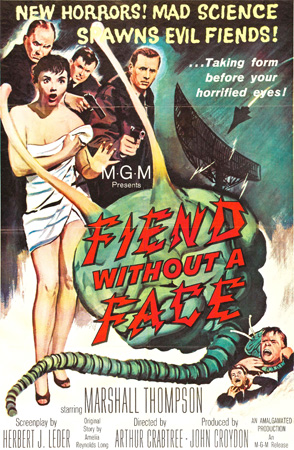
Now Playing: Fiend Without a Face (1958)
Pros: Creepy horror elements add just the right amount of fear and dread; Expert build-up of suspense
Cons: The materialized creatures are more ludicrous than scary; The effects at the climax look like bad claymation
In brief: At an American air base in a remote corner of Canada, the military is experimenting with atomic power-enhanced radar to better track the rascally Russians. When several locals near the base turn up dead, their brains and spinal cords sucked out of their bodies by some sort of "mental vampire," the base commander, fearing the Americans will be blamed, tasks his right hand man, Major Jeff Cummings (
Marshall Thompson), with investigating the mysterious deaths. In typical American fashion, Cummings blunders in on the daughter of one of the victims (Barbara, played by
Kim Parker) as she's taking a shower and gets into a fistfight with her boyfriend.
Meanwhile, the town mayor is killed by the invisible "vampire" in the comfort of his own home. Jeff finds out from Barbara that Prof. Wingate (
Kynaston Reeves), an eminent scientist in the fields of cybernetics and thought control, happens to live nearby (hmmmm….). When Jeff stops by to pick the old man's brain (pun intended) about what might be going on, the scientist gets very nervous (hmmmm…..). Things really come to a head (minus a brain of course), when the town constable, who had been hunting for the fiend, breaks into an emergency town council meeting moaning and gibbering -- he's apparently had an encounter with the vampire, and it's sucked out a good portion of his brain!
 |
Poorly designed thought control experiment + lightning
= mental vampires preying on innocent townspeople |
As the body count mounts, Prof. Wingate finally comes clean about his unusual experiments. He had struggled to move objects and materialize his thoughts until lightning surged through his equipment, and he realized his thoughts had finally been "freed" and he had the power of telekinesis. To continue his experiments, he devised a way to tap into the base's atomic power. The result: independent, sentient creatures with the form of living brains, but invisible to the eye… and deadly. And, they're intelligent enough to muck around with the base's atomic lab, drawing on its power to create even more fiends to prey on humanity. Soon, the fiends have Jeff, Wingate, Barbara and several other military and town officials trapped in Wingate's house…
Bill Warren describes
Fiend as "one of the most ghoulish, gory pictures of the '50s." [Ibid.] This one is as much horror as it is sci-fi, with its scenes of lonely, creepy woods at night, people being attacked by invisible creatures that make eerie slurping sounds, and others being turned into walking, moaning zombies from a half-baked brain-sucking job. The scene of the zombified constable breaking up the council meeting is particularly effective. As Jeff argues with the town officials over who is to blame for the mysterious deaths, an unearthly moan sounds from the adjoining corridor. The disheveled thing that was once Gibbons appears at the doorway, his blistered face half in shadow, and then he stumbles into the room, his mind clearly (and literally) gone. When I saw this scene for the first time as a kid, I almost stopped watching the movie right then. I suspect many people even today would be creeped out by it.
At the climax the creatures "materialize" into ambulatory brains with antennae and whip-like spinal cords that they use to move around like worms and strangle their victims. Many fans have found these scenes to be thrilling and inventive, and the special effects to be superior for the time. I'm perhaps in the minority, thinking that the materialized creatures and their movements look almost comical (especially when the creatures are shot -- the effect looks like bad claymation and the "slurpy" sound effects are completely over-the-top). I'm not sure what I would have done with the ending, but when the creatures become visible, all the carefully built suspense and horror goes out the window. It almost becomes a western, with the heroes trapped in a cabin by marauding raiders…
 |
| "Who invited the brain creature to the picnic?" |
Key effects artists: In an extensive interview with Tom Weaver, executive producer
Richard Gordon related how he hired the German effects team of
Flo Nordhoff and
Karl-Ludwig Ruppel:
"One day early on, [producer] John Croydon and I were having lunch with them at Walton Studios, discussing the project -- this was before we had made a commitment. John was describing the story of Fiend, and all the time he was talking, Nordhoff was sitting there doodling away on little pieces of paper. We thought he was just being slightly distracted and not paying too much attention, but at the end of John's recounting of the story, Nordhoff suddenly turned over these pieces of paper and asked us to look at them. As he was listening to the story, he had been creating the Fiends in his mind and then putting them down on paper, and they were very much like the Fiends as they appear in the original picture! That of course was the clincher, and we immediately signed them." [Weaver, The Horror Hits of Richard Gordon, BearManor Media, 2011]
Key moment in free publicity: Gordon also was amused by the extreme reaction the picture got in his native England:
"What I wasn't prepared for was that, when the film was released in England and it opened by itself at the Ritz Theatre in Leicester Square, the newspapers would be so offended by what they considered the excessive gruesomeness of the picture, that they made a major issue of it in the reviews, and it got to the point where somebody brought up in Parliament the fact that the British Board of Film Censors did not seem to be fulfilling its obligations in preventing the showing of a film like Fiend, which as a 'disgrace' to the British film industry… What went through my mind was that I could never have afforded to buy that publicity, if it hadn't come my way free, and that it was the best possible thing that could happen to the picture." [Ibid. For more on the sci-fi/horror hits of Richard Gordon, see my recent post on First Man Into Space.]
Where to find it:
Amazon Instant Video
Oldies.com
"Spawning Madness! Breeding Monsters!"