Showing posts with label Angry Red Planet; The (1959). Show all posts

August 6, 2020

“Welcome to my parlor,” said the spider to the sci-fly

Arachnophobia is an abnormal or pathological fear of spiders. I don’t happen to share that fear, but I understand it. Spiders, especially in magnified close-up, look positively unearthly. They don’t have faces, per se, they have way too many legs, and many are bristly and hairy and have wicked-looking fangs. They look like they’ve been engineered to grab and eat other living things in the most nightmarish way possible.

Public domain image, an impressive looking arachnid
"You look absolutely mahvelous dahling!"

I love weird things, so I’m more fascinated by spiders than afraid. I suppose this won’t reassure arachnophobes, but house spiders are great at pest control, consuming ticks, fruit flies and cockroach larvae.

Like most things in nature, if you leave it alone, it will leave you alone (and maybe work doubly hard at consuming the truly irritating household pests). Plus, the chances of accidentally being bitten by a honest-to-goodness venomous spider are vanishingly small.

Keep repeating: "spiders are our friends, spiders are our friends..."

Because of their size, “hairiness,” and menacing look, tarantulas have gotten a particularly bum rap in popular culture. There are some tarantula relatives in Central and South America and Australia that are more aggressive and highly venomous, but by and large tarantulas are shy creatures who bite only as a last resort, and even then may only deliver a “dry” bite absent any venom. Most venomous tarantula bites are very treatable -- you don’t want to get one, but they’re not usually life-threatening.

When I was a kid, tarantulas often popped up in movies and TV, and in every case the implication was that one bite meant instant death. Villains were always turning their pet tarantulas loose on people as they slept or on heroes chained up in some dank dungeon. These scenes were guaranteed to make people’s skin crawl, but it’s hard to think of a more inefficient way to kill a person.

A high point for tarantulas in the movies (or low point, from the tarantula’s perspective), may be the first James Bond movie, Dr. No, when one of the villain’s henchmen slips an evil-looking specimen into Bond’s bed. The poor creature, a pink-toed tarantula, gets the brush off and the heel of a slipper for its troubles, even though that particular spider has small fangs, is reluctant to bite, and is not dangerous to humans.

"The name is Antula... Terry Antula."

Whereas Dr. No’s eight-legged would-be assassin seems feeble in hindsight, vintage sci-fi doubled down on the misunderstood tarantula’s skin crawl factor and blew it up to fearsome proportions, to the point where venom was an afterthought -- these gigantic creatures could literally eat you alive. Some were space-age cousins hiding out in caves on the moon, and others were terrestrial, their gigantism the result of radiation or some other misbegotten experimentation. And one was an ordinary house spider dwelling in a basement, patiently waiting for some mysterious radioactive cloud to turn a human into bite-sized prey for him.

Here are clips of some of my favorite retro sci-fi arachnids. As always, this is a select list. If I’ve overlooked any of your favorites, please share in the comments!


The astronauts of a pioneering moon mission discover a cave on the dark side of the moon with breathable air, but the cave also comes with not one but two (count ‘em!) giant, man-eating spiders!


Missile was a remake of Cat-Women (both distributed by Astor Pictures). The giant moon spider in this one makes his appearance much later in the movie, but the thing’s comically bulging eyes and huge, elongated mouth make it worth the wait.


Okay, so this is more of a rat-bat-spider hybrid, but I love how the astronauts at first mistake the creature for an odd-looking Martian tree. See also an earlier blog post with details about how Rat-Batty was brought to life by the effects artists.


Earth vs. the Spider (aka The Spider, 1958)


In a nod to The Blob, teenagers alert a rural town to the threat of a monster -- in this case, a giant mutant spider. Check out the monster spider’s web, which looks more like a net used in a circus high-wire act.


Tarantula (1955)


The King of ‘50s sci-fi monster spiders! This is one of the more effective scenes, set at night, with the added suspense of the horses sensing danger. At first the monster is only seen in silhouette, then it advances menacingly on the stable.


"Hey, go find your own sewing project!"

June 24, 2020

“What’s a nice girl like you doing on a rocketship like this?”: Women Astronauts in ‘50s Sci-Fi

Poster - Fritz Lang's Woman in the Moon (Frau im Mond, 1929)
Last year I wrote about how, in spite of societal pressures to restrict women to roles as wives, mothers and homemakers, quite a few sci-fi movies of the ‘50s bucked the prevailing norms and featured strong, intelligent women scientists and doctors who were right there with the men battling all kinds of monstrous menaces. I purposely excluded women astronauts, as this was yet another robust category of sci-fi roles that went against the grain, and I wanted to give them their due in a post of their own.

Cinematic depictions of female pioneering astronauts got a very early start with Fritz Lang’s science fiction epic Woman in the Moon (aka Frau im Mond), which premiered in Berlin in October, 1929. Written by Lang’s then-wife Thea von Harbou, the silent movie tells the story of the first expedition to the moon.

A wealthy industrialist, Wolf Helius (Willy Fritsch), becomes interested in Prof. Georg Manfeldt’s (Klaus Pohl) theory that the moon is abundant with gold, and starts planning for a trip to the moon to test the theory. The ship takes off with a crew consisting of Helius, Manfeldt, Walter Turner (representing a rival group of businessmen, played by Fritz Rasp), and Helius’s two assistants, Hans Windegger (Gustav von Wangenheim) and Friede Velten (Gerda Maurus). After launch, they discover a stowaway in the form of a young boy, Gustav (Gustl Gstettenbaur), whom Helius had befriended earlier.

Lang took great pains to make his moon trip as realistic as possible according to the scientific knowledge of the day. The director brought in rocket expert Hermann Oberth to advise, and the result accurately predicted what many aspects of future space flight would look like. At a time when American Robert Goddard was experimenting with rickety-looking liquid-fueled rockets that could barely travel more than a mile high, Woman in the Moon depicted a multi-stage rocket launching from a pad, and the crew experiencing G-forces and zero gravity. The film is also famous for using the first launch countdown -- added for dramatic tension and adopted decades later by NASA.

The hard science fiction elements serve as a launch pad for more conventional human drama featuring a love triangle between the industrialist and his two assistants, espionage, blackmail, and betrayal. It’s not only remarkable that Friede is part of the crew of the first moon mission (and that the rocketship is named for her), but that she also takes heroic and poignant action to ensure the ship’s safe return to earth.

Gerda Maurus as Friede in Woman in the Moon (Frau im Mond, 1929)
Okay, so Woman in the Moon didn't get everything right...

Such a passion for enlisting scientific expertise to ensure the most realistic cinematic spaceship ride imaginable wouldn’t be seen again for decades, until George Pal’s Destination Moon blasted off in theaters in 1950. Based on a Robert Heinlein novel (and co-scripted by the author), Pal’s film had libertarian, anti-government undercurrents amidst all the techno-razzledazzle. And it was definitely a “boys only” affair -- unsurprisingly, no women were selected for that mission. In contrast, the other quasi-realistic space picture that actually beat Destination Moon into theaters that year, Robert Lippert’s Rocketship X-M, featured a brilliant female scientist, Dr. Van Horn (Osa Massen), as part of the crew. To add further fuel to the competition, Rocketship X-M also set itself apart from Pal’s picture with a grim anti-nukes message (see my two part series on the race between Pal and Lippert to be the first to put a movie spaceship on the moon, here and here).

If the sausage-fest Destination Moon had been the only popular moontrip audiences saw that year, subsequent movie space flights might also have been largely male-only affairs. But Rocketship X-M captured a good share of the popular imagination, and Osa Massen’s dynamic, pioneering presence undoubtedly influenced a number of B moviemakers to add women to their spaceship crews.

Just like my previous post on women scientists in ‘50s sci-fi films, I’ve included a very select list of women astronauts -- please use the comments to add anyone that I’ve overlooked. Like last time, each entry lists the astronaut’s resume, her biggest screen moment, and, because the fifties weren’t exactly a high point of female empowerment, the biggest “cringe” moment of embarrassing sexism.

Rocketship X-M (1950)
Name: Dr. Lisa Van Horn (Osa Massen)

Resume: Dr. Van Horn is a distinguished chemist and assistant to moon mission commander and lead scientist Dr. Eckstrom (John Emery). Her research into “monatomic hydrogen” has resulted in a fuel concentrated and powerful enough to enable interplanetary spaceflight.

Biggest screen moment: SPOILERS! After a disastrous encounter with the savage remnants of an ancient Martian civilization that leaves two crewmembers dead and the navigator (Hugh O’Brian) injured and delirious, Van Horn and the pilot, Col. Floyd Graham (Lloyd Bridges) manage to lift off from the Martian surface. Lisa does her best to navigate the ship back to earth, but there’s not enough fuel left for a landing. She and Graham get on the radio and inform HQ of everything that went wrong with the mission -- and their theory about the Martians blowing themselves up in a nuclear war -- so that the people of earth can avoid future tragic mistakes.

Van Horn and Graham wax poetic under the light of the silvery moon.

Biggest cringe moment:
Early in the flight, the ship’s engines inexplicably power down. When the crew reports that they can’t find any equipment malfunctions, Eckstrom determines the problem must be with the fuel mixture. He and Van Horn get to work using pencil and paper (!!) to determine an optimal mixture to restart the engines. When their figures don’t agree, Van Horn adamantly insists that she hasn’t made any errors. In overruling her, Eckstrom becomes patronizing: “surely you’re not going to let emotion enter into this!” After she apologizes, he rubs salt in the wound: “[Apologize] for what? For momentarily being a woman? It’s completely understandable Miss Van Horn.” She refrains from saying “I told you so!” when the rocket accelerates exponentially and goes wildly off course, missing the moon entirely and hurtling toward Mars.

Additional notes: Massen, born in Denmark, was working as a news photographer and had plans to become a film editor when she was tapped for a role in a Danish crime film. She was quickly imported to Hollywood at a time when studios were recruiting waves of Scandanavian actresses in an attempt to find the next Greta Garbo. She worked mostly in B movies during the ‘40s, and television (of course!) starting in the early ‘50s. Her other sci-fi/horror credits include Cry of the Werewolf (1944) and a guest spot on the Science Fiction Theatre TV series (1955).

Flight to Mars (1951)
Name: Carol Stadwick (Virginia Huston)

Resume: Carol’s father was a respected physicist, and she has followed in his footsteps, becoming first assistant to the chief engineer and co-designer of the Mars rocketship, Dr. Jim Barker (Arthur Franz). Although she is a computational whiz with responsibilities for calculating navigational trajectories and fuel usage, she is also a whiz at pining hopelessly for Barker, who is more interested in spaceships than women.

Biggest screen moment: Unfortunately, Carol is a wash-out in the heroics department, as she spends almost the entire movie pouting over Jim. However, it’s a Martian woman who ends up saving the day. Alita (Marguerite Chapman) is Carol’s counterpart in the underground Martian civilization that the expedition discovers. She is also the daughter of a famous scientist and a formidable one in her own right. Alita steps in to assist Jim in repairing the ship for its return to earth. Moreover, when she learns that the Martian ruler plans to take over the ship once repairs are done and use it to invade earth, she devises a plan for the earthlings to stall for time while they secretly get the ship ready to blast off.
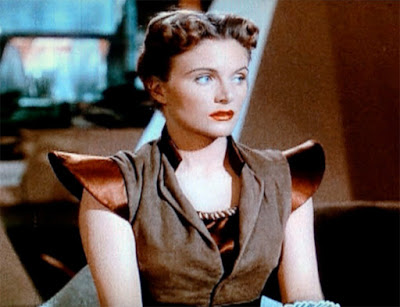
Virginia Huston as Carol Stadwick in Flight to Mars (1951)
Carol is not happy that shoulder pads have made a comeback on Mars.

Biggest cringe moment:
Mid-way in their trip to Mars, the crew members are sitting around ruminating about the mission, the cosmos, life, and the meaning of it all. When the senior scientist, Prof. Jackson (Richard Gaines) gloomily states that he expects the ship to be his coffin, the rest of the crew dumps on him for being so pessimistic. Carol passionately stands up for the professor: “He’s contributed more than any of us, a real wife, a home, two lovely grandchildren… I’d trade ten trips to Mars for that!”

Additional notes: Virginia Huston, like her character Carol, seems to have preferred marriage and family over career. She retired from acting in the mid-fifties after appearing in a baker’s dozen of movies and TV shows. Along the way, she appeared in the classic noirs Out of the Past (1947), Flamingo Road (1949) and Sudden Fear (1952), and also was Jane to Lex Barker’s Tarzan in Tarzan’s Peril (1951).

Marguerite Chapman kept busy during the 1940s making dozens of B movies. By the mid-fifties she was working almost exclusively in television, appearing in such classic anthology series as Lux Video Theatre and Studio 57. Her last film role was in Edgar G. Ulmer’s sci-fi cheapie The Amazing Transparent Man (1960).

Cat-Women of the Moon (1953)
Helen Salinger (Marie Windsor)

Resume: The film doesn’t waste any time on character backstories or preparations for the mission. Early on, we learn that Helen is the ship’s navigator on humanity’s very first mission to the moon. She’s apparently so good at her job, she can navigate a complex spaceship and attend to her looks at the same time (see her big cringe moment below).

Biggest screen moment: Alpha (Carol Brewster), leader of the ancient civilization of lunar Cat-Women, informs Helen that they plan on taking over the spaceship with her help and pilot it back to earth -- without the male crew members. When Helen, who is being telepathically manipulated by Alpha, objects that she’s only the navigator and needs the men to help operate it, Alpha’s second in command snickers: “Show us their weaknesses and we’ll take care of the rest.” Helen, staring off into space, responds, “It’s strange, I should care what happens to them… and yet I don’t!”

Marie Windsor as Helen Salinger in Cat-Women of the Moon (1953)
“Calling all stations…clear the air lanes…clear all air lanes for the big broadcast!”

Biggest cringe moment:
At the outset, the film tries to generate suspense by showing the crew in their reclining seats suffering from the g-forces generated by the rocket’s take-off. When the ship reaches outer space and the crew start to move around the cabin, the first thing Helen does is to fish out a comb and hand mirror from a drawer and fiddle with her hair. When the mission commander (Sonny Tufts) asks her if the ship is on course, she perfunctorily replies “On course,” without looking at her console and without missing a stroke.

Additional notes: “Queen of the B’s” Marie Windsor’s dark hair and smoldering eyes made her the perfect femme fatale for crime dramas and film noir. Among her better known noirs are Force of Evil (1948, with John Garfield), The Narrow Margin (1952), and Stanley Kubrick’s The Killing (1956). Sci-fi/horror outings were rare, but after Cat-Women she played the enigmatic Madame Rontru in Abbott and Costello Meet the Mummy (1955).

The Angry Red Planet (1959)
Dr. Iris ‘Irish’ Ryan (Nora Hayden)

Resume: Dr. Ryan is a brilliant biologist and zoologist, and the daughter of a renowned scientist (being related to a prominent male scientist seems almost to have been a prerequisite for women scientists of ‘50s B movies).

Biggest screen moment: SPOILERS! “Irish” heroically comes through in a pinch not once but twice. First, she saves the ship from a giant Martian amoeba that’s enveloped it by suggesting sending an electric current through it. Then, after she’s single-handedly piloted the ship back to earth, she comes up with a way to save the life of the pilot, Col. Thomas O’Bannion (Gerald Mohr), who is near death after a portion of the amoeba has attached itself to his arm. Even though she is recovering from shock and exhaustion, she rallies, and remembers an old experiment she conducted with earthly amoebas, also involving electric current.
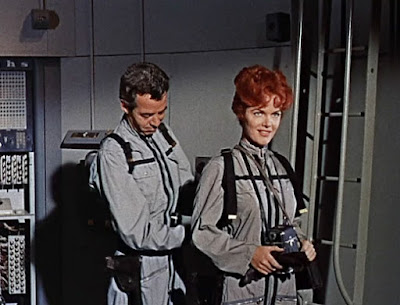
Nora Hayden and Gerald Mohr in The Angry Red Planet (1959)
O'Bannion helps Irish adjust the straps on her spacesuit.

Biggest cringe moment: During some downtime on the way to Mars, O’Bannion tries out his lounge lizard lines on Iris:
O’Bannion: "You know Irish, you’re the first scientist I’ve ever known with lovely, long red hair."
Ryan: "And you’re the first pilot I’ve ever gone to Mars with. And listen, my name is Iris, not Irish! I never know if you’re calling me by name or nationality!"
O’Bannion: "When I call you by name, you’ll know it!"
A few minutes later, Iris dabs some perfume behind her ears when she thinks no one is looking.

Additional notes: After Angry Red Planet, Nora Hayden’s career largely consisted of guest shots on TV series. She wrote and starred in her last film, The Perils of P.K. (1986), about a former movie star working as a stripper in Las Vegas who has dreams of reviving her movie career. The film had an interesting and diverse cast including Dick Shawn, Sammy Davis, Jr., Larry Storch, Louise Lasser, and Joey Heatherton, among others.

February 25, 2020

Shocking Scenes in 1950s Sci-Fi: Special “I can’t believe my parents let me watch that stuff!” Edition

In the all-encompassing, 24/7 infotainment/social media bubble we live in, the things that shock, frighten and disgust us keep changing and mutating like the titular monster in the remakes of The Thing from Another World. (Guess what -- since the original and the remakes didn’t shock or disgust us quite enough, Hollywood wants to do it yet again… yeesh!)

While the most extreme depictions of violence and dismemberment elicit yawns in Anytown USA, millions of Americans gasp and groan at the latest Trump tweet, then, like rats in a conditioning experiment in Hell, keep swiping at their feeds to be shocked all over again.

In simpler times, screen time meant shelling out a quarter at the neighborhood theater for a newsreel, a short subject, and a feature (or even two B pictures if your gluteus maximus could handle it). The things that spooked audiences of the 1930s and ‘40s -- like Jack Pierce’s 1931 Frankenstein monster make-up -- would be hard-pressed to nudge the films into PG territory today.

Still - Boris Karloff in Frankenstein (1931)
Many people did not like how this scene ended.
Speaking of the original Frankenstein, that film might be the exception that proves the rule. The scene in which the monster inadvertently kills the the little girl who has befriended him by throwing her into the pond got the attention of several state film boards, which demanded that it (and another scene, in which Henry Frankenstein exalts that “Now I know what it feels like to be God!”) be cut. When Frankenstein was reissued to theaters the scenes were gone, and wouldn’t be restored until the 1980s.

Today there are no state boards demanding cuts to films, but most filmmakers don’t need censors or social media condemnation to deter them from killing off children in their movies -- that taboo is still going strong.

Eventually the classic Gothic monsters punched out on their time clocks, and the next shift -- the radioactive and space-traveling menaces of the atomic age -- punched in. There were plenty of monsters and horror elements in the new ‘50s & ‘60s breed, but most fans remember them for the thrills and not so much the chills (Them!, The Beast from 20,000 Fathoms, Godzilla, and their ilk notwithstanding).

Publicity photo of The Duke, Malcolm & Esmeralda, hosts of the mid-1960s late night show Gravesend Manor
The Duke, Malcolm and Esmeralda of Gravesend Manor
(broadcast in central Iowa, circa mid-1960s.)
When I was in elementary school, I was lucky to live within the range of two TV stations that broadcast creature features. On Friday nights we’d get mostly sci-fi from the ‘50s and early ‘60s, including things like Earth vs. the Flying Saucers, Invisible Invaders, World Without End, etc. (I wish I could remember the name of the show). Then on Saturday nights the horror host ensemble of Malcolm, the Duke, Claude and Esmeralda at Gravesend Manor would introduce the old Universal classics that were part of the Shock Theater TV package. (I was even lucky enough to get a signed photograph of the cast from a friend whose dad worked at the station!)

At first it was like pulling teeth to get my parents to allow me to stay up, but I think when they realized I’d do anything for viewing privileges -- clean my room, eat my vegetables, do my homework -- they wearily relented.

There was one incident that no doubt had them rethinking the wisdom of late-night horror shows. My parents were entertaining guests upstairs, while downstairs my brother and I, already in our pajamas, were watching a Twilight Zone re-run. It was the classic episode with William Shatner as the nervous airline passenger who can’t get anyone to believe that there’s a gremlin on the wing of the plane, dismantling the engine (“Nightmare at 20,000 Feet," 1963).

William Shatner in the Twilight Zone episode "Nightmare at 20,000 Feet"
"Hey buddy, do you have an extra set of earbuds?
I want to catch the in-flight movie."
When Shatner’s character drew the window curtain aside to see the hideous thing’s face pressed against the glass, we both shot up the stairs, screaming at the top of our lungs. It’s testimony to my parents’ stoicism that the “Nightmare in the Basement” incident didn’t end the horror show privileges right then and there.

I would get plenty more adrenaline rushes from the late night shows. The classic Universal monsters on Saturday night were more fun than scary. I especially liked the monster “rallies” -- Frankenstein Meets the Wolf Man, House of Frankenstein, House of Dracula, and Abbott and Costello Meet Frankenstein -- that featured monsters galore and were like professional wrestling matches in some dark universe.

Interestingly, it was the Friday sci-fi creatures, not the Gothic monsters, that more often haunted my childhood dreams. Of course, the sci-fi Bs had their share of lame, low-rent monsters that no self-respecting kid could possibly think were scary (see my last post for some examples). But once in awhile, I’d be cruising along, munching my popcorn and enjoying a seemingly innocuous sci-fi programmer, and bam!, it would hit me with a scene that would have me shaking under the blankets later that night. Some of the examples below I watched for the first time on the Friday night sci-fi show. I don’t think my parents had any idea how rough some of these movies were. After all, how bad could something called The Atomic Submarine be? If they’d known, I suspect the late nights would have been cut-off, and I might have grown up to be a stable, semi-respectable member of society. I’m so glad they never suspected a thing.

Disclaimer: The content below may not be suitable for all audiences, including, but not limited to, children, adults and other living things. The clips below are queued up to the scenes described in the text. Click the Play button if you dare!


The Angry Red Planet (1959): First man to be turned into jello salad


When I first saw this movie, I handled the Rat-Bat-Spider monster with equanimity. But the scene in which one of the astronauts gets absorbed and digested by the giant amoeba monster stuck with me for some time. In retrospect, perhaps the most shocking thing was the filmmakers’ decision to use their “Cinemagic” process, in which the scenes on Mars’ surface look like a glowing, red-tinted cartoon made by someone on LSD. Experience Cinemagic for yourself by playing the clip below! (Interesting facts about the making of Rat-Batty can be found at my post “How to Make a Monster.”)


The Atomic Submarine (1959): These are the voyages of the expendable crew members


Several years before the original Star Trek series, a hard-charging Captain led his men into a confrontation with a menacing alien intelligence and managed to get them killed in a variety of gruesome ways. In addition to the horrifying deaths in this scene, the shadowy, minimal sets and the echoing voice of the spaceship’s occupant set up an uncanny, surreal atmosphere.


The Crawling Eye (1958): If you can keep your head when all about you are losing theirs…


This was my first introduction to headless corpses in the movies. The film teases the audience with a pre-titles scene in which a pair of mountain climbers haul up a fallen comrade dangling from a rope, only to find that he is **GASP!** missing his head, but it cuts to their reactions before we see anything. It delivers the goods midway in when rescuers find the headless corpse of another climber in a cabin. Even though the body is somewhat obscured by shadows, I had a hard time sleeping that night.


Fiend Without a Face (1958): This is Spinal Tap, 1950s style


A number of characters are choked to death in this film, at first by something invisible, but the creatures obligingly make an appearance at the climax, taking shape as brains with antennae sitting atop whip-like spinal cord tails. I chuckled when I first saw the stop-motion monstrosities, but stopped when one whipped its spinal cord around its hapless victim’s neck. The sound effects as the creatures lay siege to the house are both comical and hideous. (Find out more about how the “fiends” were brought to life in “How to Make a Monster.”)


Not of This Earth (1957): This was your grandpa’s Alien facehugger


When Ridley Scott’s Alien first came out, many thought it was strikingly original, but fans of old-school sci-fi were well aware that it borrowed liberally from such films as It! The Terror from Beyond Space and The Planet of Vampires. I don’t know for certain that Alien’s facehugger was inspired by the “flying umbrella” in Not of This Earth, but there are disgusting similarities between the two creatures. While no ravenous worms burst out of anyone’s chest in this movie, the blood that slowly seeps out after the thing envelops the doctor’s head and he collapses, is enough to send shivers down anyone’s spine.

February 28, 2019

How to Make a Monster: FFB’s Low Budget Creature Effects Awards

Now that the slow, rolling train wreck that was this year’s Academy Awards is finally over, the Governors or whatever they call themselves must be breathing a heavy sigh of relief. Profiles in courage they were not. First, to address the show’s declining viewership, they tried to introduce a new “Popular Film” category. They backed down when social media exploded with derision. Next, they picked popular comedic actor Kevin Hart to host. The social media warriors immediately dug up dirt to prove that he was a normal human being who makes mistakes, and he was gone. Finally, adding insult to injury, they proposed offloading the cinematography and editing awards from the live show to a few seconds of tape, and once again they backed down after a tidal wave of indignation (rightly so, of course).

“Ladies and gentlemen, by technical knockout in the third round, your winner and new world champion, Social Mediaaaaa!!!!!!”

"I don't think I can last another round -- those tweets are so mean!"
I do feel sorry for the Academy. It’s an impossible task to try to please everyone -- fans, critics, industry types, the show’s advertisers, etc. IMHO, their biggest challenge is the growing chasm between the big budget, big effects, big box office movies that are loved the world over, and the smaller, character-driven dramas that dominate the major awards but that relatively few people see.

Lumping something like Roma or Green Book with Black Panther in one Best Picture category is like comparing apples and elephants. Ultimately, I think the Best Picture category needs to diversify, but instead of “Popular” (which focuses too much on marketing and box office), they should go in the direction of the Golden Globes, with possibly three best pictures in such major genres as Action, Drama, and Comedy/Musical.

Even with the current status quo, the popular big effects movies do have their own sort of best picture award -- Best Visual Effects. (Interestingly, the Academy delivered something of a rebuff to comic books and sci-fi this year, as the award went to the docudrama First Man. Damien Chazelle’s biopic of Neil Armstrong was nominated in various technical categories, but was shut out of the major awards. In spite of some initial positive press, a fact-based movie about white men with crew cuts flying phallic-like rockets to the moon was/is distinctly out of step with current Hollywood culture. On the other hand, it seems the effects artists voting in this category rightly acknowledged that recreating authentic spaceflight on the big screen has its own set of challenges, perhaps even greater in some ways than creating a complete fantasy world.)

Obviously, this is a collective, not an individual’s award. A veritable army of highly talented artists and technicians, backed by big bucks, labors months on end to bring fantasy worlds and action heroics to life.

Before CGI helped sci-fi and fantasy action dominate the movie market, filmmakers with ambitious visions still had quite an array of tools on hand, from mechanical props and foam rubber appliances, to stop motion photography, mattes and optical printers. But they could scarcely imagine how computers would transform the business to the point that anything someone could dream up could be vividly and realistically depicted on the screen. Or how much money would flow into sci-fi and comic book adaptations -- genres that in their time were often disreputable and threadbare.

Of course, this blog specializes in just those disreputable and threadbare movies of old that against all odds, still have a fan base to this very day. In the spirit of the recently concluded film awards season, I’d like to honor the special effects maestros who didn’t have wads of cash or supercomputers to work with, but still managed to create some of the more memorably weird creatures of ‘50s sci-fi with the equivalent of chewing gum and baling wire (and lots of foam rubber).

Without further ado, here are my nominees for Outstanding Achievement in 1950s Low Budget Sci-fi Creature Effects:

Nominee: Paul Blaisdell
Film: It Conquered the World (1956)
Creature: Beulah, the Venusian vegetable monster

Paul Blaisdell was the premier wizard of low budget effects in the ‘50s, responsible for some of the weirdest, most imaginative monsters of the pre-CGI era. He was a sort of one man effects shop, designing and fashioning props, mechanical creatures and monster suits, and then operating and/or wearing them on camera.

He worked so cheaply and reliably that he was the go to monster maker for Roger Corman and American International Pictures, creating such unforgettable menaces as Marty the Mutant from Day the World Ended (1955) and the surrealistic She-Creature (1956).

Still, Beverly Garland with Beulah, It Conquered the World (1956)
"I wonder if I still have that recipe for Venusian vegetable soup?"
Perhaps his most outlandish creation is the titular monster of It Conquered the World, which he affectionately dubbed “Beulah.” The film is about a Venusian creature that establishes radio contact with an earth scientist (Lee Van Cleef), who, believing the advanced alien intends to bring peace and prosperity to the world, unwittingly helps it to establish mind control over key government people in order to subjugate the planet.

In his biography Paul Blaisdell, Monster Maker (McFarland, 1997), author Randy Palmer relates that, in developing the concept of the Venusian menace, Blaisdell, director Roger Corman and American International Pictures president Jim Nicholson all agreed that a creature from Venus’s particular environment and gravity “should naturally be built low to the ground.” But Blaisdell took the conception even farther, and Palmer quotes him at length:
At that time the belief about the physiognomy of Venus was that it was hot, humid and conducive to plant life but not too well suited to animal life. If anybody would care to think it out, there is a kind of vegetation we have right here on earth that you wouldn’t particularly feel like fooling around with… something that grows in the darkness and dampness, something that might grow on the planet Venus. Something that might, in lieu of animal life, develop an intelligence of its own. … It would move like a perambulating plant, but it would not move very far. When it wanted to conduct direct action, it would send out small creatures which it would give birth to, and they would do its dirty work. (p. 65)
The result looks like nothing else from ‘50s sci-fi. Purportedly, when actress Beverly Garland first set eyes on the creature, she responded with a sarcastic “That conquered the world?!”  The press also got in on the action, referring to it as the “cucumber” from space.

However, “Beulah” got its revenge on the set.
According to the script, Garland’s character uses a Winchester rifle to fill the monster full of lead in between lines of dialogue, but ends up perishing in its lethal grasp. To help Blaisdell play the scene, Corman stationed two prop men below the camera lens who would help maneuver the costume’s monstrous arms into the frame. The first take was ruined when one of them misjudged the target and smacked Garland square in the chest with those oversized pincers. (Palmer, pp. 70-71)
Beulah is truly a one-of-a-kind monster next to all the rubber-suited humanoids and giant insects and dinosaurs that rampaged across drive-in screens in the '50s. After you get over your initial instinct to snicker, her distinctive WTF! ugliness commands attention. She reputedly was director Roger Corman’s favorite of all of Blaisdell’s creations.

Nominees: K.L. Ruppel and Baron Florenz von Nordhoff
Film: Fiend Without a Face (1958)
Creatures: The brain creatures

This category would not be complete without a stop-motion animated monster, and Fiend Without a Face delivers a ghastly gaggle of repulsive animated creatures that make your skin crawl even as another part of your brain is marveling at how ridiculous they are.

At a military nuclear research facility in Canada, Major Cummings (Marshall Thompson) has his hands full when several local townspeople die under mysterious circumstances and people start blaming the facility. At the same time, the facility experiences inexplicable power drains on the nuclear reactor. It seems a local scientist is hijacking the facility’s power in order to conduct experiments on turning thought into material form. What could go wrong?

Still, a brain creature from Fiend Without a Face (1958)
The brain creatures dial up the suspense in Fiend Without a Face.
 The terrifying mind-into-matter creatures were the brainchildren (pun intended) of German effects specialists K.L. Ruppel and Baron Florenz von Nordhoff. The duo managed to pull off some amazing stop motion effects using the SFX equivalent of a low rent Frankenstein’s laboratory. In his book Cheap Tricks and Class Acts (McFarland, 1996), John “J.J.” Johnson quoted from an old Fangoria magazine interview with the film’s producer John Croydon:
The entire maze [Ruppel’s studio] was a mixture of an aircraft control panel and a computer. Each button controlled a selsyn motor, used primarily for the activation of aircraft rudders and flaps on an early motion-control principle, refined years later by George Lucas’s Industrial Light and Magic. To these were attached wires which, in turn, activated a single movement of a fiend: to raise the head, to make it stand on its tail, to fasten its feelers beneath the wooden boards barricading the windows, to pick up and withdraw a hammer left on the sill. Ruppel had carefully timed the movements of the fiends to coincide with the camera shutter. The creature models were linked up with the camera in such a way that a single small movement of a fiend was photographed on two frames of film. … It was a long laborious process, taking three weeks to accomplish, but once this footage was combined with live-action through rear projection and blue-backing traveling mattes, the results were fantastically realistic. (pp. 72-73)
The beauty of the brain creatures is that when you first see them -- naked brains with insect-like antennae and spinal cord tails -- you want to guffaw. But when they wrap their tails around the necks of the horrified victims, they suddenly aren’t so ridiculous. This alone makes Fiend Without a Face one of the more memorable minor classics of the ‘50s.

Nominee: Richard Cassarino
Film: The Hideous Sun Demon (1958)
Creature: The reptilian Sun Demon

Although The Hideous Sun Demon had an ultra-low budget somewhat south of $50,000, it boasts one of the coolest (and yes, most hideous) creature masks in a decade that swarmed with all manner of foam rubber horrors.

Still, Robert Clarke as the Hideous Sun Demon (1958)
"Do you want pepperoni or mushrooms on your pizza?"
The Sun Demon was born when B actor extraordinaire Robert Clarke, noting the box office success of the cheap-as-dirt The Astounding She-Monster (1957) he had recently starred in, decided that he could do just as well producing his own monster movie.

He had the idea to do a sci-fi variant on the classic Jekyll and Hyde story, but instead of a serum, it’s accidental exposure to radiation that turns the mild mannered scientist into a ravening monster. Another story kicker is that as a result of chromosomal damage to his body, the protagonist only changes into a monster when exposed to the sun.

In an interview with Tom Weaver (Interviews with B Science Fiction and Horror Movie Makers, McFarland, 1988), Clarke revealed that he had thrown in $5000 of his own money to get the project started. To keep costs down, he recruited non-professional actors, used students from nearby U.S.C. as crew members, and shot the film on weekends. He also got a screamin’ deal on the monster mask and suit (although at the time it seemed like a huge cost):
For us it was a major expense -- five hundred bucks is what it cost. I went to see Jack Kevan, the fellow who did Creature from the Black Lagoon, and he said, ‘To make what you want, I would charge you at least $2,000.’ He was not overpricing it, but luckily I found this fellow Richard Cassarino, who was a film buff and sometimes-actor. … The suit was made on the base of a skin diving wetsuit, and it was hotter than blue blazes! It was so hot that my perspiration ran down my body and [laughs] into my trunk area, shall we say, and during the fight we got so much energy going that one of the still shots shows me standing up there with this wet appearance -- it looks like I couldn’t make it to the men’s room... (p. 86)
Although overall the film looks as cheap as its budget and the acting is variable at best, the hideous, reptilian Sun Demon looks way, way cooler and scarier than its $500 cost would suggest.

Nominees: Herman Townsley and Howard Weeks
Film: The Angry Red Planet (1959)
Creature: The Rat-Bat-Spider-Crab

The rat-bat-spider-crab monster is featured prominently on the poster for The Angry Red Planet (1959)
When I first saw Angry Red Planet at about the age of 9 or 10, I was mesmerized by it. It had everything a sci-fi fan could want: a needle-nosed spaceship, wisecracking astronauts, a beautiful red-haired scientist-astronaut (Nora Hayden), a weird, glowing red Martian landscape (thanks to Cinemagic!), and monsters galore. There was a gelatinous blob with a huge rotating eye, a three-eyed Martian, and best of all, the unique Rat-Bat-Spider-Crab that towered over the terrified space travelers.

This hybrid horror was designed by effects supervisor Herman Townsley and brought to fruition by model maker Howard Weeks. It required a lot of finesse and “fly by the seat of your pants” ingenuity to pull off the ambitious creature sequence. In his biography of director Ib Melchior (Ib Melchior: Man of Imagination, Midnight Marquee Press, 2000) Robert Skotak notes how tricky it was to make the lightweight Rat-Bat-Spider puppet convincing for the big screen:
Known for his invisible wire work, Townsley had solved the problem of visible strings on the batrat puppet by casting the critter in the lightest weight resin known, allowing him to use superfine wires coated with a patented acid he’d developed, which eliminated the metallic reflections. Even the the whole thing, -- complete with monkey fur -- hardly weighed a couple of ounces, Townsley had faced knotty physics problems in working out the delicate weight-to-support ratios… Howard Weeks, who had created the effects for the low budget The Man from Planet X in the early ‘50s, employed a double ‘flying T’ rig to operate the creature, but, unfortunately, found the nearly weightless marionette had a bouncy quality that was difficult to eliminate in only one or two takes… He hired marionette maestro Bob Baker to help operate it. (pp. 110-111)
It’s a good thing that the crew found a way to make it all work within the limited budget, as it’s the most memorable scene in the film. And befitting his status as the lead attraction, Rat-Bat-Spidey is featured prominently on most versions of the film’s poster.

Nominee: Jack Kevan
Film: The Monster of Piedras Blancas (1959)
Creature: A Poor Man’s Creature from the Black Lagoon

Like the Hideous Sun Demon, this nomination is all about the suit. While Robert Clarke found Jack Kevan to be a little too pricey for his production, the producers of The Monster of Piedras Blancas scored a coup in enlisting Kevan to work up their creature suit. Kevan had not only been involved in helping to create The Creature from the Black Lagoon (1954), he also lent his talents to such sci-fi classics as It Came from Outer Space (1953) and The Incredible Shrinking Man (1957).

Still, the Monster of Piedras Blancas (1959)
"Alas, poor Yorick! I knew him, Horatio; a fellow
of infinite jest, of most excellent fancy..."
The Piedras Blancas creature was partially built, Frankenstein-like, from other body parts. The Metaluna Mutant of This Island Earth (1955) contributed his feet and torso, and the huge claws came from The Mole People (1956).

Even with borrowed body parts, the monster has its own distinctive, gruesome look. The producers, perhaps feeling that a cool suit by itself wouldn’t bring audiences flocking to the drive-in, upped the gore factor considerably -- the monster likes nothing better than to decapitate its meals before eating them.

In his survey of American sci-fi films of the 1950s and early ‘60s Keep Watching the Skies (McFarland, 1982), Bill Warren compared the Piedras Blancas monster with its obvious inspiration, The Creature from the Black Lagoon:
Certainly the design … isn’t as interesting or as logical as those for the 1950s Universal monsters, although it is well-constructed. … The Monster … is in the ‘diplovertubron’ family, and was ‘created at the bottom of the sea.’ An amphibious ‘mutation of the reptilian family,’ he deserves comparison with the Creature from the Black Lagoon, the Gill-Man. And on the basis of reasonableness, the Monster doesn’t measure up to the Gill-Man. The Creature, of course, is unlikely, but has an overall logic: to protect against the water, the eyes are shielded and glassy; it has a mouth like a frog, and no nose at all; there are highly visible gills; the hands and feet are webbed. While it plays hob with any know ideas of adaptability to the water, it has its own logic, and is such a plausible design that creators of amphibious monsters, whether for comic books, film or TV, have to work hard to make their monsters not look like the Gill-Man. It’s that persuasive and logical. (pp. 319-320)
Again, like the Hideous Sun Demon, the film suffers from cheap production values, but in the end is redeemed by an ultra-cool member of the Gill-Man family.

And the winner is:

"I only have eyes for you." Paul Blaisdell with his creation.
Paul Blaisdell for his freakish, yet endearing creation Beulah. She is both an imaginative suit and a mechanical contrivance. Some may disparage Beulah for her cartoonish appearance, but she is the result of Blaisdell’s thoughtfulness about what sort of a creature might evolve on a planet with extreme atmospheric pressures and gravity.

Ib Melchior, the director of The Angry Red Planet, was also an advocate of not just creating fearsome-looking monsters, but making them plausible:
To me, if you design a creature that lives in a world that is bathed under two suns, and you design a creature with huge eyes -- it’s nonsense. Its eyes would be tiny. … It seems most people just design these monsters which don’t bear any relationship to where they come from. Same thing if you design a creature that comes from a planet with 10 times the Earth’s gravity and you give it long, spindly legs. You don’t do that. They would be squat. This is what I object to in monster design, that there is no relationship between what they [look like] and their environment. (Skotak, p. 114)
There’s no record that Ib ever saw Beulah, but I think he would have approved.