Showing posts with label Zombies. Show all posts

May 26, 2026

Dead Guys & Dolls: The Dead Don't Die

Cover art - The Dead Don't Die (1975)
Now Playing:
The Dead Don't Die (TV Movie; 1975)


Pros: Creates an atmosphere of darkness and dread in various spots; Some well-executed, spooky sequences.
Cons: The film's protagonist is miscast, and some veteran actors are wasted in small roles; awkward use of clunky expository dialog.

Okay, so I'm a sucker for the made-for-TV horror and sci-fi movies of the 70s. Life was good back then -- my parents broke down and got a color TV, so I could enjoy my favorite late night horror hosts, The Ghoul and Hoolihan and Big Chuck, in living color as they broadcast from the great metropolis of Cleveland.

When I wasn't looking forward to the hosted horror shows, the networks were tantalizing me with their movie of the week offerings that so often included horror, mystery-thrillers and sci-fi. The network execs had finally figured out that broadcasting movies in prime time could be lucrative, and by the early '70s, their own made-for-TV features were capturing eyeballs and in some cases generating eye-popping ratings. For example, as the vampire Janos Skorzeny was draining the blood of Las Vegans in the original airing of The Night Stalker in 1972, he was also racking up a 33.2 rating and 54 share -- monstrously large ratings almost unheard of for scripted TV at the time. Fortunately, the Night Stalker's success guaranteed that there would be many more TV fright features to come.

When I started this blog with the mission to revisit the nearly forgotten B horror and sci-fi flicks of my misspent youth, made-for-TV fright fare was in the mix, but my go-to titles were the generally low hanging fruit of things already in my DVD collection or readily available in cheap public domain collections. Over the years, the list of TV movies available on demand has grown exponentially, especially on YouTube (and with an honorable mention nod to Tubi). It's almost to the point that if you can remember it, you can watch it -- just don't expect a pristine copy in all cases. As a result, I've been wandering the made-for-TV corridors more and more: sample some of the posts here.

FYI, the subject of today's post is not one of those movies I recall fondly from my days in front of the Magnavox console TV. Somehow, The Dead Don't Die flew over my head, under my radar, and around whatever TV guide I was using, because I was completely unaware of the existence of this movie until recently. To further obscure matters, it shares a title with with the very peculiar Jim Jarmusch zombie film starring Bill Murray and Adam Driver (itself rapidly receding from collective memory, as it did not connect with audiences).

I think I was looking up the Jarmusch film when I stumbled, zombie-like, across a reference to the 1975 film and became intrigued. The cast was certainly interesting, with veterans Ray Milland, Ralph Meeker and Joan Blondell, eye candy in the persons of Linda Cristal and George Hamilton, and the always creepy character actor Reggie Nalder mixing things up in a horror tale set in 1930s Chicago.

"What's not to like?" I thought to myself (readers of this blog will probably understand, if not necessarily members of the population at large). Well, to trot out a time-worn cliche, the result is somewhat less than the sum of its parts. Some of the parts are reasonably effective and atmospheric, but we'll get to that in short order.

George "Crispy Colonel" Hamilton plays Don Drake, a sailor who has taken leave to visit his brother, who unfortunately is on death row for the murder of his wife. Before being executed in Old Sparky, the brother (Jerry Douglas) swears his innocence and gets Don to promise that he will find the real murderer and clear his name.

Don is no private investigator, but reasonably, he starts his quest at the scene of the crime -- the Loveland Ballroom, where brother Ralph and his wife had been participating in a dance marathon, and where he had been found passed out in a back room next to his wife's body.

The ballroom owner Jim Moss (Ray Milland) is cooperative and sympathetic, even giving Don the money that his brother had earned in the competition. Something seems off however, when one of the near walking dead marathon contestants drops in a heap on the floor, and Moss roughly tells his attendants to get her out of there before genially resuming his conversation with Don. (For the uninitiated, dance marathons that lasted for days on end were an exploitative fad in the grim days of the the Great Depression, with desperate contestants willing to literally run themselves into the ground for the slim hope of winning prize money. They figure prominently in the celebrated novel and film adaptation of They Shoot Horses, Don't They?. The backdrop of the marathon in The Dead Don't Die helps set up its dark atmosphere and prefigures later developments.)

Screenshot - Ray Milland and George Hamilton in The Dead Don't Die (1975)
Don Drake (George Hamilton) has a conversation with ballroom owner Jim Moss (Ray Milland) as dance marathon contestants shuffle around like zombies in the background.

Moss sends Don on his way by suggesting he track down Frankie, the trainer who found Ralph with his wife's body -- although Frankie has mysteriously disappeared. At Ralph's gravesite, Don is shadowed by a mysterious and beautiful woman dressed in black. As Don is dining at his hotel, the mystery woman, Vera LaVelle (Linda Cristal), approaches Don and begs him to leave Chicago immediately for his own good. As they're conversing, Don glances out the window and sees what he thinks is his brother Ralph standing in the street.

Screenshot - Linda Cristal in The Dead Don't Die (1975)
Linda Cristal as Vera LaVelle looks absolutely funereal. 

Don rushes outside, following Ralph to a shop door, where he disappears. Don barges into the place, an antiques shop, where he is confronted by an old woman, Levenia (Joan Blondell) and the creepy-looking shop owner Perdido (Reggie Nalder). They insist no one came into the shop. Convinced they're hiding something, Don struggles with Perdido, who hits his head hard as the pair fall to the floor. Levenia insists Don has killed Perdido, and while he's looking for signs of life, the woman brains him with a lamp.

Don regains consciousness at Vera's place. The next morning, Don discovers Vera hurriedly packing to leave. She pulls a gun on him, which he grabs. Vera tells the disbelieving sailor that he is in grave danger from Varek, a voodoo zombie master who is enslaving the dead for his own evil purposes.

When Don insists upon meeting Varek, the pair take a cab to a funeral home (an appropriate enough place for a zombie-maker to hang out). The attending undertaker has never heard the name Varek, but directs Don to a room where Perdido's body is on display. As Don approaches the body in the casket, a hideous, rasping voice that seems to be coming from the body identifies itself as Varek, whereupon  the corpse reaches out and grabs Don by the throat.

Tearing himself away, Don is aghast as the dead (?) Perdido climbs out of the coffin and shambles toward him. The panicked man fires several shots into Perdido, to no avail, and then flees the room. 

Screenshot - Reggie Nalder in The Dead Don't Die (1975)
Perdido (Reggie Nalder) decides to get up and greet the mourners at his own funeral.

Don breathlessly reports the strange events to Lt. Reardon (Ralph Meeker) at the local police station, who wearily decides he has to check it out. At the antiques shop Don is shocked to see that Perdido is very much alive and kicking. Reardon figures he's got a nutcase on his hands.

WARNING: Before you scroll zombie-like to the next paragraph be aware that there are spoilers ahead.

Before all is said and done and the last zombie has stopped shambling, our intrepid protagonist

  • has another encounter with Vera, who tells him that she is one of Varek's zombies sent to kill him, but she has broken the Master's spell by falling in love;
  • travels with Moss to the cemetery where Ralph is buried to dig up his body;
  • is saved from another zombie attack by Frankie the trainer, who reveals that it is he who actually killed Ralph's wife while under Varek's spell;
  • finally confronts the Zombie Master in an abandoned warehouse (that also doubles as a zombie cold storage unit), and learns of his plan to use a zombie army to take control of the city and eventually the world.
Screenshot - Ray Milland menaces the hero in The Dead Don't Die (1975)
Ray Milland makes a wardrobe and attitude adjustment for the final act of the film.

If this sounds to you like an overheated Poverty Row B programmer on the order of something like King of the Zombies (1941), with a mad zombie-maker hell bent on world domination, you're not far off. The Dead Don't Die also indulges in a few film noir cliches, including a protagonist on a mission to clear a loved one's name, and a femme fatale who can't decide whether to kill him or kiss him. The plethora of scenes that take place in the dead of night further enhances the noirish atmosphere. 

The 1930s setting is somewhat curious -- the plot could just have easily fit into a contemporary setting. One wonders if the producers had ready access to period sets and costumes and chose the time period to set it off from the other TV movies that were being churned out. On the other hand, the Depression-era dance marathon, with its weary, desperate contestants shuffling like zombies around the dance floor, nicely foreshadows events to come.

Screenshot - Jerry Douglas as an angry zombie in The Dead Don't Die (1975)
Don's unjustly executed brother Ralph (Jerry Douglas) is somewhat miffed at being used as an unwitting pawn.

Unfortunately, fighting against the film's dark atmosphere is the casting of George Hamilton, whose fabulous California tan sticks out like a bronzed sore thumb in a night world populated with pallid zombies. Hamilton could be effective with the right material -- see my post on The Power (1967 -- but in this he wears a constant pained expression as he stumbles around, dazed and confused (at least his pencil mustache fits with the time period).

Playing coy with the villain role is veteran Ray Milland, who won an Oscar for his portrayal of an alcoholic in The Lost Weekend (1945), and in The Dead Don't Die portrays a madman drunk on power. Milland was one of those actors who didn't know how to quit working, and consequently over the years appeared in many beloved B horror and sci-fi movies, including X: The Man with the X-Ray Eyes (1963; see my post here) and The Thing with Two Heads (1972), among many others. 

The director, Curtis Harrington, recalled how he offered on the set to burnish Milland's image, but the old pro would have none of it:

"Ray Milland was well past his Academy Award-winning days, but I felt very privileged to work with such a distinguished actor. He was still very handsome and would have looked even more so if he had allowed us to put a toupee on him. But his attitude was the he should be accepted as he was, so he played the part entirely bald. He was open to accepting whatever parts came his way at this point in his career. He told me that he had been talking to his friend James Stewart, who expressed envy at the fact that Ray was working and he was not. James Stewart was still the bigger star, and I doubt anyone would have had the temerity to offer him a part in an ordinary television show." [Curtis Harrington, Nice Guys Don't Work in Hollywood: The Adventures of an Aesthete in the Movie Business, Drag City Incorporated, 2013, p. 172.]
Screenshot - Don Drake (George Hamilton) looks on in horror at the finale of The Dead Don't Die (1975)
Don Drake finally gets it: the dead really don't die.

Harrington also employed two other veterans, Joan Blondell and Ralph Meeker, presumably for their name value, but both are wasted in bit parts. Joan is just an appendage to Reggie Nalder's character Perdido, but at least as an actress whose heyday was in the '30s, she fits into the period ambience.

Meeker, who was so intense as PI Mike Hammer in Kiss Me Deadly (1955), is reduced 20 years later to playing a stereotypical Irish cop whose function is to give the protagonist the stinkeye when he insists that there are dead guys walking around. 

Whatever chills The Dead Don't Die manages to conjure up is entirely due to boogeyman Reggie Nalder's presence. The Austrian-born actor suffered facial burns as a young man, which contributed to a distinctive, gaunt look that made him a natural for certain parts, especially menacing ones. Nalder appeared in a small but key role in Hitchcock's The Man Who Knew Too Much (1956), and is perhaps best known for his work in the infamous exploitation film Mark of the Devil (1970), as well as for the Nosferatu-like vampire in the mini-series Salem's Lot (1979).
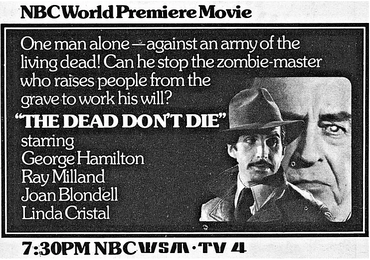
Image - Original newspaper had for The Dead Don't Die (1975) - courtesy of www.robertbloch.net
My heart would leap for joy when I saw ads like this.

For better or worse, Nalder didn't need much makeup to look like a walking corpse. The scene in which Varek's rasping voice seems to be coming from Perdido's dead body lying in the coffin, its mouth stretched back in a deathly rictus, induces real goosebumps. Knowing a good thing when they saw it, the producers recycled Perdido footage in a later nightmare sequence, which ends with a hackneyed shot of a hand breaking through the cemetery dirt to clutch Don's ankle.

Less effective in her part is leading zombie lady Linda Cristal. She starts out mysterious and enigmatic, but the Argentinian actress struggles with her thick accent in relating her incredible and complicated backstory to the disbelieving protagonist. Her character's final exit should have been one of the film's highlights, but crude practical effects and editing veer it into unintentional comedy. Let's just say that the scene brings new meaning to the phrase, "smoldering looks."

Suspense and horror master Robert "Psycho" Bloch wrote the teleplay from his short story. With its clueless, meandering protagonist and clunky expository dialog that slows down the proceedings, the film is not a highlight in the esteemed author's resume. Bloch would go on to contribute better material to such classic TV anthology shows as Boris Karloff's Thriller, Alfred Hitchcock Presents, Hammer's Journey to the Unknown, Night Gallery, and Tales from the Darkside, among others. Bloch himself quipped, "Two years later we [Curtis Harrington] teamed up again for another TV movie, The Dead Don't Die. Maybe they don't but the show did." [RobertBloch.net]

The film may not have been a hit at the time, but over the years it has refused to die, clawing itself out of the grave of forgotten TV movies and into places like YouTube with the help of appreciative fans. If only for corpse-like Reggie Nalder menacing some familiar veteran actors, you should check it out.

October 14, 2022

Zombie Dearest: A Selective Look at Pre-Romero Zombie Movies

I’ve said it on this blog before and I’ll say it again: I’m not a big fan of the endless hordes of plague-spawned zombies that have shambled their way across movie and TV screens ever since George Romero’s Night of the Living Dead opened up the flood gates. For me, modern zombies are too abstract a threat, too numerous, and too interchangeable to be all that interesting after you’ve seen a handful of these shows.

I get it that apocalyptic zombies are just there to get the survivalist drama going, whereby we learn something about ourselves -- the good, the bad and ugly -- through characters desperately trying to get by in a desolate and dangerous world. But for me, the relentless survivalist thing with hardly a glimmer of hope gets awfully old awfully fast.

In contrast to the bleakness of a zombified world, I prefer my horrors to be more up close and personal and not quite so earth shattering. With more traditional horror, you can have your monsters and beat them too. When it comes to creating zombies, Voodoo practitioners and mad doctors are a lot more tangible and colorful than viruses or experimental gasses. And they make great foils in the eternal struggle of good vs. evil -- defeating a living, breathing mad person is so much more satisfying.

Zombies in the Great Depression

Poster - White Zombie, 1932
Voodoo-style zombies got their start in Hollywood around the same time that Dracula and Frankenstein debuted for Universal Pictures. In fact, it was Dracula himself, Bela Lugosi, as the enigmatic and aptly named “Murder” Legendre, who conjured up the first cinematic zombies in White Zombie (1932).

Legendre is the sinister foreman on a Haitian plantation owned by Charles Beaumont (Robert Frazer). Legendre is worth his weight in gold to Beaumont, as he is able to create zombies out of the local population who are absolutely obedient and work for nothing (Jeff Bezos, take note). When Beaumont meets Neil and Madeline (John Harron and Madge Bellamy), an attractive young couple who are engaged to be married, he invites them to stay at his mansion and have the ceremony there.

Of course, the creepy old rich guy has designs on the beautiful girl, and he has his Voodoo-master henchman Legendre turn Madeline into a zombie so that he can have her for himself. Beaumont quickly realizes his mistake, as zombies are not exactly the life of the party, and orders Legendre to restore Madeline to life. When Legendre refuses, it becomes apparent who really runs the show (hint: it’s the guy with the platoon of zombies under his control). Legendre seems to be riding high, but Neil and a local missionary, Dr. Bruner (Joseph Cawthorn), may have something to say about that.

Although not well-received at the time, over the years White Zombie’s reputation has returned from the dead to be regarded as an example of the triumph of creepy atmosphere and moody black and white cinematography over stilted acting. According to Bela Jr., the film was a personal favorite of his father’s. But it was also an early indicator of bad career decisions that would haunt Lugosi throughout his life -- for years afterward he regretted taking a paltry sum upfront instead of a cut of the robust box office receipts. 

Still - Frederick Peters and Bela Lugosi in White Zombie, 1932
"Stick with me kid and you'll go places!"


Zombies go to war

While it was no Night of the Living Dead, White Zombie inspired more than a few imitators. Next out of the gate was Revolt of the Zombies (1936), which was not so much an imitation as a follow-up to White Zombie made by the same producers and director. Set shortly after World War I, Revolt switches locales from Haiti to the exotic temples of Cambodia, where an expedition sent by the Allied Command is rummaging around, looking for the arcane “Secret of the Zombies” (shades of Indiana Jones and the Raiders of the Lost Ark!).

One of the eggheads attached to the expedition, Armand (Dean Jagger), stumbles upon the secret of making zombies, and uses his newfound power to intimidate the only female member of the group, Claire Duval (Dorothy Stone), who loves another.

The outbreak of World War II couldn’t stop the advance of zombies in the B movie units of Hollywood. Initially, the movie villains exploiting zombies shifted from evil plantation owners and Voodoo followers to Nazi operatives using their arcane knowledge to subvert the allied cause.

Poster - King of the Zombies, 1941
Monogram Pictures, King of the “Poverty Row” studios specializing in B programmers, made near-identical twin zombie pictures in the early ‘40s. King of the Zombies (1941) and Revenge of the Zombies (1943) share so many plot points and themes (and two cast members), that they’re easy to get confused with one another:

✔ Both feature suave doctors who turn out to be Nazi spies using Voodoo and zombies to further their sinister aims (Dr. Sangre in King, played by Henry Viktor, and Dr. Von Altermann in Revenge, played by John Carradine).

✔ Both doctors have beautiful wives who walk around in a catatonic state (I’ll leave it to you to guess why).

✔ Instead of just one rock-jawed protagonist, the films opt for a tag-team bro duo who for much of the time are maddeningly clueless to all the creepy stuff happening in front of their noses (Dick Purcell and John Archer in King; Robert Lowery and Mauritz Hugo in Revenge).

✔ Both feature an attractive female second lead for romantic subplot purposes (Sangre’s niece played by Joan Woodbury and Von Altermann’s secretary played by Gale Storm).

✔ Both Doctors’ households are run by Madame Sul-Te-Wan, who, according to IMBDb, was the first African-American actress to secure a contract with a major studio.

Poster - Revenge of the Zombies, 1943
✔ And then there is the dubious comic relief of bug-eyed Manton Moreland, who plays a superstitious valet in both. Monogram could still get away with such stereotyped characters in the ‘40s. Manton’s routines were so popular that he was a regular go-to character actor for the studio, appearing in a recurring role in their Charlie Chan series (and often getting favorable billing). Even though Moreland jumps at every shadow that crosses his path, to be fair, he is far more perceptive than his obtuse bosses, who couldn’t sense danger if it walked up and slapped ‘em silly.

The biggest distinction between the two films, such as it is, is the scope of the villains’ ambitions. In King, Sangre, partnering with the Voodoo priestess played by Madame Sul-Te-Wan, attempts Voodoo soul transference (!?) on a Navy admiral he has captured in order to extract defense secrets. (This being 1941, shortly before the U.S. entered the war, the government Sangre is working for is unnamed...wink, wink.)

A couple of years later, with the U.S. fully immersed in the fight against the Germans and Japanese, Revenge ups the ante considerably, making Von Altermann into a mad Nazi doctor intent on creating an army of zombies to turn the tide of the war.

Will the dense protagonists get wise in time to foil the nefarious plots? Will the more handsome of the pair get the girl? Will Manton Moreland’s belief in zombies be vindicated? Take a wild guess.

Lobby card - Revenge of the Zombies, 1943


War-weary zombies

As the global conflict ground on, movie-makers scaled back the war themes in their B programmers in deference to audiences who simply wanted to forget their troubles for a couple of hours at the theater.

Auteur B movie producer Val Lewton wisely set his 1943 film I Walked with a Zombie on a fictional Caribbean island, and borrowed liberally from Charlotte BrontĂ«’s Jane Eyre in telling the atmospheric tale of a young nurse (Frances Dee), who begins to believe that the expressionless, sleep-walking wife of her wealthy employer (Tom Conway) is really a zombie.

Lewton carries on the tradition of having a beautiful wife under a zombie spell, but also includes one of the creepiest male zombies ever for good measure. And thankfully, there’s not a whiff of war or spies or mad Nazi doctors.

Darby Jones' zombie scared the snot of me when I first saw I Walked with a Zombie.

Lewton’s film is dark, moody, beautifully photographed, and includes some genuinely suspenseful moments. On the other end of the scale is producer Sam Katzman’s Voodoo Man (1944), which is as gloriously cheesy as Lewton’s film is somber and serious.

Voodoo Man has the distinction of being the first self-aware, meta-zombie movie in Hollywood history. Tod Andrews plays Ralph Dawson, a screenwriter working for Banner Pictures (the actual name of Katzman’s production company). The studio boss S.K. (uh-huh) summons Ralph to his office to assign him a horror script based on a ripped-from-the-headlines story of women who have mysteriously gone missing in the area. Ralph reminds him that he’s taking time off to get married and go on his honeymoon.

The hapless scenarist runs out of gas on the way to his fianceĂ©’s house, and by chance is picked up by Sally (Louise Curry), who just happens to be the maid of honor and is headed to the house as well.

After they turn off on a detour in the middle of nowhere, Sally’s car dies. Ralph spots a nearby mansion, but is rebuffed at the door by a servant. When he gets back to the car, Sally is nowhere to be found. It seems that Ralph has stumbled into the missing girl mystery that S.K. wanted him to exploit.

Poster - Voodoo Man, 1944

At the center of the conspiracy is Dr. Richard Marlowe (Bela Lugosi), whose beautiful wife (Ellen Hall) is dead, but still able to walk around (you didn’t think they’d leave out the beautiful zombified wife, did you?). He needs healthy young women in order to transfer their life essences to his wife and restore her to the living. Marlowe is aided in his mad plan by Nicholas (George Zucco), the local gas station owner and Voodoo witch doctor (now there’s a unique skill set!), who identifies likely candidates and officiates at the transference ceremonies. John Carradine is on hand as half of a duo of mentally-challenged henchmen who do the actual kidnapping (a big comedown from his stint as the Nazi doctor in Revenge).

The ceremony is a marvel of B movie cheese, and it alone is worth looking up Voodoo Man. As master of ceremonies, the normally professorial-looking Zucco sports a feathered headdress, facial paint and a classic magician’s robe with stars and crosses. His dignity takes a further hit when he’s given lines like: “Ramboona is all powerful!” (All powerful, yes, but apparently Ramboona helps those who help themselves to unwary young women.)

Lugosi’s outfit is more restrained, but he gets the best lines of all as he facilitates the soul/life force transference. He summons up his best halting Dracula voice as he intones over and over, “Mind…to…mind, soul from body…to…body, emotion…to…emotion, life…to…death…” In the background, John Carradine's idiot henchman bangs on bongo drums (!?) with a vacant, almost zombie-like look on his face.

There’s not a chance of suspense in something this silly, but there is one notable scene in which Carradine releases several young women, the product of previous failed experiments, from their cells in the basement. Dressed in their long-flowing ceremonial robes and staring ahead, lifeless, yet still ambulatory, they’re reminiscent of Dracula’s brides.

The self-awareness comes full circle at the end, when Dawson delivers a script titled "Voodoo Man" based on his experiences, and he suggests to S.K. that Bela Lugosi play the lead (cue the laugh track).

Years later, Sam Katzman would try his hand with yet another zombie movie, The Zombies of Mora Tau (1957). That one is about a group of zombie sailors guarding a sunken treasure. Despite the unique nautical angle, Mora Tau is deadly dull compared to the madcap antics of Voodoo Man.

Lobby card - Voodoo Man, 1944


Zombies in the big city

In an era of total war, traditional movie monsters seemed lame and innocuous in comparison. So B movie makers embraced the lameness by increasingly mixing broad comedy with horror, often bringing together established comedic teams with horror icons. The result was pictures like Spooks Run Wild (1941) and Ghosts on the Loose (1943), in which Bela Lugosi serves as a foil for the comic pranks of the East Side Kids.

Poster - Zombies on Broadway, 1945
Several years before Universal decided to team up their stable of classic monsters with Abbott and Costello, RKO Radio Pictures jumped on the bandwagon by making a sort of sequel to the classic I Walked with a Zombie -- only this time featuring their own comic duo.

In Zombies on Broadway, two inept press agents, Jerry Miles and Walt Strager (Wally Brown and Alan Carney) are ordered by their gangster boss (Sheldon Leonard) to find a real living-dead zombie to appear at the opening of his new night club, The Zombie Hut. They travel to the Caribbean island of San Sebastian (the same fictional locale as the Lewton film), where a certain Dr. Renault (Bela Lugosi) has supposedly become an expert in creating zombies.

Needing help to find the elusive doctor, the boys team up with a beautiful nightclub singer, Jean La Dance (Anne Jeffreys), who in exchange wants a ride back to New York. Plans go awry when Jean is kidnapped by one of Renault’s zombies (Darby Jones, in the identical make-up he wore in I Walked with a Zombie), and Walt is zombified (but only temporarily) by the mad doctor.

By this point Lugosi, whose glory days were far behind him, was used to being upstaged by low-rent comedy acts in horror cheapies that exploited his name recognition. But just a few years later, Lugosi would have the last laugh (and the last big boost of his career) with yet another horror comedy, reprising his cherished Dracula role to wide acclaim in Universal’s Abbott and Costello Meet Frankenstein (1948). RKO, in recycling characters and locales from I Walked with a Zombie and bringing in Lugosi to share in the fun, provided a sort of dress rehearsal for Bela’s last big break at Universal.

Lobby card - Zombies on Broadway, 1945


Epilogue

As the Atomic Age dawned and the Cold War set in, supernatural zombies shuffled off the stage to make way for irradiated giant monsters and alien invaders. But you can’t keep the living dead down for long. Inevitably, zombies made a spectacular comeback via the imagination of an unassuming low-budget filmmaker named George Romero, and they’ve been overwhelming the earth ever since, powered by strange viruses instead of Voodoo.

Romero could scarcely imagine the endless zombie plagues that would be unleashed by Night of the Living Dead. But the old-time zombies are still around, waiting patiently on DVD and streaming sites for that special, nostalgic viewer to summon them.

September 9, 2011

A Mr Movie Fiend Post-Labor Day Special

The Plague of the Zombies (1966)


So, another summer, and another nice, refreshing Labor Day weekend have come and gone. It’s hard to imagine these days, but Labor Day started out as — you guessed it — a celebration of good old fashioned labor. According to the venerable Wikipedia:
Labor Day is a United States federal holiday observed on the first Monday in September (September 5 in 2011) that celebrates the economic and social contributions of workers. The first big Labor Day in the United States was observed on September 5, 1882, by the Central Labor Union of New York. It was first proposed by Peter J. McGuire of the American Federation of Labor in May 1882, after witnessing the annual labor festival held in Toronto, Canada. (Of course there’s more to it than that, but you get the drift.)
I don’t know about you, but I don’t often sit around on Labor Day thinking about the economic and social contributions of the virtuous, common worker (or even my own meager workplace contributions). Like most everyone else, I relax– I eat, I drink, I channel surf, and of course, watch a movie or two.
There’s not much to celebrate on the labor front anyway. Lately, the average working stiff’s contributions have been rewarded with shrinking paychecks, dwindling job opportunities, underwater mortgages, deflated 401k plans, steadily rising prices, and sundry other threats to his economic well-being.  Come to think of it, maybe now’s the time to put the celebration of labor (or at least a grudging appreciation) back into Labor Day.

Despite being made way back in 1966, Hammer’s The Plague of the Zombies is a cautionary (and morbidly entertaining) tale for our own times. Think you’ve got it bad now? Don’t think social security will be there for you when you retire? Thinking you’ll have to work until you drop? It could be worse. You could be like the villagers in The Plague, where even death doesn’t prevent soulless bosses from giving you maximum overtime for no pay.

See the full post at Mr Movie Fiend.


"No corpse can remain at peace in this village of the undead!"