Showing posts with label Richard Gordon. Show all posts

March 29, 2024

Ventriloquism for Dummies: Devil Doll (1964)

Poster - Devil Doll (1964)
Now Playing:
Devil Doll (1964)


Pros: Manages an uncanny atmosphere, especially in scenes in which Vorelli (the ventriloquist) and Hugo (the dummy) argue as they perform their stage act.
Cons: Skimpy production values; Yvonne Romain is somewhat wasted in a role where she is in a hypnotic trance or semi-conscious for much of the movie

This post about a man and his devilish dummy is part of The Mismatched Couples Blogathon hosted by the prolific and ever reliable bloggers Gill at Realweegiemidget Reviews and Barry at Cinematic Catharsis.

According to Psych Times, pupaphobia, or fear of puppets, is a real anxiety that can be debilitating for adults as well as children. While most of us don’t break out in a cold sweat at the sight of a ventriloquist’s dummy or a marionette (or heaven forbid, a muppet), it’s not for the entertainment industry’s lack of trying. Marionettes are one thing, but ventriloquist’s dummies, with their larger size and moving heads, mouths and eyes, can evoke a sense of the uncanny in even the most rational adult.

In 1945, the mother (or should I say father?) of all creepy dummies, Hugo, appeared in the pioneering UK anthology horror film Dead of Night. Years later, Hugo inspired not one but two sentient dummy episodes on The Twilight Zone: “The Dummy” (S3, Ep. 3, 1962), featuring a ventriloquist (Cliff Robertson) whose dummy is the real brains of the act, and “Caesar and Me,” (S5, Ep. 22, 1964), which tells the tale of an alcoholic ventriloquist (Jackie Cooper) whose wooden sidekick convinces him to pull off a series of robberies. (Interestingly, the same dummy prop was used in both episodes.)

Composite screenshot - Two sentient dummy episodes on The Twilight Zone: "The Dummy" (1962) and "Caesar and Me" (1964)
I hope this dummy was smart enough to collect overtime from Mr. Serling.

Even before The Twilight Zone became a home for delinquent dummies, Alfred Hitchcock Presents got in on the act with the episode “And So Died Riabouchinska,” (S1, Ep. 20, 1956). Based on a Ray Bradbury short story , Riabouchinska flips the dummy script with an uncanny and beautiful female mannequin who cannot tell a lie -- and becomes a witness in a murder investigation involving her ventriloquist (Claude Rains).

And then there’s Magic (1976), about a sort of love triangle involving a man, his dummy, and the ravishing Ann-Margaret. (Magic’s box office didn’t do anyone associated with it any favors, but it has since acquired a minor cult reputation.)

Perhaps as much as any of the above listed movies or TV episodes, Devil Doll will put your pupaphobia to the test (or maybe jump start a bad case if you don’t already have it). The titular “doll” Hugo, like his Dead of Night namesake, is unsettlingly ugly in the classic evil dummy way. This particular Hugo ups the creepiness factor in his ability to walk around on his own with no strings or hands attached (courtesy of 4’ 1” Sadie Corrie, who wore a Hugo costume for those scenes).

His “master,” The Great Vorelli (Bryant Haliday), is no less off-putting, but in an intense, Svengali-like way. Together they make an exceedingly creepy mismatched couple.

But they’re not the only odd pair in Devil Doll; the film is positively brimming with regrettable or unlikely relationships among abusers, abusees and those about to be abused. Let’s count:

1. Vorelli and Hugo. Vorelli, who has been selling out shows in the London theater district, has a dual act: hypnotizing volunteers on stage, and then closing with the dummy Hugo, who departs from the usual ventriloquist routine by getting up, walking up to the footlights, and addressing the audience on his own.

Vorelli has a sadistic streak. In an early scene, he hypnotizes a volunteer and convinces the poor blubbering man that he’s about to be executed. The ventriloquist part of his act is all about taunting Hugo that he’s just a dumb block of wood, while Vorelli can eat and drink wine and live life to the fullest. Hugo (or is it really Vorelli?) protests that he can drink wine too, and is thirsty. It’s a sad, depressing routine, but then, Hugo shuffling around the stage is a genuine showstopper. (Later, there’s an additional hint that Vorelli isn’t in complete control of his dummy when we see that he locks Hugo in a cage when he’s not performing.)

Screenshot - Bryant Haliday and Hugo in Devil Doll (1964)
Vorelli pours himself a glass of wine while Hugo wishes he had an esophagus.

2. Mark English and Marianne Horn. Mark (William Sylvester) is an American expat working as a reporter for a London tabloid. His editor wants him to get the scoop on the new sensation in town, The Great Vorelli. He enlists his girlfriend, the beautiful and wealthy Marianne (Yvonne Romain) to volunteer to be hypnotized at Vorelli’s next show in the hopes of exposing him as a charlatan.

Mark and Marianne are a mismatched couple -- he’s rough around the edges and pushy, and she’s somewhat passive and unsure of herself. At the theater Marianne gets cold feet about volunteering, but Mark, thinking about nothing but his story, goads her into it. Big mistake. Considering her elite status and how beautiful she is, she could do a lot better.

Screenshot - Yvonne Romain and Mark Sylvester in Devil Doll (1964)
"C'mon, don't be such a baby -- what's the worst that can happen?"

3. Vorelli and Marianne. Vorelli couldn’t have hoped for a better subject to fall into his hypnotic clutches. Using his sinister powers, he wrangles an invitation to a charity ball being hosted by Marianne’s wealthy aunt. At the ball, Vorelli solidifies his hypnotic power over Marianne, and she falls into a feverish semi-coma. When she comes out of it, she robotically professes her love for the hypnotist and tells Mark she plans to marry Vorelli.

Maybe this couple isn’t as mismatched as it seems -- he likes money and she’s got a lot of it. Except that once they’re married, her life won’t be worth a plugged nickel.

Screenshot - Yvonne Romain and Bryant Haliday in Devil Doll (1964)
Don't look him in the eyes...

4. Vorelli and Magda the buxom stage assistant. Poor Magda (Sandra Dorne) has hopelessly fallen for her boss, but his attentions are lasered in on the beautiful Marianne. In desperation, she threatens to turn him into the police if he doesn’t make an honest woman of her. Vorelli deals with the situation by telling Hugo that Magda is dishing dirt on him. Exit Magda.

But perhaps the biggest mismatch of all is the combination of hypnosis and ventriloquism in Vorelli’s act (I guess they don’t call him the Great Vorelli for nothing). Sure, hypnosis and ventriloquism have been mainstays of vaudeville for years, but it seems like combining the two could quickly go south -- like a tired Vorelli mixing up the routines and trying to stick his hand in a **ahem** inappropriate place on his volunteer’s person.

Screenshot - Sandra Dorne and Bryant Haliday in Devil Doll (1964)
Vorelli has another great talent: tuning out things he doesn't want to hear.

Producer Richard Gordon, whose credits include such B gems as The Haunted Strangler (1958) and Corridors of Blood (1958; both starring Boris Karloff), and cult sci-fi favorites like Fiend Without a Face (1958) and First Man Into Space (1959), was proud to have pioneered this odd mash-up:  

“One of the interesting things about Devil Doll is that it’s the first time that hypnotism and ventriloquism were brought together and incorporated into one film. Hypnotism in the movies goes back to the days of The Cabinet of Dr. Caligari [1919]; and in 1926, Boris Karloff played a Caligari-like hypnotist in a picture called The Bells, in which he uses hypnosis to unmask Lionel Barrymore as a murderer. And Barrymore himself used hypnotism to solve the killings in Mark of the Vampire [1935]. But I don’t think it had ever been used in conjunction with ventriloquism before.” [Tom Weaver, The Horror Hits of Richard Gordon: A Book-Length Interview, BearManor Media, 2011, p. 111.]

Devil Doll’s script, by Ronald Kinnoch and Charles Vetter, was based on a story by Frederick E. Smith that had appeared in an English pulp magazine.

The film definitely lives up to (or down to, according to your taste) its pulp roots. There are a lot of close-ups of Vorelli mesmerizing his victims, and of Hugo’s pug-ugly face with only a slight movement of the eyes betraying that he’s anything other than a wooden prop. (Especially pulpy is a scene in which Vorelli, trying to mollify Magda, beds her, and we get a peek at the voluptuous assistant in her birthday suit.)

Screenshot - Bryant Haliday as the Great Vorelli stares intensely in Devil Doll (1964)
Seriously now, DON'T LOOK HIM IN THE EYES!

The frequent close-ups lend the film a sort of claustrophobic feeling, as if we the viewers are being hypnotized and can only see and obey Vorelli. Relying on close-ups also allowed Gordon to get the film in the can for something between $60 - $70 K, less than even the previous Karloff films or the sci-fi Bs:

“In making any low-budget movie, one tended to use closeups more frequently and more prominently than otherwise, because it helped to reduce production costs; you didn’t have to light and dress up a whole set in order to shoot a scene.” [Weaver, p. 112]

Of course, the real star of the show is Hugo, who is both animated and ambulatory. Dummies who could move on their own had been done before, but they tended to work in the shadows when no one was looking.

On the other hand, Devil Doll Hugo’s uncanny ability to walk is part of Vorelli’s stage act, so something else is going on beyond hallucinations or a disturbed ventriloquist investing his dummy with the other half of his split personality.

Screenshot - Hugo takes a stroll during the stage act in Devil Doll (1964)
The Dummy walks!

When, after the charity ball, Hugo visits Mark in the middle of night and cryptically implores him to “Help me. Find me in Berlin… 1948…” Mark takes the hint and travels to the German capital to look into Vorelli’s and Hugo’s past. Apparently Vorelli was no mere classically trained hypnotist or vaudevillian, but was also a dedicated student of Eastern occult arts. And it’s that occult knowledge, combined with hypnosis, that has Mark worried about Vorelli’s designs on Marianne.

Speaking of interesting pasts, Bryant Haliday had as much of an intriguing, if less sinister, career arc as the character he played. Initially interested in theology, he spent some time in a monastery, then took a detour to study international law at Harvard University.

At Harvard Haliday caught the acting bug, and guaranteed himself a wealth of experience by helping to establish the Brattle Theater company and the Cambridge Drama Festival. Then, branching out into films, he and a Harvard colleague co-founded Janus Films, the first American distributor of such international cinema luminaries as Ingmar Bergman, Federico Fellini, and Michelangelo Antonioni. (Haliday has been featured on the blog before -- see my review of another Richard Gordon / Bryant Haliday collaboration, The Projected Man.) 

Screenshot - Vorelli (Bryant Haliday) entertains Marianne (Yvonne Romain) in his lair: Devil Doll (1964)
Bryant Haliday gives his pitch to a potential Janus Films investor.

Also no stranger to the blog is Yvonne Romain (Marianne), who was last seen here providing the love interest for Oliver Reed in Hammer’s swashbuckler Night Creatures (aka Captain Clegg, 1962). Romain's horror credits include a small role in Gordon's Corridors of Blood (1958), Circus of Horrors (1960; in which her disfigured face is restored by a scheming plastic surgeon played by Anton Diffring), and Curse of the Werewolf (1961; where she once again hooks up with the cursed Oliver Reed).

American William Sylvester’s notable genre appearances include Gorgo (1961; playing a sailor who helps his Captain capture a juvenile prehistoric monster), and 2001: A Space Odyssey (1968; playing a NASA administrator trying to deal with the discovery of a mysterious monolith on the moon).

While Devil Doll is not the perfect cinematic ventriloquist’s act -- the emphasis on close-ups makes it seem more like a TV show than a movie, and it squanders Yvonne Romain by keeping her hypnotized and/or semi-conscious for much of the running time -- it does manage a few genuinely creepy moments.

Shots of Hugo staring (but maybe not quite blankly) out from between the bars of his cage, and close-ups of his small, stiff legs as he shuffles down a hallway in the dead of night, are enough to elicit an uncanny shudder or two. There is a Mystery Science Theater 3000 episode featuring Devil Doll out there, but I would take in this ventriloquist act without the hijinks.

Screenshot - Vorelli (Bryant Haliday) keeps his dummy locked up in a cage; Devil Doll (1964)
Hugo bides his time in solitary confinement

Where to find it: Streaming | DVD  

February 23, 2014

Phantom of the Sci-Fi Soap Opera

Poster for double-bill, The Projected Man and Island of Terror (1966)
Now Playing: The Projected Man (1966)

Pros: Some suspense and pathos materialize towards the end; Relatively effective monster make-up
Cons: Lackadaisical love triangle; Villains’ motives are unclear; Intriguing aspects of teleportation are unexplored

What is life without taking risks? No life at all, for even the most staid and cautious among us have to realize that simply moving around and engaging in any sort of activity, no matter how mundane, entails some level of risk. The baby takes a chance with its first steps. The common commuter takes daily risks driving or riding to work. Even the most hidebound, obsessive-compulsive creature of habit has risked more than he or she cares to think about – after all, there had to be a first time, and an element of risk, however small, in that behavior or practice that through repetition has become an unexamined part of everyday life.

Of course there’s risk, and then there’s batsh*t crazy dangerous. I am a science fiction fan of long-standing. Heck, I was there, dagnabbit!, sitting cross-legged in front of the old black and white TV when the crew of the Enterprise went where no man has gone before for the very first time! (September 8, 1966 for those who are counting). So you know I’ve watched and read some crazy stuff over the years, and then inevitably wondered “what if?” Board a starship and zip across the universe at greater-than-light warp speed? Sign me up! Travel through time to the age of the dinosaurs or the far future? Where’s my camera? Have all the atoms that make up the unique, irreplaceable person I call me scanned, disassembled, teleported, then reassembled at a distant location? Wait, hold up, don’t even think about touching that lever!

Steiner and his assistants prepare for a demonstration of their matter projector
Pizza delivery of the future:
"Get it in 30 milliseconds or less or it's free!" ®
Demonstrate this technology to me using a rock, or bottle, or maybe a model of the starship Enterprise, and I’ll be very, very impressed. But I have to think that a living organism, especially a human being, is more than just the sum of its parts. Dammit, we’re not furniture kits from IKEA to be hauled off and reassembled somewhere! No matter how quick and efficient, teleportation is the ultimate risky form of travel. You can buy a toothbrush if you lose it in transit, but what about your soul (or your unique consciousness for those of a less religious persuasion)?

By the 23rd century of the Star Trek universe, we’re asked to believe that no one gave the metaphysics of “beam me up” a second thought. Like elevators, transporters were just another ho-hum daily means of transportation, a device to quickly get those red-shirted crewmen down on the surface of a new planet where they could be eaten, mangled or otherwise abused by the local fauna. Sure accidents happened, just like the occasional elevator accident, but who’s going to let an astronomically small chance of being reassembled inside-out get in the way of such convenience?

Poster - The Fly (1958)
Come to think of it, my all-time favorite Star Trek character, Leonard “Bones” McCoy, was famously leery of transporters (but then he was grumpy about a lot of things, thus my identification with the character). Perhaps by the time he got to Star Fleet Academy, McCoy had done the mental calisthenics around the whole concept and come to some horrifying conclusions – like the character Badger on Breaking Bad, whose weed-fueled monologue on the perverse risks of transporters (and misuse in pie-eating contests) attracted a lot of attention when it was aired.

While George Langelaan’s 1957 short story “The Fly” was not the first to feature scientific teleportation, the first movie it inspired, The Fly (1958, directed by Kurt Neumann and starring David Hedison and Vincent Price) certainly helped to move the concept front and center into popular consciousness. (Supposedly the original film and its teleportation concept were brought to Star Trek creator Gene Roddenberry’s attention as a cost effective way to move his characters around fictional worlds.) David Cronenberg’s thought-provoking 1986 remake further highlighted the technological risks in a very intense and graphic way (while also suggesting the dangers of relying too much on computer programs and artificial “intelligence”).

The Projected Man is no The Fly, or even on par with an average episode of the original Star Trek series. But it does feature a couple of fairly suspenseful moments and at least tries to leave the monster that emerges from the botched teleportation attempt with a little bit of its humanity intact.

Bryant Haliday, Norman Wooland and Mary Peach in The Projected Man
Dr. Steiner (Bryant Haliday, left) is under the gun from the
weaselly foundation director to produce results or else.
The plot: Genius physicist Dr. Paul Steiner (Bryant Haliday) and his assistant Dr. Chris Mitchel (Ronald Allen) are on the verge of perfecting a laser-based system for turning matter into pure energy, storing it in a receiving cell, then projecting it wherever they want. At first they’re elated when they successfully project a live guinea pig. Elation turns to disappointment when Steiner touches it and it promptly dies, giving him a shock in the process. Inexplicably, the imperious director of the foundation that they work for, Dr. Blanchard (Norman Wooland) threatens to pull the project's funding if they don’t make more progress, and fast (like teleporting inanimate matter is just routine—no, nothing to see here folks, can’t think of any lucrative applications for that! There’s some speculation between Steiner and Mitchel that Blanchard is jealous of Steiner’s success, but that doesn’t explain at all why the director would sit on the greatest scientific breakthrough of all time.)

Steiner brings in a former colleague, pathologist Patricia Hill (Mary Peach), to help sort out the issues with projecting living organisms. At first the young, attractive doctor doesn’t seem to be too impressed as Steiner explains the technology. But when the team disintegrates her watch and brings it back again, she finally gets excited and deems the whole thing “incredible!” All three seem dumbfounded when they see the hands of the rematerialized watch spinning around the dial. When Hill touches it and gets a shock, the hands spin even faster.

The demonstration for Prof. Lembach goes up in smoke.
"What part of 'Danger! High Voltage'
did you not understand?"
A lot of jargon gets thrown around about “changes in the direction and polarity” of the transporter chamber’s magnetic field and needing a “time phase adjustment,” but the scientists seem to think they’re on to something. Applying what they’ve learned, they try to project another living animal, this time a monkey. After it materializes seemingly fit and healthy (and shock-free), Patricia gives it the most cursory of examinations and declares success. Meanwhile, Blanchard meets with a shadowy but apparently well-connected co-conspirator to work out a nefarious scheme to discredit Steiner. Blanchard arranges for world-renowned physicist and Steiner’s mentor Prof. Lembach (Gerard Heinz) to attend a teleportation demonstration – one that they will conveniently sabotage. Steiner protests that he’s not ready, but goes along to keep his funding. To add to his distraction, Patricia and Mitchel seem to be getting along quite well. He brushes off suggestions that he has feelings for the attractive pathologist, but the budding romance obviously bothers him. Of course, the demonstration for Lembach goes disastrously wrong in a shower of sparks and flame. Mitchel notices that a vital piece of equipment has been purposely corroded with acid and alerts the disconsolate senior scientist. They work feverishly to get the equipment back up and running.

Dr. Steiner (Bryant Haliday), post-projection
"Hold still, you've got something on your face."
At a dinner party Blanchard is holding for Lembach at his townhouse, Steiner protests that his equipment’s been sabotaged, but the smug director declares that the project is dead nonetheless. Steiner verifies that the dinner guests will be sticking around the townhouse for the next couple of hours and storms out. He rushes back to the lab and grabs bubble-headed receptionist Sheila (Tracy Crisp) to help project him in dramatic fashion right into Blanchard’s dining room (there’s no time to round up Mitchel and Hill and do things by the book). Naturally, the projection doesn’t go quite as planned, and Steiner ends up in a dark alley outside of Blanchard’s place, one side of his face and a hand horribly burned. And, he’s a walking power generator who can kill with a mere touch. Not to mention, he’s mightily pissed off (I guess I’d be upset too). The Projected Man fritters away a lot of suspense in its first two-thirds with duplicative lab scenes, a desultory, oddly dispassionate love triangle, and an unconvincing Snidely-Whiplash villain (Blanchard) whose motivations are obscure to say the least. (Is he trying to steal Steiner’s work? Is he working for a foreign government? Is he just jealous? Get a grip man! You don’t sabotage something that can make you world-famous and a billionaire!)

In the last third the film gets dark (literally and figuratively) and becomes more horror than sci-fi film. When I watched the projected Steiner, a cloth covering the ruined part of his face, confronting lovebirds Mitchel and Hill in the assistant scientist’s apartment, an image of Herbert Lom in Hammer’s version of The Phantom of the Opera (1962) beamed into my brain. Like Lom’s Phantom (and Claude Rains’ in Universal’s 1943 version), Steiner is a genius whose work has been stolen by an unscrupulous higher-up, and in trying to get it back (along with his dignity), he’s inadvertently turned himself into a monster. There’s a moment of pathos in the apartment scene when Steiner, his burned face turned toward a darkened window, listens for a moment to Mitchel and Hill pleading to let them help him. But Steiner won’t have it—he’s literally got bigger fish to fry. As Steiner stalks off, Mitchel tries to console Patricia and himself: “Think of him as the projected man who has nothing in common with Paul Steiner.” It's an interesting concept — are you still you after your atoms have been scrambled and reassembled? – that is left largely unexplored in the rush to get to the B movie climax.

The Projected Man confronts his colleagues
The Phantom of the Projection Lab
shows up at Mitchel's apartment.
Projected Man Bryant Haliday made only a handful of films, most of them horror/sci-fi for UK B producer Richard Gordon (as the Great Vorelli in Devil Doll, 1964; Voodoo Blood Death, aka Curse of the Voodoo, 1965; and Horror on Snape Island, aka Tower of Evil, 1972). Unlike many B movie actors who saw these films as just a paycheck and preferred to forget about them, Haliday was a big horror movie fan.

In Tom Weaver’s The Horror Hits of Richard Gordon (BearManor Media, 2011), Gordon (who didn’t produce the film himself but put together the deal for the double-bill of The Projected Man and Island of Terror with Peter Cushing) paid Haliday a great compliment:
"I thought Bryant was very effective and handled his role extremely well. Towards the end, he was actually able to arouse the sympathy of the audience and did not come across as just a monster on a killing spree. It reminded me of so many films in which Boris Karloff had played a scientist who becomes a monster through no fault of his own, as opposed to Bela Lugosi who was usually an outright villain. In fact, you might say that Bryant paid tribute to the memory of Bela in Devil Doll and Karloff in The Projected Man! As for the female lead, Mary Peach, she became Mrs. Jimmy Sangster in the 1990s, and the last time I saw her was with Sangster at one of the FANEX conventions in Baltimore [July 1997]. When I mentioned The Projected Man, she said, ‘Oh, I don’t want to talk about that film!’ – I think she didn’t want to appear to have been a horror film leading lady and become a part of that ‘clan’..."
Somewhat like the mutated results of a covered-up top secret experiment, The Projected Man is only whispered about in dark alleyways by hard-core sci-fi fans. It’s no The Fly, but it hardly deserves the obscurity into which it’s been teleported.


Where to find it:
Available on DVD

Sinister Cinema


"Science runs amok when human beings tamper with unknown forces!"

July 7, 2013

Fantastic Faceless Foes From Fifties Sci-fi: Extra Special Outdoor Movie Party Edition

A year or so ago I posted a "love letter" to the vanishing American drive-in, and wrote about how easy and fun (and relatively economical) it can be to recreate a little of the outdoor movie experience in your backyard ("Backyard Movies on a Budget").  I'm in the homestretch of a marathon move, but before I got out of Dodge for good, I wanted to have my friends over for one last outdoor movie party. (Ironically, I'm moving to a much larger city that has -- you guessed it -- one of the last drive-ins left in the country. *Fist pump*!)

Two fans at a recent outdoor movie party
These two outdoor movie fans seem to have
forgotten their popcorn!
If you're going to go to the trouble of setting up a screen and projector in your back yard and pretend you're at the drive-in, then you might as well go all the way and pretend that you're at the drive-in in its heyday, the 1950s. And while you're at it, you might just go for a double-bill featuring two of the more unusual sci-fi movie menaces of the '50s, Kronos (1957) and Fiend Without a Face (1958). Speaking of faceless, way back in September of 2011, I wrote about the first group of Fantastic Faceless Foes from '50s Sci-fi, and promised another installment. And here it is, almost two years later -- now that's what I call an irregular blog feature!

In the first installment, I talked a little about how '50s sci-fi movies tried to address, in an entertaining and ultimately reassuring way, the inchoate fears of an American public that had recently been hit with a number of shocks to the All-American system of comfortable middle class security: first the A bomb and radioactivity, then the H bomb, then Sputnik (which meant that the Russians could lob bombs at us with intercontinental missiles just as easily as putting up harmless satellites).

Book by Don and Susan Sanders,
Crestline, 2013 (reprint ed.)
There were plenty of conventional sci-fi threats in the Eisenhower years: lumbering dinosaurs awakened by atomic testing; saucer men threatening teenagers in their hot rods, and even the venerable Frankenstein monster and the Wolf Man were turned into especially bummed out teenagers. But then, the free-floating anxieties of the atomic age called for other, more nebulous threats as well. Ironically, the low cost of these productions, the profit potential, and the insatiable demand for product on the part of drive-in owners resulted in a number of crazy projects getting green lighted that would never have stood a chance in any other era. (In contrast, today's American movie industry is extremely reluctant to take chances on original content or characters. The vast majority of releases are based on known quantities: popular video games, comic books, graphic novels and TV series. The few blockbusters that try original material almost invariably sink quickly at the box office. The result, for all the state-of-the-art CGI effects, is a depressing sameness.)

So, this unique set of circumstances in the '50s resulted in an explosion of far-out ideas from low-budget filmmakers with nothing to lose (they almost couldn't lose -- if you could deliver the product, it was almost certain to make a profit). Drive-in movie heroes and heroines were threatened by omnivorous blobs; 50-foot tall men and women; all manner of giant insects and animals (including ants, grasshoppers, preying mantises and, *gulp*, a giant buzzard); an assortment of disembodied heads and brains; quick-growing, towering crystals; and even a virulent fungus.

The Faceless Foes featured here fit very nicely into this drive-in theater of the absurd. The first is a giant, faceless energy-sucking robot from space. The second is an army (or maybe a battalion) of "thought" creatures in the form of disembodied brains with antennae and spinal cord "tails." Awesome!

Poster - Kronos (1957)
Now Playing: Kronos (1957)

Pros: Great, non-anthropomorphic giant robot concept and design; Ingenious ending
Cons: Alien mind-control subplot is superfluous and mildly distracting

In brief: A pulsating flying saucer, hovering against a backdrop of stars, releases a ball of light that head towards earth. A truck driver on a lonely desert road gets out to figure out why his vehicle stalled. The eerie light overwhelms him, then, zombified, he gets backs in his truck and drives to the nearest secret research base, where he confronts Dr. Hubbell Eliot (John Emery). The light shoots out of the driver's eyes and into the scientist's, whereupon the "messenger" collapses, dead. Meanwhile, another team of scientists, led by Dr. Leslie Gaskell (Jeff Morrow) are alarmed to find that a giant asteroid is headed straight for earth (actually, it looks just like the flying saucer seen right after the credits!). When missiles are fired to intercept it, the asteroid changes course, as if it were piloted (duh!), and splashes harmlessly (?) into the ocean just off of Mexico.

A team headed by Gaskell, including his fiancee Vera (Barbara Lawrence) and fellow scientist Arnold Culver (George O'Hanlon), travel down to Mexico to investigate the asteroid splashdown. Their suspicions about the odd behavior of the asteroid are confirmed when a colossal dome rises out of the ocean where the asteroid went down, and a giant robot suddenly appears on the beach nearby. The giant thing is weirdly alien-looking, it's "body" consisting of two huge cubes joined by a pylon, and its "head" a dome with antennae sticking out on either side. The robot moves around using four massive pistons at its base that rapidly fire in sequence.

Still - Helicopter scene - Kronos (1957)
The scientific team checks out Kronos from the air.
Gaskell's team lands a helicopter on the top of the temporarily motionless robot to investigate, but they're forced to take off when machinery starts stirring and whirring on the thing. Back at the lab, Eliot, inhabited by an alien intelligence, seems to be directing the robot. It moves inland, stomping on farmers as it goes, to a Mexican power plant, whereupon it sucks up all the plant's electric power. Conventional arms are of no use, as the robot uses its power stores to destroy the jet planes attacking it. As it starts heading toward the U.S., the military brass decide to blow it up with a hydrogen bomb. Gaskell, whose Mama didn't raise a dummy, realizes it's a very bad idea to use nuclear power against a thing that sucks up power like a sponge. Seconds before the plane is to drop its payload, Gaskell gets the military to call it off, but the robot captures the plane in a tractor field and the bomb explodes anyway, making the colossal metal power-robber bigger than ever. There seems to be nothing that can stop it from sucking up all of Los Angeles' power, and then the entire world's. But the crackerjack scientist has an ingenious plan…

Kronos is definitely not a cute, anthropomorphic bucket of bolts in the tradition of a Robby or 3CP0. It's a gargantuan, cubic thing seemingly designed by an intelligence so alien, it's all but incomprehensible. (Thankfully, the filmmakers refrain from introducing us in any significant way to its makers, thereby preserving the mystery and wonder.) As it goes about its energy-absorbing mission, the robot is as oblivious to human beings as a monster truck tire is to ants on a dirt road. The "birth" of Kronos in the sea off of the Mexican coast is about as awe-inspiring and uncanny as it gets it '50s sci-fi. And it also helps that Kronos has an unusually intelligent script featuring a scientist solving an almost hopeless problem with a plausible application of scientific theory (plausible at least for a giant-robot-ravages-the-earth-for-its-energy movie.) On the downside, the takeover of Dr. Eliot's mind by the alien force doesn't make all that much sense and adds little to the film. (Why do the aliens need to take over the primitive humans? Can't they just program the robot to do its stuff?)

Still - Robot on the move! - Kronos (1957)
One of the most beautiful robots ever designed
for film? You be the judge!
Key filmmaker: Director Kurt Neumann started out in the early '30s directing shorts for Universal, and was considered for Bride of Frankenstein until being bumped for James Whale (who was fresh off another hit, The Invisible Man). Neumann directed B programmers for Universal throughout the '30s and '40s, including the memorable Secret of the Blue Room (1933) and two of the better Weissmuller Tarzans, Tarzan and the Amazons (1945) and Tarzan and the Leopard Woman (1946). Towards the end of his career, he directed some of the more memorable B sci-fi pictures of the '50s, including the first "realistic" story of humanity's attempt to conquer space to hit American theaters, Rocketship X-M (1950), Kronos, and The Fly (1958) with Vincent Price.

Key effects artist: Bill Warren, the titanic chronicler of '50s sci-fi, reports that effects designer Irving Block was very proud of his creation, Kronos. The robot was named after one of the Greek Titans, who notoriously ate his rivals. In this sci-fi version, Kronos is eating the earth up (or at least all its energy). Says Block, "I remember it distinctly and I know exactly why I did it, how I did it… I wanted it to be anthropomorphic, to look like a robot, but at the same time I wanted it to look like a piece of machinery. I spent a lot of time on it… At one point it looked more like a construction by Picasso, but I reduced it down by a whole series of steps until it ultimately became just a black box." In Warren's estimation, "It is one of the most beautiful robots ever designed for film." [Bill Warren, Keep Watching the Skies! Vol. I: 1950 - 1957, McFarland, 1982.]


Where to find it:
Available online

Amazon Instant Video

Available on DVD

Oldies.com

"An awesome monster such as human eyes have never seen!"


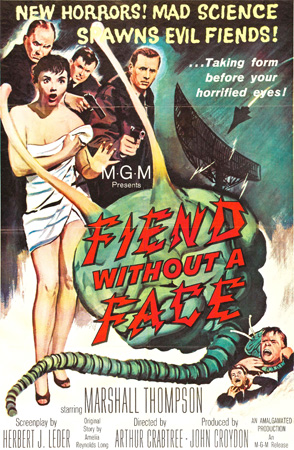
Poster - Fiend Without a Face (1958)
Now Playing: Fiend Without a Face (1958)

Pros: Creepy horror elements add just the right amount of fear and dread; Expert build-up of suspense
Cons: The materialized creatures are more ludicrous than scary; The effects at the climax look like bad claymation

In brief: At an American air base in a remote corner of Canada, the military is experimenting with atomic power-enhanced radar to better track the rascally Russians. When several locals near the base turn up dead, their brains and spinal cords sucked out of their bodies by some sort of "mental vampire," the base commander, fearing the Americans will be blamed, tasks his right hand man, Major Jeff Cummings (Marshall Thompson), with investigating the mysterious deaths. In typical American fashion, Cummings blunders in on the daughter of one of the victims (Barbara, played by Kim Parker) as she's taking a shower and gets into a fistfight with her boyfriend.

Meanwhile, the town mayor is killed by the invisible "vampire" in the comfort of his own home. Jeff finds out from Barbara that Prof. Wingate (Kynaston Reeves), an eminent scientist in the fields of cybernetics and thought control, happens to live nearby (hmmmm….). When Jeff stops by to pick the old man's brain (pun intended) about what might be going on, the scientist gets very nervous (hmmmm…..). Things really come to a head (minus a brain of course), when the town constable, who had been hunting for the fiend, breaks into an emergency town council meeting moaning and gibbering -- he's apparently had an encounter with the vampire, and it's sucked out a good portion of his brain!

Still - Prof. Wingate's flashback on his thought control experiments - Fiend Without a Face (1958)
Poorly designed thought control experiment + lightning
= mental vampires preying on innocent townspeople
As the body count mounts, Prof. Wingate finally comes clean about his unusual experiments. He had struggled to move objects and materialize his thoughts until lightning surged through his equipment, and he realized his thoughts had finally been "freed" and he had the power of telekinesis. To continue his experiments, he devised a way to tap into the base's atomic power. The result: independent, sentient creatures with the form of living brains, but invisible to the eye… and deadly. And, they're intelligent enough to muck around with the base's atomic lab, drawing on its power to create even more fiends to prey on humanity. Soon, the fiends have Jeff, Wingate, Barbara and several other military and town officials trapped in Wingate's house…

Bill Warren describes Fiend as "one of the most ghoulish, gory pictures of the '50s." [Ibid.] This one is as much horror as it is sci-fi, with its scenes of lonely, creepy woods at night, people being attacked by invisible creatures that make eerie slurping sounds, and others being turned into walking, moaning zombies from a half-baked brain-sucking job. The scene of the zombified constable breaking up the council meeting is particularly effective. As Jeff argues with the town officials over who is to blame for the mysterious deaths, an unearthly moan sounds from the adjoining corridor. The disheveled thing that was once Gibbons appears at the doorway, his blistered face half in shadow, and then he stumbles into the room, his mind clearly (and literally) gone. When I saw this scene for the first time as a kid, I almost stopped watching the movie right then. I suspect many people even today would be creeped out by it.

At the climax the creatures "materialize" into ambulatory brains with antennae and whip-like spinal cords that they use to move around like worms and strangle their victims. Many fans have found these scenes to be thrilling and inventive, and the special effects to be superior for the time. I'm perhaps in the minority, thinking that the materialized creatures and their movements look almost comical (especially when the creatures are shot -- the effect looks like bad claymation and the "slurpy" sound effects are completely over-the-top). I'm not sure what I would have done with the ending, but when the creatures become visible, all the carefully built suspense and horror goes out the window. It almost becomes a western, with the heroes trapped in a cabin by marauding raiders…

Still - Brain fiend creeping through the woods - Fiend Without a Face (1958)
"Who invited the brain creature to the picnic?"
Key effects artists: In an extensive interview with Tom Weaver, executive producer Richard Gordon related how he hired the German effects team of Flo Nordhoff and Karl-Ludwig Ruppel:
"One day early on, [producer] John Croydon and I were having lunch with them at Walton Studios, discussing the project -- this was before we had made a commitment. John was describing the story of Fiend, and all the time he was talking, Nordhoff was sitting there doodling away on little pieces of paper. We thought he was just being slightly distracted and not paying too much attention, but at the end of John's recounting of the story, Nordhoff suddenly turned over these pieces of paper and asked us to look at them. As he was listening to the story, he had been creating the Fiends in his mind and then putting them down on paper, and they were very much like the Fiends as they appear in the original picture! That of course was the clincher, and we immediately signed them." [Weaver, The Horror Hits of Richard Gordon, BearManor Media, 2011]
Key moment in free publicity: Gordon also was amused by the extreme reaction the picture got in his native England:
"What I wasn't prepared for was that, when the film was released in England and it opened by itself at the Ritz Theatre in Leicester Square, the newspapers would be so offended by what they considered the excessive gruesomeness of the picture, that they made a major issue of it in the reviews, and it got to the point where somebody brought up in Parliament the fact that the British Board of Film Censors did not seem to be fulfilling its obligations in preventing the showing of a film like Fiend, which as a 'disgrace' to the British film industry… What went through my mind was that I could never have afforded to buy that publicity, if it hadn't come my way free, and that it was the best possible thing that could happen to the picture." [Ibid. For more on the sci-fi/horror hits of Richard Gordon, see my recent post on First Man Into Space.]


Where to find it:
Available online

Amazon Instant Video

Available on DVD

Oldies.com

"Spawning Madness! Breeding Monsters!"

June 14, 2013

The Bleeding Edge of Space

Now Playing: First Man Into Space (1959)

Pros: Effective use of stock footage for a semi-documentary feel; Above average, spooky black and white photography; Simple but effective monster
Cons: Obtuse technobabble will have you scratching your head; Somewhat implausible sibling rivalry

Ever since the first telling of the Icarus story in ancient Greece, couch potatoes the world over have found a thousand and one excuses for taking it easy, settling into that easy chair and letting some other fool take risks, test boundaries, and crash and burn in the process (and don't those crashes look awesome on our high definition 46 inch flatscreens!).

As couch potatoes have gotten ever lazier and ever larger, the vicarious lives they lead through television have also changed dramatically. Where once they were thrilled by images of soldiers storming beaches under heavy fire and "right stuff" astronauts blasting into space with thousands of pounds of highly combustible fuel under their keisters, now they thrill to the sights and sounds of celebrities blowing their routines on Dancing with the Stars and American Idol contestants not quite hitting their high notes.

In spite of (or perhaps because of) the tragic space shuttle accidents, piloted space flight no longer fires the collective imagination. Except for a small, dwindling number of space geeks, circling the earth at an altitude of a couple hundred miles does nothing more than elicit yawns. And proposals for actual human space exploration that might awaken at least some of us from our slumber -- going back to the moon, visiting an asteroid, making the long, arduous journey to Mars --  sputter around in the low atmosphere of our 24 hour news cycle and then unceremoniously crash like lead balloons.

It seems like the more we fiddle with our iPhones and tweet each other about the latest reality shows and misbehaving celebrities, the less able we are to think "big" or to take risks to accomplish something important (or even bother to cheer on other risk-takers). I won't go into details here on why I think piloted space exploration is important for humanity -- please see my post on the Czech space drama Ikarie XB-1 for more thoughts on the subject.  But if we're to thrive as a species, we've got to somehow challenge ourselves beyond figuring out how to use the latest smartphones.

NASA file photo - Test pilot Bill Dana standing in front of his X-15 rocketplane
NASA X-15 pilots like Bill Dana truly had the "right stuff."
I'm old enough to remember the huge, nationwide excitement as crack pilots stuffed into tiny "tin can" capsules lifted off on thundering rockets converted from military use. We all knew that we desperately needed to get our guys up there orbiting the earth (and planting the first flag on the moon), or sure as shootin' we'd all be speaking Russian in a few short years. Everyone was glued to their fuzzy, black and white console TVs as first Alan Shepard blasted off on a Redstone rocket for his short, 15 minute suborbital flight, then, more exciting still, All-American Marine Corps pilot John Glenn became the first American to orbit the earth. Take that commies!

With all the attention on the "spam in a can" Mercury 7 astronauts, few Americans in the early '60s fully appreciated the contributions made by the fearless test pilots who first broke the sound barrier, then flew to the edge of space and beyond in their cool, dangerous rocket planes. Chuck Yeager, the decorated World War II fighter pilot and the first man to break the sound barrier, is still the best known test pilot from this period, immortalized in Tom Wolfe's 1979 book The Right Stuff.  Virtually forgotten today are the jet jockeys who fired up the engines of the coolest rocket plane ever, the North-American X-15, and took it to heights never before seen from a cockpit. To this day, the X-15, built in the late '50s and retired in the late '60s, holds the official record for the fastest speed ever attained by a manned aircraft.

Several X-15 pilots earned astronauts' wings from the U.S. Air Force for exceeding heights of 80 km (50 miles). One, Joseph Walker, twice flew higher than 100 km (62 miles), qualifying as an astronaut by international definition.  Neil Armstrong, before he joined the NASA astronaut corps and eventually became the first to walk on the moon, donned the X-15 pressure suit and logged one of the fastest flights ever-- a dizzying 6,420 km/h (3,989 mph). And there was the inevitable tragedy. Major Michael J. Adams was killed on November 15, 1967 when his craft went into a hypersonic spin and the airframe broke up at an altitude of 18 km (60,0000 ft.). (Considering the ambitious missions designed for the X-15 it's fortunate that more pilots weren't killed during the program's nearly decade-long span.)

A tense control room
Cmdr. Prescott (Marshall Thompson) and Dr. Von Essen (Carl Jaffe)
are worried that hot shot test pilot Dan Prescott (Bill Edwards)
is not following the flight plan.
First Man Into Space was released by MGM (yes, that MGM) in early 1959, several months before the first X-15 took flight, and a full two years before Yuri Gagarin became the first real man in space. First Man tells the tale of two brothers, one, a Navy commander in charge of a rocket plane program very similar to the real-life X-15 (Cmdr. Charles Prescott, played by Marshall Thompson), and the other, a glory-seeking, hot-shot test pilot who is itching to be acclaimed as the first man into space (Lt. Dan Prescott, played by Bill Edwards). The film opens with a test flight of the Y-12 rocket plane piloted by Dan Prescott. Big brother Chuck, along with space medicine specialist Dr. Von Essen (Carl Jaffe), is in the control room, sweating every tense second of the flight.

We gather that the rocket plane program is a rehearsal for the day that they shoot a man into outer space for real -- the limits of man and machine need to be tested at extreme high altitude, data gathered and analyzed, and so on. Charles and Von Essen are relieved when Dan passes what they call the "controllability barrier" (presumably the altitude at which the rocket plane becomes difficult if not impossible to control), but the flight isn't over, and there's still a lot that can go wrong.

At an altitude of almost 100 miles, Dan the man can see the curvature of the earth, and he becomes giddy. (Okay, so the first actual American in space, Alan Shepard, only flew to an altitude of 116 statute miles in his Mercury capsule, and the ‪FĂ©dĂ©ration AĂ©ronautique Internationale‬ defines the limit of space at 100 kilometers / 62 miles, but we'll set all that aside for now.) He loses control of the craft, it starts to spin out of control, and he passes out. Fortunately, the unflappable Dr. Von Essen gets the pilot's attention over the radio and talks him down. "First, control yourself," he tells Dan (which come to think of it, is pretty good advice for anyone, at any time of crisis).

Dan crashes his rocket plane in the New Mexico desert (which looks more like a quiet forest in, oh, I don't know, the English countryside maybe… more on that later...), but emerges unscathed. As the Commander investigates the crash site, he notices a sort of shiny dust on the plane wreckage, but then doesn't think anything more about it. (Uh-oh… cue the ominous music.)

Bill Edwards as test pilot Dan Prescott
Dan is positively giddy at the prospect of being
the first man into space.
Rather than getting debriefed or working with the space medicine staff or his brother to prepare for the next flight, Dan does what any self-respecting hot shot test pilot who flirts with death on a daily basis would do -- he hops in the sack with a beautiful woman. In this case, it's the sultry, exotic Tia Francesca (Marla Landi), an assistant to Dr. Von Essen in the space medicine lab. He tells Tia of the rush he got flying to the edge of space, but he wants more: "Who's going to forget the first man in space?" he asks.

Dan's straight-arrow, duty-bound brother tracks him to Tia's apartment. He is beyond outraged: "You just wrecked $10 million in equipment and I find you lolligagging around here!" (I think Dan was doing more than lolligagging, but we'll set that too aside for now.) It's hard to believe Chuck and Dan are brothers -- Chuck is all business, and Dan is 100% all-American hot dog. Later, Chuck complains to the good doctor Von Essen, "How can I make him understand that even though he's up there in space alone, he still has to obey orders?"

In spite of Chuck's reservations, the military brass select Dan for the next test flight because of all the favorable publicity generated from the previous record-setting flight. When he gets to the altitude limit set for the mission, Dan keeps going. An exasperated Chuck orders him to keep to the flight plan, but he demurs: "No sir, I'm going straight up -- first man into space!" ("Top of the world ma!!") He fires his emergency boosters and the craft rockets to an altitude of 250 miles!  In the control room, the somber Commander tells Von Essen, "he'll either hit the moon or orbit the earth for the rest of his life."

Unbeknownst to Chuck, there is a third possibility. A blizzard of meteor (?) dust hits the rocket plane. Dan separates the nose cone/cockpit from the booster, and down he goes. Back on earth, the recovery team finds the nose cone completely encrusted with a strange, silvery material. There is no sign of the fame-hungry test pilot who wanted to be the first man into space. Chuck eulogizes his brother: "Even as a kid, he was always climbing the highest tree…"

Marla Landi as space medicine assistant Tia Francesca
Tia (Marla Landi) reacts somewhat negatively to the shiny
new coat of space dust that her boyfriend is wearing.
Back at the base, the lab guys find out that the layer of space dust on the nose cone is so strong and dense that even X-rays can't penetrate it. While Chuck and Von Essen ponder the mysteries of the new substance and what might have happened to Dan's body, the police get reports of strange occurrences near the crash site. Cattle are being mutilated and drained of their blood. Inexplicably, an encrusted portion of Dan's oxygen mask and hose are found under a dead cow. Then comes the report of the horrible murder of a nurse at a nearby blood bank. The nurse's wounds are eerily similar to those found on the cattle and strange silvery flecks are found on the body. Baffled, the police call in Commander Prescott to help investigate. Little do they know that soon the horrible, tragic answer to the mystery will show up at the space medicine lab…

First Man Into Space is a taut, well-crafted B sci-fi horror thriller. It uses stock U.S. military footage to good effect, lending an air of authenticity to the test flight scenes. And the monster is simple and well done. It's all the more poignant, given that it was once a human being, and not some strange invader from space whose motivations are a complete mystery. The cattle mutilations are a nice touch as well, and prophetic, given that cattle mutilations attributed to UFOs didn't hit the headlines until the late '60s.  Marshall Thompson, an actor of limited range, is just right for the part of the stoic, by-the-book commander. And Italian beauty Marla Landi shines at the climax when she finds out what has happened to her lover (considering that she hardly knew English at the time, it's a very good performance). 

In addition to portraying the pre-crusty test pilot, actor Bill Edwards suited up as the monster
Back at the lab, Cmdr. Prescott spends a poignant moment with
what's left of his brother in an experimental pressure chamber.
Where First Man breaks down, dissipating the suspense somewhat, are the scenes between Chuck and Von Essen as they investigate the mysterious crusty space dust and try to piece together the mystery. The technobabble flies fast and furious as Von Essen first tries to explain the properties of the dust, how it actually shielded the craft (and presumably its occupant) from deadly cosmic rays, and then goes completely around the bend, speculating that some intelligent agency put the dust there as protection against cosmic radiation. (?!!??)  Even though he's an M.D. specializing in space medicine, he also seems to be an expert physicist and engineer -- a space age renaissance man.

Von Essen's dry explanations and screwy speculations serve only to confuse the poor viewer, and should have been cut back drastically (the film never follows up on the idea that the dust was put there by intelligent design). A possible explanation for the nonsensical dialog can be found in the accompanying short documentary "Making Space" on the Criterion Collection DVD. Director Robert Day, who confesses he was never a fan of the sci-fi genre, also confesses that he and the producer were constantly rewriting the script on the set. I have strong doubts that they made it better.

The Horror Hits of Richard Gordon [book], Bear Manor Media, 2011
Tom Weaver's book-length interview with Gordon
was published in 2011 by Bear Manor Media.
First Man is one of a string of B sci-fi and horror hits put together by executive producer and UK native Richard Gordon. A lifelong movie fan, Gordon emigrated with his brother Alex to the United States in the 1940s. He eventually started his own production company, Gordon Films, to distribute British and other foreign films in the states. He was very busy from the late '50s to the mid-'60s setting up low-budget productions shot in the UK and featuring big name stars like Boris Karloff, or Americans like Marshall Thompson (if you couldn't get Boris, a familiar American face like Thompson's helped sell the films in the U.S.) In 1958 alone, he introduced the world to The Haunted Strangler and Corridors of Blood (both starring Karloff), and set the Fiend Without a Face (also with Marshall Thompson) loose in U.S. theaters. [Tom Weaver, Interviews with B Science Fiction and Horror Movie Makers: Writers, Producers, Directors, Actors, Moguls and Makeup, McFarland, 1988.]

While the UK shooting locations weren't normally problematic, Gordon told Weaver that there was something of a glitch at the U.S. premiere of First Man into Space:
"The funny thing was that when we eventually delivered the picture to MGM, they turned it over to their distribution department, which of course had no idea what the background of the picture was-- they were just presented with the finished film and told to release it. Someone in the publicity department looked at it and said, 'It would be a great idea if we had the world premiere in Albuquerque, New Mexico, because that's where the film was shot.' So they staged an opening in New Mexico and it got a somewhat sarcastic reception [laughs], because the people recognized immediately it wasn't shot there!" [Ibid.]
If you're not a native New Mexican and can overlook that the southwest desert looks like a sleepy English forest, and, like me you happen to be a fan of piloted space exploration (fictional or otherwise), you might just want to take a 77 minute joyride with the First Man Into Space.


Where to find it:
Available on DVD

Oldies.com


"Can science prepare him for what no man has experienced before?"