Showing posts with label Trading cards. Show all posts

August 11, 2022

Freakish Fish People of Sci-fi #4: The Island of the Fishmen

Freakish, Frightful Fish People #4: The Island of the Fishmen (1979)

The Island of the Fishmen (1979) is like an Italian fish stew (Zuppa di Pesce) with a little bit of everything thrown into the pot: a shipwreck, sketchy prisoners, an uncharted Caribbean island, a lost underwater city, a well-meaning but mad scientist, an imperious, evil colonizer, a Voodoo queen, and the ethereally beautiful Barbara Bach for maximum sex appeal. It’s a dish that looks tasty enough at first glance, but a few too many ingredients, too many cooks (we’ll get to that later), and indifferent execution make it something less than delectable.

Lt. Claude de Ross (Claudio Cassinelli), a military physician, and a handful of prisoners manage to wash up on the shore of an uncharted island when their prison ship sinks. The group’s good luck turns sour when it becomes evident that some sort of dangerous predator is stalking them. Several of the men go missing or are butchered by the unseen thing.

De Ross and the survivors continue to explore the island, where they find evidence of Voodoo ceremonies. They encounter a beautiful woman on horseback (Amanda Marvin, played by Barbara Bach), who cruelly tells them to leave at once, that the island is no refuge for them. The men soldier on, and soon discover a stately plantation house owned by the stern and arrogant Edmond Rackham (Richard Johnson), who is hosting the beautiful Amanda and her doddering scientist father, Prof. Marvin (Joseph Cotten).

De Ross eventually gets to the bottom of the mystery: Prof. Marvin has perfected a technique to transform humans into fish-human hybrids for the “noble” purpose of allowing humanity to live in the ocean when land-based resources are exhausted. Rackham is using Marvin’s fish people for his own nefarious purposes -- having them dive to the underwater ruins of Atlantis just off the coast of the island to retrieve its priceless treasures.

Rackham uses implied threats to Amanda to keep the Prof. in line. Rackham also uses his mistress, the scary Voodoo Priestess Shakira (Beryl Cunningham) to recruit unwary natives into the ranks of the fishmen and to keep order on the island.

It looks grim for the doctor, the professor and Mary Ann Amanda, but the beautiful woman’s mysterious telepathic link to the fishmen may just save the day for the trio.

Poster - L'Isola Degli Uomini Pesce - The Island of the Fishmen (1979)

“-The fishmen are revolting! -You can say that again!”

Director Sergio Martino and the screenwriters mix a huge, heaping cup of The Island of Dr. Moreau with tablespoons of Voodoo and Atlantis mythology, and add just a dash of H.P. Lovecraft and Universal’s The Mole People for flavor. There’s even a standard-issue simmering island volcano that of course explodes right on cue at the end.

The recipe seems like a promising enough variation on H.G. Wells’ Moreau, but ultimately the ingredients don’t mesh. As noted above, much of the problem boils down to the execution, or, to belabor the metaphor, the stirring of the pot. (Note: This review is based on the New Worlds Pictures 1981 release of Island retitled Screamers. That version added a prologue sequence and cut footage from the original Italian production - more details below. To be fair, the faults listed here are at least partly due to a "re-heated" U.S. version that sacrificed story continuity for cheap, gory thrills.)

The fishmen are modern science’s version of Voodoo-created zombies -- creatures without a will of their own who perform dirty work for their masters. (This is belied, however, by their mental connection with the empathetic Amanda, which eventually leads to them turning on their hubristic and greedy master.)

Although the film cleverly aligns Western mad science and the dark arts -- Rackham utilizes both for his malevolent purposes -- it doesn’t fully exploit the Voodoo angle, and Shakira spends most of her time acting as a mere henchperson for Rackham (although certainly a beguiling one).

Richard Johnson as Rackham scowls and sneers at everyone concerned in his best Snidely Whiplash imitation. It’s a wonder he got the fishmen to do his bidding in the first place, as he seems to have never heard the adage “You catch more fish with honey than vinegar” (or something like that). Their uprising is very reminiscent of the Mole people’s revolt against the cavern-dwelling Sumerians in the 1956 Universal film (both have more than a hint of modern class warfare underlying the story).

Screenshot - The Island of the Fishmen, 1979
"I now pronounce you fish man and wife."

The Fishmen become “Screamers”

Speaking of exploitive capitalists (and I mean that in the very best sense of the term), Roger Corman’s New World Pictures picked up the distribution rights to The Island of the Fishmen, and after filming an additional prologue scene with actors Cameron Mitchell and Mel Ferrer that included gory killings to juice things up for the drive-in market, New World released it as Something Waits in the Dark.

That version was a box-office dud, so, not wanting his investment to go to waste, Corman had his protege Jim Wynorski work up a lurid trailer for yet another release, this time under the title Screamers:

“Wynorski’s first big success came when, on a $40 budget, he recut the trailer for an unsuccessful Italian-made horror film called Something Waits in the Dark (1979). Wynorski’s ‘Coming Attractions’ reel, which lured potential ticket-buyers with the promise of seeing ‘a man turned inside out,’ incorporated new footage of ‘this guy running around, covered with slime … all his veins hanging out, chasing a girl in a bikini.’ The film, retitled Screamers (1979), opened in Atlanta, Georgia, on a Friday. Early Saturday morning Corman phoned Wynorski and demanded that his new material be edited into the film itself, to appease the disappointed audiences who ‘rioted in the drive-ins last night, tore out the speakers, tried to lynch the manager…’ [Beverly Gray, Roger Corman: An Unauthorized Biography of the Godfather of Indie Filmmaking, Renaissance Books, 2000, p. 167]

Let that be a lesson: you can push fishmen and drive-in goers only so far…

August 4, 2022

Freakish Fish People of Sci-fi #3: Spawn of the Slithis

Freakish, Frightful Fish People #3: Spawn of the Slithis (1978)

This third installment of Frightful Fish People takes us to the scenic Venice area of westside Los Angeles, with its famous beach, canals, boardwalk, murals, street performers… and occasionally, radioactive humanoid-fish mutants.

The protagonist of 1978’s Spawn of the Slithis is Wayne Connors (Alan Blanchard), a terminally bored high school journalism teacher whose newshound instincts are revived by reports of animals and people in Venice’s canal district being killed and the flesh sucked off their bones (yikes!).

The amateur sleuth sneaks into the house of a murdered couple, and finds a mysterious mud-like substance at the scene. He takes samples, which he delivers to a scientist friend, Dr. John (Dennis Falt). After Dr. John analyzes the stuff, he tells Connors that it appears to be Slithis, a rare organic form of mud resulting from radioactive contamination, that can absorb the properties of any lifeform it comes into contact with. According to Dr. John, Slithis first appeared near an atomic plant in Wisconsin, but authorities suppressed the findings to avoid a panic.

More murders take place. Connors interviews one survivor, a homeless veteran, who swears he saw a huge man-like lizardy-fish creature. Later, Connors talks to yet another expert, a nuclear scientist, Erin Burick (J.C. Claire) who confirms the presence of Slithis in the Venice area due to a leak from a nearby atomic energy facility. Burick speculates that Slithis can evolve into highly complex forms... like a murdering, face-sucking fish creature. (Burick has hideous facial scarring from a presumed lab accident -- this character definitely got my attention the first time I saw the movie.)

Poster - Spawn of the Slithis, 1978

Connors tries to get the police involved, but they prefer their own cult ritual murder theory. Connors and Dr. John take it upon themselves to drain the canals at the main lock to prevent the Slithis creature from getting ready access to the town, but the murders continue in the harbor.

The intrepid duo hires a SCUBA expert (Mello Alexandria) and his boat to collect mud samples near the energy plant to prove their Slithis theory. But, evidence or not, they soon realize that the police will do nothing and that they will have to capture the creature themselves.

You’ve got to have more faith in your monster suit

Spawn of the Slithis, released just a year after Star Wars revolutionized cinematic sci-fi and turned the genre into a gold mine, is a throwback to the ‘50s era of rubber-suited, atomic age monsters.

Producer/writer/director Stephen Traxler reportedly made his retro drive-in movie in just 12 days for a paltry $100K by spending long days shooting on location around Venice, Marina del Rey and Santa Monica. (Traxler’s only other directorial credit is a failed TV pilot/TV movie, Sam Churchill: Search for a Homeless Man, shot in Santa Barbara and broadcast in 1999.)

While that area of Southern California is scenic and funky and deserving of some cinematic attention, the film is slowed down considerably by lingering shots of local landmarks (including a whole scene devoted to -- wait for it -- a turtle race held at a local bar).

It also doesn’t help that some of the expository dialog is repetitive and long-winded -- various characters, including two scientists, go on and on about the origins and properties of Slithis, while the actual product of the gunk, the flesh-sucking creature, is given relatively little screen time.

To add insult to injury, most of the meager time the creature does get is so dark it’s hard to make him out. The rare close-ups and medium shots of the thing reveal a suit that’s not half bad. It’s not as if this is some Val Lewton-esque exercise in stimulating the audience’s imagination and fear of things in the shadows. Drive-in monsters should be seen and heard. But it seems as if Traxler didn’t have enough faith in his monster to put it out there unabashedly.

Screenshot - climax of Spawn of the Slithis, 1978
There he is! Lookin' good Slithis!

Traxler does try to mix things up with “fish-eye” POV shots of the creature stalking the streets and canals of Venice. And he provides a pretty good nighttime climax of the fish-man attacking the monster-hunters on their boat, which echoes classic scenes from Creature from the Black Lagoon and Jaws.

And then there’s this line, voiced by the boat’s captain (Alexandria) in his best Quint imitation: "Remember, this thing is just a fish, and I’m one hell of a fisherman.”


July 14, 2022

Freakish Fish People of Sci-fi #2: The Monster of Piedras Blancas

Freakish, Frightful Fish People #2: The Monster of Piedras Blancas (1959)

Much like the first entry in the series, The She-Creature, the Monster of Piedras Blancas is a prehistoric humanoid reptilian amphibian (or amphibious reptilian, or whatever) that likes to hang out along a section of the California coast and kill any landlubbers who are unfortunate enough to cross its path. (As I noted in the first installment, I am using the term “fish people” very liberally to include not only humanoid fish monsters, but ambulatory amphibians, crustaceans, cephalopods and other assorted mutant sea creatures.)

Although I didn’t know it when I first saw the movie, Piedras Blancas is a real place. It’s located in the central part of the beautiful California coast, just up the road from San Simeon and Hearst Castle off of Highway 1. The area is known for its historic lighthouse and elephant seal watching. (However, the movie was actually shot in Cayucos, CA and at the Point Conception lighthouse in Lompoc.)

Imagined Google Maps (TM) review of Piedras Blancas

The Monster of Piedras Blancas
is a cautionary tale about the dangers of people feeding wildlife. The film opens in a very Creature-from-the-Black-Lagoon-like way with a wicked-looking claw suddenly appearing from behind a rock and grabbing a big metal food bowl. Later, we find out that the grizzled lighthouse keeper Sturges (John Harmon) has been looking after his monster friend and feeding it ever since he discovered the thing hiding in a cave near the beach.

Sturges, probably driven batty by his lonely job, started feeding the creature fish, then gradually added meat scraps from the local store to its diet. So now the creature has decided it likes people -- for meals. And it has a distressing habit of playing with its food by decapitating it first.

When townspeople start turning up dead, the best the old coot can do is to warn his daughter Lucy (Jeanne Carmen) to stay away from the caves near the beach. Fortunately, Lucy’s boyfriend Fred (Don Sullivan), the town constable Matson (Forrest Lewis) and the town doctor Jorgenson (Les Tremayne) seem to possess all their marbles, and eventually they form a posse to hunt the creature down -- but not before it’s taken a considerable bite out of the town’s population.

The Hand-me-down Monster

Jack Kevan, who produced the film, was a make-up and special effects artist who helped create some of Universal Studios’ most iconic monsters, including the Creature from the Black Lagoon (1954), the Xenomorph from It Came from Outer Space (1953), and Monster on the Campus (1958).

With his Universal Studios connection, he supplied the Piedras Blancas monster with the claws from one of The Mole People (1956), and feet from the Metaluna Mutant of This Island Earth (1955). (For more on the making of the Monster, see my post on “How to a Monster: FFB’s Low Budget Creature Effects Awards.") 

"The Fiend that walks lovers' beach with the feet of the Metaluna Mutant!"

The monster is credited with being a living-fossil offshoot of the Diplovertebron family of prehistoric amphibians dating back 300 million years. In his review of the film, sci-fi historian Bill Warren concedes that the monster is scary for a B movie, but lacks the logic and elegance of Universal’s exquisitely designed Creature (well, duh!):

[T]he Monster of Piedras Blancas seems to be designed solely to be scary. It follows no obvious logic, and while individually its various characteristics may seem plausible, and though it’s well designed in that all its body parts seem to hang together (although it has the Mutant’s fee and the hands of the Mole People), it completely misses on the basis of amphibious monster logic. … The head is preposterous. It has inexplicable stubby little horns, huge flared nostrils (in a sea creature?), and a mouth which, though full of sharp teeth and inclined to drool, seems to be incapable of being opened: there are two extrusions from the upper lip which are fastened to the lower. It’s a monster all right, and certainly ugly -- but it does not make sense. [Bill Warren, Keep Watching the Skies, Vol. II, McFarland, 1986, p. 320]

While there's always a place for logic and consistency, Warren seems to miss the point here. Nightmares are inherently illogical, and although this unpretentious B movie can’t hold even a tiny cupcake-sized candle to Universal’s Creature, it was nonetheless effective enough to cause a sleepless night or two for some Monster Kids back in the day (including yours truly). 


July 7, 2022

Freakish, Frightful Fish People of Sci-fi B-movies, Part One: The She-Creature

Last year I created a series of posts on Amazing Animal People of Sci-fi, Fantasy & Horror. For the first post on Lota, the panther woman from the Island of Lost Souls, I observed that

“[O]ur myths and folklore are full of awe and wonder at the animal kingdom. From the animal-headed gods of ancient Egypt, to Native American animal shapeshifters, to werewolves and other were-beasts of European folklore, we have long been fascinated with the idea of taking on animal attributes and becoming something more than mere human.”

The series did feature one representative from the reptile kingdom, The Alligator People (1959), but I decided to save examples from the surprisingly robust B-movie fish/amphibian people category for another day (and that day is today).

Of course, the greatest anthropomorphic amphibian of them all is the Creature from the Black Lagoon. In the movie, the Creature is the last, lonely remnant of some evolutionary dead-end. For Universal Studios, he was an evolutionary bridge from the aging Gothic horrors of Frankenstein, Dracula and the Wolf Man to the space aliens and radioactive monsters of the Atomic Age.

More so than other human-animal hybrids, the Gillman and his kind speak to humankind’s primordial origins. According to one popular meme, at some point in our deep, dark evolutionary past we were sea creatures that sprouted legs and learned to crawl on land.

The Creature finds that he is not alone in the Black Lagoon.
"Julie! Grandpa! What are you doing here?!"

So here we are countless millennia later, sprouting so much extra body fat that we’re ready to start crawling again, if we can even manage that.

Who knows? In some parallel universe, a prehistoric butterfly may have fluttered its wings, causing an Alamosaurus to sneeze, which altered the flight of a flock of Pterosaurs, which affected wind currents just enough to generate a superstorm, which wiped out a struggling group of mammals that otherwise would have successfully competed with land-crawling fish, which evolved into 21st century Gill people, who watch horror movies about hairy, smelly mammals that can **GASP** walk around on two legs.

But thankfully, we live in a universe where hairy, smelly apex mammals make cheesily entertaining movies about fish-human hybrids. Here then is the first exhibit in Films From Beyond’s aquarium of the damned.

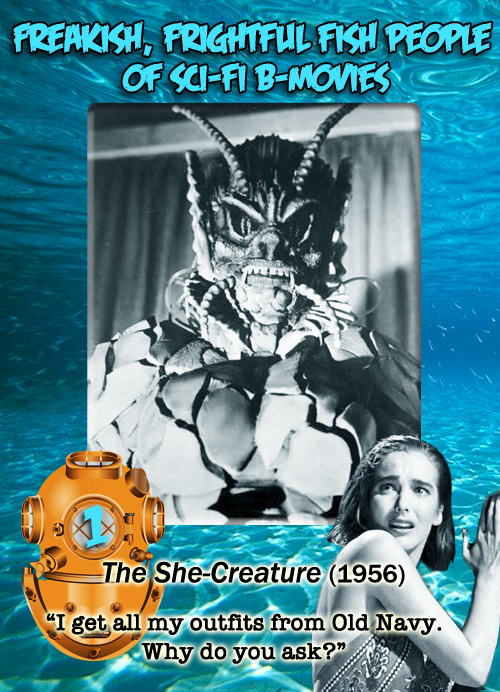
Freakish, Frightful Fish People #1: The She-Creature (1956)

Speaking of prehistoric amphibians that have the ability to lumber around on land and take out clueless humans, the She-Creature is perhaps second only to her cousin from the Black Lagoon.

The She-Creature’s cracked premise was inspired by the story of Bridey Murphy, which was all the rage at the time. Under hypnosis, housewife Virginia Tighe recounted all sorts of details about her past life as Murphy, an Irishwoman who lived in the first half of the 19th century. The story was serialized in 1954, and a best-selling book and movie came out in 1956, generating a huge wave of interest in reincarnation. 

Not content to just exploit the reincarnation angle, American International Pictures decided to make it drive-in friendly by tacking on a monster.

The sinister hypnotist Dr. Lombardi (Chester Morris) has a young woman, Andrea (Marla English), under his thumb, and uses her to prove his theories on reincarnation.

Lombardi conducts public sessions in which Andrea is able to summon not only the memories but the actual spirit of Elizabeth, a 17th century English woman. Lombardi further wows audiences with telekinetic tricks and dire prophecies of doom.

Lombardi and Andrea become a sensation, and the hypnotist publishes a best-selling book that makes him rich. But Lombardi, not satisfied with mere wealth and fame, has a dark secret. Under deep hypnosis, Andrea can cause her earliest incarnation, the fearsome, primordial She-Creature, to physically manifest itself. Lombardi uses his control of Andrea and her prehistoric self to kill his rivals, but typically for B-movie madmen, his scheme backfires.  

The She-Creature gets cosmetic surgery

The She-Creature was the product of the fertile imagination of monster-maker extraordinaire Paul Blaisdell, who was also responsible for some of the more memorable creatures of ‘50s sci-fi: Marty the Mutant from Day the World Ended (1955), Beulah the Venusian vegetable monster from It Challenged the World (1956), and It! The Terror from Beyond Space (1958), among others. (For more on Paul Blaisdell on this site, click here.)

The She-Creature is Blaisdell’s most iconic creation, and a gift to B sci-fi movies that kept giving. The suit, or at least parts of it, was used in several more movies and TV specials, including Voodoo Woman (1957) and Ghost of Dragstrip Hollow (1959).

Half-sheet poster, The She-Creature, 1956

Blaisdell was a freelancer who worked up his creations for next-to-nothing on next-to-nothing budgeted movies. His wild imagination and meticulousness made up for lack of big bucks.

In his book Paul Blaisdell: Monster Maker, Randy Palmer devotes several pages to the painstaking work that went into creating the She-Creature. Under one photograph of the suit, he sums her up nicely:

[The She-Creature] was built up from over 70 lbs. of foam rubber and latex. The bony protuberances on her elbows, claws, knees, and heels were carved out of white pine. The ‘lunch hooks’ in the creature’s abdomen were also made from pine. Using his stomach muscles, Blaisdell could make the lunch hooks open and close, but director Edward L. Cahn never utilized the effect in the movie. [Randy Palmer, Paul Blaisdell: Monster Maker, McFarland, 1997, p.86]

[Note: At this point I need to fess up for all the sticklers out there. The She-Creature is not a fish person per se. In fact, she has breasts (see below), which technically makes her a sea mammal. However, she is so iconic, I couldn’t in good conscience leave her out of this series. So, I am playing fast and loose with the term “fish people” to include sea mammals, amphibians, crustaceans and other assorted ambulatory, bipedal sea creatures that aren’t mutated fish. Just so you know.]

The director couldn’t be bothered with utilizing the creature’s horrific abdominal hooks, but he did want to make sure movie-goers knew exactly what her gender was:

“When [director] Eddie Cahn got a good look at Paul’s first female monster, he decreed that the creature wasn’t top heavy enough. ‘She’s gotta have bigger boobs,’ Cahn decided. Paul transported the costume back to the workshop for an evening of alterations. When he returned to the set the following day, Cahn took one look at Cuddles’ new set of double-D knockers and exclaimed, ‘Holy Christ! Well, at least now you can tell it’s definitely a woman.’” [Palmer, p. 91]


April 24, 2021

Amazing Animal People #7: The Bat People

Amazing Animal People #7, The Bat People, 1974

On their honeymoon somewhere in the American southwest, Dr. John Beck (Stewart Moss) and his wife Cathy (Marianne McAndrew) decide to take a tour of some caverns before hitting the ski slopes. Cathy suggests that they ditch the tour group and find an out-of-the-way place for some impromptu lovemaking. As she looks for a good spot she promptly falls down a crevice. John scrambles down to rescue her, but climbing back out is a problem. Before help arrives, John is bitten on the forehead by a rogue bat.

Later, as they’re taking a gondola up to the ski run, John has an eye-rolling seizure. Cathy is worried, and even though the incubation period for rabies is a minimum of several weeks, she insists John get treated at once. At the hospital, John has an even more violent reaction to the rabies shot, and is kept at the hospital for overnight observation.

John is not only suffering from severe seizures, but he’s also having terrible nightmares of shrieking bats, and of stalking and attacking people in the dead of night. Sure enough, wherever he goes, he seems to leave a trail of bodies in his wake: first, a night nurse at the hospital whose throat is cut open, then an unfortunate girl living in a trailer park, and finally a homeless man living out in the desert.

Sleazy police sergeant Ward (Michael Pataki) is suspicious of Beck, having found his patient ID bracelet next to the nurse’s body, and begins shadowing the tortured doctor. But Ward seems as interested in hitting on Cathy as he is in solving the string of homicides.

Even as the evidence is stacking up against her husband, Cathy wants to believe that John is just having severe hallucinations as a result of the rabies treatment. Will her love be enough to prevent John from joining the ranks of The Bat People?

Funanimal fact: The Bat People was special effects wizard Stan Winston’s first makeup credit for a feature film (his very first credit was for the TV movie Gargoyles, 1972). He would later go on to do creature effects and makeup for such sci-fi classics as The Terminator (1984), Aliens (1986), Predator (1987), Jurassic Park (1993), Galaxy Quest (1999) and Iron Man (2008). Along the way, he won 4 Oscars in the categories of Best Visual Effects and Best Makeup. He is just the second special effects person to earn a star on the Hollywood Walk of Stars.

Winston is quoted as saying, “I don’t do special effects. I do characters. I do creatures.”

Publicity photo - Stan Winston with some of his creations
Stan Winston (1946 - 2008)


Lobby card - It Lives by Night aka The Bat People, 1974
"Go back to sleep dear, it was only a bat dream."

Animal Crack-up (click on the text to see the punchline):


Bat silhouette
Don't miss these other Amazing Animal People:
Lota from Island of Lost Souls | Paula Dupree, Captive Wild Woman | The Mole People | Leonora the Cat Girl | The Alligator People | The Vulture

April 13, 2021

Amazing Animal People #6: The Vulture

Amazing Animal People trading card #6, The Vulture, 1967

On a dark and stormy night in a remote village in Cornwall, a woman decides to take a shortcut home through a church cemetery. To her horror, something claws its way out of a nearby grave and takes flight on huge wings. Later at the hospital, the woman, whose hair has turned completely white, describes the thing as having the body of a huge bird, grasping, human hands and a horrible human head.

The police discover that the coffin at the gravesite is empty. Local legend had it that the person buried there, Francis Real, had been accused of sorcery by the patriarch of the area’s most prominent family, the Strouds, and was buried alive along with a strange vulture-like pet and a chest of gold coins. Legend also had it that before dying, Real had vowed to rise again and kill off every remaining Stroud descendent.

American nuclear scientist Dr. Eric Lutens (Robert Hutton) and his wife Trudy (Diane Clare) are visiting Trudy’s uncle, Brian Stroud (Broderick Crawford) at his large estate. The police think graverobbers are to blame for the incident at the graveyard, but when Lutens hears the hospitalized woman’s story first hand, he’s not so sure.

The absence of footprints at the gravesite, and a strange feather found there, seem to confirm the woman’s story. Later, a mutilated sheep’s carcass is found high up on a cliff ledge, as if a huge bird of prey had carried it there. Lutens interviews a local scholar and antiquarian, Prof. Hans Koniglich (Akim Tamiroff), who confirms the details of the legend and agrees that there may be an extraordinary explanation for what’s happening.

Will Lutens solve the mystery of The Vulture before the curse claims the lives of the Strouds, including his beloved Trudy?

Funamimal Fact: American actor Robert Hutton was offered the lead in The Vulture while he was in London editing a film he had shot in Lisbon, Portugal. He recalled wanting very much to work with veteran Akim Tamiroff and Broderick Crawford, who was a longtime friend. But on the set, Crawford was not above messing with him:

“In the movie Brod[erick] had a cane with a wolf’s head on it, very highly polished. And I remember I had a long speech by a fireplace and he had to just sit there and listen to me go on and on. During rehearsal he played with that wolf’s head and twisted it around and made it reflect the light. Stealing the scene. And I thought, ‘Now, that’s not right, not while I’m talking -- I’ve got a long speech here!’ So just before we got to the actual take, I said, ‘Brod, are you going to play with that wolf’s head like you did in rehearsal?’ And he said [laughs], ‘No, I was just trying you out.’ He was a wonderful guy." [Interview in Science Fiction Stars and Horror Heroes, Tom Weaver, McFarland, 1991]


Lobby card - The Vulture, 1967
"So, how long have you been working here?"

Animal Crack-up (click on the text to see the punchline):

Why are vultures reluctant to fly on commercial airliners?


Don't miss these other Amazing Animal People:

Lota from Island of Lost Souls | Paula Dupree, Captive Wild Woman | The Mole People | Leonora the Cat Girl | The Alligator People

March 25, 2021

Amazing Animal People #5: The Alligator People

Amazing Animal People trading card #5: Paul Webster, The Alligator People, 1959

Under treatment for amnesia, Jane Marvin (Beverly Garland) is administered sodium pentothal to help her recover her memories. In a hypnotic state, Jane recalls that her name is Joyce Hatten, and while working as an Army nurse, she had fallen in love with Paul Webster (Richard Crane), an officer recovering from injuries sustained in an air crash.

After being discharged, Joyce and Paul were married. Traveling by train on their honeymoon, Paul received a telegram that visibly upset him. At the next stop, Paul got off the train and promptly disappeared. Distraught, Joyce talked to the police, the Army and Paul’s friends to no avail. Finally she tracked down an old address from her husband’s university records.

After arriving in Paul’s hometown in the heart of Louisiana’s bayou country, Joyce found her long lost husband, but also learned a terrifying secret. Paul had been far more severely injured in the crash than he had let on. He had been made whole again with an experimental treatment to regenerate limbs using reptilian hormones, but there was a catch -- after a while, the patients began to take on the characteristics and features of reptiles.

Discovering that her handsome husband had tragically become one of The Alligator People led to Joyce’s amnesia.

Funanimal Fact: By this point in her career, Garland was used to encountering all kinds of monsters and beasts. For Roger Corman she battled a Venusian vegetable creature (It Conquered the World, 1956) and a space vampire (Not of This Earth, 1957). In The Alligator People, Beverly worked with real ‘gators:

One scene required Beverly to walk through a swamp infested with alligators. The swamp was faked but the gators were real. Incredibly, she wasn’t bothered about doing the scene. "I have worked with so many snakes and animals of all sorts, that alligators just don’t bother me. I worked with this incredible boa constrictor when I did Curucu, Beast of the Amazon, which was 20 feet long and didn’t bother me. Alligators, lions… I can work with them very well. They’re just another actor." [Deborah Del Vecchio, Beverly Garland: Her Life and Career, McFarland, 2013, pp. 64-65]


Richard Crane (?) and Beverly Garland in The Alligator People, 1959
"Honey, did you renew the supplemental dental insurance? I just got
slammed with a huge bill at the dentist's!"

Animal Crack-up (click on the text to see the punchline):

What do you call an alligator that always starts fights?

Alligator silhouette

Don't miss these other Amazing Animal People:
Lota from Island of Lost Souls | Paula Dupree, Captive Wild Woman | The Mole People | Leonora the Cat Girl

March 13, 2021

Amazing Animal People #4: Cat Girl

Amazing Animal People trading card #4: Leonora, Cat Girl, 1957

Beautiful Leonora (Barbara Shelley), recently married to a dissolute playboy with a wandering eye, is summoned by her weird old uncle (Ernest Milton) to return to the ancestral home to discuss her inheritance. Along with the dark old house, the uncle informs her that she will also be inheriting the centuries-old Brandt family curse: to be forever connected with the soul of a killer cat, lusting for blood when the moon is full.

The uncle, who keeps a leopard caged up in his study, tells Leonora that the big cat is his other self. The old man frees himself from the curse and passes it on to his niece by willing the leopard to kill him. When Leonora starts to believe that the curse is real, she turns to an old childhood friend, psychiatrist Brian Marlowe (Robert Ayres), for help. But will he be able to convince her she is not a Cat Girl before it’s too late?

Funanimal Fact: Barabara Shelley, who starred in such classic horror and sci-fi films as Village of the Damned, The Gorgon, and Dracula: Prince of Darkness, made yet another cat-themed horror film in the early ‘60s.

In The Shadow of the Cat (1961), Shelley plays Beth Venable, the niece of a wealthy woman who has recently died under suspicious circumstances. When she is invited by her uncle to come stay at the estate, she gets caught up in a dark conspiracy -- which she unravels with the help of her aunt’s loyal tabby cat.


Still - Barbara Shelley and Paddy Webster in Cat Girl, 1957
Unfortunately, Leonora misunderstood the meaning of "I've got your back."

Animal Crack-up (click on the text to see the punchline):

What's a cat's favorite cereal?

Don't miss these other amazing animal people

Don't miss these other Amazing Animal People:
Lota from Island of Lost Souls | Paula Dupree, Captive Wild Woman | The Mole People

March 2, 2021

Amazing Animal People #3: The Mole People

Amazing Animal People trading card #3: The Mole People, 1956

The mutant humanoid underground dwellers known as The Mole People are slaves to a lost civilization of Sumerian albinos living in caverns beneath a remote mountain in Asia. They do the heavy manual labor for the effete Sumerians, including gathering the main food staple, mushrooms. Even though they are crucial to keeping the place running, the poor brutes are whipped, abused and exploited at every turn by the humans.

When a team of archaeologists discovers the hidden civilization and have to battle for their lives to keep from being sacrificed to a Sumerian god, the cunning Mole People seize the opportunity to rebel against their oppressive masters.

Funanimal Fact: One of the stars of The Mole People, John Agar, once told an interviewer that he was not impressed with the film’s script:

“Yeah, I remember too that there was some silly dialogue in The Mole People, and I went to [producer] Bill Alland and told him, ‘Bill, people don’t say things like this.’ He said something to the effect that he paid a guy a lot of money to write that dialogue, and I said, ‘Well, you got cheated!’”

He also revealed how the effect of men being dragged underground by the mole people was achieved:

“They put a rubber mat down over a hole in the floor; the mat had an X-shaped slit in it. They covered it with some kind of light material -- it could have been styrofoam -- that was supposed to be earth or gravel. Even when someone was being pulled down through from below, the earth was held up -- a lot of it could not fall through at once. The remaining earth would then cover up where they went through.” [Tom Weaver, Interviews with B Science Fiction and Horror Movie Makers, McFarland, 1988, p. 8]


Still from The Mole People, 1956
"What's the matter Bob, you're as white as a ghost!"

Animal Crack-up (click on the text to see the punchline):

How do you get a mole to stop digging?


Don't miss these other Amazing Animal People!

Don't miss these other Amazing Animal People:
Lota from Island of Lost Souls | Paula Dupree, Captive Wild Woman

February 27, 2021

Amazing Animal People #2: Captive Wild Woman

Amazing Animal People trading card #2: Paula Dupree, Captive Wild Woman, 1943

Mad endocrinologist Dr. Sigmund Walters (John Carradine) has been experimenting with transmuting animals into higher orders of species with glandular transplants. When he decides that he needs to experiment on larger animals, he arranges to have Cheela, a gentle gorilla, stolen from a local circus.

Walters is convinced that in order to transform Cheela into a human with true human emotions, a brain transplant is also needed. He sacrifices his insubordinate female lab assistant (Fay Helm) for the purpose, and voila!, sultry Paula Dupree (Acquanetta) is born.

The mad doctor brazenly introduces his new creation to the circus' animal trainer, Fred Mason (Milburn Stone), who originally captured Paula in her gorilla form. Paula immediately falls for Fred, even saving his life when a circus lion gets out of control. But when Paula finds out Fred has a beautiful fiancée (Evelyn Ankers), jealousy causes her to revert to her animal nature.

Funanimal Fact: Although Acquanetta (born Mildred Davenport in 1921) had been in a couple of other movies previously, Universal still decided to “introduce” her as Paula Dupree, “A New Sensation in Savagery,” in its marketing campaign. Captive Wild Woman was the first of a series of three films featuring the character -- two mediocre follow-ups, Jungle Woman (1944) and The Jungle Captive (1945) ran the franchise into the ground.

Acquanetta didn’t have a single line of dialog in Captive Wild Woman. Nonetheless, she found the experience exhilarating and exhausting:

“There was no preparation on my part, but I sat sometimes for two and a half hours being made up by a makeup artist. I think I had more emotional feeling, being made up for that, than anything I ever did, because it was exhausting. Edward Dmytryk [the director] and I had great rapport -- we dated briefly. I thought he was tremendous. Eddie gave me more freedom, I think, than other directors. I’ve always felt that I was never ‘me’ in movies -- do you know there was never a film where I was allowed to smile?” [Tom Weaver, Michael Brunas and John Brunas, Universal Horrors, The Studio’s Classic Films, 1931-1946, 2nd Ed., McFarland, 2007, p. 343]


John Carradine and Acquanetta in Captive Wild Woman, 1943
"That'll be two bits for the haircut and the shave, Miss Dupree."

Animal Crack-up (click on the text to see the punchline):

Why don't gorillas play poker?

Don't miss these other Amazing Animal People

Don't miss the first installment of the Amazing Animal People:
Lota from the Island of Lost Souls (1932)
and the full review of Captive Wild Woman right here on this site!

February 23, 2021

Amazing Animal People of Sci-Fi, Fantasy and Horror #1: Lota from the Island of Lost Souls

For millennia, human beings have been alternately in awe of and frightened by wild animals. Without our clever brains, we frail, awkward, slow, thin-skinned humans would have been slashed, skewered, filleted, gnoshed on and generally driven to extinction by animal competitors thousands of years ago.

Even though humanity has “won” the competition many times over (causing the extinction of untold species in the process), our myths and folklore are full of awe and wonder at the animal kingdom. From the animal-headed gods of ancient Egypt, to Native American animal shapeshifters, to werewolves and other were-beasts of European folklore, we have long been fascinated with the idea of taking on animal attributes and becoming something more than mere human.

Masked villagers, The Wicker Man (1973)
"A fish, a hare and a goat walk into a bar..."

Of course, modern movie myth-makers have been all-too happy to feed this fascination. From the early days of the silents to the present day, movies have featured all kinds of human-animal hybrids: werewolves, catwomen, apemen, birdmen, minotaurs, bat people and even alligator people.

It’s to these terrifying anthropomorphic animals (or if you prefer, animalistic anthropoids), that I dedicate this third set of virtual monster trading cards, The Amazing Animal People of Sci-fi, Fantasy and Horror.

Every movie decade from the 1930s to the 1970s has at least one representative captured from the celluloid jungle. Get in touch with your inner animal and “collect” them all!

Amazing Animal People trading card #1: Lota from Island of Lost Souls, 1932

Derived from a panther, the exotically beautiful Lota (Kathleen Burke) is Doctor Moreau’s (Charles Laughton) greatest, most “human” creation. When shipwrecked sailor Edward Parker (Richard Arlen) washes up on Moreau’s Island of Lost Souls, the mad doctor seizes the opportunity for the ultimate experiment -- to see if Lota can fall in love.

Funanimal Fact: Prior to its release, Island of Lost Souls was kicked around by industry and government censors. 14 states in the U.S. rejected it for exhibition based on Moreau’s likening himself to God, and for its references to evolution as a scientific fact. In the U.K. it was rejected three separate times (the last time in 1957), mostly for its depictions of cruelty to animals.

Still from Island of Lost Souls, 1932
"Hi, I'm Darryl, and this is my other brother Darryl."
 

Animal Crack-up (click on the text to see the punchline):


October 27, 2020

Heinous Henchmen of Classic Horror #7

In the mid-19th century, cadavers for medical research and teaching are hard to come by. Dr. Wolfe "Toddy" MacFarlane (Henry Daniell; no relation to Todd MacFarlane), is a respected surgeon who has taken to teaching at a medical college in his advanced middle age. 

When a distraught mother approaches MacFarlane as a last resort to help her crippled young daughter, he at first refuses to help, telling her that if he conducted surgeries for everyone who came to him, he would have no time for teaching. 

Over drinks at a local tavern, MacFarlane's medical student assistant, Fettes (Russell Wade), and his supplier of cadavers, cabman John Gray (Boris Karloff) manage to get the doctor to change his mind, as the poor girl's condition will only worsen if she doesn't have an operation. Fettes is perplexed by the relationship between the esteemed doctor and the lowly cabman, with Gray being extremely familiar with the uptight MacFarlane and contemptuously calling him by the nickname Toddy.

The doctor needs a fresh cadaver to prepare for the girl's complex operation, and Gray is called in to supply one ASAP. MacFarlane will once more have to look the other way as Gray The Body Snatcher employs his extremely dubious methods for securing bodies.

Boris Karloff, Bela Lugosi and Henry Daniell in The Body Snatcher (1945)
MacFarlane: "Gray, I must be rid of you, you've become a cancer, a malignant,
evil cancer rotting my mind." 
Gray: "You've made a disease of me, eh Toddy?"


Boris Karloff as Cabman John Gray in The Body Snatcher, 1945


PERFORMANCE EVALUATION
DELIVERY MAN

Name:  John Gray           Date:   1945       

Supervisor:  Dr. Wolfe MacFarlane              

Category Unsatisfactory Satisfactory Excellent Comment
Work Productivity

X Gray and I go back a long way, and in all that time the employee has delivered dozens, if not hundreds, of bodies.
Work Quality

X The cadavers Gray delivers are invariably fresh and very suitable for teaching and research purposes.
Communication/
Work Relationships
X

I do wish Gray would stop calling me by that infernal nickname "Toddy."
Initiative
X
Is there such a thing as too much initiative? Gray should not be getting specimens from the "pre-deceased."
Dependability

XEvery time I turn around, Gray is there, pulling up to the delivery door with a fresh body, or frequenting my favorite tavern. He's nothing if not dependable.

Summary: I can live with the way Gray obtains the cadavers, but I can't stand it when he calls me Toddy in front of my colleagues and students.


Menacing shadow (Nosferatu)
Don't miss these other great henchmen!
Fritz (Frankenstein, 1931) | Morgan (The Old Dark House, 1932) | Sandor (Dracula's Daughter, 1936) | Jake (The Human Monster, 1939) | Ygor (Son of Frankenstein, 1939) | The Creeper (House of Horrors, 1946)

October 21, 2020

Heinous Henchmen of Classic Horror #6

Struggling avantgarde sculptor Marcel De Lange (Martin Kosleck) is so poor, he can't even afford food for his cat. However, he is cheered by the prospect of selling a major sculpture to a wealthy collector. 

When a pompous art critic (Alan Napier) sabotages the sale by trashing the piece and the artist in front of the prospective buyer, De Lange succumbs to despair. He wanders over to the waterfront with the intent of throwing himself in the river, but stops when he sees a figure trying to pull himself out of the water.

De Lange helps the water-logged man onto dry land and takes him back to his studio. The man has a face that even a mother would be hard-pressed to love, but to the sculptor, he is the perfect embodiment of a Neanderthal living in the present. 

It turns out his new friend is the Creeper (Rondo Hatton), a serial killer who specializes in snapping the spines of his victims. Conveniently, the police think the Creeper is dead. De Lange now has inspiration for a sculpture that he is sure will be his masterpiece, as well as an amigo who is so grateful, he will do anything for De Lange -- including eliminating the artist's harshest critics. Soon, the creepy studio will turn into a House of Horrors.

Rondo Hatton and Martin Kosleck in House of Horrors (1946)
"Ours is a very fortunate alliance, my friend."


Rondo Hatton as the Creeper in House of Horrors (1946)


PERFORMANCE EVALUATION
ARTIST'S MODEL/ASSISTANT

Name:  The Creeper           Date:   1946       

Supervisor:  Marcel De Lange              

Category Unsatisfactory Satisfactory Excellent Comment
Work Productivity

X As a modern Neanderthal, the Creeper is the inspiration for my greatest sculpture, and is also very handy in dealing with my critics.
Work Quality

X The employee has the utmost patience sitting for me for hours at a time. As a handyman, he has spine-snapping down to a science -- one quick snap and he's out of there.
Communication/
Work Relationships


X The Creeper is a man of few words, but a very good listener -- almost as good as my cat.
Initiative

X The employee makes good use of shadows and dark alleyways, and gets the job done cleanly and quietly.
Dependability

XThe Creeper will do anything for me. He has already dispatched two of my worst critics, and I expect him to be just as efficient with that meddlesome reporter Joan Medford.

Summary: Before the Creeper came into my life, I felt put upon. I was haunted constantly by the feeling that I was persecuted, helpless to fight back. But now I have a feeling of power... limitless power. No one shall stand in my way. Soon every critic will recognize my greatness.


Menacing shadow (Nosferatu)
Don't miss these other great henchmen!
Fritz (Frankenstein, 1931) | Morgan (The Old Dark House, 1932) | Sandor (Dracula's Daughter, 1936) | Jake (The Human Monster, 1939) | Ygor (Son of Frankenstein, 1939)