
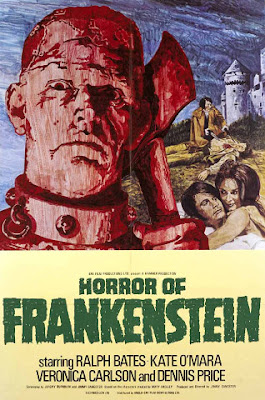
Pros: A couple of the supporting characters are lively; the black humor works well for the most part
Cons: Slow and talky for much of the running time; the monster is a disappointment
A long, long time ago, when I was a snot-nosed kid growing up in America’s Heartland, I lived in monster kid paradise. The local TV stations broadcast not one but two (!!) creature features on successive nights. On Fridays, I’d get into my pajamas and plant myself in front of the TV to watch sci-fi epics from the ‘50s and ‘60s, and then on Saturday nights fire up the old boobtube again to watch Gravesend Manor’s Malcolm the Butler and his fellow cracked cast members introduce the Universal monsters in all their black and white glory.
That lasted only a few years, but as I transitioned into awkward adolescence, I discovered something new and exciting… Girls, yes, but as a clueless pencil-neck geek I was in no position to do anything about that at the time… Rather, it was Hammer Films’ bloody, technicolor re-imaginings of the Universal monsters (not to mention the exposed skin of Hammer's female protagonists) that occupied much of my still developing brain.
The Hammer horrors, which got more and more “adult” as time went on, were a sort of pop culture rite of passage for a secular nerd such as myself. I remember sitting in a darkened theater for a matinee of Dracula: Prince of Darkness, watching a victim being hung upside down like a side of beef and bled dry over the ashes of the sinister count. Who knew you could bring back a vampire that way?
Like any reasonably obsessed film nerd, once I’d gone through Hammer’s Horrors, Curses and Evils, I wanted to see what else they had to offer. I started exploring the studio's sci-fi (the Quatermass movies, X the Unknown, etc.), thrillers (Scream of Fear, Paranoiac, The Maniac, etc.) and even swashbucklers (see my review of Night Creatures elsewhere on this site).
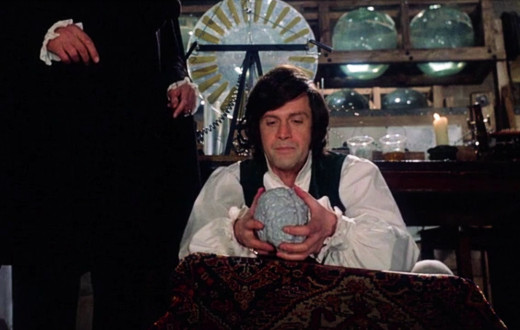 |
| This is your brain after bingeing on Hammer horror films. |
While I was wandering down those genre byways, I was keeping an eye out for any of the horror films, especially the late Hammers of the early ‘70s, that I had somehow missed. Over the years I checked off such titles as Twins of Evil and Dr. Jekyll and Sister Hyde that were rarely shown on TV or were slow to crack the U.S. home video market.
In spite of my nerdish zeal to see as much of Hammer’s catalog as possible, one film -- and one of their horror films at that -- remained unseen. And it wasn’t as if it was hard to find.
For years, Horror of Frankenstein sat there, fat and happy, mocking my pretensions of being a Hammer horror film completist. Sure, Hammer was in decline by the time the film was made. Sure, it committed the cardinal sin of casting Ralph Bates as Victor Frankenstein, instead of the beloved Peter Cushing. Sure, many reviewers have dismissed it as too glib and tongue-in-cheek.
But dammit, it’s a Hammer horror film, and as such I should have watched it years ago! For example, right now it’s streaming on such platforms as YouTube, Amazon, Apple TV and Vudu for anywhere from $1.99 to $3.99, less than the price of a small popcorn at the theater.
But I am a cheap SOB, and I just hate to shell out even a measly dollar beyond what I already plunk down for streaming privileges. So I will try to find a free copy on YouTube or at the library, or anywhere, before I dig into my metaphorical wallet for a couple of bucks (it’s a sickness, it really is).
Every time I thought about finally getting around to seeing The Horror of Frankenstein, it snickered at me behind some teensy-tiny paywall. But I had the last laugh. A few weeks ago, as I was browsing movies in the Hoopla app (subsidized by my local library), I stumbled upon The Horror sitting there on a virtual shelf, just waiting to be borrowed for free... nothing, nada, zero, zilch!
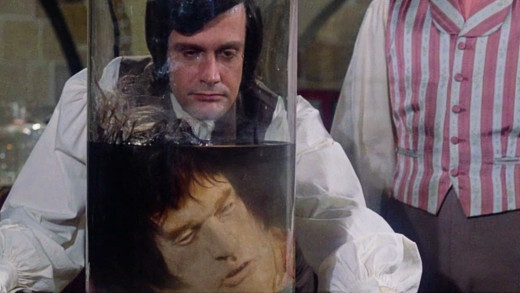 |
| It's easy to lose your head when you're a film nerd. |
So now I’ve seen just about everything in Hammer’s Gothic horror catalog, and my inner Scrooge is content. Was it worth the wait? Well….
The Horror of Frankenstein is a reboot of Hammer’s Frankenstein saga (almost a remake of the original Curse of Frankenstein), reprising the rise of Victor Frankenstein from a precocious and arrogant medical student to a sociopath willing to sacrifice anyone and anything in his quest to create artificial life. And in its bid to look cooler and more youth-oriented, Hammer inserted 30-year-old Ralph Bates into Peter Cushing's old role.
Writer-producer-director Jimmy Sangster freely admitted that he created a subpar entry in Hammer’s line of Gothic horrors. In his memoir Do You Want it Good or Tuesday, Sangster recalled being contacted by Hammer about polishing a new Frankenstein script by Jeremy Burnham. He initially declined, but told them he’d do it if he could also produce and direct the film. They readily agreed, but his bubble was about to burst:
“Three days later the script arrived. I read it and my heart sank. It was virtually identical to the script I’d written for Hammer umpty years ago, the first Frankenstein movie they made [The Curse of Frankenstein]. As far as I could see they needn’t have bothered paying a writer to come up with something they as good as owned already. All of a sudden I didn’t want to do it any more.” [Jimmy Sangster, Do You Want it Good or Tuesday: From Hammer Films to Hollywood! A Life in the Movies. Midnight Marquee Press, 1997, p. 113]
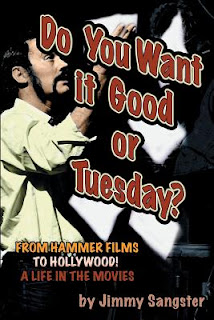
Sangster also recalled that, in spite of his initial reservations, he and Bates had a great time during the filming:
“Indeed we had a good laugh, but we also took the shooting very seriously. At least, I did. I’m pretty sure Ralph did too. Because we enjoyed ourselves it didn’t mean we were turning out bad work. Some directors believe that unless the set is rife with fear and tension the end result won’t be any good. Reduce the cast to a state of helpless terror so the director can better force his own will on them. Personally, I think that’s a load of bullshit. … Nevertheless, happy set or not, I am forced to admit that I didn’t make a very good movie. I meant it to be lighthearted. It was so lighthearted its feet never touched the ground. … I think one of the reasons it wasn’t as good a movie as it should have been was that there was nobody to keep me in check. I was the writer/producer/director, the closest you can get to being God. Nobody was around to say ‘you can’t do this’ or ‘that doesn’t work.’ [Ibid., p. 115]
All the main elements of The Curse of Frankenstein, which launched Hammer’s Gothic horror craze, are in The Horror of Frankenstein: the depiction of the Baron’s early life, illuminating his single-mindedness; his obsession with his experiments to the exclusion of everyone and everything else; the lab assistant with a conscience that the Baron lacks; Frankenstein resorting to murder to get ahold of a decent brain for the creature; and even the brain being damaged by broken glass before being transplanted into the creature’s skull.
But where Curse had energy and daring (and Peter Cushing) going for it 13 years before, Horror is a comparatively by-the-numbers exercise trying to milk a fading genre one last time with the inclusion of some **wink wink, nudge nudge** sexual innuendo, bountiful cleavage and black humor.
If anything, Ralph Bates’ Frankenstein is even more of a sociopath than Cushing’s, not even pretending to be interested in anything but his experiments, and remorselessly eliminating anyone -- friend, foe, colleague, or servant -- who stands in his way. But his delivery is so flat that he sucks the energy out of scenes that should have been rousing or at least titillating. He may have had a great time on the set, but you couldn’t prove it from the film that made it into the can.
The first two thirds of Horror is very talky, amounting to a character study of a very unlikeable Victor Frankenstein. When he’s not making sly references to boffing his housekeeper Alys (Kate O’Mara), Frankenstein spends an inordinate amount of screen time making notes in his lab or preparing corpses for dissection.
The monster doesn’t make an appearance until well after an hour in, and is a big disappointment for all the build-up. 6’6” muscleman David Prowse (who would later play Darth Vader in the first round of Star Wars movies) sports a sloppy head prosthetic with a few scars and staples and body sutures that look like they were drawn on with a red marker.
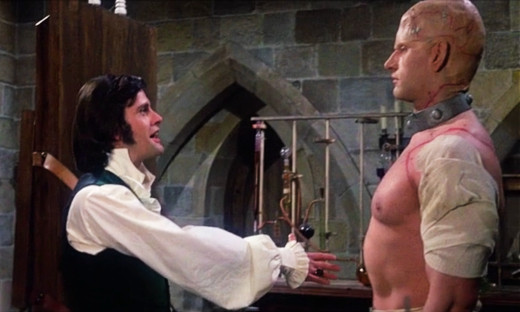 |
| "Welcome to the family!" |
Still, a couple of Horror’s supporting characters keep things relatively interesting and lively. The housekeeper-with-benefits Alys is a dark, scheming beauty who gives as good as she gets and is not above using sex and blackmail to manipulate her amoral employer. (In contrast, the ethereally beautiful Veronica Carlson doesn’t have much to do playing a neighbor and childhood friend of Victor’s.)
The real star of The Horror of Frankenstein is Dennis Price, who plays the graverobber that Victor employs to supply body parts for his experiments. Price is a stout, self-satisfied wheeler-dealer whose business happens to be digging up fresh cadavers from local graveyards. The jovial ghoul provides the film’s best moments of black humor.
In one scene, when Frankenstein asks what he can get his hands on, the man responds that the selection is poor, “...very poor. Times are hard. People just aren’t dying off so quick. It’s the welfare state, that’s what it is!”
Then, he tells Frankenstein that he needs to get going, since “I like to get to them [the recently buried bodies] before the soil settles. Digging is easier that way.” Cut to the graveyard, where Price is lounging next to the gravesite, drinking from a bottle, while his wife is furiously digging away.
Price plays his part to the hilt, and his character’s prominence in the film saves it from being just a garden-variety remake of The Curse of Frankenstein. At this relatively late point in his career, Price would go on to appear in such horror films as Twins of Evil, Tower of Evil, Theater of Blood, Horror Hospital, and a grab-bag of titles from schlock-auteur Jess Franco (Vampyros Lesbos, Dracula, Prisoner of Frankenstein and The Erotic Rites of Frankenstein). (See also my review of the underrated UK sci-fi B The Earth Dies Screaming, co-starring Price.)
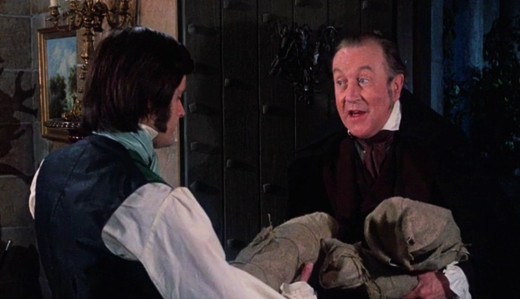 |
| "Anything I bring you will be so fresh, it will get past the government meat inspector!" |
Jimmy Sangster and Ralph Bates may have had just a little too much fun to make a truly good movie, but a couple of supporting performances and some inspired black humor and sly social commentary make The Horror of Frankenstein worth a watch.
Where to find it: Streaming | Blu-ray
RIP Veronica Carlson
I was saddened to see the news that Veronica Carlson recently passed away at the age of 77. While she appeared in only a comparative handful of films and TV shows, her presence in three Hammer horror films -- Dracula Has Risen from the Grave, Frankenstein Must be Destroyed, and The Horror of Frankenstein -- assured her a solid place in the pantheon of the studio’s stars.
According to her IMDb page, before being “discovered” by Hammer’s James Carreras, she had studied art and design. She willingly left show business to raise a family and pursue other interests. She lived in Florida and South Carolina, and became a very successful painter.
Years later, she would appear with three other Hammer veterans -- Caroline Munro, Martine Beswick and Christopher Neame -- in low-budget filmmaker Joshua Kennedy’s homage to Hammer, House of the Gorgon (2019).
I was lucky to be able to attend the world premiere of the film at the Monster Bash convention in Mars, PA in 2019. It was a special treat to see the film and hear first-hand the recollections of this gracious and talented actress and artist. See my review of the film and the convention here.
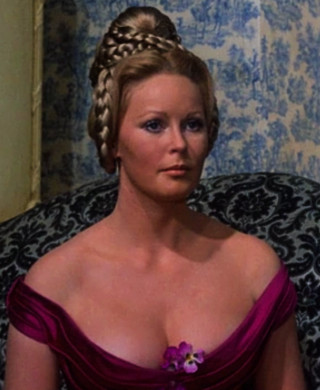 |
| Veronica Carlson, 1944 - 2022 |


