Showing posts with label Brain Creatures. Show all posts

February 25, 2022

The Great Brain Robbery: The Brain from Planet Arous

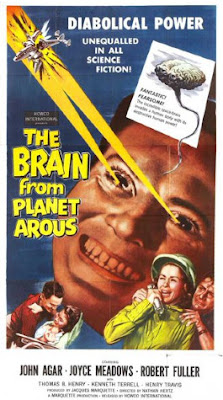
Poster - The Brain from Planet Arous, 1957
Now Playing:
The Brain from Planet Arous (1957)


Pros: Intriguing premise inspired by sci-fi pulp magazines; John Agar gets to laugh maniacally playing a scientist possessed by an evil alien brain
Cons: The production’s cheapness undercuts its lofty ambitions

This post is part of the fourth annual So Bad It’s Good blogathon hosted by brainy Rebecca at her Taking Up Room blog. Once you’ve checked out this entry, zip on over there for more takes on the art and entertainment of bad movies.

Ever since Fritz stole a diseased criminal’s brain to plop into the monster’s skull in the original Frankenstein, horror and sci-fi fans have had brains on the brain.

And who’s to blame them? Detached from its protective skull, the human brain is a disgusting, alien-looking thing, a rounded gelatinous mass of folds, fissures and crevices that looks like it's just waiting to launch itself at you and eat your face off.

Various versions of the Frankenstein story alone have put the brain front and center in pop horror culture. In Hammer’s Frankenstein series, after the Baron stitched together the horrific creature in Curse of Frankenstein, he learned his lesson in subsequent films and concentrated on transplanting brains between pre-owned bodies.
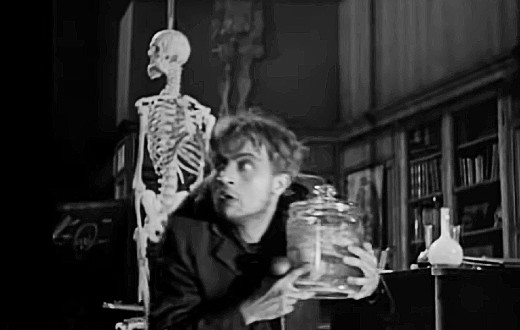
In retrospect, Frankenstein should have run this important errand himself.

And then there’s Donovan’s Brain (1953), which, while being kept alive in a laboratory, develops telepathic powers and possesses one of the lab scientists. The Brain That Wouldn’t Die (1962) picked up on the Donovan theme, featuring a whole head (and brain of course), played by Virginia Leith, that establishes a telepathic link with a Frankenstein-like creature in the basement laboratory that they share.

In a particularly gross-out variation, there’s the brains-as-delicacy theme exemplified by modern zombie movies. Contrary to popular belief, George Romero’s Night of the Living Dead (1968) and the Romero-directed sequels did not establish zombies’ predilection for eating brains. While Romero’s zombies can’t get enough of human flesh in general, it was Dan O’Bannon’s wonderfully comedic Return of the Living Dead (1985) that cemented the idea of zombies voraciously going after human grey matter. Since then it’s become a trope, with legions of fans speculating on why brains are such a special treat.

In yet another variation, The Brain from Planet Arous is a 30’s-style sci-fi pulp story brought to life in glorious black and white, featuring an alien menace that is all-brain with evil, glowing eyes.

Brain begins with a mysterious light descending from the heavens and finally exploding near a remote mountain range in the desert southwest. Nearby at a lab at the White Sands Proving Grounds, nuclear scientists Steve Marsh (John Agar) and Dan Murphy (Robert Fuller) notice that their instruments are picking up intermittent pulses of intense radiation from the area of Mystery Mountain.

The two men decide to drive out to the mountain to investigate, but not before having lunch with Steve’s fiancée Sally (Joyce Meadows) and her father John Fallon (Thomas Browne Henry). John warns the two that the daytime heat can be intense in the mountains, but they’re undeterred.

When they arrive at Mystery Mountain, a rock fall has blocked the road leading up to the mountain’s base, so they have to go the rest of the way on foot. They discover a cave that looks to have been recently blasted out of the rock, but there are no footprints or other signs of human activity.

Inside the cave, they encounter mysterious lights and sudden jumps in their Geiger counter readings. Suddenly, they’re confronted by a gigantic floating brain that zaps them with an intense light as Steve shoots wildly at it. Dan manages to get a shot off before succumbing to the radiation. The brain becomes semi-transparent, shrinks in size and enters Steve’s body as he lies unconscious on the cave floor.
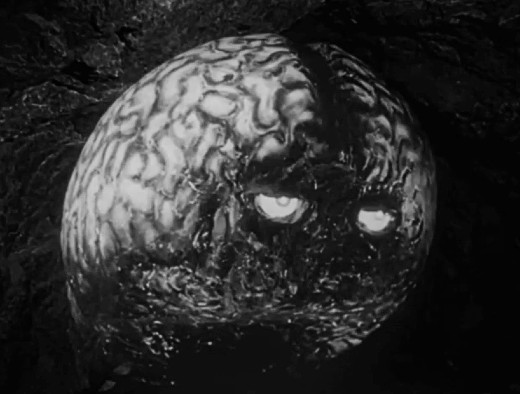
Screenshot - the criminal brain Gor, The Brain from Planet Arous, 1957
Q: Why did the brain go running?
A: It wanted to jog its memory.

A week later, just as Sally is getting really worried about her fiancé's absence (!!), Steve shows up at her house with a suspicious story about not finding anything at the mountain, and Dan going off to Las Vegas for some R&R.

Sally’s suspicions mount when Steve becomes uncharacteristically and aggressively romantic to the point of physically assaulting her, only relenting when Sally’s dog George comes to her defense. To top things off, Steve is suddenly having seizures, which he attributes to a tooth acting up (uh-huh).

Sally’s father initially dismisses her concerns with an offhand “boys will be boys” attitude, but then agrees to go with her to Mystery Mountain to see if they can find any reason for Steve’s abrupt personality change.

They’re shocked when they find Dan’s burnt body in the cave, and amazed when confronted with yet another floating brain. This new alien introduces himself as Vol, a policeman from the planet Arous who is chasing Gor, a criminal who has taken over Steve’s body in order to further his mad plans for world domination.

The two earth people and the space policeman plot to stick close to Gor/Steve to figure out what he’s up to and to strike when he’s most vulnerable. Instead of inhabiting Sally or her Dad, Vol chooses the body of the dog to hide out in, because, well, George is loyal and friendly and spends almost as much time with Steve as the other two (okaaaaay….).
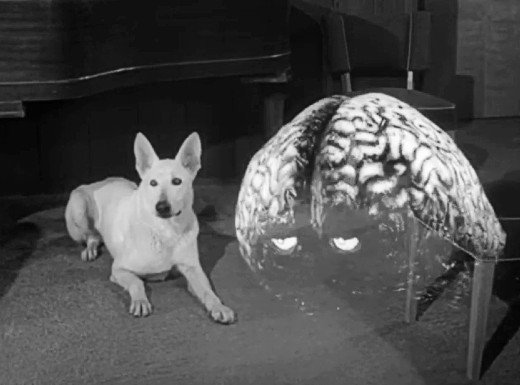
Screenshot - Vol prepares to inhabit George the dog; The Brain from Planet Arous, 1957
George the dog is a brain's best friend

Brains from the planet Arous are apparently invulnerable when they’re in their semi-transparent transitory state or when they’re occupying a body, but every 24 hours they have to materialize and leave their hosts in order to recharge and suck in life-giving oxygen. That’s the only time Gor will be vulnerable, and Vol solemnly informs Sally that a blow to Gor’s fissure of Rolando is the only sure way to take him out. (Yes Virginia, the fissure of Rolando is a real thing.)

While Sally is waiting for a crack at Gor’s fissure (okay now, get your minds out of the gutter!), the alien occupier, unaware that anyone is on to him, is busy blowing planes out of the sky, frying inquisitive policemen, and demonstrating to incredulous government officials that his awesome telekinetic powers are more powerful than the atomic bomb. If the earthlings and Vol don’t stop him, Gor plans to subjugate the earth and use slave labor to build a space fleet to invade his home world!

In the first scene, the film reveals its pulp sci-fi roots when it shows Steve scurrying around the lab trying to make sense of the radiation readings, while Dan is seen relaxing in a chair reading a science fiction magazine (shades of The Big Bang Theory, where scientists spend most of their time reading comic books and role-playing!).
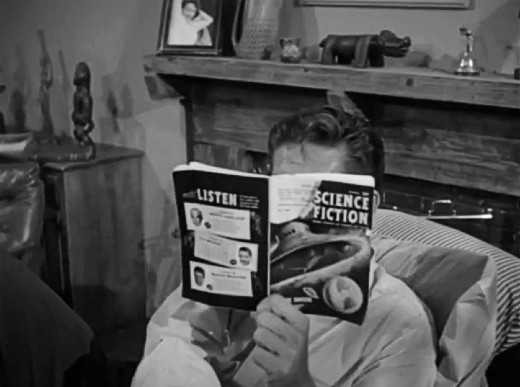
Screenshot - Dan (Robert Fuller), reads a science fiction magazine; The Brain from Planet Arous, 1957
Dan catches up on the er, um, scientific literature.

The sci-fi pulps of the early-to-mid 20th century were notorious for featuring lurid stories and cover art of bug-eyed monsters threatening curvaceous females. The Brain from Planet Arous is solidly in this camp, featuring a brain monster with glowing eyes and almost unlimited powers lusting after poor, confused Sally after he has infiltrated her fiancé’s body.

For an advanced brain creature that is supposedly all intellect, Gor is pretty inept at covering his tracks and posing as a human. When Gor/Steve suddenly shows up at Sally’s place, the best he can come up with is the dubious story of a futile search and Dan running off to Vegas. He doesn’t even bother to conceal Dan’s body, leaving it in the cave for Sally and her father to find.

Gor also seems unconcerned about blowing his cover by nearly ripping Sally’s clothes off in their first encounter. It’s understandable that a creature who has spent his whole life as nothing but pure intellect would be eager to try out his new body, but it seems a little strange for an evil mastermind to get distracted from his mission of world domination by falling for the charms of a fairly ordinary, albeit attractive, earth woman.

And charmed he most definitely is. Later, still pretending to be Steve, Gor drives Sally out to an overlook to take in the lights of the city sprawled out in the valley below. In an expansive mood, and bragging like a teenager trying to puff himself up in front of his best girl, he promises Sally the world… literally:

Gor: "That’s our world out there Sally, yours and mine."
Sally: "Really? All of it?"
Gor: "If you want it. … I can give it to you, believe me!"

It’s obvious that when occupying a body, Gor can access the memories and even some of the personality quirks of the host in order to pose as a human, but it’s not clear how much influence the suppressed host has on the occupier. Maybe a lot, given Gor’s infatuation.

Whatever the dynamic, the Gor/Steve hybrid is much more exciting than Steve alone. After experiencing her first kiss with the new, occupied Steve, Sally looks like she’s ready to pass out before exclaiming, “You never kissed me like that before!” Gor returns the favor later on when he muses that “She gives me a very strange, very new elation!” If only Gor wasn’t so dead set on conquering the world, they might have made a wonderful threesome.

Screenshot - John Agar and Joyce Meadows in The Brain from Planet Arous, 1957
Gor has a lot of catching up to do after a lifetime without a body.

The whole conquering the world thing also raises a question or two. It appears that Gor has deliberately chosen to land at Mystery Mountain because of its nearness to the White Sands nuclear testing grounds. Additionally, inhabiting the body of Steve, a nuclear scientist, will get him access to the inner sanctum of the country’s’ nuclear defense establishment.

But for some reason he just sits in the cave he’s blasted out of the mountain and waits for Steve to come to him (how he knows it will be a valuable nuclear scientist and not just some ordinary lunkhead is another mystery).

To add insult to ridiculousness, Gor doesn’t want access to the nuclear testing facility to appropriate the weapons, but rather to demonstrate to the gathered officials that his telekinetic powers are far more powerful than their measly atom bombs, and that they have 24 hours to assemble representatives from the world’s major powers to hear his ultimatum.

If I were Gor, I’d cut out the middleman (sorry Steve), fly directly to Washington D.C., obliterate something showy, like the Washington monument, and then issue my ultimatum on national TV. But I guess Gor didn’t want to be seen as some low-grade knock-off of the venerated Klaatu. And he wouldn’t have been able to partake of some of those, ahem, earthly pleasures that floating brains don’t get to experience very often.

But, let’s face it, all this nitpicking violates the first law of watching so-bad-they’re-good sci-fi movies: just turn off your brain and enjoy the show.
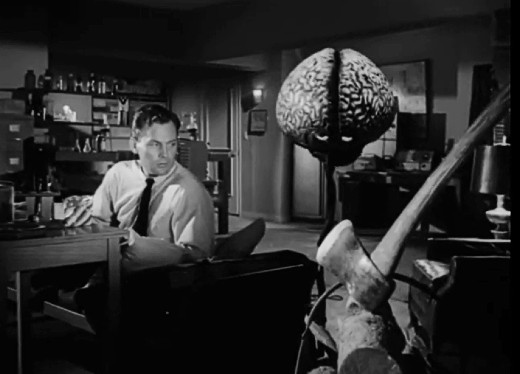
Screenshot - climactic scene, The Brain from Planet Arous, 1957
Steve tries to do the math in his head: Gor in a solid, vulnerable state +
the fissure of Rolando + a sharp axe = ?

The Brain from Planet Arous is cheap, even by ‘50s sci-fi standards, but you’ve got to admire the audacity of trying to make a movie about evil brains and world domination on a budget so tight that you can almost hear the screech of the producers being separated from their nickels and dimes as you watch it unfold.

Speaking of producers, Jacques Marquette, who was best known as a cinematographer, but who started out producing low-budget sci-fi movies like The Brain from Planet Arous and that most iconic example of ‘50s sci-fi cheese, Attack of the 50 foot Woman, was interviewed by B movie historian Tom Weaver about his early gigs. Marquette good naturedly addressed the inspiration for the story and the cost-cutting involved in the production:

Where did your idea for Brain come from?
It was a story which I had sort of halfway stolen from Amazing Stories, I used to read that, Astounding Science Fiction, all of those -- I loved science fiction. One of them ran a story about a guy on the beach in the summer, and this thing came out of the ocean, went up into his foot and took him over.

What was your budget on Arous?
The budget, as I recall, was about fifty-eight thousand dollars. I did all the optical effects in the camera; otherwise, it would have cost probably five hundred dollars for one effect.

What do you remember about the brain prop?
We told the people who were going to make it what we wanted, and that we wanted lights inside. It was made of plastic and held up with wires. Later on, after we finished the picture, my kids got a hold of it and put on a show. They’d get other kids together, charge ‘em five cents and put on a show with the brain in there. [laughs].
[Weaver, Tom. Attack of the Monster Movie Makers, McFarland, 1994; pp. 197-198]

In the interview Marquette also mentions the silver-coated contact lenses that star John Agar wore for the scenes in which Steve, under Gor’s control, demonstrates his awesome powers. In yet another Weaver interview, Agar acknowledged enjoying the opportunity to play a kind of Jekyll-and-Hyde role, but the contact lenses were a big challenge:

“I’ll tell you one thing, that picture was a very painful experience for me. When that alien being took over my body, they inserted these full contact lenses in my eyes. They’d painted ‘em silver and they forgot that that doggone paint would chip off. Every time I blinked, some of that silver would come off the lens and it was like having sand in my eyes.”
[Weaver, Interviews with B Science Fiction and Horror Movie Makers: Writers, Producers, Directors, Actors, Moguls and Makeup, McFarland, 1988; p. 10]

Yikes! Despite the pain of having flecks of silver paint in his eyes, Agar gives it his all, laughing maniacally in classic melodramatic fashion as he terrorizes the world.
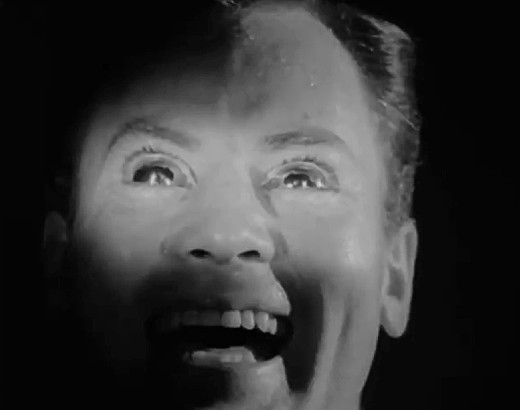
Screenshot - Steve (John Agar) is possessed by the evil brain Gor, The Brain from Planet Arous, 1957
Prerequisites for world domination:
Awesome telekinetic powers - check
Maniacal laugh - check
Rad silver-coated contact lenses - ouch!

In the early part of his career Agar snagged roles in several prestige A pictures -- John Ford’s Fort Apache (1948) and She Wore a Yellow Ribbon (1949), and Allan Dwan’s Sands of Iwo Jima (1949) prominent among them -- but he will forever be remembered for grade-B sci-fi cheese like The Brain from Planet Arous. At best a middling actor, his ultimate career path from A pictures to Bs and even Zs (e.g., Zontar: The Thing from Venus, 1967 and Curse of the Swamp Creature, 1968) was perhaps a foregone conclusion. Later on, he expressed no remorse about being associated with those pictures, and was just grateful for the opportunity to entertain people (see my write up of The Hand of Death elsewhere on the blog).

Gor’s and Steve’s main squeeze, Joyce Meadows, made just a handful of films, but like many actors of her generation, she kept busy making guest appearances in every nook and cranny of TV from the ‘50s through the ‘90s.

Director Nathan Juran is a sci-fi movie hall of famer, with a number of classics and near-classics on his resume: The Deadly Mantis (1957), Twenty Million Miles to Earth (1957), Attack of the 50 Foot Woman (1958), The 7th Voyage of Sinbad (1958), and First Men in the Moon (1964). Toward the end of his career, he directed multiple episodes of such popular Irwin Allen TV shows as Voyage to the Bottom of the Sea, The Time Tunnel, Lost in Space and Land of the Giants.

As for the merits of The Brain from Planet Arous, I’ll let yet another venerable B movie historian, Bill Warren, have the final say:

“In doing research for this film, I was startled to find that several reviews called the plot ‘conventional.’ Though the film is conventionally made, the premise is truly bizarre, anything but ‘conventional.’ The idea is too grandiose for the budget level, and it’s silly throughout, but at least it’s imaginative and unusual.”
[Warren, Keep Watching the Skies! American Science Fiction Movies of the Fifties, Volume II, McFarland, 1986; p. 33.]

Where to find it: DVD | Streaming 

July 7, 2013

Fantastic Faceless Foes From Fifties Sci-fi: Extra Special Outdoor Movie Party Edition

A year or so ago I posted a "love letter" to the vanishing American drive-in, and wrote about how easy and fun (and relatively economical) it can be to recreate a little of the outdoor movie experience in your backyard ("Backyard Movies on a Budget").  I'm in the homestretch of a marathon move, but before I got out of Dodge for good, I wanted to have my friends over for one last outdoor movie party. (Ironically, I'm moving to a much larger city that has -- you guessed it -- one of the last drive-ins left in the country. *Fist pump*!)

Two fans at a recent outdoor movie party
These two outdoor movie fans seem to have
forgotten their popcorn!
If you're going to go to the trouble of setting up a screen and projector in your back yard and pretend you're at the drive-in, then you might as well go all the way and pretend that you're at the drive-in in its heyday, the 1950s. And while you're at it, you might just go for a double-bill featuring two of the more unusual sci-fi movie menaces of the '50s, Kronos (1957) and Fiend Without a Face (1958). Speaking of faceless, way back in September of 2011, I wrote about the first group of Fantastic Faceless Foes from '50s Sci-fi, and promised another installment. And here it is, almost two years later -- now that's what I call an irregular blog feature!

In the first installment, I talked a little about how '50s sci-fi movies tried to address, in an entertaining and ultimately reassuring way, the inchoate fears of an American public that had recently been hit with a number of shocks to the All-American system of comfortable middle class security: first the A bomb and radioactivity, then the H bomb, then Sputnik (which meant that the Russians could lob bombs at us with intercontinental missiles just as easily as putting up harmless satellites).

Book by Don and Susan Sanders,
Crestline, 2013 (reprint ed.)
There were plenty of conventional sci-fi threats in the Eisenhower years: lumbering dinosaurs awakened by atomic testing; saucer men threatening teenagers in their hot rods, and even the venerable Frankenstein monster and the Wolf Man were turned into especially bummed out teenagers. But then, the free-floating anxieties of the atomic age called for other, more nebulous threats as well. Ironically, the low cost of these productions, the profit potential, and the insatiable demand for product on the part of drive-in owners resulted in a number of crazy projects getting green lighted that would never have stood a chance in any other era. (In contrast, today's American movie industry is extremely reluctant to take chances on original content or characters. The vast majority of releases are based on known quantities: popular video games, comic books, graphic novels and TV series. The few blockbusters that try original material almost invariably sink quickly at the box office. The result, for all the state-of-the-art CGI effects, is a depressing sameness.)

So, this unique set of circumstances in the '50s resulted in an explosion of far-out ideas from low-budget filmmakers with nothing to lose (they almost couldn't lose -- if you could deliver the product, it was almost certain to make a profit). Drive-in movie heroes and heroines were threatened by omnivorous blobs; 50-foot tall men and women; all manner of giant insects and animals (including ants, grasshoppers, preying mantises and, *gulp*, a giant buzzard); an assortment of disembodied heads and brains; quick-growing, towering crystals; and even a virulent fungus.

The Faceless Foes featured here fit very nicely into this drive-in theater of the absurd. The first is a giant, faceless energy-sucking robot from space. The second is an army (or maybe a battalion) of "thought" creatures in the form of disembodied brains with antennae and spinal cord "tails." Awesome!

Poster - Kronos (1957)
Now Playing: Kronos (1957)

Pros: Great, non-anthropomorphic giant robot concept and design; Ingenious ending
Cons: Alien mind-control subplot is superfluous and mildly distracting

In brief: A pulsating flying saucer, hovering against a backdrop of stars, releases a ball of light that head towards earth. A truck driver on a lonely desert road gets out to figure out why his vehicle stalled. The eerie light overwhelms him, then, zombified, he gets backs in his truck and drives to the nearest secret research base, where he confronts Dr. Hubbell Eliot (John Emery). The light shoots out of the driver's eyes and into the scientist's, whereupon the "messenger" collapses, dead. Meanwhile, another team of scientists, led by Dr. Leslie Gaskell (Jeff Morrow) are alarmed to find that a giant asteroid is headed straight for earth (actually, it looks just like the flying saucer seen right after the credits!). When missiles are fired to intercept it, the asteroid changes course, as if it were piloted (duh!), and splashes harmlessly (?) into the ocean just off of Mexico.

A team headed by Gaskell, including his fiancee Vera (Barbara Lawrence) and fellow scientist Arnold Culver (George O'Hanlon), travel down to Mexico to investigate the asteroid splashdown. Their suspicions about the odd behavior of the asteroid are confirmed when a colossal dome rises out of the ocean where the asteroid went down, and a giant robot suddenly appears on the beach nearby. The giant thing is weirdly alien-looking, it's "body" consisting of two huge cubes joined by a pylon, and its "head" a dome with antennae sticking out on either side. The robot moves around using four massive pistons at its base that rapidly fire in sequence.

Still - Helicopter scene - Kronos (1957)
The scientific team checks out Kronos from the air.
Gaskell's team lands a helicopter on the top of the temporarily motionless robot to investigate, but they're forced to take off when machinery starts stirring and whirring on the thing. Back at the lab, Eliot, inhabited by an alien intelligence, seems to be directing the robot. It moves inland, stomping on farmers as it goes, to a Mexican power plant, whereupon it sucks up all the plant's electric power. Conventional arms are of no use, as the robot uses its power stores to destroy the jet planes attacking it. As it starts heading toward the U.S., the military brass decide to blow it up with a hydrogen bomb. Gaskell, whose Mama didn't raise a dummy, realizes it's a very bad idea to use nuclear power against a thing that sucks up power like a sponge. Seconds before the plane is to drop its payload, Gaskell gets the military to call it off, but the robot captures the plane in a tractor field and the bomb explodes anyway, making the colossal metal power-robber bigger than ever. There seems to be nothing that can stop it from sucking up all of Los Angeles' power, and then the entire world's. But the crackerjack scientist has an ingenious plan…

Kronos is definitely not a cute, anthropomorphic bucket of bolts in the tradition of a Robby or 3CP0. It's a gargantuan, cubic thing seemingly designed by an intelligence so alien, it's all but incomprehensible. (Thankfully, the filmmakers refrain from introducing us in any significant way to its makers, thereby preserving the mystery and wonder.) As it goes about its energy-absorbing mission, the robot is as oblivious to human beings as a monster truck tire is to ants on a dirt road. The "birth" of Kronos in the sea off of the Mexican coast is about as awe-inspiring and uncanny as it gets it '50s sci-fi. And it also helps that Kronos has an unusually intelligent script featuring a scientist solving an almost hopeless problem with a plausible application of scientific theory (plausible at least for a giant-robot-ravages-the-earth-for-its-energy movie.) On the downside, the takeover of Dr. Eliot's mind by the alien force doesn't make all that much sense and adds little to the film. (Why do the aliens need to take over the primitive humans? Can't they just program the robot to do its stuff?)

Still - Robot on the move! - Kronos (1957)
One of the most beautiful robots ever designed
for film? You be the judge!
Key filmmaker: Director Kurt Neumann started out in the early '30s directing shorts for Universal, and was considered for Bride of Frankenstein until being bumped for James Whale (who was fresh off another hit, The Invisible Man). Neumann directed B programmers for Universal throughout the '30s and '40s, including the memorable Secret of the Blue Room (1933) and two of the better Weissmuller Tarzans, Tarzan and the Amazons (1945) and Tarzan and the Leopard Woman (1946). Towards the end of his career, he directed some of the more memorable B sci-fi pictures of the '50s, including the first "realistic" story of humanity's attempt to conquer space to hit American theaters, Rocketship X-M (1950), Kronos, and The Fly (1958) with Vincent Price.

Key effects artist: Bill Warren, the titanic chronicler of '50s sci-fi, reports that effects designer Irving Block was very proud of his creation, Kronos. The robot was named after one of the Greek Titans, who notoriously ate his rivals. In this sci-fi version, Kronos is eating the earth up (or at least all its energy). Says Block, "I remember it distinctly and I know exactly why I did it, how I did it… I wanted it to be anthropomorphic, to look like a robot, but at the same time I wanted it to look like a piece of machinery. I spent a lot of time on it… At one point it looked more like a construction by Picasso, but I reduced it down by a whole series of steps until it ultimately became just a black box." In Warren's estimation, "It is one of the most beautiful robots ever designed for film." [Bill Warren, Keep Watching the Skies! Vol. I: 1950 - 1957, McFarland, 1982.]


Where to find it:
Available online

Amazon Instant Video

Available on DVD

Oldies.com

"An awesome monster such as human eyes have never seen!"


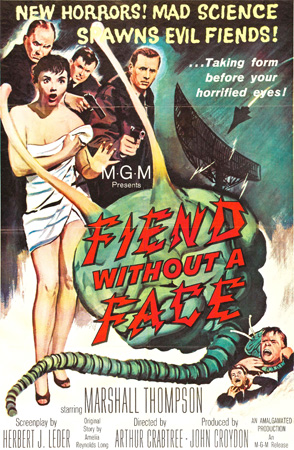
Poster - Fiend Without a Face (1958)
Now Playing: Fiend Without a Face (1958)

Pros: Creepy horror elements add just the right amount of fear and dread; Expert build-up of suspense
Cons: The materialized creatures are more ludicrous than scary; The effects at the climax look like bad claymation

In brief: At an American air base in a remote corner of Canada, the military is experimenting with atomic power-enhanced radar to better track the rascally Russians. When several locals near the base turn up dead, their brains and spinal cords sucked out of their bodies by some sort of "mental vampire," the base commander, fearing the Americans will be blamed, tasks his right hand man, Major Jeff Cummings (Marshall Thompson), with investigating the mysterious deaths. In typical American fashion, Cummings blunders in on the daughter of one of the victims (Barbara, played by Kim Parker) as she's taking a shower and gets into a fistfight with her boyfriend.

Meanwhile, the town mayor is killed by the invisible "vampire" in the comfort of his own home. Jeff finds out from Barbara that Prof. Wingate (Kynaston Reeves), an eminent scientist in the fields of cybernetics and thought control, happens to live nearby (hmmmm….). When Jeff stops by to pick the old man's brain (pun intended) about what might be going on, the scientist gets very nervous (hmmmm…..). Things really come to a head (minus a brain of course), when the town constable, who had been hunting for the fiend, breaks into an emergency town council meeting moaning and gibbering -- he's apparently had an encounter with the vampire, and it's sucked out a good portion of his brain!

Still - Prof. Wingate's flashback on his thought control experiments - Fiend Without a Face (1958)
Poorly designed thought control experiment + lightning
= mental vampires preying on innocent townspeople
As the body count mounts, Prof. Wingate finally comes clean about his unusual experiments. He had struggled to move objects and materialize his thoughts until lightning surged through his equipment, and he realized his thoughts had finally been "freed" and he had the power of telekinesis. To continue his experiments, he devised a way to tap into the base's atomic power. The result: independent, sentient creatures with the form of living brains, but invisible to the eye… and deadly. And, they're intelligent enough to muck around with the base's atomic lab, drawing on its power to create even more fiends to prey on humanity. Soon, the fiends have Jeff, Wingate, Barbara and several other military and town officials trapped in Wingate's house…

Bill Warren describes Fiend as "one of the most ghoulish, gory pictures of the '50s." [Ibid.] This one is as much horror as it is sci-fi, with its scenes of lonely, creepy woods at night, people being attacked by invisible creatures that make eerie slurping sounds, and others being turned into walking, moaning zombies from a half-baked brain-sucking job. The scene of the zombified constable breaking up the council meeting is particularly effective. As Jeff argues with the town officials over who is to blame for the mysterious deaths, an unearthly moan sounds from the adjoining corridor. The disheveled thing that was once Gibbons appears at the doorway, his blistered face half in shadow, and then he stumbles into the room, his mind clearly (and literally) gone. When I saw this scene for the first time as a kid, I almost stopped watching the movie right then. I suspect many people even today would be creeped out by it.

At the climax the creatures "materialize" into ambulatory brains with antennae and whip-like spinal cords that they use to move around like worms and strangle their victims. Many fans have found these scenes to be thrilling and inventive, and the special effects to be superior for the time. I'm perhaps in the minority, thinking that the materialized creatures and their movements look almost comical (especially when the creatures are shot -- the effect looks like bad claymation and the "slurpy" sound effects are completely over-the-top). I'm not sure what I would have done with the ending, but when the creatures become visible, all the carefully built suspense and horror goes out the window. It almost becomes a western, with the heroes trapped in a cabin by marauding raiders…

Still - Brain fiend creeping through the woods - Fiend Without a Face (1958)
"Who invited the brain creature to the picnic?"
Key effects artists: In an extensive interview with Tom Weaver, executive producer Richard Gordon related how he hired the German effects team of Flo Nordhoff and Karl-Ludwig Ruppel:
"One day early on, [producer] John Croydon and I were having lunch with them at Walton Studios, discussing the project -- this was before we had made a commitment. John was describing the story of Fiend, and all the time he was talking, Nordhoff was sitting there doodling away on little pieces of paper. We thought he was just being slightly distracted and not paying too much attention, but at the end of John's recounting of the story, Nordhoff suddenly turned over these pieces of paper and asked us to look at them. As he was listening to the story, he had been creating the Fiends in his mind and then putting them down on paper, and they were very much like the Fiends as they appear in the original picture! That of course was the clincher, and we immediately signed them." [Weaver, The Horror Hits of Richard Gordon, BearManor Media, 2011]
Key moment in free publicity: Gordon also was amused by the extreme reaction the picture got in his native England:
"What I wasn't prepared for was that, when the film was released in England and it opened by itself at the Ritz Theatre in Leicester Square, the newspapers would be so offended by what they considered the excessive gruesomeness of the picture, that they made a major issue of it in the reviews, and it got to the point where somebody brought up in Parliament the fact that the British Board of Film Censors did not seem to be fulfilling its obligations in preventing the showing of a film like Fiend, which as a 'disgrace' to the British film industry… What went through my mind was that I could never have afforded to buy that publicity, if it hadn't come my way free, and that it was the best possible thing that could happen to the picture." [Ibid. For more on the sci-fi/horror hits of Richard Gordon, see my recent post on First Man Into Space.]


Where to find it:
Available online

Amazon Instant Video

Available on DVD

Oldies.com

"Spawning Madness! Breeding Monsters!"