Showing posts with label Dennis Price. Show all posts

March 18, 2022

Catching up with The Horror of Frankenstein

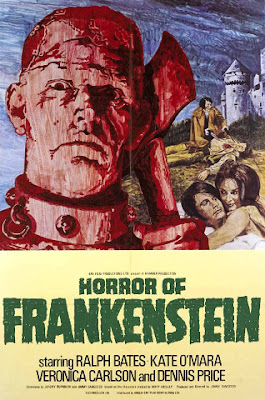
Poster - The Horror of Frankenstein, 1970
Now Playing:
The Horror of Frankenstein (1970)


Pros: A couple of the supporting characters are lively; the black humor works well for the most part
Cons: Slow and talky for much of the running time; the monster is a disappointment

A long, long time ago, when I was a snot-nosed kid growing up in America’s Heartland, I lived in monster kid paradise. The local TV stations broadcast not one but two (!!) creature features on successive nights. On Fridays, I’d get into my pajamas and plant myself in front of the TV to watch sci-fi epics from the ‘50s and ‘60s, and then on Saturday nights fire up the old boobtube again to watch Gravesend Manor’s Malcolm the Butler and his fellow cracked cast members introduce the Universal monsters in all their black and white glory.

That lasted only a few years, but as I transitioned into awkward adolescence, I discovered something new and exciting… Girls, yes, but as a clueless pencil-neck geek I was in no position to do anything about that at the time… Rather, it was Hammer Films’ bloody, technicolor re-imaginings of the Universal monsters (not to mention the exposed skin of Hammer's female protagonists) that occupied much of my still developing brain.

The Hammer horrors, which got more and more “adult” as time went on, were a sort of pop culture rite of passage for a secular nerd such as myself. I remember sitting in a darkened theater for a matinee of Dracula: Prince of Darkness, watching a victim being hung upside down like a side of beef and bled dry over the ashes of the sinister count. Who knew you could bring back a vampire that way?

Like any reasonably obsessed film nerd, once I’d gone through Hammer’s Horrors, Curses and Evils, I wanted to see what else they had to offer. I started exploring the studio's sci-fi (the Quatermass movies, X the Unknown, etc.), thrillers (Scream of Fear, Paranoiac, The Maniac, etc.) and even swashbucklers (see my review of Night Creatures elsewhere on this site).
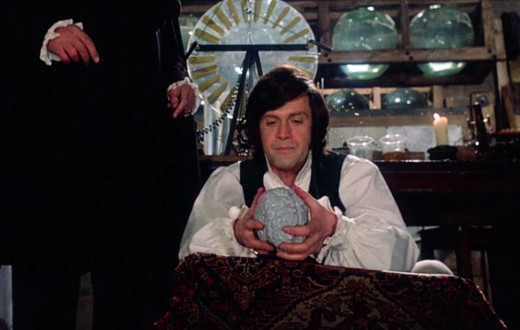
Ralph Bates (Victor Frankenstein) with a damaged brain, The Horror of Frankenstein, 1970
This is your brain after bingeing on Hammer horror films.

While I was wandering down those genre byways, I was keeping an eye out for any of the horror films, especially the late Hammers of the early ‘70s, that I had somehow missed. Over the years I checked off such titles as Twins of Evil and Dr. Jekyll and Sister Hyde that were rarely shown on TV or were slow to crack the U.S. home video market.

In spite of my nerdish zeal to see as much of Hammer’s catalog as possible, one film -- and one of their horror films at that -- remained unseen. And it wasn’t as if it was hard to find.

For years, Horror of Frankenstein sat there, fat and happy, mocking my pretensions of being a Hammer horror film completist. Sure, Hammer was in decline by the time the film was made. Sure, it committed the cardinal sin of casting Ralph Bates as Victor Frankenstein, instead of the beloved Peter Cushing. Sure, many reviewers have dismissed it as too glib and tongue-in-cheek.

But dammit, it’s a Hammer horror film, and as such I should have watched it years ago! For example, right now it’s streaming on such platforms as YouTube, Amazon, Apple TV and Vudu for anywhere from $1.99 to $3.99, less than the price of a small popcorn at the theater.

But I am a cheap SOB, and I just hate to shell out even a measly dollar beyond what I already plunk down for streaming privileges. So I will try to find a free copy on YouTube or at the library, or anywhere, before I dig into my metaphorical wallet for a couple of bucks (it’s a sickness, it really is).

Every time I thought about finally getting around to seeing The Horror of Frankenstein, it snickered at me behind some teensy-tiny paywall. But I had the last laugh. A few weeks ago, as I was browsing movies in the Hoopla app (subsidized by my local library), I stumbled upon The Horror sitting there on a virtual shelf, just waiting to be borrowed for free... nothing, nada, zero, zilch!
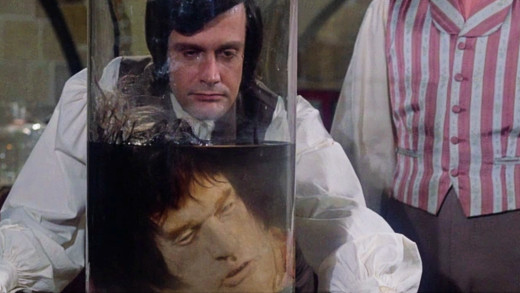
A highwayman's head in a jar, The Horror of Frankenstein, 1970
It's easy to lose your head when you're a film nerd.

So now I’ve seen just about everything in Hammer’s Gothic horror catalog, and my inner Scrooge is content. Was it worth the wait? Well….

The Horror of Frankenstein is a reboot of Hammer’s Frankenstein saga (almost a remake of the original Curse of Frankenstein), reprising the rise of Victor Frankenstein from a precocious and arrogant medical student to a sociopath willing to sacrifice anyone and anything in his quest to create artificial life. And in its bid to look cooler and more youth-oriented, Hammer inserted 30-year-old Ralph Bates into Peter Cushing's old role.

Writer-producer-director Jimmy Sangster freely admitted that he created a subpar entry in Hammer’s line of Gothic horrors. In his memoir Do You Want it Good or Tuesday, Sangster recalled being contacted by Hammer about polishing a new Frankenstein script by Jeremy Burnham. He initially declined, but told them he’d do it if he could also produce and direct the film. They readily agreed, but his bubble was about to burst:

“Three days later the script arrived. I read it and my heart sank. It was virtually identical to the script I’d written for Hammer umpty years ago, the first Frankenstein movie they made [The Curse of Frankenstein]. As far as I could see they needn’t have bothered paying a writer to come up with something they as good as owned already. All of a sudden I didn’t want to do it any more.” [Jimmy Sangster, Do You Want it Good or Tuesday: From Hammer Films to Hollywood! A Life in the Movies. Midnight Marquee Press, 1997, p. 113]
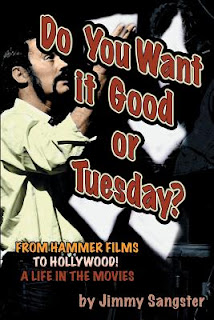
Book cover - Do You Want it Good or Tuesday, Jimmy Sangster

Sangster also recalled that, in spite of his initial reservations, he and Bates had a great time during the filming:

“Indeed we had a good laugh, but we also took the shooting very seriously. At least, I did. I’m pretty sure Ralph did too. Because we enjoyed ourselves it didn’t mean we were turning out bad work. Some directors believe that unless the set is rife with fear and tension the end result won’t be any good. Reduce the cast to a state of helpless terror so the director can better force his own will on them. Personally, I think that’s a load of bullshit. … Nevertheless, happy set or not, I am forced to admit that I didn’t make a very good movie. I meant it to be lighthearted. It was so lighthearted its feet never touched the ground. … I think one of the reasons it wasn’t as good a movie as it should have been was that there was nobody to keep me in check. I was the writer/producer/director, the closest you can get to being God. Nobody was around to say ‘you can’t do this’ or ‘that doesn’t work.’ [Ibid., p. 115]

All the main elements of The Curse of Frankenstein, which launched Hammer’s Gothic horror craze, are in The Horror of Frankenstein: the depiction of the Baron’s early life, illuminating his single-mindedness; his obsession with his experiments to the exclusion of everyone and everything else; the lab assistant with a conscience that the Baron lacks; Frankenstein resorting to murder to get ahold of a decent brain for the creature; and even the brain being damaged by broken glass before being transplanted into the creature’s skull.

But where Curse had energy and daring (and Peter Cushing) going for it 13 years before, Horror is a comparatively by-the-numbers exercise trying to milk a fading genre one last time with the inclusion of some **wink wink, nudge nudge** sexual innuendo, bountiful cleavage and black humor.

If anything, Ralph Bates’ Frankenstein is even more of a sociopath than Cushing’s, not even pretending to be interested in anything but his experiments, and remorselessly eliminating anyone -- friend, foe, colleague, or servant -- who stands in his way. But his delivery is so flat that he sucks the energy out of scenes that should have been rousing or at least titillating. He may have had a great time on the set, but you couldn’t prove it from the film that made it into the can.

The first two thirds of Horror is very talky, amounting to a character study of a very unlikeable Victor Frankenstein. When he’s not making sly references to boffing his housekeeper Alys (Kate O’Mara), Frankenstein spends an inordinate amount of screen time making notes in his lab or preparing corpses for dissection.

The monster doesn’t make an appearance until well after an hour in, and is a big disappointment for all the build-up. 6’6” muscleman David Prowse (who would later play Darth Vader in the first round of Star Wars movies) sports a sloppy head prosthetic with a few scars and staples and body sutures that look like they were drawn on with a red marker.
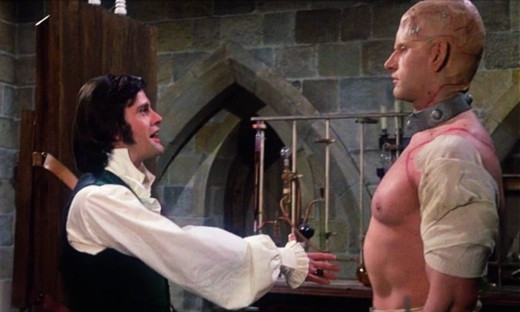
Ralph Bates and David Prowse in The Horror of Frankenstein, 1970
"Welcome to the family!"

Still, a couple of Horror’s supporting characters keep things relatively interesting and lively. The housekeeper-with-benefits Alys is a dark, scheming beauty who gives as good as she gets and is not above using sex and blackmail to manipulate her amoral employer. (In contrast, the ethereally beautiful Veronica Carlson doesn’t have much to do playing a neighbor and childhood friend of Victor’s.)

The real star of The Horror of Frankenstein is Dennis Price, who plays the graverobber that Victor employs to supply body parts for his experiments. Price is a stout, self-satisfied wheeler-dealer whose business happens to be digging up fresh cadavers from local graveyards. The jovial ghoul provides the film’s best moments of black humor.

In one scene, when Frankenstein asks what he can get his hands on, the man responds that the selection is poor, “...very poor. Times are hard. People just aren’t dying off so quick. It’s the welfare state, that’s what it is!”

Then, he tells Frankenstein that he needs to get going, since “I like to get to them [the recently buried bodies] before the soil settles. Digging is easier that way.” Cut to the graveyard, where Price is lounging next to the gravesite, drinking from a bottle, while his wife is furiously digging away.

Price plays his part to the hilt, and his character’s prominence in the film saves it from being just a garden-variety remake of The Curse of Frankenstein. At this relatively late point in his career, Price would go on to appear in such horror films as Twins of Evil, Tower of Evil, Theater of Blood, Horror Hospital, and a grab-bag of titles from schlock-auteur Jess Franco (Vampyros Lesbos, Dracula, Prisoner of Frankenstein and The Erotic Rites of Frankenstein). (See also my review of the underrated UK sci-fi B The Earth Dies Screaming, co-starring Price.)
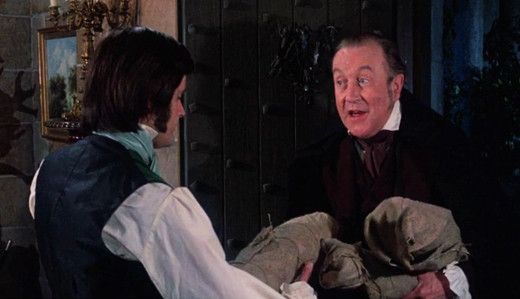
Dennis Price as the graverobber in The Horror of Frankenstein, 1970
"Anything I bring you will be so fresh, it will get past the government meat inspector!"

Jimmy Sangster and Ralph Bates may have had just a little too much fun to make a truly good movie, but a couple of supporting performances and some inspired black humor and sly social commentary make The Horror of Frankenstein worth a watch.

Where to find it: Streaming | Blu-ray

RIP Veronica Carlson

I was saddened to see the news that Veronica Carlson recently passed away at the age of 77. While she appeared in only a comparative handful of films and TV shows, her presence in three Hammer horror films -- Dracula Has Risen from the Grave, Frankenstein Must be Destroyed, and The Horror of Frankenstein -- assured her a solid place in the pantheon of the studio’s stars.

According to her IMDb page, before being “discovered” by Hammer’s James Carreras, she had studied art and design. She willingly left show business to raise a family and pursue other interests. She lived in Florida and South Carolina, and became a very successful painter.

Years later, she would appear with three other Hammer veterans -- Caroline Munro, Martine Beswick and Christopher Neame -- in low-budget filmmaker Joshua Kennedy’s homage to Hammer, House of the Gorgon (2019).

I was lucky to be able to attend the world premiere of the film at the Monster Bash convention in Mars, PA in 2019. It was a special treat to see the film and hear first-hand the recollections of this gracious and talented actress and artist. See my review of the film and the convention here.
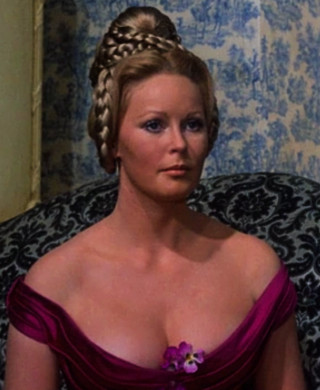
Veronica Carlson in The Horror of Frankenstein, 1970
Veronica Carlson, 1944 - 2022

August 20, 2021

Alien Robot Invasions, Part Two: The Earth Dies Screaming

Poster - The Earth Dies Screaming, 1964
Now Playing:
The Earth Dies Screaming (1964)


Pros: Presents a pretty effective human drama that plays out against the backdrop of an alien invasion; Adds an extra layer of horror on top of killer robots.
Cons: The robots are cheap-looking, even for 1964.

In part one, I examined how Hollywood in the early ‘50s addressed fears of nuclear war both directly, with films about attacks on America and end-of-the-world scenarios, and indirectly with films like Target Earth, depicting protagonists stranded in an eerily deserted city that has been evacuated due to some unknown emergency. Target Earth’s protagonists eventually run into an advance guard of invaders, but instead of Russians, the invaders are alien-produced robots that shoot death-rays from their faceplates.

Perhaps because the UK had somewhat less skin in the Cold War game than the U.S., filmmakers there were a bit slower to exploit invasion themes. But they got off to an unusual and titillating start with Devil Girl from Mars (1954), about a black leather-clad, dominatrix Martian who lands her spaceship in the English countryside, looking for fertile men to take back to her planet.

Still, Devil Girl from Mars, 1954
"Excuse me ma'am, is this where I sign up to help repopulate Mars?"

Shortly thereafter, Hammer Films really got the alien invasion thing going with its series of Prof. Quatermass adaptations (from the teleplays by the brilliant Nigel Kneale), starting with The Quatermass Xperiment (1955), wherein the sole survivor of the UK’s first manned space mission unwittingly brings back a dangerous alien organism. The sequel, Quatermass II (1957), considerably upped the threat to humanity by having the good professor stumble upon alien infiltration into the highest levels of government.

By the time our featured US-UK co-production, The Earth Dies Screaming, debuted in 1964, two certifiable UK classics, Village of the Damned (1960) and The Day of the Triffids (1963), had set a high bar for creative and unusual alien invasion stories.

Both are based on novels by John Wyndham. Village opens with all of the fertile women in an English village being mysteriously impregnated on the same day, resulting in a brood of uncanny, dangerously telekinetic children. Day of the Triffids is about an epic meteor storm that blinds most of the world’s population while simultaneously seeding the earth with ambulatory killer plants.

Like its better known predecessors, The Earth Dies Screaming opens with a dramatic event: all across England, people are keeling over from some unknown, invisible force, and the wreckage of crashed planes, trains and automobiles litters the countryside.

Enter Jeff Nolan (Willard Parker), who pulls his Landrover into a small English village. Grim and determined, he surveys the carnage -- bodies laying all over the place -- with a sort of clinical detachment.

He pops into an inn to test the radio and TV, and promptly runs into two more survivors, Taggart and Peggy (Dennis Price and Virginia Field), who eye Nolan suspiciously. Taggart happens to have a gun, which he trains on Nolan until he’s satisfied that he’s no threat. Jeff turns out to be an American aviation engineer who had been consulting on a UK-based project when the sh*t hit the fan. Taggart is far less open, simply claiming that he and Peggy are a couple (which turns out later to be a lie).

Dennis Price and Virginia Field in The Earth Dies Screaming, 1964
"I don't want any arguments. I get to decide what we watch on the telly tonight... got it?"

As the three survivors speculate on what’s happened and what they should do next, stark differences in outlook emerge. Jeff insists that they all need to stay together to survive. Taggart has a far bleaker take on what looks to be an enemy attack: “Whoever it is has won the war -- once they move in, it’s every man for himself!”

Soon, the three are joined by four more ragtag survivors. Ed and Vy (Thorley Walters and Vanda Godsell), are a dissolute, alcoholic middle-aged couple who initially seem more put out that their partying has been interrupted than about the massacre of their fellow countrymen. Mel and Lorna (David Spenser and Anna Palk) are teenagers who eloped, and now, with Lorna ready to give birth at any moment, are desperately trying to get back to whatever is left of civilization.

After hearing their stories, Jeff, the logical engineer, figures out that when the event happened they had all been in indoor locations where the air was thoroughly filtered, suggesting a gas attack. But nothing can prepare the group for the terrifying, unearthly menace that they will soon encounter.

By 1964, the storyline of a motley band of survivors quarrelling over a mysterious end-of-the-world calamity was a firmly entrenched sci-fi clichĂ©. But that didn’t prevent UK low-budget filmmakers from exploiting the well-worn material over and over. The Earth Dies Screaming’s director, Terence Fisher (who had already distinguished himself by directing such Hammer classics as Horror of Dracula and Curse of the Werewolf), would in short order go on to helm two more in the same sci-fi vein: Island of Terror (1966) and Island of the Burning Damned (aka Night of the Big Heat, 1967; see my review here.)

Willard Parker and Dennis Price in The Earth Dies Screaming, 1964
"Hey Taggart, go over there and see what made that noise."
"You've got the gun, you do it!"

The material was attractive to filmmakers with modest resources, as they could tell an intimate, character-driven (and cheap) story within the context of an epic, alien invasion concept. As Terence Fisher’s biographer, Peter Hutchings, relates,

“All three films tell stories of invasion -- in The Earth Dies Screaming and Night of the Big Heat the invaders are extraterrestrial while in Island of Terror they are the unexpected by-product of a scientific experiment gone terribly wrong -- and all three share certain properties with other British invasion fantasies of the 1960s. During the 1950s, Nigel Kneale’s Quatermass TV series (all three of which were subsequently filmed by Hammer) and John Wyndam’s SF invasion novels (The Day of the Triffids, The Kraken Wakes and The Midwich Cuckoos) had presented scenarios in which an extraterrestrial incursion escalated to a point at which it threatened the whole nation and in some cases the whole world. The invasion fantasy as imagined by British filmmakers in the 1960s and 1970s changes this in certain respects; in most of the films the threat of global escalation has receded and instead, one finds invasion represented on a smaller, more intimate scale, often in terms of the domestic and familial, and played out in isolated settings.” [Peter Hutchings, Terence Fisher, Manchester Univ. Press, 2002, p. 127]

After establishing its apocalyptic scenario with opening scenes of trains and planes crashing, The Earth Dies Screaming settles down to form with its more intimate story of disparate survivors finding each other in the small, remote village. The one loner in the group, Jeff, immediately asserts himself as the leader. Which makes sense, as his training as an engineer and test pilot gives him authority and confidence (and it probably helps that initially he’s the only one with a rifle). The only other contender for alpha male is mystery man Taggert, who has his own revolver (Mel is far too immature and Ed is constantly looking to get drunk). Taggert will present problems later on, but initially he decides to go along to get along.

The place that the group uses as its ad hoc headquarters is yet another feature of UK horror and sci-f: the ever-present inn/tavern. In countless horror films, the tavern is where superstitious locals warn monster-hunters not to investigate the deserted castle. It’s their safe zone, and there seems to be an unwritten movie rule that even the most ravenous monster will not transgress on a place where the benighted villagers gather to have a pint and forget their troubles.

So, it’s fitting that The Earth Dies Screaming’s survivor community congregates at this most iconic of UK institutions. Peter Hutchings again:

“[F]isher’s films opt for a more obviously studio-based approach interspersed with some location shooting… A key setting in all three turns out to be the local pub. On very low-budget productions such as these, having a single set where all the characters can interact -- rather than having these characters dispersed across several sets -- obviously has budgetary advantages. But the solidity and attendant cosiness of these pub sets, and the sense we get of them being separate from the world outside, also helps to accentuate the way in which -- particularly in The Earth Dies Screaming and Night of the Big Heat -- they operate as refuges for the characters from an external alien threat. [Ibid., p. 128]
Willard Parker and Thorley Walters in The Earth Dies Screaming, 1964
"Tell me again, how do you play this game you call beer pong?"

But of course, if it was a fail safe refuge, there wouldn’t be much of a movie. Soon enough, strange silver-suited humanoids start tromping down the body-littered streets. Vy, who is still in deep denial, spots a pair and immediately assumes that they’re military personnel in hazmat suits come to save the day. Ignoring the warnings of her new friends, she runs after them, only to be confronted by creatures with cylindrical, metallic approximations of faces under their clear helmets.

She gets zapped for her troubles and joins the rest of the dead bodies on the street. After the creatures move on, the other survivors manage to drag her lifeless body back to the inn -- something they will regret later on.

The presence of killer alien robots wandering around spurs Jeff and the group to find a more secure refuge, and they end up breaking into an army reserve training hall at the edge of town, where they find more weapons. But even that may not be enough, as they soon discover that the invasion force of robots is being supplemented by human victims who are rising up from the dead as blank-eyed zombies.

So, with a two-fer of killer robots and shambling zombies, what’s not to like? Depending upon your tolerance for ambiguity, maybe a lot. The robots are definitely low rent, with their crude metallic heads, jerky, clomping movements and outfits that look like retro spacesuits. But Vy’s shock when, instead of military rescuers, she encounters something that’s definitely not human, or organic for that matter, is well done.

Vy (Vanda Godsell) gets zapped by a robot in The Earth Dies Screaming, 1964
Vy learns the hard way not to shuffle around on shag carpet and then touch a metallic robot.

Like Target Earth, the robots appear to be an invasion’s advance guard, combing the countryside and mopping up before the main force arrives. Unlike Target Earth, where attracting the robots’ attention meant getting a faceful of deathray, the behavior of this variety of metal marauder is far less consistent and more enigmatic.

Vy yells and runs after the invaders, but they don’t turn around until she’s close enough to touch them. In another goose-pimply nighttime scene, one of the robots stands outside a window, watching Lorna, who is completely unaware as she helps herself to a glass of milk. Then it simply walks away, passing Jeff, who is standing guard in the shadows just a few feet away.

If you like a heaping side order of certainty with your sci-fi, then the scene probably seems wildly inconsistent and needlessly perplexing. Hey invaders, if you’re going to take the time and trouble to gas most of humanity to death, why in the world wouldn’t you program your robots to eliminate whatever survivors were left? On the flip side, the robots’ unpredictable behavior adds to the tension and mystery. Just what is the robots’ mission anyway, if it's not to immediately zap anything running around on two legs? The film never does explain it, and I appreciate that. Anything alien, even a robot, should be mysterious.

Human victims rise from the dead as zombies in The Earth Dies
"Hey guys, our Uber is here!"

Speaking of mysterious and unpredictable, Taggart provides the perfect foil for the upstanding Jeff. He reveals himself early on as perhaps not the best team player with his remark about every man for himself, but for much of the movie he seems solid, reliable and almost as unflappable as Jeff.

Midway through, Taggart provides yet another clue to his character in a scene where Mel shows everyone a satchel of cash he collected from various deserted banks as he and Lorna were traveling. “A week ago I couldn’t get it [the money]... what’s the use of it now?” Mel says as he starts throwing rolls of bills into the fireplace. Taggart scrambles to save the bills from the fire, then promptly stops himself, looking abashed as everyone stares in silent embarrassment.

Yep, in addition to deadly gasses, killer robots and human zombies (oh my!), we know that Taggart is going to become yet another headache for the little band of survivors -- we just don’t know when or how. At the same time, we know that Jeff -- quiet, competent and assured -- is going to be the antidote to the worst instincts that catastrophes can bring out in people.

While setting up that ultimate showdown, the film, even with its short runtime, allows the other characters their moments to display their peculiar strengths, weaknesses and quirks. It’s a valiant attempt on a very low budget to combine horror-tinged sci-fi thrills with a more intimate, human drama.

Where to find it: Blu-ray | Streaming

Astonishing Fact #1: The lone American lead, Willard Parker (Jeff) was born Worcester Van Eps (!!) in New York City in 1912. He was a professional tennis player before hanging up his racquet to embark on an acting career. He had been married to London-born Virginia Field (Peggy) for 12+ years when they made The Earth Dies Screaming together. The film was his second to last.

Astonishing Fact #2: In an interview with B movie historian Tom Weaver, screenwriter Harry Spalding shared his thoughts on the film’s title: “That, I thought, was the worst title in the world. Somebody said that as a joke, and somehow it just stuck! That’s the way things sometimes worked in those days. It had a good director, Terence Fisher, but apparently they had a lot of trouble on the set. What the problem was, I couldn’t say, because I wasn’t there. And I’ve always wished that picture would kind of go away, because I hate that title so much! [laughs.]” [Tom Weaver, Attack of the Monster Movie Makers: Interviews with 20 Genre Giants, McFarland, 1994, p. 334

Virginia Field is menaced by a robot in The Earth Dies Screaming, 1964
"Die screaming earth woman! ... Oops, who put that banana peel there?"