Showing posts with label Arthur C. Pierce. Show all posts

April 27, 2023

2024 Lies in Wait Beyond the Time Barrier

Poster - Beyond the Time Barrier (1960)
Now Playing:
Beyond the Time Barrier (1960)


Pros: Creative location shooting and use of repurposed state fair exhibit halls; A fairly unique explanation for its dystopian setting
Cons: Gets bogged down with a lot of pseudo-scientific dialog; Some of the principal actors are as stiff as dept. store mannequins

Many thanks to Barry at Cinematic Catharsis and Gill at Realweegiemidget Reviews for coming up with the Futurethon event and inspiring their fellow bloggers to explore the future through movies. If you haven’t already, check out their sites for links to more cinematic prognostications.

So here I am in the futuristic year 2023, and I’m only now getting around to reviewing the film that provided the name (in part) for this blog. All I can say is that it’s about time. 2024, the year in which Beyond the Time Barrier is set, is almost upon us. If there is even the slightest possibility that the events depicted in the film are prophetic, then there is precious little time to prepare.

As a public service, Films From Beyond is breaking through the time barrier to present our near future as envisioned in the 1960 movie. Are these events highly improbable? Perhaps. Impossible? You be the judge.

Robert Clarke stars as Major William Allison, an Air Force test pilot who has been assigned to fly the X-80 rocket-plane to the edge of outer space. After firing the rocket engine and soaring to an altitude of 100 miles, the plane accelerates uncontrollably, and Allison loses contact with the base.

Lobby card - Robert Clarke in Beyond the Time Barrier (1960)
Put your tray tables up and fasten your seat belts -- 2024 is going to be a bumpy ride!

Once Allison gets control back and brings the plane in for a landing, he’s amazed to find that the base is completely deserted and in an extremely dilapidated state. Off in the distance he spots the ruins of a city, and next to that, weird structures, including huge towers with blazing lights illuminating the landscape.

As Allison approaches the structures, he’s hit with a paralyzing ray, whereupon figures in radiation suits trundle him off to an underground lair.

The major soon finds that he’s not in Kansas anymore. After being decontaminated in a giant glass enclosure and getting into a shoving match with some guards, he is introduced to the elderly leader known as The Supreme (Vladimir Sokoloff), his second-in-command, the Captain (Boyd “Red” Morgan), and The Supreme’s granddaughter Trirene (Darlene Tompkins).

Allison learns from The Supreme that he is a “guest” at The Citadel, a subterranean complex built as a haven from the hordes of violent mutants that roam the contaminated surface. The Supreme and the Captain are the only members of the Citadel that can hear and talk -- all the others, including Trirene, are deaf mutes as the result of a mysterious plague (although Trirene has the extrasensory ability to read minds). The major is mightily confused, not understanding how so much could have happened in the short time he was aloft in his rocket plane.

Screenshot - Major Allison (Robert Clarke) meets the rulers of The Citadel in Beyond the Time Barrier (1960)
"Excuse me, but I seem to have taken a wrong turn at the ionosphere..."

Allison’s troubles are compounded by the Captain, who is suspicious that he is some sort of spy. The major is thrown into a dungeon reserved for captured mutants, but is released a short time later when Trirene, who has taken a shine to the handsome pilot, convinces her grandfather that he’s no threat.

After gaining The Supreme’s confidence by way of Trirene, Allison is allowed to meet three other “guests” of the Citadel: Gen. Kruse (Stephen Bekassy), Prof. Bourman (John Van Dreelen) and Captain Markova (Arianne Ulmer), who, conveniently, can also hear and talk. It’s this crew that clues the major into the fact that he’s traveled into the 21st century -- 2024 to be exact.

Kruse explains that the notorious plague was caused by radioactive dust from above-ground atomic tests breaking down the atmosphere’s protective layers, allowing deadly cosmic radiation to blanket the earth. Much of the planet’s population was killed off, with most of the survivors ending up either sterile deaf mutes or ravening bald-headed mutants.

Like Allison, all three accidentally broke the time barrier traveling in spaceships that approached the speed of light, and ended up prisoners at the Citadel after crash landing. The Captain, not wanting to let their knowledge and expertise go to waste, put them to work developing a solar energy plant. Markova cattily suggests to the clueless major that his job is now to mate with Trirene, one of the few women left who isn’t sterile.

When the group learns that Allison left his plane at the base intact and ready to fly, their eyes light up. Bourman excitedly explains that there’s a chance that they can send Allison back to 1960, where he can prevent the plague from ever happening. The professor lays out a deceptively simple formula on a chalkboard: take the rocket-plane’s escape velocity and add the velocities of earth’s rotation, its orbit around the sun, and the solar system’s movement through space, and voila!, you’ve got the near-light speed you need to enter the fifth dimension and travel back through time! (Uh-huh...)

Screenshot - A lecture on time travel in Beyond the Time Barrier (1960)
"Pay attention class, there's going to be a quiz later."

Standing in the way of the plan is the paranoid Captain, who has surveillance devices everywhere and is not likely to just sit back and let his prisoner jet off to parts unknown. And then there’s the Kruse crew -- one or more of them may have plans of their own for the plane. Finally, there’s Trirene -- who wouldn’t be tempted to stay put and regenerate civilization with such a special, beautiful girl? (And that doesn’t even take into account the mutants, who are itching to burst from their confines and wreak vengeance on their cruel masters.)

Okay, rather than spoil the ending, let’s see what Beyond the Time Barrier got right about life in the roaring 2020s:

✔ The ruling elites live in luxurious enclaves surrounded by bleak ruins and decaying infrastructure.
✔ Xenophobia runs rampant.
✔ Draconian security measures and omnipresent surveillance keep everyone in line.
✔ The general rule is to shoot your ray gun first and ask questions later.
✔ Society’s undesirables (the mutants) are consigned to poverty and prison.
✔ Much of the population is mute and goes along with whatever the elites say.
✔ A well-meaning but doddering old man nominally rules over the whole mess.

And on the bright side:

✔ Solar power is an up-and-coming energy source.

What it got wrong:

✔ The Partial Nuclear Test Ban Treaty of 1963 prohibited all above-ground nuclear tests, which were the cause of Time Barriers’s cosmic radiation plague. (However, the plot point does prefigure the depletion of the ozone layer that became an issue in the ‘70s.)
✔ Interior design predominantly based on the equilateral triangle never caught on.
✔ Jumpsuits that made everyone look like 1950s gas station attendants never became mandatory work attire.

Screenshot - Futuristic landscape in Beyond the Time Barrier (1960)
Beyond the Time Barrier also predicted the advent of 5G cell towers... or maybe not.

The man responsible for Time Barrier's prophecies was Arthur C. Pierce. In addition to Time Barrier, Pierce wrote a number of B sci-fi scripts in the ‘50s and ‘60s, including The Cosmic Man (1959), Invasion of the Animal People (aka Terror in the Midnight Sun, 1959), The Human Duplicators (1965), Women of the Prehistoric Planet (1966) and The Navy vs. the Night Monsters (1966), among others (see my reviews of the first two films here and here). 

While Pierce never penned any true sci-fi classics, he had a knack for writing scientific-sounding dialog and tweaking familiar themes in unique ways (i.e., atomic testing degrading the earth’s protective atmosphere). On the downside, Pierce was a bit too enamored with pseudo-science; his movies were often bogged down by characters laboriously mansplaining cracked science concepts (like Prof. Bourman’s chalkboard lecture on time travel and the speed of light).

While working on Time Barrier, Pierce created one very tense, dramatic scene that never made it into the script. In his memoir, Robert Clarke (who produced the film in addition to starring in it) recalled a story conference between the screenwriter and director Edgar G. Ulmer that became overheated:

“One day in the office at General Service Studios, Art [Pierce] turned in the umpteenth rewrite of one particular scene and once again Edgar seemed to be displeased, and he said something that provoked Art. I don’t remember Edgar’s comment, but it was like lighting a firecracker under Art. Edgar was seated at a desk and Art was sitting in a chair, doodling with a long yellow pencil. Something snapped in this poor, tormented writer’s mind: He jumped up out of his chair and leaned across Edgar’s desk and broke the yellow pencil in half right in front of Edgar’s nose. …
  It was a very dramatic moment, but later on, one could see the lighter side of it. Art was a conscientious and resourceful sci-fi writer who knew the necessary nomenclature and had done his homework on the technical aspects, but his dialogue wasn’t what Edgar was seeking and finally Art got fed up with Edgar’s goading. … The incident seemed to bother Edgar a little bit; I remember that later on, Edgar in his heavy Hungarian accent referred to Art as ‘This wrrriter who brrreaks his pencil in front of my face!’ But Edgar’s resentment soon passed; he was the type who let everything roll off his back.” [Robert Clarke and Tom Weaver, Robert Clarke: To “B” or Not to “B”, A Film Actor’s Odyssey, Midnight Marquee Press, 1996, p. 202]

No one, especially Ulmer, had time to hold a grudge. Beyond the Time Barrier and The Amazing Transparent Man were shot back-to-back at the same Texas location over the course of only two weeks (neither Pierce or Clarke were involved in the latter production).

These would be the last films Ulmer would direct on American soil. Savvy fans know Ulmer as one of the great B movie directors, with a resume that includes such cult classics as The Black Cat (1934; with Bela Lugosi and Boris Karloff), Bluebeard (1944; with John Carradine), Detour (1945; the low budget film-noir masterpiece with Tom Neal and Ann Savage), and The Man from Planet X (1951; also with Robert Clarke).

By the time Time Barrier and Transparent Man rolled around, Ulmer’s best work was behind him. As hinted by the story conference fracas, Ulmer was probably not greatly inspired by Time Barrier's script; he was content to shoot long, plodding scenes of dialog in stationary medium shots and call it a day. On the plus side, the veteran director managed to get his daughter Arianne the part of the duplicitous, femme-fatale-ish Capt. Markova.

Screenshot - Darlene Thompkins and Robert Clarke in Beyond the Time Barrier (1960)
Trirene and Major Allison relax after a hard day listening to incessant technobabble.

WARNING: SPOILERS ARE LURKING JUST BEYOND THE TIME BARRIER

The film manages to break through the boredom barrier at the climax, when Markova has treacherously let loose the imprisoned mutants and Allison is desperately trying to escape and get back to his plane. In the scenes where the maddened mutants chase down terrified Citadel dwellers, it’s obvious that the bare-bones production could only afford to outfit a handful of mutant extras with ratty clothes and ill-fitting skull caps. The extras are supplemented with mismatched stock footage of scruffy dungeon dwellers from Fritz Lang’s 1959 costume potboiler The Indian Tomb.

But the mutants' screams and shouts as chaos ensues are truly jarring, and you feel sorry for the poor Citadel denizens whose only fault was to blindly (and mutely) follow inept leaders. On top of that, the back stabbing comes fast and furious as various characters jockey to see who gets to ride on the rocket-plane back to their original time period.

For these and other scenes, Clarke and crew made great use of ready-made locations. The futuristic Citadel consisted of structures and exhibits left over from expositions held at Fair Park in Dallas, Texas. Carswell Air Force Base near Ft. Worth stood in for Major Allison’s home base, and a nearby abandoned WWII-era Marine Corps Air Base was utilized for the deserted 2024 ruins. [IMDb trivia]

When Clarke made Beyond the Time Barrier, he was hoping to become a B movie mogul. After appearing in the micro-budgeted sci-fi thriller The Astounding She-Monster (1957), he was astounded by how much money the threadbare production made at the theaters. He told himself he could do even better, and the result was The Hideous Sun Demon (1958), which Clarke wrote, produced, directed and starred in (see my reviews of She-Monster and Sun Demon). 

He took a print of Sun Demon to American International Pictures (AIP) in the hopes of securing a multiple picture distribution deal, but was turned down. On the rebound, he signed with a small outfit, Miller Consolidated Pictures, to do Beyond the Time Barrier. It wasn’t long after Time Barrier hit the theaters that the overextended company went under, and ironically, AIP ended up taking over distribution of the picture. After the dust settled, Clarke never saw a dime of profit from either Sun Demon or Time Barrier; all he had to show for his efforts was his $1,000 salary for acting in Time Barrier.
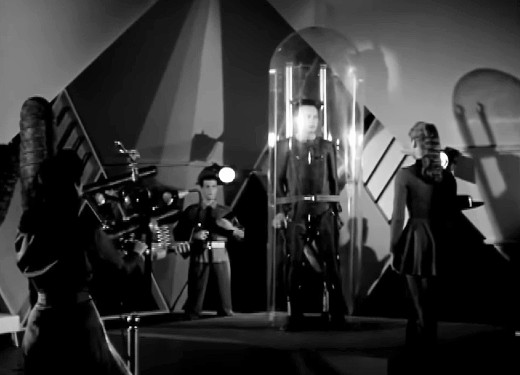
Screenshot - Major Allison (Robert Clarke) is taken captive in Beyond the Time Barrier (1960)
AIP executives hold Robert Clarke hostage while they run off with all the profits from Beyond the Time Barrier.

But Clarke was nothing if not resilient. In a interview with film historian Tom Weaver, Clarke insisted that he was grateful for his experiences behind the camera:

I would never say I was sorry because if I had not done it, I think I would have been sorry and would be saying that I wish I had tried it. It was an interesting experience. I wish, of course, that it had turned out more profitably and that it had led to other things that would have been more mainstream. With Roger Corman, pictures like these were stepping stones to bigger productions. But I took such a terrible bath with the bankruptcy on both Sun Demon and Time Barrier that I just felt there was no way to make another one and come out with anything. [Tom Weaver, Interviews with B Science Fiction and Horror Movie Makers, McFarland, 1988, pp. 90-91.]

If you decide to check out Beyond the Time Barrier, here’s hoping you’re as resilient as Robert Clarke and don’t regret your decision. Because, Prof. Bourman’s theories notwithstanding, most physicists insist that traveling back in time and undoing past actions is impossible.

Where to find it: Streaming #1 | Streaming #2 | DVD
November 17, 2012

Klaatu's Funny Uncle

The Cosmic Man (1959) poster
Now Playing: The Cosmic Man (1959)

Pros: Intelligent script celebrates science; Bruce Bennett is interesting and credible in the lead role
Cons: Bottom-of-the-barrel effects; Minimal excitement

I know as a fan of '50s sci-fi that I am supposed to love and revere The Day the Earth Stood Still (1951), but there's one small catch… I don't. There, I said it. I don't own a copy, I don't go out of my way to catch it when it's shown on TCM, and I haven't seen it in years. I remember as a kid being impressed with the saucer landing in beautiful Washington D.C., the space-suited alien slowly emerging from the craft, the nervous soldier shooting the figure, and then, best of all, Gort the robot vaporizing all the military equipment. Then it went on a long, slow downhill slide from there. It got all talky and serious and moralistic, like an overeager parent trying to steer you through puberty and sell you on the importance of eating vegetables all in one long, excruciating lecture.

Klaatu and Gort from The Day the Earth Stood Still (1951)
Klaatu tells the people of Earth: "Be more like me or die!"
Even though I was a dumb kid, I just didn't trust or like the Michael Rennie Klaatu character. While the film tries to convince you that this guy is wise and compassionate and all-knowing, to me he comes off as slick and self-righteous. I mean really -- what kind of person invades your turf, then says that if you don't play by his rules, he'll kill you?
"It is no concern of ours how you run your own planet, but if you threaten to extend your violence, this Earth of yours will be reduced to a burned-out cinder. Your choice is simple: join us and live in peace, or pursue your present course and face obliteration. We shall be waiting for your answer. The decision rests with you."
That's not tough love, that's sociopathic. In decent, red-blooded '50s sci-fi like Earth vs. the Flying Saucers (1956), we booted jerks like this off our planet without getting all mushy over what wonderful, advanced beings they might be.  In the words of Earth vs.' General Edmunds: "When an armed and threatening power lands uninvited in our capitol, we don't meet him with tea and cookies!" (On the other hand, sometimes it really was better to think first and shoot later when encountering an alien threat, as we shall see shortly.)

I think the primary reason for Day's sterling reputation over the years is that it's got a supposed highfalutin' message for mainstream movie fans who wouldn't normally touch sci-fi with a ten-foot tractor beam -- flying saucers and giant robots with death rays coming out of their faceplates are marginally acceptable as long as there's a moral to the story. And many true-blue classic sci-fi fans have somehow been browbeaten by the rest of society into giving this thing way more credit than it deserves.

By contrast, The Cosmic Man, with a plot that's more than a little reminiscent of Day, gets absolutely no credit at all. This thing is about as obscure as low-budget '50s sci-fi can get. So obscure in fact, that even I hadn't seen it until just a week ago. There's no real mystery to its uncelebrated status:  it's in-your-face cheap; the effects are minimal; the Cosmic Man (in human disguise) looks like somebody's funny great-uncle; and it's slow-paced and talky.

Even the great chronicler of classic '50s sci-fi, Bill Warren -- a guy who made it his business to see every forlorn, forgotten sci-fi film that ever existed -- had not seen The Cosmic Man when the first edition of his exhaustive Keep Watching the Skies! was published in the mid-'80s (McFarland, 1986). He managed however to write 6 tightly-spaced pages on the film, apparently from reading contemporary reviews and press releases and talking to people who had seen it. In spite of only knowing about it second-hand, he wasn't above passing judgment:
"Although something can be said for the makers of The Cosmic Man apparently having the desire to make something a little different from the usual story of invaders, their lack of skill apparently made the film dull, and the lack of originality made it too familiar."
The military tries to cut open the Cosmic Man's spacecraft
This "golf ball" from outer space is the film's
most sophisticated effect.
Fortunately, The Cosmic Man is now available on DVD and through online streaming (see below), and we don't have to just take Bill's word for it. IMHO, Warren's blind assessment gets it half right. There's no cool giant robot to liven things up. The best effect is a spaceship that looks like a giant golf ball suspended in mid-air. The second best effect is the Cosmic Man in a hood and cloak, printed in the negative, then superimposed to make him look like a being who's half in this universe and half somewhere else. It's dull in spots and cloyingly sentimental in others. And it borrows liberally from a number of films, most notably The Day the Earth Stood Still. In spite of its defects, The Cosmic Man does manage to set itself apart from the typical run of '50s B sci-fi by actually celebrating science and scientists, instead of indulging in the same old science run-amok clichés, with scientists portrayed as either naive or demented or both.

The story is simple (dictated by the ultra-low budget). Military radar picks up a UFO traveling at impossibly fast speeds. Soon, a mysterious white sphere is discovered suspended above the ground in a remote canyon. The military acts quickly to seal the area off, but not before a local lodge owner, Kathy Grant (Angela Greene) arrives at the scene and wants to know what's going on. Kathy is a Korean war widow with a precocious son Ken (Scotty Morrow), who has some unspecified affliction and is confined to a wheelchair. Of course she's a very attractive blonde (aren't they all?). Col. Matthews (Paul Langton) of military intelligence takes an immediate shine to the attractive widow, and swears her to secrecy.

The craft is uncomfortably close to a number of military installations. The general in charge (Herbert Lytton) wants to call in a noted physicist at nearby Pacific Tech University, Karl Sorenson (Bruce Bennett), to help with the investigation. Matthews is skeptical about bringing civilians in, but follows orders. Meanwhile, the locals are terrorized by a creepy, shadowy figure. Sorenson's lab is broken into, and a problematic equation for an ion propulsion project is corrected by an invisible hand. The military installations in the area also report break-ins.

A mysterious visitor (John Carradine) shows up at the lodge.
You'd think an advanced alien civilization would have heard of
contact lenses or laser eye surgery!
An odd-looking man dressed in a trench coat, hat, and thick glasses shows up at Kathy's lodge, wanting a room where he won't be disturbed. She assumes he's one of the scientists called in by the military. Neither the military or the civilian scientists are having any luck figuring out the sphere. It can't be cut with the most advanced torches, and it can't be moved with even the heaviest equipment. Sorenson has a theory that the craft converts light into energy, and he rigs up some equipment to try to tap into the sphere's energy, unleashing a tremendous sonic explosion in the process. Alarmed, the military calls in yet another scientist, Dr. Steinholtz (Hal Torey), to destroy the thing by surrounding it with a magnetic field. Sorenson preaches caution, to no avail.

The military and civilian types gather at Kathy's lodge to talk strategy. Suddenly the lights go out, and a black silhouette confronts the bewildered humans. The Cosmic Man makes a Klaatu-like speech revealing that the earth has been visited many times by interstellar neighbors, and that science, not fear, will enable earth people to join the community of the "free cosmos":
 "… I will speak to those of you who have expressed words and thoughts of understanding. You Dr. Sorenson, are engaged in a difficult field of endeavor-- you search for truth in a society that fears the truth. But you and others like you are the hope of the world. You must hold to your convictions, you must continue your work-- the fate of your civilization will become your responsibility."
Thankfully, this alien visitor is not one to threaten the planet with incineration if earthmen don't play by his rules. Still frightened by a creature with obviously superior technology, the military men give Steinholtz the go-ahead to disable the sphere with magnetic fields. Sorenson and his assistant rush to prevent them from possibly starting an interstellar war...

The peaceful nature of the Cosmic Man and the salute to science as mankind's best hope is certainly different for this type of B sci-fi. Not only that, but the leading characters are surprisingly adult and multidimensional. There are no absolute heroes or villains. The military men put up a brave front, but are clearly frightened by the unknown. Sorenson admits that there's much he doesn't know, and that he could be wrong about the Cosmic Man's intentions. The tension between the military men and the civilians is very plausible, but in the end, neither side really wins the day for humanity. This really goes against the formula grain for a cold war sci-fi programmer. Compare, for example, to Howard Hawks' highly regarded The Thing from Another World (1951), wherein a well-meaning but hopelessly naive scientist gets pulverized trying to communicate with the alien, while the wise-cracking guys in bomber jackets heroically save everyone's keisters.

Credit Arthur C. Pierce, a WWII Navy combat photographer, with a story that humanizes everyone, and steers clear of the same old "military good, civilians and scientists naive" cold war claptrap. (Pierce also contributed the screenplay to the Swedish-U.S. co-production Terror in the Midnight Sun, reviewed elsewhere on this blog.) The undisputed king of B sci-fi actors, John Carradine, has little to do but show up for a couple of brief scenes in a trench coat and coke bottle glasses, and lend his resonant voice for the Cosmic Man's climactic speech. As hammy as John was in this later stage of his marathon career, I never get tired seeing him in these roles, however small.

Bruce Bennett as Dr. Karl Sorenson
Dr. Sorenson (Bruce Bennett) listens with rapt
attention to the unearthly visitor.
Bruce Bennett is dignified and quietly competent as Sorenson. A star athlete in the 1928 Olympics, Bennett (born Herman Brix), lost out to Johnny Weissmuller for the role of MGM's Tarzan the Ape Man (1932), but he ended up playing the role anyway in an independently produced serial, The New Adventures of Tarzan (1935). He played in dozens of B movies through the '40s and '50s. According to Bill Warren, he retired temporarily from acting in the early '60s and made a lot of money in real estate (Ibid.). His best known role is Cody, the lone wolf prospector who tries to horn in on the gold action in The Treasure of the Sierra Madre (1948).

Sorenson/Bennett has a line that is as relevant today as it was 50 years ago-- perhaps especially so for a 21st century society that seems increasingly predisposed to rejecting science and the higher pursuit of knowledge in favor of superstition and make-a-quick-buck hucksterism.
"It's seems to be a common problem today, everybody's afraid of scientists… they seem to feel we know some sort of deep dark secret about the mysteries of life… Really, they're not afraid of what the scientists know, they're afraid of what they themselves don't know. All we're trying to do is find the answers to a lot of questions."
Amen.


Where to find it:
Available on DVD

Oldies.com

Available online

Amazon Instant Video

"Power beyond anything human! Terror from a world beyond!"

January 2, 2012

There's No Beast like a Snow Beast

Terror in the Midnight Sun (aka Invasion of the Animal People,  1959)

The Arctic region, along with its polar opposite, the Antarctic, present some of the most forbidding, surreal and hazardous landscapes humans have ever tread (and tried to survive) upon. The name derives from the Greek word ἄρκτος (arktos), meaning bear. From wherever you are, keep following the constellation Ursa Minor, the "Little Bear" (home of the north star Polaris), and you'll eventually wind up in the Arctic. The conditions are so extreme, and travel so difficult, that it's only been in the last hundred years or so that human beings have set foot on the geographic North Pole (a little over one hundred years if you accept Robert Peary's claim to be the first to get there).

During the Cold War seemingly no place on earth was exempt from U.S. - Soviet competition, and the Arctic was no exception. In addition to the space race of the late 1950s, there was a race to prove who could better secure and control the world's oceans, which culminated in the first submerged transit under the North Pole by America's first nuclear-powered submarine, the USS Nautilus (SS-168) in 1958. It's not hard to see why the forbidding Arctic piqued the interest of sci-fi moviemakers. Howard Hawks' classic The Thing from Another World (1951) was the first to exploit the lonely Arctic setting for its sci-fi terrors. Then atomic testing in the Arctic released The Beast from 20,000 Fathoms (1953). Other frigid sci-fi adventures included The Deadly Mantis (1957), The Land Unknown (1957; set in Antarctica), and The Atomic Submarine (1960; a unique underwater look at the Arctic region).

Add to the list 1959's Terror in the Midnight Sun, which, as stated in the end credits, was filmed in Lapland, above the Arctic circle in the north of Sweden. Terror is the very best American-Swedish sci-fi co-production made in the 1950s for under $50,000. Okay, that was snarky. This is not a great film, even for '50s sci-fi. But it does have its moments, especially when the alien monster makes its infrequent appearances. And if you like winter sports and activities, Terror is almost a filmed catalog of all the ways to have fun in desolate, frigid places.

The core story of Terror in the Midnight Sun, about 30 - 40 minutes' worth of the movie's short running time, is fairly straightforward. Something that is first thought to be a meteor has crashed into the remote northern wilds of Lapland. An expedition is hurriedly formed, consisting of an American scientist, Dr. Frederick Wilson (Robert Burton), a Swedish geologist and playboy, Eric Engstrom (Sten Gester), and various local scientific and military types. The mystery is heightened when local witnesses claim that the object traveled horizontally over the country for hundreds of miles before crashing into the base of a mountain. The team observes from the air that the object left long skidmarks in the tundra, very uncharacteristic for a meteor. Other mysterious occurrences may be connected to the meteor: huge animal tracks are seen in the vicinity of avalanches that seem to have no cause, and a herd of reindeer is decimated, possibly by the owner of the improbably large tracks.

Terror's alien spacecraft (right) was apparently inspired by
the eerie geodesic craft in It Came from Outer Space (1953).
Eric's scientific curiosity is piqued by the mystery meteor, and it doesn't hurt that Dr. Wilson's beautiful and shapely daughter Diane (Barbara Wilson) is also staying at the resort that serves as the expedition's base camp (a bystander describes her as "an Olympic star"). Far too much time is spent showing Eric ogling the beautiful Diane as she 1.) figure skates, 2.) does some downhill skiing, and 3.) stows away on the plane that sets out for the meteor crash site. Once out at the site, it becomes apparent that this is no ordinary meteor: "We're standing before some sort of craft from outer space!" Dr. Wilson exclaims, observing the unmistakable hexagonal portholes set in a metal, spherical exterior (the spherical craft and its crash landing seem to have been inspired by the Ray Bradbury classic It Came from Outer Space, 1953). At this point the action picks up, as we see from a bird's-eye POV shot some sort of giant creature advancing toward the expedition's plane and its pilot, who shoots at it with no effect.

The rest of the expedition members return to a wrecked plane and a dead pilot. Diane, the Olympic athlete, and Erik volunteer to ski to the nearest Laplander village for help. Mid-way, they take shelter in a rescue cabin, where the giant creature makes its first appearance. The scene is very well done, with the flickering fireplace in the darkened cabin contributing to the spooky atomosphere (see the clip below). The lumbering creature causes an avalanche that destroys the cabin and knocks Eric out cold. Diane tries to flee on foot, but gets scooped up and carried away by the beast, classic monster style.

The Death figure (left) from Ingmar Bergman's The Seventh Seal (1957)
seems to have been the model for Terror's hooded aliens.
Before all is said and done, Diane encounters the hooded humanoid occupants of the spacecraft (looking like the "Death" character from Ingmar Bergman's The Seventh Seal, 1957), the giant alien "pet" destroys a Laplander village, and then in turn is pursued by an enraged Laplander mob, torches in hand like an arctic version of 1931's Frankenstein. For a relatively short B movie, Terror takes way too long to deliver the goods, preferring to waste precious minutes and test the viewer's patience on "travelogue"-type scenes of the protagonists skiing, skating, dancing in a nightclub, etc. To add insult to injury, the canned travelogue music during these interminable sequences is perfectly awful. On the flip side, the tusked, furry giant creature is well-realized, especially considering the film's low budget. The filmmakers used some economical forced perspective shots and a few miniatures to lens some very effective scenes. Another nice touch is that for all its mystery, the creature at times seems somewhat sympathetic-- it treats Diane with tender care, and only becomes violent when shot at. The humanoid aliens never speak, but seem concerned about the creature, gesturing at Diane and then at the creature's tracks, as if asking her to help them find their "pet." At the end, Diane guesses that all they wanted was to retrieve the animal and go home. To its credit, Terror doesn't take the typical B route of clearly explaining the aliens' motivations.

Screenwriter Arthur C. Pierce, a Navy combat photographer in World War II, contributed to a number of B (and even cheaper) sci-fi movies of the '50s, '60s and '70s, including The Cosmic Man (1959), Edgar G. Ulmer's Beyond the Time Barrier (1960), The Human Duplicators (1965), and The Astral Factor (1976; with Robert Foxworth and Stefanie Powers). (He was the uncredited director of both Duplicators and The Astral Factor.) Robert Burton (Dr. Wilson) did tons of TV in all genres from the '50s right up to his death in 1962. His last film credit was the execrable The Slime People (1963), where he played another standard issue professor.

Z-grade sci-fi impresario Jerry Warren secured the rights to Terror in the Midnight Sun and added some scenes with always-ready-to-work John Carradine, and released his version as Invasion of the Animal People. Although I haven't seen this version, I've read that it takes the modest but watchable original version and makes it all but incomprehensible. Avoid Invasion and stick with the original. Terror is available on DVD-R from Sinister Cinema, as a download from Something Weird Video, and as a stream or download from Amazon.com.


In the dark of a remote wilderness cabin, Diane (Barbara Wilson) and Erik (Sten Gester) encounter a giant occupant from a downed alien spaceship: