Showing posts with label Paul Blaisdell. Show all posts

June 2, 2024

A Trip Down Monster Kid Memory Lane with Roger Corman

The great Roger Corman, master of the quick and cheap exploitation picture, producer and distributor of hundreds of films, and mentor to a whole generation of influential filmmakers and actors, passed away on May 9th of this year at the age of 98.

Public domain image courtesy of Wikimedia Commons
Roger Corman on the set of The Trip (1967; Wikimedia Commons)

Rather than duplicate a career summary that you can get in a thousand different places on the web, I thought I’d honor Roger by reminiscing about his influence on this particular Monster Kid growing up in the midwest in the ‘60s and ‘70s.

I’ve told this story before, so bear with me if it feels like a case of deja vu all over again. Living in central Iowa in the mid-‘60s was Monster Kid Heaven. On Friday nights, one of the Des Moines TV stations ran sci-fi movies, introducing me to such thrilling delights as The Beast from 20,000 Fathoms, Earth vs. the Flying Saucers and the like (there were also duds like Teenage Monster or Giant from the Unknown, but being a resilient kid, I took the bad with good and was grateful that my ever-suffering parents allowed me to stay up to watch this stuff at all).

Then on Saturday nights, my local station presented Gravesend Manor, which was hosted by the wacky ensemble cast of Malcolm, the butler of the manor, his vampire buddy the Duke, cigar-chomping Esmeralda, and Claude, the mute, put-upon assistant. Gravesend Manor was the icing on the weekend monster cake, showing selections from the Shock Theater package featuring the classic Universal monsters, with a few non-horror mysteries and thrillers thrown in (it was always a letdown when the familiar monsters failed to make an appearance, but on the up-side, anticipation would then build for the next week).

To say the least, the one-two, Friday-Saturday punch of sci-fi thrills and Universal monster chills made a deep mark on my very impressionable mind. After all, here I am, decades upon decades later, and I’m still revisiting these films and posting about them.

Newspaper ad from The Courier-Journal, June 9, 1957, Page 78, via Newspapers.com

I didn’t realize it at the time, but Roger Corman (and to give credit where it’s due, frequent writing collaborator Charles B. Griffith) had crept into my young head and were occupying it every bit as much as my beloved Universal monsters. I’d be lying to say I was impressed with every Corman film that showed up on Friday nights. I wouldn’t become familiar with the term “production values” until much later, but I knew cheap when I saw it.

These weren’t what you'd call polished pictures, but they still made an impression. For instance, the giant mutated crabs of Attack of the Crab Monsters (1957), with their lidded googly eyes and frowny faces, look like live-action cartoons. But there’s something very un-cartoony about the premise of giant irradiated crabs not only consuming human beings, but absorbing their consciousness and using that ability to lure more unsuspecting human prey into their maws (or whatever it is crabs eat with).

Okay, so giant crabs throwing their voices like ventriloquists, imitating the people they just ate for lunch is ridiculous on its face, but also creepy as hell. And then there’s the other doom facing the scientists -- the island they’re stranded on is quickly breaking up and falling into the sea. Even though the idea is wacky in the extreme, it still somehow resonated.

“The Most Terrifying Horror Ever Loosed on a Shuddering Earth!”

“A horror film has got to have something in every single scene, so the audience never has a chance to sit back for more than a moment. These films are constructed very carefully -- you do have to give people a few moments to relax and then come back into it. My main goal in Crab Monsters was to integrate tension into each scene, leading to the horror conclusion.” -- Roger Corman, The Movie World of Roger Corman (edited by J. Philip di Franco, Chelsea House, 1979)

Speaking of approaching Doom, it was Roger Corman who introduced 10-year-old me to the Apocalyptic variety via Last Woman on Earth (1960), an ultra-cheap fantasy-melodrama featuring a fatal love triangle between end-of-the-world survivors Betsy Jones-Moreland, Antony Carbone and future Oscar-winning screenwriter Robert Towne (who, in addition to writing, took acting gigs while he was still getting his feet wet in Hollywood).

I know, I know -- what in the world was a 10 year old boy doing watching something like that? Well, it was on one of those precious late-night creature shows, and in the olden days before video on demand, you took what they gave you and liked it.

“Liked” is maybe too strong a word in the case of Last Woman. Compared to all-out nuclear war resulting in a decimated earth filled with irradiated mutants, Last Woman’s apocalypse is almost gentle -- the trio had been scuba diving in Puerto Rico when a mysterious event depleted all the oxygen in the atmosphere just long enough to kill off everyone not breathing through some sort of gear. The film is a mostly slow-moving affair, with the survivors wandering around, bickering among themselves until the inevitable climactic blow-up.

This was a guaranteed snoozer for a prepubescent Monster Kid, with one exception. As the trio is walking through the streets of San Juan wondering what the hell happened, they encounter the body of a little girl lying like a large rag doll on the sidewalk. Needless to say, this got my attention, since one of the great unwritten rules of film violence is that adults are fair game, but kids and dogs are not. Disturbing as it was (especially as I wasn’t much older than the girl), this scene made the film Memorable, and automatically exempted it from the mental Dud pile.

“On an island of tropical splendor, these three must make their own world, their own new code of morals...”

A definite Dud (at least at the time) was the other film Corman made while shooting down in Puerto Rico, Creature from the Haunted Sea (1961). (Roger wanted the most bang for his buck when he invested in location shooting, so he was always looking to get an additional movie out of the deal.)

Featuring the same acting trio as Last Woman, Corman’s Creature is a comedy-horror mash-up about an American gangster who agrees to transport the deposed officials of a Caribbean banana republic to a safe harbor, but secretly plans to relieve them of their lives and treasure while blaming everything on a made-up sea monster.

Some of the comedy bits are cringey even for a 10-year-old, and the monster is comically cheap-looking, literally made from random household items. But screenwriter Charles Griffith’s premise is clever and adult for a cheap drive-in flick, and there are some wry comic moments to reward those who can look past its faults (see my full review here).

“It’s alright, be calm everybody, the boat’s insured!”

Much more in line with my Monster Kid sensibilities was Day the World Ended (1955), which was set in a more traditional apocalyptic post-nuclear war landscape, featuring a band of quarreling survivors threatened by a single (and singular) irradiated mutant (others are hinted at, but the budget apparently could only bear the cost of one monster suit).

Marty the Mutant, as the creature would come to be affectionately dubbed, was the creation of Paul Blaisdell, an independent effects artist who was highly ingenious and economical, and the go-to guy for several of Corman’s 50’s creatures. (Paul also saved costs by wearing the suit himself.)

Marty is positively demonic-looking, with pointed bat-like ears, horns growing out of his head, and three eyes (you scoff, but are you absolutely sure radiation from a nuclear war wouldn’t produce a Marty or two?). Marty’s evil looks are interesting enough, but he’s also somewhat sympathetic, with a psychic connection to one of the normie survivors that puts him a grade above the typical ‘50s B monster.

“The Screen’s New High in Naked, Screaming Terror!”

But the ultimate Corman-Blaisdell creature collaboration was Beulah, the squat, fierce-looking Venusian vegetable monster from It Conquered the World (1956). Beulah didn't quite achieve the lofty goal of the title mainly because, for budgetary reasons, she tried the conquering thing all by herself.

Although she may not look it to the untrained eye, Beulah was the Corman-Blaisdell team’s highest-concept creature. Corman and Blaisdell reasoned that in such an alien environment as Venus’, vegetables rather than animals might have reached the highest stage of sentient being. That alone wasn’t groundbreaking, given that the humanoid alien in The Thing from Another World (1951) was supposed to be an ambulatory vegetable.

Blaisdell took it a step farther with the idea that any kind of humanoid would be crushed by Venus’ atmospheric pressure (not to mention melted by the heat, but we digress), so natural selection would favor some other form of body type. And so, the squat, conical would-be conqueror Beulah was born. Once again, Blaisdell wore the suit himself (which was more like a small parade float with moveable arms than a suit).

Like many such other slow-moving menaces, would-be victims had to almost throw themselves at the creature, but there’s no denying that Beulah is unique in the annals of B sci-fi. (For more on Beulah, click here.)

“The Most Terrifying Monster the Mind of Man Can Conceive!”

“The first day we were shooting [It Conquered the World], I took the creature out. Beverly Garland, the leading lady, went over and looked at the creature. Standing over it, she said, ‘So you’ve come to conquer the world, eh? Take that!' and she kicked it.” -- The Movie World of Roger Corman

(I love that these creatures have nicknames.While they don’t represent the height of creature effects even for the time, they are wackily idiosyncratic with their exaggerated, frowning monster faces, and a refreshing change from all the giant insects and various other enlarged monsters that proliferated during the decade.)

This post wouldn’t be complete without addressing one other solitary invader from the ‘50s Corman archive. A year after Beulah failed to conquer the world, Corman had another alien set up shop in Southern California. Although he was Not of This Earth, Paul Johnson (Paul Birch) could definitely pass for human by covering up his cloudy, all-white eyes with dark glasses. Lacking a creature like Beulah, Not of This Earth (1957) had to compensate with some other-worldly ideas.

Johnson, looking like the original Man in Black, is an alien from the planet Davana who has come to Earth in search of uncontaminated blood (it seems his people have been sickened with blood disease as the result of a nuclear war.) To aid in his mission, Johnson has a matter transporter and holographic communicator installed in a closet (!) of his comfortable ranch-style home.

Posing as a man with a mysterious blood disease, Johnson enlists the unwitting aid of a doctor and nurse (Beverly Garland) to receive regular blood transfusions. The stakes couldn’t be higher: if the transfusions work, Johnson’s home planet will invade and subjugate the earth for access to healthy human blood. If they don’t, the earth will be destroyed.

I confess I was not too impressed with the movie the first go-round. It was slow moving and talky, and the alien menace, despite the disturbing eyes, was just a doughy middle-aged man in black (Johnny Cash he was not). However, a couple of scenes kept me from falling asleep.

In the first, Johnson is perturbed by a vacuum cleaner salesman who shows up on his doorstep (played by Corman mainstay Dick Miller). Sensing an opportunity, the alien invites the man down to the cellar for a demonstration of the product. Blathering away as he tries to make a sale, Miller’s character belatedly senses something’s not right, takes a look at Johnson’s featureless eyes, does a double-take, then looks forlornly at the camera for a brief moment before being dispatched by the space vampire.

This was my introduction to breaking the fourth wall, and it's a perfect example of the black humor that peppered Corman’s films and made even pre-pubescent Monster Kids like me sit up and take notice.

“Look buddy, let me have five minutes of your time in your own cellar, and I’ll prove to you that this little baby can do what no other vacuum cleaner in the world can do!”

Another sit-up-and-take-notice moment comes later when Johnson has been exposed as an alien invader. Deciding that he’s done with the doctor, the alien dispatches a flying, umbrella-like creature that wraps itself around the victim’s head and, well, maybe it’s best not to use your imagination.

The creature is a creepy forerunner of Alien’s infamous face-hugger. While this and the Dick Miller bit weren’t quite enough to redeem the film for me that first time, subsequent viewings revealed a wryly subtle take on mid-century American paranoia and strange agents hiding in plain sight in sunny Suburbia.

Whether the film hooked viewers the first time, or, as in my case, required repeat viewing to appreciate, it certainly has had an outsized impact for an early Corman exploitation flick, having been remade twice (most famously in 1988 with Traci Lords in the Beverly Garland role).

The ultimate Roger Corman cheapie that rewards repeat viewings is of course The Little Shop of Horrors (1960), which, appropriately enough, also enjoys the biggest cult reputation of all -- much of it due to its resurrection via a Broadway musical and a big budget remake.

This tale of a nerdy flower shop employee and his co-dependent relationship with a man-eating plant was made in a couple of days on a next-to-nothing budget. Full of ad-libbed dialog and seemingly ad-libbed sight gags, Little Shop is perhaps one of the unlikelier cult hits in cinematic history. Somehow, scenes that by themselves might seem sophomoric or forced -- like a duel to the death with dentist’s tools -- come together in a surreal package that has something for everyone (well, almost everyone).

It’s as if the super-accelerated production got the casts’ adrenaline going and brought out everyone’s best. There are physical bits and sight gags for Stooges fans and puns and malapropisms for the more verbally oriented (enough that it takes several viewings to fully take it all in). It’s hard not to like something about it.

Still, Little Shop was an unlikely attraction for a Monster Kid weaned on the more dignified Universal Monsters, but I was thrilled whenever it played on one of my creature features.

“Where a talking, man-eating plant gives Homicide something to think about!”

“If Bucket [A Bucket of Blood, 1960] and Little Shop, two of the cheapest films I ever directed myself, look like they were made on a bet, they pretty much were. In the middle of 1959, when AIP wanted me to make a horror film but had only $50,000 available I felt it was time to take a risk, do something fairly outrageous. I shot Bucket on only a few sets in five days. When the film worked well, I did Little Shop in two days on a leftover set just to beat my speed record.” -- Roger Corman (with Jim Jerome), How I Made a Hundred Movies in Hollywood and Never Lost a Dime, Da Capo Press, 1998, p. 62

Roger Corman inevitably graduated to bigger and better things, starting with the elegant Poe films he made with Vincent Price for American International Pictures. The man never stopped working, producing hundreds of films over the decades -- and as if that wasn’t enough, he somehow found time to do cameo appearances in some of his former mentees’ pictures.

But none of those achievements will ever fully eclipse the wonderfully quirky cheapies from the early years.They weren’t great films, but they invariably turned a profit, and Corman gained the kind of experience and smarts that money (especially bloated Hollywood budgets) can’t buy. But best of all, he created indelible memories for a whole generation of monster-loving kids.

July 7, 2022

Freakish, Frightful Fish People of Sci-fi B-movies, Part One: The She-Creature

Last year I created a series of posts on Amazing Animal People of Sci-fi, Fantasy & Horror. For the first post on Lota, the panther woman from the Island of Lost Souls, I observed that

“[O]ur myths and folklore are full of awe and wonder at the animal kingdom. From the animal-headed gods of ancient Egypt, to Native American animal shapeshifters, to werewolves and other were-beasts of European folklore, we have long been fascinated with the idea of taking on animal attributes and becoming something more than mere human.”

The series did feature one representative from the reptile kingdom, The Alligator People (1959), but I decided to save examples from the surprisingly robust B-movie fish/amphibian people category for another day (and that day is today).

Of course, the greatest anthropomorphic amphibian of them all is the Creature from the Black Lagoon. In the movie, the Creature is the last, lonely remnant of some evolutionary dead-end. For Universal Studios, he was an evolutionary bridge from the aging Gothic horrors of Frankenstein, Dracula and the Wolf Man to the space aliens and radioactive monsters of the Atomic Age.

More so than other human-animal hybrids, the Gillman and his kind speak to humankind’s primordial origins. According to one popular meme, at some point in our deep, dark evolutionary past we were sea creatures that sprouted legs and learned to crawl on land.

The Creature finds that he is not alone in the Black Lagoon.
"Julie! Grandpa! What are you doing here?!"

So here we are countless millennia later, sprouting so much extra body fat that we’re ready to start crawling again, if we can even manage that.

Who knows? In some parallel universe, a prehistoric butterfly may have fluttered its wings, causing an Alamosaurus to sneeze, which altered the flight of a flock of Pterosaurs, which affected wind currents just enough to generate a superstorm, which wiped out a struggling group of mammals that otherwise would have successfully competed with land-crawling fish, which evolved into 21st century Gill people, who watch horror movies about hairy, smelly mammals that can **GASP** walk around on two legs.

But thankfully, we live in a universe where hairy, smelly apex mammals make cheesily entertaining movies about fish-human hybrids. Here then is the first exhibit in Films From Beyond’s aquarium of the damned.

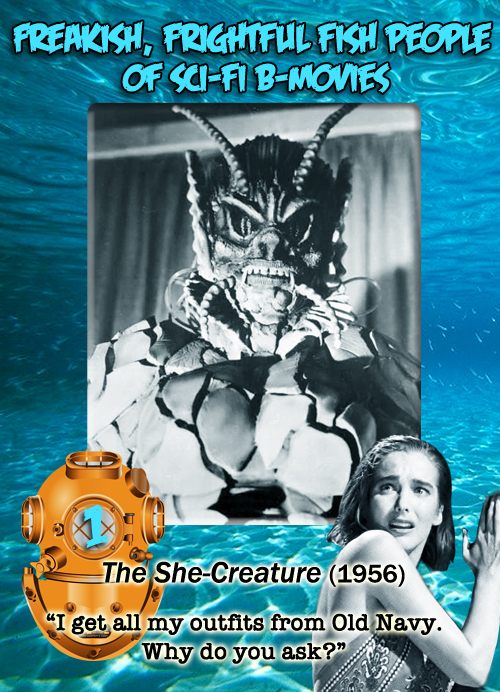
Freakish, Frightful Fish People #1: The She-Creature (1956)

Speaking of prehistoric amphibians that have the ability to lumber around on land and take out clueless humans, the She-Creature is perhaps second only to her cousin from the Black Lagoon.

The She-Creature’s cracked premise was inspired by the story of Bridey Murphy, which was all the rage at the time. Under hypnosis, housewife Virginia Tighe recounted all sorts of details about her past life as Murphy, an Irishwoman who lived in the first half of the 19th century. The story was serialized in 1954, and a best-selling book and movie came out in 1956, generating a huge wave of interest in reincarnation. 

Not content to just exploit the reincarnation angle, American International Pictures decided to make it drive-in friendly by tacking on a monster.

The sinister hypnotist Dr. Lombardi (Chester Morris) has a young woman, Andrea (Marla English), under his thumb, and uses her to prove his theories on reincarnation.

Lombardi conducts public sessions in which Andrea is able to summon not only the memories but the actual spirit of Elizabeth, a 17th century English woman. Lombardi further wows audiences with telekinetic tricks and dire prophecies of doom.

Lombardi and Andrea become a sensation, and the hypnotist publishes a best-selling book that makes him rich. But Lombardi, not satisfied with mere wealth and fame, has a dark secret. Under deep hypnosis, Andrea can cause her earliest incarnation, the fearsome, primordial She-Creature, to physically manifest itself. Lombardi uses his control of Andrea and her prehistoric self to kill his rivals, but typically for B-movie madmen, his scheme backfires.  

The She-Creature gets cosmetic surgery

The She-Creature was the product of the fertile imagination of monster-maker extraordinaire Paul Blaisdell, who was also responsible for some of the more memorable creatures of ‘50s sci-fi: Marty the Mutant from Day the World Ended (1955), Beulah the Venusian vegetable monster from It Challenged the World (1956), and It! The Terror from Beyond Space (1958), among others. (For more on Paul Blaisdell on this site, click here.)

The She-Creature is Blaisdell’s most iconic creation, and a gift to B sci-fi movies that kept giving. The suit, or at least parts of it, was used in several more movies and TV specials, including Voodoo Woman (1957) and Ghost of Dragstrip Hollow (1959).

Half-sheet poster, The She-Creature, 1956

Blaisdell was a freelancer who worked up his creations for next-to-nothing on next-to-nothing budgeted movies. His wild imagination and meticulousness made up for lack of big bucks.

In his book Paul Blaisdell: Monster Maker, Randy Palmer devotes several pages to the painstaking work that went into creating the She-Creature. Under one photograph of the suit, he sums her up nicely:

[The She-Creature] was built up from over 70 lbs. of foam rubber and latex. The bony protuberances on her elbows, claws, knees, and heels were carved out of white pine. The ‘lunch hooks’ in the creature’s abdomen were also made from pine. Using his stomach muscles, Blaisdell could make the lunch hooks open and close, but director Edward L. Cahn never utilized the effect in the movie. [Randy Palmer, Paul Blaisdell: Monster Maker, McFarland, 1997, p.86]

[Note: At this point I need to fess up for all the sticklers out there. The She-Creature is not a fish person per se. In fact, she has breasts (see below), which technically makes her a sea mammal. However, she is so iconic, I couldn’t in good conscience leave her out of this series. So, I am playing fast and loose with the term “fish people” to include sea mammals, amphibians, crustaceans and other assorted ambulatory, bipedal sea creatures that aren’t mutated fish. Just so you know.]

The director couldn’t be bothered with utilizing the creature’s horrific abdominal hooks, but he did want to make sure movie-goers knew exactly what her gender was:

“When [director] Eddie Cahn got a good look at Paul’s first female monster, he decreed that the creature wasn’t top heavy enough. ‘She’s gotta have bigger boobs,’ Cahn decided. Paul transported the costume back to the workshop for an evening of alterations. When he returned to the set the following day, Cahn took one look at Cuddles’ new set of double-D knockers and exclaimed, ‘Holy Christ! Well, at least now you can tell it’s definitely a woman.’” [Palmer, p. 91]


March 23, 2019

How to Make a Monster, Part 2: If Life Gives You Lemons...

Last post I celebrated several of the more effective/imaginative creature effects done for low-budget sci-fi movies of the 1950s. In part 2 of How to Make a Monster, I thought I’d delve into some of my favorite stories of effects artists, crew members and even actors, who, when faced with adversity and little or no money to make things right, did everything they could to bring their monsters to life.

The great filmmaker John Ford once said, “Most of the good things in pictures happen by accident.” If true, then the accident-prone pictures profiled here must be very good indeed.

Or maybe, just as it takes money to make money, it takes money to take advantage of happy accidents. The accidents and workarounds described here didn’t necessarily make the films better, but they do exemplify the spirit of “the show must go on!”

Beulah, the Venusian vegetable-monster, is the victim of a hit-and-run

To recap from the last post, the extraordinarily creative B movie monster-maker Paul Blaisdell created a wild-looking creature for Roger Corman’s It Conquered the World (1956) that he affectionately dubbed Beulah (and that others at the time nicknamed the Space Cucumber).

Poster: It Conquered the World (1956)
It was more of a mechanical contrivance than a suit, 6 feet tall and over 12 feet at the base, with moveable arms and crab-like pincers that could be manipulated with interior cables. From within the creature Blaisdell could also move the mouth via a wire.

On a frenetic set like Corman’s, where the overriding imperative was to get the film shot as quickly and cheaply as possible, it was inevitable that Beulah would run into trouble. In his book Paul Blaisdell, Monster Maker (McFarland, 1997), Randy Palmer describes her harrowing first day on the set:
"Unfortunately, disaster struck the very first time the costume was wheeled to the set. With members of the crew scurrying about to set up the camera and lights, Paul left Beulah by herself in a stationary position, with the arms resting on the ground. Before he knew it, one of Corman’s crew dragged a grip cart over the outstretched arms. The weight of the cart, piled high with film equipment, snapped the inner cables inside that worked the claw-pincers. When he checked, Blaisdell found that he could still raise and lower the arms, but the pincers would never again be able to pluck a handkerchief out of a breast pocket unless they were rebuilt and rewired, and there clearly wasn’t time for that. … [Later], When Pvt. Ortiz (Jonathan Haze) rushes the monster and tries to kill it with a bayonet, 'It' crushes him to death with its enormous piledriver arms. Because the cables controlling the claws had been severed, Blaisdell was unable to operate the pincers, which flapped uselessly on camera as Paul worked the arms around his attacker. Despite the ludicrousness of the scene, Corman kept it in the final cut." (pp. 69-70)

Beulah is smokin’ hot!

Lee Van Cleef tries to set Beulah on fire
"A light? No thanks, I'm trying to quit smoking."

 Palmer also relates how director Roger Corman missed shooting a neat but unintended special effect by being a little too quick to complete a scene:

"For the scene in which the monster is riddled with bullets, Beulah was outfitted with explosive squibs to simulate gunshots. For reasons of safety Blaisdell remained outside the costume, watching from the sidelines as the soldiers let loose with a barrage of rifle fire. On cue the squibbs detonated, leaving trails of smoke drifting in the air. When he thought he had enough footage, Corman yelled 'Cut!' He failed to notice that Beulah’s interior had become saturated with smoke, which started leaking out of every orifice on the creature’s conical body.
    Dick Miller, who had badly twisted his ankle in an earlier scene but remained on the set because Corman had drafted him into the crew, countermanded the director’s order: 'Don’t cut!'
   'I said cut!' Corman screamed.
   'Keep filming!' Fingers were pointing at something behind Corman.
   Corman turned around and saw his movie monster smoking like a cherry bomb. He ran over the cameraman, Fred West. 'Did you get that?' Corman asked.
   'No, you said to cut,' West replied.
   [Expletive deleted]" (Ibid., p. 71)

The Terror from Beyond Space sticks its tongue out

Another classic “It” that Paul Blaisdell designed and created from scratch was It! The Terror from Beyond Space (1958). More than 20 years before Alien, It! featured a terrifying humanoid-reptilian monster from Mars that stows away on a spaceship bound for earth and starts hunting the unsuspecting astronauts.

Ray Corrigan in the It! costume
"See if you can guess what this next shadow animal is!"
Inventive as always, Blaisdell built the suit up from a pair of long johns that the stunt man portraying the monster, Ray Corrigan, provided. He modeled lizard-like scales of different sizes in clay, then applied the finished latex ones in overlapping patterns to give the suit maximum flexibility. He fashioned the creature’s wicked-looking teeth and claws in soft wood.

However, a problem came up in fashioning the headpiece. Corrigan never showed up for Blaisdell to get a mold of his head, and with time growing short, Paul had to proceed using his own head as a guide. When it came time for the first fitting, the result was suboptimal:
"Ray Corrigan was standing in the center of the room wearing the It costume, holding the headpiece under one arm while the film’s makeup artist, Lane 'Shotgun' Britton, dusted his eyes with a mixture of powder and greasepaint. 'What’s going on?' Paul asked.
   By way of explanation, Corrigan pulled the mask down over his head. It was a tight squeeze -- the headpiece was much too small for Corrigan’s considerable countenance -- but with a little stretching and tugging he was able to wrestle it on. The only problem was that Ray’s bulbous chin stuck out of the mouth like a half-swallowed softball. …
   'You know, I’ve got an idea what you could do,' [producer] Bob Kent interjected. … 'You could paint his chin, or something,' Kent suggested. 'Maybe that would make it blend in better.'
   … Lane Britton had a better idea. 'What about this -- we’ll put some makeup on his chin and make it look like a tongue.' Before anyone had a chance to respond, Britton pulled out his greasepaints and went to work…" (Palmer, pp. 202-03)
Blaisdell added a bottom row of teeth to further conceal the chin, and It! was ready to go menace some astronauts.

Frankenstein’s monster undergoes gender reassignment

Frankenstein’s Daughter (1958), directed by B movie maestro Richard Cunha, updated the Frankenstein story to 1950s Los Angeles, and ambitiously featured two mad scientists and two (allegedly) female monsters.

Harry Wilson and Donald Murphy in Frankenstein's Daughter (1958)
"The girl at the mall told me this lipstick was perfect for my skin tone."
One of the scientists, Carter Morton (Felix Locher), decides to test his formula for ridding mankind of disease and old age on his niece Trudy (Sandra Knight). One of the regrettable side effects is a physical reversion to a bestial, cavewoman state. His partner, the truly mad Oliver Frank (Donald Murphy) is a chip off the old Frankenstein block -- he wants to sew the head of an innocent young girl onto a dead body and bring it back to life as… Frankenstein’s Daughter.

All well and good, except no one told the make-up man who was to create the monster that it was supposed to be female. All he knew was that he was making up a very male actor, Harry Wilson, and he made the natural assumption that the monster was male as well.

In an interview with Tom Weaver, Cunha reminisced about Harry and his reaction when he first saw the actor (who had dubbed himself “The Ugliest Man in Pictures”) in full-makeup for his role as Frankenstein’s daughter:
"He [Wilson] was a very patient man, and he suffered a great deal with that makeup and the suit that was required for him. And with the speed that we had to shoot at, it wasn’t like he could rest between takes…
   … We had no preparation time, and Frankenstein’s Daughter was designed on the set on the first day of shooting. And suddenly someone came up to me and said, 'Look, here’s your monster!' And I nearly died. We said, 'No, that's not quite what we need, but by God we can’t do anything about it!' And we pushed the guy on the set and started shooting -- the show must go on. So the monster wasn’t designed like that, it just … ended up like that, and once we achieved that [laughs], we had to keep it!” (Tom Weaver, Interviews with B Science Fiction and Horror Movie Makers, McFarland, 1988, pp. 115-16)
They carried on in the finest B movie tradition by having the makeup man slap lipstick on Wilson’s mug, creating a monster that only a Franken-mother could love.

February 28, 2019

How to Make a Monster: FFB’s Low Budget Creature Effects Awards

Now that the slow, rolling train wreck that was this year’s Academy Awards is finally over, the Governors or whatever they call themselves must be breathing a heavy sigh of relief. Profiles in courage they were not. First, to address the show’s declining viewership, they tried to introduce a new “Popular Film” category. They backed down when social media exploded with derision. Next, they picked popular comedic actor Kevin Hart to host. The social media warriors immediately dug up dirt to prove that he was a normal human being who makes mistakes, and he was gone. Finally, adding insult to injury, they proposed offloading the cinematography and editing awards from the live show to a few seconds of tape, and once again they backed down after a tidal wave of indignation (rightly so, of course).

“Ladies and gentlemen, by technical knockout in the third round, your winner and new world champion, Social Mediaaaaa!!!!!!”

"I don't think I can last another round -- those tweets are so mean!"
I do feel sorry for the Academy. It’s an impossible task to try to please everyone -- fans, critics, industry types, the show’s advertisers, etc. IMHO, their biggest challenge is the growing chasm between the big budget, big effects, big box office movies that are loved the world over, and the smaller, character-driven dramas that dominate the major awards but that relatively few people see.

Lumping something like Roma or Green Book with Black Panther in one Best Picture category is like comparing apples and elephants. Ultimately, I think the Best Picture category needs to diversify, but instead of “Popular” (which focuses too much on marketing and box office), they should go in the direction of the Golden Globes, with possibly three best pictures in such major genres as Action, Drama, and Comedy/Musical.

Even with the current status quo, the popular big effects movies do have their own sort of best picture award -- Best Visual Effects. (Interestingly, the Academy delivered something of a rebuff to comic books and sci-fi this year, as the award went to the docudrama First Man. Damien Chazelle’s biopic of Neil Armstrong was nominated in various technical categories, but was shut out of the major awards. In spite of some initial positive press, a fact-based movie about white men with crew cuts flying phallic-like rockets to the moon was/is distinctly out of step with current Hollywood culture. On the other hand, it seems the effects artists voting in this category rightly acknowledged that recreating authentic spaceflight on the big screen has its own set of challenges, perhaps even greater in some ways than creating a complete fantasy world.)

Obviously, this is a collective, not an individual’s award. A veritable army of highly talented artists and technicians, backed by big bucks, labors months on end to bring fantasy worlds and action heroics to life.

Before CGI helped sci-fi and fantasy action dominate the movie market, filmmakers with ambitious visions still had quite an array of tools on hand, from mechanical props and foam rubber appliances, to stop motion photography, mattes and optical printers. But they could scarcely imagine how computers would transform the business to the point that anything someone could dream up could be vividly and realistically depicted on the screen. Or how much money would flow into sci-fi and comic book adaptations -- genres that in their time were often disreputable and threadbare.

Of course, this blog specializes in just those disreputable and threadbare movies of old that against all odds, still have a fan base to this very day. In the spirit of the recently concluded film awards season, I’d like to honor the special effects maestros who didn’t have wads of cash or supercomputers to work with, but still managed to create some of the more memorably weird creatures of ‘50s sci-fi with the equivalent of chewing gum and baling wire (and lots of foam rubber).

Without further ado, here are my nominees for Outstanding Achievement in 1950s Low Budget Sci-fi Creature Effects:

Nominee: Paul Blaisdell
Film: It Conquered the World (1956)
Creature: Beulah, the Venusian vegetable monster

Paul Blaisdell was the premier wizard of low budget effects in the ‘50s, responsible for some of the weirdest, most imaginative monsters of the pre-CGI era. He was a sort of one man effects shop, designing and fashioning props, mechanical creatures and monster suits, and then operating and/or wearing them on camera.

He worked so cheaply and reliably that he was the go to monster maker for Roger Corman and American International Pictures, creating such unforgettable menaces as Marty the Mutant from Day the World Ended (1955) and the surrealistic She-Creature (1956).

Still, Beverly Garland with Beulah, It Conquered the World (1956)
"I wonder if I still have that recipe for Venusian vegetable soup?"
Perhaps his most outlandish creation is the titular monster of It Conquered the World, which he affectionately dubbed “Beulah.” The film is about a Venusian creature that establishes radio contact with an earth scientist (Lee Van Cleef), who, believing the advanced alien intends to bring peace and prosperity to the world, unwittingly helps it to establish mind control over key government people in order to subjugate the planet.

In his biography Paul Blaisdell, Monster Maker (McFarland, 1997), author Randy Palmer relates that, in developing the concept of the Venusian menace, Blaisdell, director Roger Corman and American International Pictures president Jim Nicholson all agreed that a creature from Venus’s particular environment and gravity “should naturally be built low to the ground.” But Blaisdell took the conception even farther, and Palmer quotes him at length:
At that time the belief about the physiognomy of Venus was that it was hot, humid and conducive to plant life but not too well suited to animal life. If anybody would care to think it out, there is a kind of vegetation we have right here on earth that you wouldn’t particularly feel like fooling around with… something that grows in the darkness and dampness, something that might grow on the planet Venus. Something that might, in lieu of animal life, develop an intelligence of its own. … It would move like a perambulating plant, but it would not move very far. When it wanted to conduct direct action, it would send out small creatures which it would give birth to, and they would do its dirty work. (p. 65)
The result looks like nothing else from ‘50s sci-fi. Purportedly, when actress Beverly Garland first set eyes on the creature, she responded with a sarcastic “That conquered the world?!”  The press also got in on the action, referring to it as the “cucumber” from space.

However, “Beulah” got its revenge on the set.
According to the script, Garland’s character uses a Winchester rifle to fill the monster full of lead in between lines of dialogue, but ends up perishing in its lethal grasp. To help Blaisdell play the scene, Corman stationed two prop men below the camera lens who would help maneuver the costume’s monstrous arms into the frame. The first take was ruined when one of them misjudged the target and smacked Garland square in the chest with those oversized pincers. (Palmer, pp. 70-71)
Beulah is truly a one-of-a-kind monster next to all the rubber-suited humanoids and giant insects and dinosaurs that rampaged across drive-in screens in the '50s. After you get over your initial instinct to snicker, her distinctive WTF! ugliness commands attention. She reputedly was director Roger Corman’s favorite of all of Blaisdell’s creations.

Nominees: K.L. Ruppel and Baron Florenz von Nordhoff
Film: Fiend Without a Face (1958)
Creatures: The brain creatures

This category would not be complete without a stop-motion animated monster, and Fiend Without a Face delivers a ghastly gaggle of repulsive animated creatures that make your skin crawl even as another part of your brain is marveling at how ridiculous they are.

At a military nuclear research facility in Canada, Major Cummings (Marshall Thompson) has his hands full when several local townspeople die under mysterious circumstances and people start blaming the facility. At the same time, the facility experiences inexplicable power drains on the nuclear reactor. It seems a local scientist is hijacking the facility’s power in order to conduct experiments on turning thought into material form. What could go wrong?

Still, a brain creature from Fiend Without a Face (1958)
The brain creatures dial up the suspense in Fiend Without a Face.
 The terrifying mind-into-matter creatures were the brainchildren (pun intended) of German effects specialists K.L. Ruppel and Baron Florenz von Nordhoff. The duo managed to pull off some amazing stop motion effects using the SFX equivalent of a low rent Frankenstein’s laboratory. In his book Cheap Tricks and Class Acts (McFarland, 1996), John “J.J.” Johnson quoted from an old Fangoria magazine interview with the film’s producer John Croydon:
The entire maze [Ruppel’s studio] was a mixture of an aircraft control panel and a computer. Each button controlled a selsyn motor, used primarily for the activation of aircraft rudders and flaps on an early motion-control principle, refined years later by George Lucas’s Industrial Light and Magic. To these were attached wires which, in turn, activated a single movement of a fiend: to raise the head, to make it stand on its tail, to fasten its feelers beneath the wooden boards barricading the windows, to pick up and withdraw a hammer left on the sill. Ruppel had carefully timed the movements of the fiends to coincide with the camera shutter. The creature models were linked up with the camera in such a way that a single small movement of a fiend was photographed on two frames of film. … It was a long laborious process, taking three weeks to accomplish, but once this footage was combined with live-action through rear projection and blue-backing traveling mattes, the results were fantastically realistic. (pp. 72-73)
The beauty of the brain creatures is that when you first see them -- naked brains with insect-like antennae and spinal cord tails -- you want to guffaw. But when they wrap their tails around the necks of the horrified victims, they suddenly aren’t so ridiculous. This alone makes Fiend Without a Face one of the more memorable minor classics of the ‘50s.

Nominee: Richard Cassarino
Film: The Hideous Sun Demon (1958)
Creature: The reptilian Sun Demon

Although The Hideous Sun Demon had an ultra-low budget somewhat south of $50,000, it boasts one of the coolest (and yes, most hideous) creature masks in a decade that swarmed with all manner of foam rubber horrors.

Still, Robert Clarke as the Hideous Sun Demon (1958)
"Do you want pepperoni or mushrooms on your pizza?"
The Sun Demon was born when B actor extraordinaire Robert Clarke, noting the box office success of the cheap-as-dirt The Astounding She-Monster (1957) he had recently starred in, decided that he could do just as well producing his own monster movie.

He had the idea to do a sci-fi variant on the classic Jekyll and Hyde story, but instead of a serum, it’s accidental exposure to radiation that turns the mild mannered scientist into a ravening monster. Another story kicker is that as a result of chromosomal damage to his body, the protagonist only changes into a monster when exposed to the sun.

In an interview with Tom Weaver (Interviews with B Science Fiction and Horror Movie Makers, McFarland, 1988), Clarke revealed that he had thrown in $5000 of his own money to get the project started. To keep costs down, he recruited non-professional actors, used students from nearby U.S.C. as crew members, and shot the film on weekends. He also got a screamin’ deal on the monster mask and suit (although at the time it seemed like a huge cost):
For us it was a major expense -- five hundred bucks is what it cost. I went to see Jack Kevan, the fellow who did Creature from the Black Lagoon, and he said, ‘To make what you want, I would charge you at least $2,000.’ He was not overpricing it, but luckily I found this fellow Richard Cassarino, who was a film buff and sometimes-actor. … The suit was made on the base of a skin diving wetsuit, and it was hotter than blue blazes! It was so hot that my perspiration ran down my body and [laughs] into my trunk area, shall we say, and during the fight we got so much energy going that one of the still shots shows me standing up there with this wet appearance -- it looks like I couldn’t make it to the men’s room... (p. 86)
Although overall the film looks as cheap as its budget and the acting is variable at best, the hideous, reptilian Sun Demon looks way, way cooler and scarier than its $500 cost would suggest.

Nominees: Herman Townsley and Howard Weeks
Film: The Angry Red Planet (1959)
Creature: The Rat-Bat-Spider-Crab

The rat-bat-spider-crab monster is featured prominently on the poster for The Angry Red Planet (1959)
When I first saw Angry Red Planet at about the age of 9 or 10, I was mesmerized by it. It had everything a sci-fi fan could want: a needle-nosed spaceship, wisecracking astronauts, a beautiful red-haired scientist-astronaut (Nora Hayden), a weird, glowing red Martian landscape (thanks to Cinemagic!), and monsters galore. There was a gelatinous blob with a huge rotating eye, a three-eyed Martian, and best of all, the unique Rat-Bat-Spider-Crab that towered over the terrified space travelers.

This hybrid horror was designed by effects supervisor Herman Townsley and brought to fruition by model maker Howard Weeks. It required a lot of finesse and “fly by the seat of your pants” ingenuity to pull off the ambitious creature sequence. In his biography of director Ib Melchior (Ib Melchior: Man of Imagination, Midnight Marquee Press, 2000) Robert Skotak notes how tricky it was to make the lightweight Rat-Bat-Spider puppet convincing for the big screen:
Known for his invisible wire work, Townsley had solved the problem of visible strings on the batrat puppet by casting the critter in the lightest weight resin known, allowing him to use superfine wires coated with a patented acid he’d developed, which eliminated the metallic reflections. Even the the whole thing, -- complete with monkey fur -- hardly weighed a couple of ounces, Townsley had faced knotty physics problems in working out the delicate weight-to-support ratios… Howard Weeks, who had created the effects for the low budget The Man from Planet X in the early ‘50s, employed a double ‘flying T’ rig to operate the creature, but, unfortunately, found the nearly weightless marionette had a bouncy quality that was difficult to eliminate in only one or two takes… He hired marionette maestro Bob Baker to help operate it. (pp. 110-111)
It’s a good thing that the crew found a way to make it all work within the limited budget, as it’s the most memorable scene in the film. And befitting his status as the lead attraction, Rat-Bat-Spidey is featured prominently on most versions of the film’s poster.

Nominee: Jack Kevan
Film: The Monster of Piedras Blancas (1959)
Creature: A Poor Man’s Creature from the Black Lagoon

Like the Hideous Sun Demon, this nomination is all about the suit. While Robert Clarke found Jack Kevan to be a little too pricey for his production, the producers of The Monster of Piedras Blancas scored a coup in enlisting Kevan to work up their creature suit. Kevan had not only been involved in helping to create The Creature from the Black Lagoon (1954), he also lent his talents to such sci-fi classics as It Came from Outer Space (1953) and The Incredible Shrinking Man (1957).

Still, the Monster of Piedras Blancas (1959)
"Alas, poor Yorick! I knew him, Horatio; a fellow
of infinite jest, of most excellent fancy..."
The Piedras Blancas creature was partially built, Frankenstein-like, from other body parts. The Metaluna Mutant of This Island Earth (1955) contributed his feet and torso, and the huge claws came from The Mole People (1956).

Even with borrowed body parts, the monster has its own distinctive, gruesome look. The producers, perhaps feeling that a cool suit by itself wouldn’t bring audiences flocking to the drive-in, upped the gore factor considerably -- the monster likes nothing better than to decapitate its meals before eating them.

In his survey of American sci-fi films of the 1950s and early ‘60s Keep Watching the Skies (McFarland, 1982), Bill Warren compared the Piedras Blancas monster with its obvious inspiration, The Creature from the Black Lagoon:
Certainly the design … isn’t as interesting or as logical as those for the 1950s Universal monsters, although it is well-constructed. … The Monster … is in the ‘diplovertubron’ family, and was ‘created at the bottom of the sea.’ An amphibious ‘mutation of the reptilian family,’ he deserves comparison with the Creature from the Black Lagoon, the Gill-Man. And on the basis of reasonableness, the Monster doesn’t measure up to the Gill-Man. The Creature, of course, is unlikely, but has an overall logic: to protect against the water, the eyes are shielded and glassy; it has a mouth like a frog, and no nose at all; there are highly visible gills; the hands and feet are webbed. While it plays hob with any know ideas of adaptability to the water, it has its own logic, and is such a plausible design that creators of amphibious monsters, whether for comic books, film or TV, have to work hard to make their monsters not look like the Gill-Man. It’s that persuasive and logical. (pp. 319-320)
Again, like the Hideous Sun Demon, the film suffers from cheap production values, but in the end is redeemed by an ultra-cool member of the Gill-Man family.

And the winner is:

"I only have eyes for you." Paul Blaisdell with his creation.
Paul Blaisdell for his freakish, yet endearing creation Beulah. She is both an imaginative suit and a mechanical contrivance. Some may disparage Beulah for her cartoonish appearance, but she is the result of Blaisdell’s thoughtfulness about what sort of a creature might evolve on a planet with extreme atmospheric pressures and gravity.

Ib Melchior, the director of The Angry Red Planet, was also an advocate of not just creating fearsome-looking monsters, but making them plausible:
To me, if you design a creature that lives in a world that is bathed under two suns, and you design a creature with huge eyes -- it’s nonsense. Its eyes would be tiny. … It seems most people just design these monsters which don’t bear any relationship to where they come from. Same thing if you design a creature that comes from a planet with 10 times the Earth’s gravity and you give it long, spindly legs. You don’t do that. They would be squat. This is what I object to in monster design, that there is no relationship between what they [look like] and their environment. (Skotak, p. 114)
There’s no record that Ib ever saw Beulah, but I think he would have approved.

January 14, 2014

Safety Last: Close Calls in B Movie Stunt Work

This brand new year is a particularly auspicious one for me, as I started a new job last week. With a new job comes new challenges, not the least of which is trying to find out where HR is holding its employee orientation in a maze-like building the size of a small city block. I was running late, had wolfed down a burnt toaster waffle for breakfast, didn't have time to make or buy a coffee, forgot my water bottle, and was desperately looking left, right, up, down and around the main foyer of the Services building, trying to find some clue as to where they were holding the orientation, when a fellow new employee (who had the presence of mind to get there early) came out of a nearby restroom, took pity on me, and mercifully guided me to the appointed meeting room.

The great Harold Lloyd in Safety Last! (1923)
"I think I have just enough time
to grab a quick cup of coffee!"
I was absolutely sure there'd be coffee, maybe even doughnuts (or at least bagels), but alas, there were no refreshments whatsoever. It was all business at an ungodly early hour of the morning. Plus, the HR people were fiendishly clever. There was a sign-up sheet up front, but also sheets to be signed and turned in only after they'd covered the material. There was to be no quick scribbling of initials, then quietly skipping to track down a nice grande latte or a fresh blueberry muffin. Instead, I had to absorb scores of Powerpoint screens full of dry information only the most zealous accountant or personnel manager could love… all without a trace of caffeine in my system!

Ironically enough, the morning was saved by the last part of the presentation… on, of all things, workplace safety. While not exactly a stand-up comedian, the presenter at least knew enough to grab attention with photos and videos of some of the most diabolical workplace hazards ever cobbled together by caffeine-starved clock-punchers whose only excuse could be that they were sleepwalking through their jobs. There was a photo of a rickety ladder tied to another rickety ladder to make the mother-of-all dangerous makeshift extension ladders. There was a daring workman, barefoot, with sopping wet pants, busily using an electric drill and extension cord while standing on an aluminum ladder set up next to a pool of water. Yet another featured a pair of workmen perched on a high, narrow ledge ringing an impressive atrium -- no railings, no tie-offs, the one using a short ladder on the ledge to get to an even higher window, the other kneeling at the foot of the ladder. One sneeze, one slip and …

But the coup-de-grace was a video clip of the one of the more dangerous workplaces I've ever seen. Behind a bar, a woman can be seen in the foreground filling a glass, her back turned to the counter. Two other employees pop into the picture, and one lifts a trapdoor in the floor (?!) right behind the woman and walks down the steps to a cellar. Oblivious, the woman finishes filling the glass, takes a step back, and promptly disappears down the hole! (The presenter assured us that although it looked bad, the woman was not killed. Apparently the investigators concluded that lack of communication was a key -- as in, "Hey there Norma, we're right behind you and and please be aware that we just opened the trapdoor to this incredibly dangerous, incredibly stupidly planned cellar located right in the center of the busy, cramped space behind the bar….")


Although it's unlikely that I'll be grappling with these kinds of safety issues (my biggest challenge will be making sure that all that hot coffee I swill stays in the mug instead of ending up in my lap or on my keyboard), it was certainly an entertaining and educational way to wrap up the orientation. It never ceases to amaze me the ingenuity that human beings bring to cutting corners so that they can grab an extra cup of joe or a quick smoke behind the dumpster.

Speaking of ingenuity and lots of corner cutting, the B movies featured on this blog couldn't have been made without those key ingredients. Lack of time, money and resources usually leads to suboptimal outcomes, but once in awhile, with talented people and the planets aligned just right, it can stimulate creativity and lead to something sublime. Val Lewton proved that you can often frighten audiences by not showing them in graphic detail the object of their fears (and save some time and a lot of money). But in the movie business, one area where you most definitely do not want to cut corners or fly by the seat of your pants is stunt work.

Unfortunately for many B productions of yore, the pressures to just get the thing in the can on time and on budget meant that directors who didn't know a pick point from a nose pick doubled as stunt coordinators, and unsuspecting actors who just wanted to get another picture on their resume suddenly found themselves risking their necks doing their own stunts. Fortunately, the guardian angels who look after fools and B movie crews apparently did double-duty, as there are many more close calls in the lore than actual tragedies.

So without further ado (and before I get carpal tunnel from typing too much), here are a few close calls from the annals of "make-it-up-as-you-go-along" B movie stunt work. And remember: Don't try this at home!

"That was a disastrous film to work on."


Actor Richard Devon
"I'm not getting paid enough for this crap!"
There are no two ways about it. Richard Devon, a fixture (especially as villains) in Roger Corman's early films, didn't particularly appreciate the King of the Bs. But then, if you'd witnessed Roger choosing to save a buck or two at the expense of his actors' safety, you might have been bitter too. In an interview with Tom Weaver, Devon talked about risking life and limb doing location shooting for The Saga of the Viking Women and Their Voyage to the Waters of the Great Sea Serpent (1957; aka The Viking Women and the Sea Serpent… whew!):
"That was a disastrous film to work on. It was as if Roger were really trying to short his skimpy shooting schedules, even more than what he had done. He was trying to beat his own record. He didn't want to waste a frame, nor did he spare anyone's feelings on the set. He was an absolute demon. As I said before, in his office he would purr like some wide-eyed kitten-- but he could be dangerous.

In one sequence in Viking Women I had to ride this horse through a small cave. It was like seventeen and half hands tall, and that's a tall horse. I was leading the other Grimaults [film characters] through the cave on this huge horse, and the sucker hung me up on a wall and damn near tore my kneecap off. As I recall,  there was never any nurse or first aid people on the set; Roger said 'uh huh' to my problem, and, 'Let's get on with it.'

Lobby card - The Viking Women and the Sea Serpent (1957)
[Speaking of shooting the Viking Women's voyage on location at a beach]. That was a condemned beach at Cabrillo. Nobody bothered to tell us it was condemned. They used to post signs when they condemned a beach; somebody had picked up the sign and threw it in the bushes, but I found it. And then we saw the water, and there was a tremendous undertow-- it was sort of scary. We were all down there on the day when Roger shot the scene where the Viking women launch their ship. If you recall the film, the rudder falls off the boat. Needless to say, that was not supposed to occur, but Roger is undaunted-- nothing stops Roger. They just kept going. The girl who swam after the boat was swimming to save her life, because of the undertow. She got to the boat, and they pulled her in."
[Tom Weaver, Science Fiction Stars and Horror Heroes: Interviews with  Actors, Directors, Producers and Writers of the 1940s through 1960s, McFarland, 1991]


Where to find it:
Available on DVD

Oldies.com

The She-Creature Meets The Three Stooges


Paul Blaisdell, monster-maker
Paul Blaisdell in his She-Creature suit.
Tragically unheralded makeup and effects artist Paul Blaisdell created some of the most memorable and outrageous B movie creatures ever to slither, stalk or stomp across a drive-in movie screen. He was a genius at taking a handful of cheap materials, locking himself in his garage, and delivering the goods just in the nick of time to satisfy the pickiest, most time-pressed director. Predictably, many of his creations were featured in, you guessed it, Roger Corman's '50s sci-fi flicks. If it was a creature suit, Paul usually wore it himself, which from time to time was his undoing. Biographer Randy Palmer relates some Three-Stooges-like miscues on the set of The She-Creature (1956):
"For the scene in which the creature smashes into Johnny's (Paul Dubov) apartment, the crew had prepared a specially scored door made of balsa wood that would come apart easily in sections. The only problem was that it was so delicately fitted together that if anyone brushed up against it the whole thing came tumbling down. Since there was just the one door (there was never enough money in the budget to do these kinds of things twice), someone had the foresight to protect the breakaway prop by reinforcing it with plywood from the opposite side. When it was time for Blaisdell to knock the hell out of the door, no one remembered that it had been reinforced. … When [director] Cahn called 'Action,' Blaisdell raised a creature claw and smashed at the door, but the rubber-coated pine costume just bounced off. Blaisdell hit the door with such force he was knocked backward and fell on the creature's tail. There was so much latex and foam in the tail it almost bounced back up. ...

Lobby card - The She-Creature (1956)
The climatic appearance of the monster was filmed on location at Paradise Cove near Los Angeles. This was the only time in the film the monster would actually be seen emerging from the waves, and Eddie Cahn wanted it to look impressive.
'Get out in the water, Paul,' Cahn told Blaisdell. 'Way out.'
Blaisdell walked into the surf and turned around.
'Farther!' Cahn yelled.
Blaisdell backed up a few paces.
'No, no! Get really far out! Farther! Get out up to your waist!'
By the time Paul reached the point where Cahn was happy with what he saw, Blaisdell had become a mere dot in the camera lens. Cahn had set everything up as a wide-angle long-shot, but Blaisdell didn't know that. Besides, he had other things to worry about. The costume was acting just like a big sponge. The foam rubber was saturated with so much sea water he could barely move. … The water-logged suit of foam rubber felt like it weighed a ton. Every time Paul pushed forward the outgoing ocean current pushed him back. So he started lunging through the water. It was the only way he could make any progress. … As it turned out, Blaisdell suffered through the oceanic acrobatics all for naught. The image of the monster lumbering out of the ocean had been shot from so far away that nobody could tell what it was, and most of the footage ended up on the cutting room floor."
[Randy Palmer, Paul Blaisdell: Monster Maker, McFarland, 1997]


Where to find it:
Available on DVD

Amazon

"Are you wearing underwear?"


John "J.J." Johnson, Cheap Tricks and Class Acts, McFarland, 1996
Writer, producer, director and all-around B movie entrepreneur Bert I. Gordon (aka Mr. B.I.G.) was notorious for his obsession with all things gigantic in such films as The Amazing Colossal Man (1957), The Cyclops (1957) and The Food of the Gods (1976). In Attack of the Puppet People (1958), he turned giantism on its head by featuring a group of unsuspecting people shrunk down to doll size by a mad scientist. In an interview originally published in Filmfax magazine (and reprinted in John "J.J." Johnson's Cheap Tricks and Class Acts), Puppet People cast member Ken Miller relates one of the funniest and scariest moments in all of Mr. B.I.G.'s long line of B productions:
Lobby card - Attack of the Puppet People (1958)
"The most horrendous physical thing I've ever had to do was on that movie during the scene where I climb up the door to peer through the keyhole. Well, that climb was 50 feet up to the top of the soundstage and I was using a thick rubber rope tied to the giant doorknob at the top. When I was about halfway up, the doorknob started to come off. ... They weren't recording sound in the scene so I yelled down, 'The damned doorknob's coming off!' and the director yelled back, 'Keep going, it looks great!' Then, to make matters worse, my pants, which felt like they'd been glued on, started to split at the crotch. So I yelled, 'My pants are starting to rip' and Bert yelled back, 'Are you wearing underwear? Then keep going!' I got to the top of the rope and held on to the doorknob as two grips reached around and grabbed me. Just as they pulled me up, the doorknob came completely off, it was that close. And the pants just ripped right up my ass. Thankfully, it doesn't show in the film. The next day I couldn't move, I had used muscles in my body that I had never used before. They had to shoot around me while I went in for some physical therapy."
[John "J.J." Johnson, Cheap Tricks and Class Acts: Special Effects, Makeup and Stunts from the Films of the Fantastic Fifties, McFarland, 1996]

Where to find it:
Available on DVD

Oldies.com