It's almost that time of year again, the time that the old Celts called Samhain, and that today we call Halloween, when the thin barrier that separates our world from that dark place where monsters, ghosts, witches and ghouls rule, evaporates altogether, allowing the denizens to break out, mingle, and generally mix it up.
Our tradition of dressing up in costume on Halloween comes from the Celts. As the website IrishMyths.com puts it, "[T]he goal of [Samhain celebrants] wasn't to appear cute or strong or extravagant, it was to disguise oneself from -- or perhaps even blend in with -- the supernatural beings that might potentially be crossing over from the Otherworld. That meant adopting a frightening appearance." [https://irishmyths.com/2022/10/14/halloween-costume-history/]
The monsters broke through to our world just in time to join a parade of trick-or-treaters.
Here at Films From Beyond we have a direct landline to the Nether/Otherworld, and have it upon good authority that, these days, the dark denizens are as afraid of us as we are of them, with good reason -- both worlds have more than their share of monsters.
But that hasn't deterred Otherworld monsters from going trick or treating on Halloween. For one thing, they don't have to worry about what costume they're going to wear -- they're already in costume, so to speak. For another, they weren't raised by helicopter parents worried about stranger danger or their little ones stubbing their toes in the dark. On Halloween night, they're raring to go. But alas, Halloween isn't always a joy, even for monsters.
Caltiki the Immortal Monster decided that instead of going door-to-door trick-or-treating, he would wait for the other kids in the neighborhood to fill up their bags, and then just eat them. Caltiki, the Immortal Monster (1959)
Caltiki's favorite treat: Eating whole houses, occupants and all.
Favorite trick: Eating whole houses, occupants and all.
Best friend to go trick-or-treating with: His cousin, the Blob.
The Thing That Couldn't Die waited hundreds of years to be dug up so he could go trick-or-treating, but then lost his head when a neighborhood kid accidentally carried it away in his treat bucket. The Thing That Couldn't Die (1958)
Favorite treat: Gummy worms.
Favorite trick: Using his head as a treat bucket.
Best friend to go trick-or-treating with: His girlfriend, The Brain That Wouldn't Die.
The Brain That Wouldn't Die was fuming when she realized that her telepathically-linked mutant assistant ate all the good Halloween candy and left her with a couple of packets of SweeTarts. The Brain That Wouldn't Die (1962)
Favorite treat: Four lumps of sugar added to the nutrient broth she sits in.
Favorite trick: Telepathically commanding the mutant to tear the arms off of people who annoy her.
Best friend to go trick-or-treating with: Well, not the mutant any more; maybe the Thing That Couldn't Die if he can find his head.
Tabanga the walking tree monster wished he could move faster, fearing that by the time he got to the first house, all the candy would be gone. From Hell It Came (1957)
Favorite treat: Miracle-Gro.
Favorite trick: Hanging a sign around his neck that says "Free Firewood" and then attacking anyone who gets close.
Best friend to go trick-or-treating with: Donald Stump.
On Halloween night, the She-Creature walked the length of her favorite beach, but was disappointed when none of the beach house dwellers would answer their doorbells. The She-Creature (1956)
Favorite treat: Swedish Fish.
Favorite trick: Tugging at fishermen's lines and then yanking them off their boats when they try to reel her in.
Best friend to go trick-or-treating with: Her cousin from South America, The Creature from the Black Lagoon.
Pros: The unique, ironic premise of out-of-control science is still fresh and relevant to our present age; Terence Fisher's direction shows flashes of a talent that would make Hammer world famous for its horror films. Cons: Some will find the pacing slow and the production design of the laboratory "slapdash."
Terence Towles Canote is hosting his 13th annual Rule Britannia Blogathon over at A Shroud of Thoughts, wherein bloggers are invited to write about any British film or any topic related to Britain's contributions to film. Not being particularly superstitious, I signed on to this year's event with the thought that not only would I write about a British film, I'd write about one in which Britannia indeed rules, at least in terms of its setting and plot.
An obvious choice would be an adventure or war film set at the height of Great Britain's empire, but since this blog is focused on sci-fi and horror, and since I'm not a big fan of empires, you'll have to go elsewhere for that sort of thing. Nope, Four Sided Triangle has no sword fights, broadsides between sailing ships, or any of the derring-do that you might normally associate with a phrase like "Rule Britannia."
In place of daring action, Four Sided Triangle features a daring idea that, brought to fruition by two unassuming British inventors, has the capacity to revolutionize the world economy and life in general. "A load of rubbish!" you say? "Nothing earth shattering or innovative came out of Britain after it was exhausted by two world wars and could only manage to shed itself of its costly empire!" you say? Well, Hammer Films, and reality, beg to differ.
I'll let Bill Bryson, American expatriate and travel writer, speak to the British innovative spirit (if not their marketing genius):
"The British are an ingenious race. There can be no question about that. Their contribution to the world's comfort and knowledge are way beyond what, measured proportionately, ought to come off a little island in the North Sea. Some years ago, Japan's Ministry of International Trade and Industry made a study of national inventiveness and concluded that in the modern era Britain had produced 55 percent of all the world's 'significant inventions,' against 22 percent for the United States and 6 percent for Japan. ... It is remarkable how often Britons invent or discover something of great value, then fail to cash in on it. The list of things invented, discovered, or developed in Britain that benefited Britain barely or not at all includes computers, radar, the endoscope, the zoom lens, holography, in vitro fertilization, animal cloning, magnetically levitated trains, and Viagra." [Bill Bryson, The Little Road to Dribbling, Doubleday, 2015, pp. 148, 150.]
In the first half of the 1950s, before Hammer Films went all in on Gothic horror, the studio echoed that innovative spirit with several black and white sci-fi films. While American sci-fi movie heroes were set back on their heels battling space invaders (It Came from Outer Space, 1953) and giant monsters unleashed by atomic tests (The Beast from 20,000 Fathoms, 1953; Them!, 1954), British protagonists were proactively preparing rockets for the first piloted flights into space (The Quatermass Xperiment, 1955; Spaceways, 1954).
Okay, so the spacecraft in The Quatermass Xperiment ended up nosediving into the ground, but still... brilliant!
And most unusual of all (if not quite as glamorous or terrifying), British inventors Bill and Robin (Stephen Murray and John Van Eyssen, respectively) were perfecting their ground-breaking matter duplicator in Four Sided Triangle. The film invests heavily in the romantic notion, so beloved by sci-fi filmmakers and fans, of the lone, eccentric inventor (or mad scientist) making earth-shattering discoveries in his remote laboratory, unhindered by the prying eyes of the uncomprehending masses.
Okay, so in this case it takes two to tango with the laws of science and dance the two step with things better left alone, but there's still a healthy helping of suspended disbelief necessary to accept that these pioneering tech bros have managed to make matter out of energy in a converted barn in the middle of the English countryside. (AI tech bros take note: Bill and Robin have also apparently figured out how to do their scientific magic without hogging their neighbors' electricity and water. Also noteworthy: the pair's fictional breakthrough predated by several years Andre Delambre's notorious experiments with matter teleportation in 1958's The Fly.)
The men may be scientific geniuses, but in matters of love and life they're a little less whippy. As narrated by the village's kindly (and somewhat busybody-ish) doctor Harvey (James Hayter), in their childhood Bill and Robin had been thick as thieves with a local girl, Lena. Inevitably, the trio had broken up -- the two boys going off to university to learn how to upend the laws of physics, and Lena (Barbara Payton) emigrating to America with her mother (thus explaining the actress' American accent). Just as the geniuses were perfecting their invention, Lena had returned to the bucolic village where she grew up, confiding to the doctor that she considered herself a failure, and had only returned to sell off her deceased mother's things in order to scrape by for a few more years.
Everyone's happy that the childhood friends have been reunited... well, maybe not everyone.
Lena's path veers in a direction she could never have imagined when Bill and Robin demonstrate their matter duplicator to her and Dr. Harvey by exactly reproducing the good doctor's pocket watch. With the success, Robin's wealthy and influential father Sir Walter instantly becomes an enthusiastic investor instead of a reluctant one (the good doctor -- ever supportive of the lads -- had sold his practice to provide more capital for the experiments after Sir Walter had turned his son down, not wanting to throw "good money after bad.")
At this point, Lena has become, in the words of the sentimental doctor, "cook, nurse, confessor, chief bottle washer, and occasional mechanic to those two conspirators." (Patronizing, but then this was 1953.) But unfortunately for Bill, she's not above playing favorites, up to and including handing over her heart to good old, smiling, guileless Robin. And who could blame this woman who, just a short while ago, had been at poverty's door and been so down on herself?
As we learn from the doctor's narration, Bill had been born on the wrong side of the tracks (I guess in this case, the wrong side of the hedgerow), and had grown up with an abusive, alcoholic father. While possessing a brilliant mind, he's also alternately taciturn, impulsive and impolitic, at one point telling his partner he's already bored with their invention and ready to move on. By contrast, Robin is enthusiastic, optimistic and practical (not to mention handsome and rich).
Poor long-faced Bill doesn't stand a chance. Instead of talking to Lena, Bill confides in the doctor about his love for her, and in his hesitation, loses out when Robin and Lena announce their engagement at a dinner party celebrating the team's success.
Handsome, wealthy and charismatic Robin is smiling like the cat that ate the canary.
After the wedding, practical Robin is off to London to negotiate more money, equipment and security arrangements with the government, while Bill stews in his bitter disappointment. But, in the grand tradition of the genre, you can't keep a mad scientist down for long, even a depressed one, and before you know it, Bill, with the aid of the conflicted and worried Doc Harvey, is experimenting with guinea pigs and rabbits to take the invention to its logical conclusion -- the duplication of living organisms.
"I think you know where I'm going with this," Bill tells the doctor, who at first refuses to help with the mad scheme. But sure enough, Harvey's scientific curiosity gets the better of him, and soon he's staring wide-eyed in amazement at the duplication of living beings. Curiosity so overtakes the doc's rational caution that he ends up convincing Lena to submit to being duplicated, assuring her that no harm will come to her. Et tu Doctor Harvey?
Also in the grand tradition of the genre, there is no way this is going to end well, and it doesn't. It's not because Bill, as a true blue mad scientist, has been reckless or careless (as in a fly in the duplicator chamber), but because he has done his job too well. Lena 2 (dubbed Helen) is a perfect replica of the original, right down to her wants, desires and... loves. Oops. Now, all Bill has to do is erase Helen's memories (along with her desires) so that the two can start over. What could possibly go wrong?
"Okay, back to the duplicating board..."
The rustic country setting and the kindly doctor's voiceover narration initially lend an almost quaint fairytale atmosphere to the film. Early on we know a reckoning is coming with the reuniting of the childhood friends, but the mood is as light as the sun on an English meadow. Director Terence Fisher does some interesting shot blocking, giving Bill a physical prominence that suggests that he is the more valuable member of the inventor duo (in one scene in the converted barn laboratory, Bill is standing on a platform, visually dominating the other characters as if his scientific prowess has made him King of his own little world).
But once it becomes obvious that Lena has chosen between her childhood pals, Triangle trades in its day-lit quaintness for the Gothic darkness and brooding that is the hallmark of mad science. As Bill becomes more haggard and desperate in his quest to reclaim (or more accurately, reproduce) his lost love, nighttime takes over, and the barn/laboratory grows darker even as new equipment for duplicating human beings fills up the space.
The production designers go full on Frankenstein with Bill's lair, and the bubbling beakers, lights and assorted levers and dials on the equipment panels harken back to Universal's Gothic labs while prefiguring the Hammer Films domain that Peter Cushing as Frankenstein would thrive in several years later. A couple of shots of Bill's under-lit face as the machinery buzzes and flashes around him, make him seem far madder and ominous than Colin Clive or Peter Cushing. (Interestingly, for all the equipment in the lab, there's nary a computer in sight or a reference to one, even though by the early '50s mainframes were fairly well known in popular culture. It's truly mad, magical science that can create matter out of energy without the help of a computer.)
You can't have mad science without a bubbling beaker.
Of course, every mad scientist needs a loyal assistant, and Doc Harvey steps in as one of the more gentle and erudite assistants to help expedite a barkin' mad scheme. Before there's any mention of duplicating living beings (not to mention beautiful Lena), the doctor is excited at the prospect of cheaply duplicating expensive or rare medicines for the benefit of humanity. But then, his empathy for poor "wrong-side-of-the-tracks" Bill and an innate human curiosity override his caution, and soon he's pulling levers and twisting dials to help in the dangerous work of replicating living things. (You also have to wonder if the doctor is himself smitten with the beautiful creature Lena has become, and would have been as enthusiastic if the human guinea pig had been someone else.)
In real life, Barbara Payton (Lena) was no stranger to love triangles, four sided or of the more conventional kind. In 1951, at the height of her brief Hollywood career, she was sharing her affections with two actors simultaneously, Franchot Tone and Tom Neal, which resulted in a vicious fight between the two men that sent Tone to the hospital. She married Tone, but after only seven weeks went back to the handsome but brutish Neal. Along the way, she wracked up affairs with the likes of Gary Cooper, Bob Hope, John Ireland, Howard Hughes and Guy Madison (not to mention five marriages). [IMDb] Incautiously burning her candle at both ends, she most definitely could have used a machine for duplicating herself.
With scandal haunting her in the U.S., Payton traveled to London to make two films for Hammer, one of which was Four Sided Triangle. While she was very graciously received by Hammer chairman James Carreras and son Michael, unfortunately the two bottom-of-the-bill B movies did nothing for her career, and by the mid-'50s she was immersed in alcohol, drugs and petty larceny; tragically she would succumb to heart and liver failure at the age of 39.
Payton biographer John O'Dowd is pretty harsh on the film and Barbara's performance:
"As the lone American in a provincial setting, Barbara delivered a distracted performance, leading one to believe she had only taken the job as a temporary diversion from her nightclubbing activities in London. ... In a prosaic bit of pap like this, Barbara must have felt she was under no obligation to extend any more than the most rudimentary effort ... and it showed. Additionally hampered by a stagnant, creeping pace and its slapdash special effects (the latter aptly described by author Philip Strick in his book, Science Fiction Movies, as 'flashing lights and cork-screws'), Four Sided Triangle proved a crashing bore and did nothing for Barbara's career." [John O'Dowd, Kiss Tomorrow Goodbye: The Barbara Payton Story, BearManor Media, 2006, p. 225]
In the grand tradition of British science, Bill works feverishly on an invention from which he will not profit in the slightest.
On the flip side of fate, Triangle's director and co-writer Terence Fisher would go on to helm some of Hammer's best and most iconic horror films, starting with The Curse of Frankenstein (1957), and following up with a parade of classic monsters: Horror of Dracula (1958), The Mummy (1958), The Two Faces of Dr. Jekyll(1960), The Curse of the Werewolf (1961), The Phantom of the Opera (1962), and The Gorgon (1964), among a slew of others.
In writing about Four Sided Triangle, film scholar Peter Hutchings is not nearly as dismissive as O'Dowd, and he finds some interesting character dynamics and ideas in the modest B programmer:
"[F]our Sided Triangle is that rare beast, a pre-1956 British science fiction film. While it follows Spaceways in privileging romantic relationships over scientific investigation, it nevertheless embraces more thoroughly some of the ideas and conventions associated with the SF genre. ... As is the case with those other pre-1956 Fisher films that are distinctive in some way or other, there appears to be conservative tone to the proceedings here. A comment made by the old doctor in Four Sided Triangle might well stand for the aspect of the work generally: 'There is often less danger in the things we fear than in the things we desire.'" [Peter Hutchings, Terence Fisher: British Film Makers, Manchester University Press, 2001, pp. 63, 67.]
While Four Sided Triangle can't be counted among Hammer's classics, this modest black and white film benefits from a unique, ironic premise, and serves as a modern fairytale-like warning that love can't be understood or captured by rationality and science. Maybe in the age of runaway AI simulacra flooding our culture and erasing the boundaries between humans and machines, we need this message more than ever.
"Damn, there's a fly buzzing around the laboratory! Now where did I put the flyswatter?"
On October 4, 1957, at a secret nuclear test site in the Nevada desert, Lt. Col. Glenn Manning was waiting with his colleagues for the detonation of an experimental plutonium bomb. When a civilian aircraft flew into the area and crashed, Manning heroically ran to the crash site to give aid, but then was caught in the test explosion.
Somehow still alive but horribly burned, the military doctors gave Manning little chance of survival. But miraculously, his skin began healing at a fantastic rate. At the same time, he began growing to the point where the army had to erect a circus tent to house him and bring in meat by the truckload to feed him.
Manning’s doctors soon found a new threat to his life -- the Colonel’s heart was not growing proportionally with his body, and the lack of blood flow to his brain would drive Manning insane before it ultimately killed him.
So, as you contemplate the hopes and challenges of a new year, consider the fate of Col. Manning, and try to imagine yourself in his shoes (size 70, 10xEEE).
In a Films From Beyond exclusive, we have unearthed Col. Manning’s journal from those amazing days after his accident, including his New Year’s resolutions for 1958. Surprisingly (or maybe not), they don’t differ much from most people’s resolutions, even in 2025.
1. Always wear sunscreen when strolling around the nuclear test site.
2. Ask doctor about Oozemplic® for weight gain problem.
3. Find a bigger apartment.
4. Deal with the gambling problem.
5. Look into anger management therapy.
Films From Beyond wishes you an Amazingly Colossal New Year, and may all your resolutions come true!
The great Roger Corman, master of the quick and cheap exploitation picture, producer and distributor of hundreds of films, and mentor to a whole generation of influential filmmakers and actors, passed away on May 9th of this year at the age of 98.
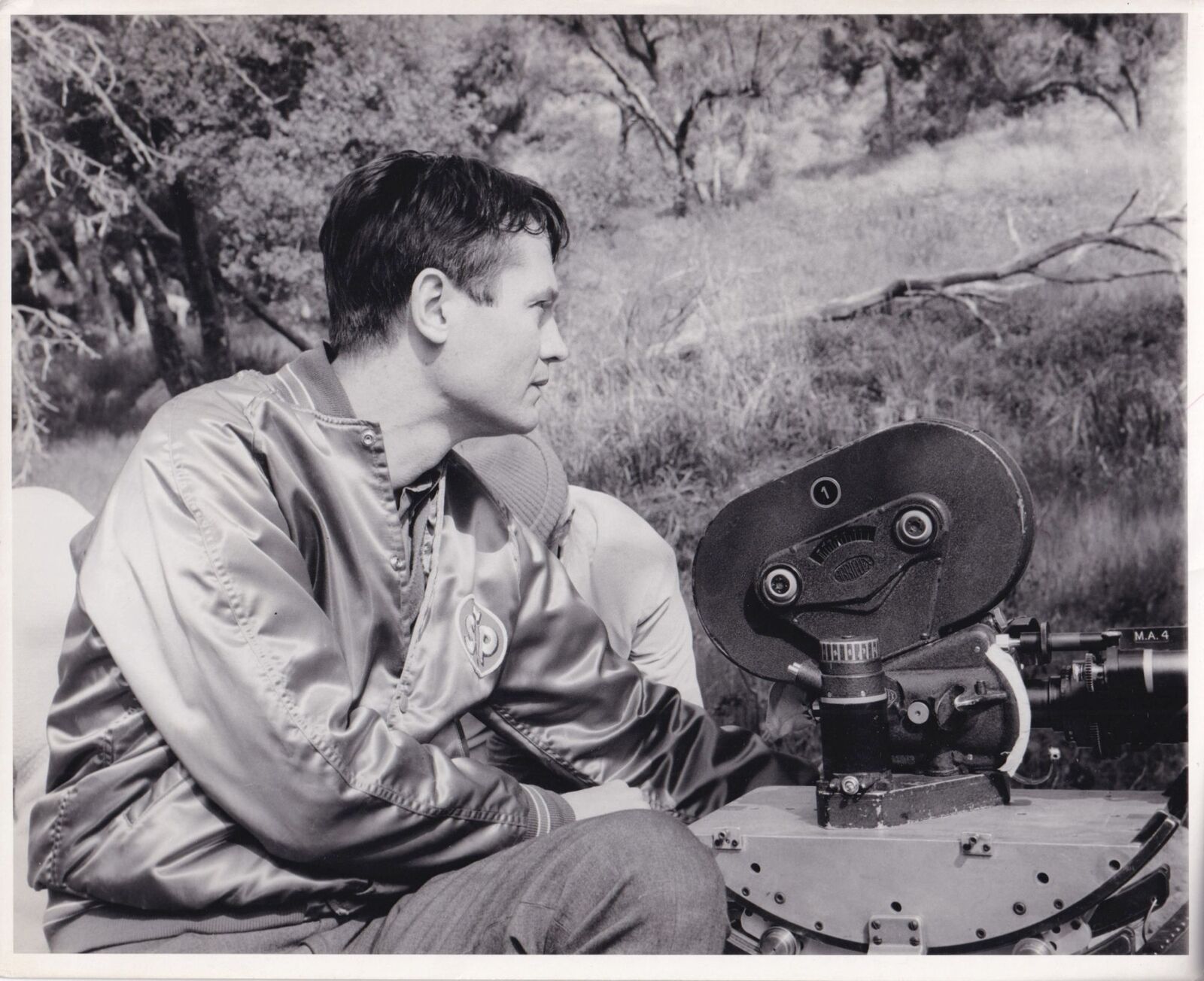
Roger Corman on the set of The Trip (1967; Wikimedia Commons)
Rather than duplicate a career summary that you can get in a thousand different places on the web, I thought I’d honor Roger by reminiscing about his influence on this particular Monster Kid growing up in the midwest in the ‘60s and ‘70s.
I’ve told this story before, so bear with me if it feels like a case of deja vu all over again. Living in central Iowa in the mid-‘60s was Monster Kid Heaven. On Friday nights, one of the Des Moines TV stations ran sci-fi movies, introducing me to such thrilling delights as The Beast from 20,000 Fathoms, Earth vs. the Flying Saucers and the like (there were also duds like Teenage Monster or Giant from the Unknown, but being a resilient kid, I took the bad with good and was grateful that my ever-suffering parents allowed me to stay up to watch this stuff at all).
Then on Saturday nights, my local station presented Gravesend Manor, which was hosted by the wacky ensemble cast of Malcolm, the butler of the manor, his vampire buddy the Duke, cigar-chomping Esmeralda, and Claude, the mute, put-upon assistant. Gravesend Manor was the icing on the weekend monster cake, showing selections from the Shock Theater package featuring the classic Universal monsters, with a few non-horror mysteries and thrillers thrown in (it was always a letdown when the familiar monsters failed to make an appearance, but on the up-side, anticipation would then build for the next week).
To say the least, the one-two, Friday-Saturday punch of sci-fi thrills and Universal monster chills made a deep mark on my very impressionable mind. After all, here I am, decades upon decades later, and I’m still revisiting these films and posting about them.
I didn’t realize it at the time, but Roger Corman (and to give credit where it’s due, frequent writing collaborator Charles B. Griffith) had crept into my young head and were occupying it every bit as much as my beloved Universal monsters. I’d be lying to say I was impressed with every Corman film that showed up on Friday nights. I wouldn’t become familiar with the term “production values” until much later, but I knew cheap when I saw it.
These weren’t what you'd call polished pictures, but they still made an impression.
For instance, the giant mutated crabs of Attack of the Crab Monsters (1957), with their lidded googly eyes and frowny faces, look like live-action cartoons. But there’s something very un-cartoony about the premise of giant irradiated crabs not only consuming human beings, but absorbing their consciousness and using that ability to lure more unsuspecting human prey into their maws (or whatever it is crabs eat with).
Okay, so giant crabs throwing their voices like ventriloquists, imitating the people they just ate for lunch is ridiculous on its face, but also creepy as hell. And then there’s the other doom facing the scientists -- the island they’re stranded on is quickly breaking up and falling into the sea. Even though the idea is wacky in the extreme, it still somehow resonated.
“The Most Terrifying Horror Ever Loosed on a Shuddering Earth!”
“A horror film has got to have something in every single scene, so the audience never has a chance to sit back for more than a moment. These films are constructed very carefully -- you do have to give people a few moments to relax and then come back into it. My main goal in Crab Monsters was to integrate tension into each scene, leading to the horror conclusion.” -- Roger Corman, The Movie World of Roger Corman (edited by J. Philip di Franco, Chelsea House, 1979)
Speaking of approaching Doom, it was Roger Corman who introduced 10-year-old me to the Apocalyptic variety via Last Woman on Earth (1960), an ultra-cheap fantasy-melodrama featuring a fatal love triangle between end-of-the-world survivors Betsy Jones-Moreland, Antony Carbone and future Oscar-winning screenwriter Robert Towne (who, in addition to writing, took acting gigs while he was still getting his feet wet in Hollywood).
I know, I know -- what in the world was a 10 year old boy doing watching something like that? Well, it was on one of those precious late-night creature shows, and in the olden days before video on demand, you took what they gave you and liked it.
“Liked” is maybe too strong a word in the case of Last Woman. Compared to all-out nuclear war resulting in a decimated earth filled with irradiated mutants, Last Woman’s apocalypse is almost gentle -- the trio had been scuba diving in Puerto Rico when a mysterious event depleted all the oxygen in the atmosphere just long enough to kill off everyone not breathing through some sort of gear. The film is a mostly slow-moving affair, with the survivors wandering around, bickering among themselves until the inevitable climactic blow-up.
This was a guaranteed snoozer for a prepubescent Monster Kid, with one exception. As the trio is walking through the streets of San Juan wondering what the hell happened, they encounter the body of a little girl lying like a large rag doll on the sidewalk. Needless to say, this got my attention, since one of the great unwritten rules of film violence is that adults are fair game, but kids and dogs are not. Disturbing as it was (especially as I wasn’t much older than the girl), this scene made the film Memorable, and automatically exempted it from the mental Dud pile.
“On an island of tropical splendor, these three must make their own world, their own new code of morals...”
A definite Dud (at least at the time) was the other film Corman made while shooting down in Puerto Rico, Creature from the Haunted Sea (1961). (Roger wanted the most bang for his buck when he invested in location shooting, so he was always looking to get an additional movie out of the deal.)
Featuring the same acting trio as Last Woman, Corman’s Creature is a comedy-horror mash-up about an American gangster who agrees to transport the deposed officials of a Caribbean banana republic to a safe harbor, but secretly plans to relieve them of their lives and treasure while blaming everything on a made-up sea monster.
Some of the comedy bits are cringey even for a 10-year-old, and the monster is comically cheap-looking, literally made from random household items. But screenwriter Charles Griffith’s premise is clever and adult for a cheap drive-in flick, and there are some wry comic moments to reward those who can look past its faults (see my full review here).
“It’s alright, be calm everybody, the boat’s insured!”
Much more in line with my Monster Kid sensibilities was Day the World Ended (1955), which was set in a more traditional apocalyptic post-nuclear war landscape, featuring a band of quarreling survivors threatened by a single (and singular) irradiated mutant (others are hinted at, but the budget apparently could only bear the cost of one monster suit).
Marty the Mutant, as the creature would come to be affectionately dubbed, was the creation of Paul Blaisdell, an independent effects artist who was highly ingenious and economical, and the go-to guy for several of Corman’s 50’s creatures. (Paul also saved costs by wearing the suit himself.)
Marty is positively demonic-looking, with pointed bat-like ears, horns growing out of his head, and three eyes (you scoff, but are you absolutely sure radiation from a nuclear war wouldn’t produce a Marty or two?). Marty’s evil looks are interesting enough, but he’s also somewhat sympathetic, with a psychic connection to one of the normie survivors that puts him a grade above the typical ‘50s B monster.
“The Screen’s New High in Naked, Screaming Terror!”
But the ultimate Corman-Blaisdell creature collaboration was Beulah, the squat, fierce-looking Venusian vegetable monster from It Conquered the World (1956). Beulah didn't quite achieve the lofty goal of the title mainly because, for budgetary reasons, she tried the conquering thing all by herself.
Although she may not look it to the untrained eye, Beulah was the Corman-Blaisdell team’s highest-concept creature. Corman and Blaisdell reasoned that in such an alien environment as Venus’, vegetables rather than animals might have reached the highest stage of sentient being. That alone wasn’t groundbreaking, given that the humanoid alien in The Thing from Another World (1951) was supposed to be an ambulatory vegetable.
Blaisdell took it a step farther with the idea that any kind of humanoid would be crushed by Venus’ atmospheric pressure (not to mention melted by the heat, but we digress), so natural selection would favor some other form of body type. And so, the squat, conical would-be conqueror Beulah was born. Once again, Blaisdell wore the suit himself (which was more like a small parade float with moveable arms than a suit).
Like many such other slow-moving menaces, would-be victims had to almost throw themselves at the creature, but there’s no denying that Beulah is unique in the annals of B sci-fi. (For more on Beulah, click here.)
“The Most Terrifying Monster the Mind of Man Can Conceive!”
“The first day we were shooting [It Conquered the World], I took the creature out. Beverly Garland, the leading lady, went over and looked at the creature. Standing over it, she said, ‘So you’ve come to conquer the world, eh? Take that!' and she kicked it.” -- The Movie World of Roger Corman
(I love that these creatures have nicknames.While they don’t represent the height of creature effects even for the time, they are wackily idiosyncratic with their exaggerated, frowning monster faces, and a refreshing change from all the giant insects and various other enlarged monsters that proliferated during the decade.)
This post wouldn’t be complete without addressing one other solitary invader from the ‘50s Corman archive. A year after Beulah failed to conquer the world, Corman had another alien set up shop in Southern California. Although he was Not of This Earth, Paul Johnson (Paul Birch) could definitely pass for human by covering up his cloudy, all-white eyes with dark glasses. Lacking a creature like Beulah, Not of This Earth (1957) had to compensate with some other-worldly ideas.
Johnson, looking like the original Man in Black, is an alien from the planet Davana who has come to Earth in search of uncontaminated blood (it seems his people have been sickened with blood disease as the result of a nuclear war.) To aid in his mission, Johnson has a matter transporter and holographic communicator installed in a closet (!) of his comfortable ranch-style home.
Posing as a man with a mysterious blood disease, Johnson enlists the unwitting aid of a doctor and nurse (Beverly Garland) to receive regular blood transfusions. The stakes couldn’t be higher: if the transfusions work, Johnson’s home planet will invade and subjugate the earth for access to healthy human blood. If they don’t, the earth will be destroyed.
I confess I was not too impressed with the movie the first go-round. It was slow moving and talky, and the alien menace, despite the disturbing eyes, was just a doughy middle-aged man in black (Johnny Cash he was not). However, a couple of scenes kept me from falling asleep.
In the first, Johnson is perturbed by a vacuum cleaner salesman who shows up on his doorstep (played by Corman mainstay Dick Miller). Sensing an opportunity, the alien invites the man down to the cellar for a demonstration of the product. Blathering away as he tries to make a sale, Miller’s character belatedly senses something’s not right, takes a look at Johnson’s featureless eyes, does a double-take, then looks forlornly at the camera for a brief moment before being dispatched by the space vampire.
This was my introduction to breaking the fourth wall, and it's a perfect example of the black humor that peppered Corman’s films and made even pre-pubescent Monster Kids like me sit up and take notice.
“Look buddy, let me have five minutes of your time in your own cellar, and I’ll prove to you that this little baby can do what no other vacuum cleaner in the world can do!”
Another sit-up-and-take-notice moment comes later when Johnson has been exposed as an alien invader. Deciding that he’s done with the doctor, the alien dispatches a flying, umbrella-like creature that wraps itself around the victim’s head and, well, maybe it’s best not to use your imagination.
The creature is a creepy forerunner of Alien’s infamous face-hugger. While this and the Dick Miller bit weren’t quite enough to redeem the film for me that first time, subsequent viewings revealed a wryly subtle take on mid-century American paranoia and strange agents hiding in plain sight in sunny Suburbia.
Whether the film hooked viewers the first time, or, as in my case, required repeat viewing to appreciate, it certainly has had an outsized impact for an early Corman exploitation flick, having been remade twice (most famously in 1988 with Traci Lords in the Beverly Garland role).
The ultimate Roger Corman cheapie that rewards repeat viewings is of course The Little Shop of Horrors (1960), which, appropriately enough, also enjoys the biggest cult reputation of all -- much of it due to its resurrection via a Broadway musical and a big budget remake.
This tale of a nerdy flower shop employee and his co-dependent relationship with a man-eating plant was made in a couple of days on a next-to-nothing budget. Full of ad-libbed dialog and seemingly ad-libbed sight gags, Little Shop is perhaps one of the unlikelier cult hits in cinematic history. Somehow, scenes that by themselves might seem sophomoric or forced -- like a duel to the death with dentist’s tools -- come together in a surreal package that has something for everyone (well, almost everyone).
It’s as if the super-accelerated production got the casts’ adrenaline going and brought out everyone’s best. There are physical bits and sight gags for Stooges fans and puns and malapropisms for the more verbally oriented (enough that it takes several viewings to fully take it all in). It’s hard not to like something about it.
Still, Little Shop was an unlikely attraction for a Monster Kid weaned on the more dignified Universal Monsters, but I was thrilled whenever it played on one of my creature features.
“Where a talking, man-eating plant gives Homicide something to think about!”
“If Bucket [A Bucket of Blood, 1960] and Little Shop, two of the cheapest films I ever directed myself, look like they were made on a bet, they pretty much were. In the middle of 1959, when AIP wanted me to make a horror film but had only $50,000 available I felt it was time to take a risk, do something fairly outrageous. I shot Bucket on only a few sets in five days. When the film worked well, I did Little Shop in two days on a leftover set just to beat my speed record.” -- Roger Corman (with Jim Jerome), How I Made a Hundred Movies in Hollywood and Never Lost a Dime, Da Capo Press, 1998, p. 62
Roger Corman inevitably graduated to bigger and better things, starting with the elegant Poe films he made with Vincent Price for American International Pictures. The man never stopped working, producing hundreds of films over the decades -- and as if that wasn’t enough, he somehow found time to do cameo appearances in some of his former mentees’ pictures.
But none of those achievements will ever fully eclipse the wonderfully quirky cheapies from the early years.They weren’t great films, but they invariably turned a profit, and Corman gained the kind of experience and smarts that money (especially bloated Hollywood budgets) can’t buy. But best of all, he created indelible memories for a whole generation of monster-loving kids.