Showing posts with label John Agar. Show all posts

February 25, 2022

The Great Brain Robbery: The Brain from Planet Arous

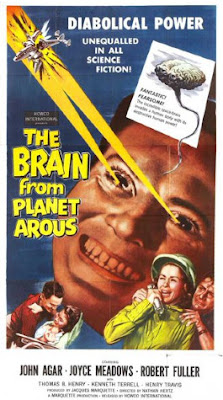
Poster - The Brain from Planet Arous, 1957
Now Playing:
The Brain from Planet Arous (1957)


Pros: Intriguing premise inspired by sci-fi pulp magazines; John Agar gets to laugh maniacally playing a scientist possessed by an evil alien brain
Cons: The production’s cheapness undercuts its lofty ambitions

This post is part of the fourth annual So Bad It’s Good blogathon hosted by brainy Rebecca at her Taking Up Room blog. Once you’ve checked out this entry, zip on over there for more takes on the art and entertainment of bad movies.

Ever since Fritz stole a diseased criminal’s brain to plop into the monster’s skull in the original Frankenstein, horror and sci-fi fans have had brains on the brain.

And who’s to blame them? Detached from its protective skull, the human brain is a disgusting, alien-looking thing, a rounded gelatinous mass of folds, fissures and crevices that looks like it's just waiting to launch itself at you and eat your face off.

Various versions of the Frankenstein story alone have put the brain front and center in pop horror culture. In Hammer’s Frankenstein series, after the Baron stitched together the horrific creature in Curse of Frankenstein, he learned his lesson in subsequent films and concentrated on transplanting brains between pre-owned bodies.
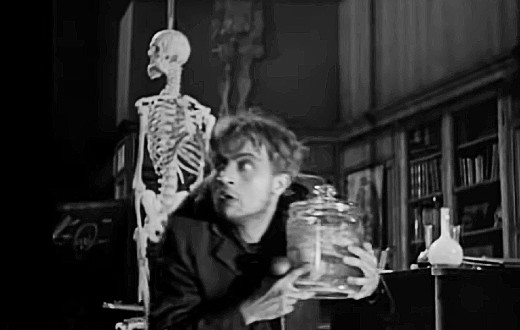
In retrospect, Frankenstein should have run this important errand himself.

And then there’s Donovan’s Brain (1953), which, while being kept alive in a laboratory, develops telepathic powers and possesses one of the lab scientists. The Brain That Wouldn’t Die (1962) picked up on the Donovan theme, featuring a whole head (and brain of course), played by Virginia Leith, that establishes a telepathic link with a Frankenstein-like creature in the basement laboratory that they share.

In a particularly gross-out variation, there’s the brains-as-delicacy theme exemplified by modern zombie movies. Contrary to popular belief, George Romero’s Night of the Living Dead (1968) and the Romero-directed sequels did not establish zombies’ predilection for eating brains. While Romero’s zombies can’t get enough of human flesh in general, it was Dan O’Bannon’s wonderfully comedic Return of the Living Dead (1985) that cemented the idea of zombies voraciously going after human grey matter. Since then it’s become a trope, with legions of fans speculating on why brains are such a special treat.

In yet another variation, The Brain from Planet Arous is a 30’s-style sci-fi pulp story brought to life in glorious black and white, featuring an alien menace that is all-brain with evil, glowing eyes.

Brain begins with a mysterious light descending from the heavens and finally exploding near a remote mountain range in the desert southwest. Nearby at a lab at the White Sands Proving Grounds, nuclear scientists Steve Marsh (John Agar) and Dan Murphy (Robert Fuller) notice that their instruments are picking up intermittent pulses of intense radiation from the area of Mystery Mountain.

The two men decide to drive out to the mountain to investigate, but not before having lunch with Steve’s fiancée Sally (Joyce Meadows) and her father John Fallon (Thomas Browne Henry). John warns the two that the daytime heat can be intense in the mountains, but they’re undeterred.

When they arrive at Mystery Mountain, a rock fall has blocked the road leading up to the mountain’s base, so they have to go the rest of the way on foot. They discover a cave that looks to have been recently blasted out of the rock, but there are no footprints or other signs of human activity.

Inside the cave, they encounter mysterious lights and sudden jumps in their Geiger counter readings. Suddenly, they’re confronted by a gigantic floating brain that zaps them with an intense light as Steve shoots wildly at it. Dan manages to get a shot off before succumbing to the radiation. The brain becomes semi-transparent, shrinks in size and enters Steve’s body as he lies unconscious on the cave floor.
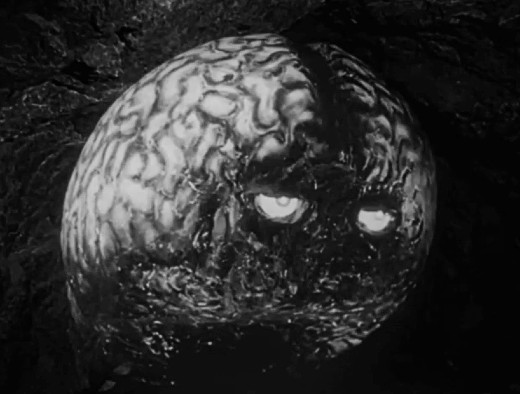
Screenshot - the criminal brain Gor, The Brain from Planet Arous, 1957
Q: Why did the brain go running?
A: It wanted to jog its memory.

A week later, just as Sally is getting really worried about her fiancé's absence (!!), Steve shows up at her house with a suspicious story about not finding anything at the mountain, and Dan going off to Las Vegas for some R&R.

Sally’s suspicions mount when Steve becomes uncharacteristically and aggressively romantic to the point of physically assaulting her, only relenting when Sally’s dog George comes to her defense. To top things off, Steve is suddenly having seizures, which he attributes to a tooth acting up (uh-huh).

Sally’s father initially dismisses her concerns with an offhand “boys will be boys” attitude, but then agrees to go with her to Mystery Mountain to see if they can find any reason for Steve’s abrupt personality change.

They’re shocked when they find Dan’s burnt body in the cave, and amazed when confronted with yet another floating brain. This new alien introduces himself as Vol, a policeman from the planet Arous who is chasing Gor, a criminal who has taken over Steve’s body in order to further his mad plans for world domination.

The two earth people and the space policeman plot to stick close to Gor/Steve to figure out what he’s up to and to strike when he’s most vulnerable. Instead of inhabiting Sally or her Dad, Vol chooses the body of the dog to hide out in, because, well, George is loyal and friendly and spends almost as much time with Steve as the other two (okaaaaay….).
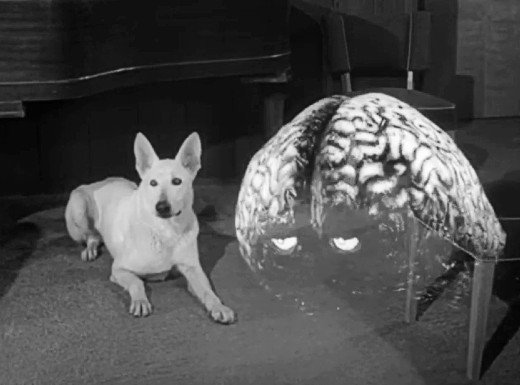
Screenshot - Vol prepares to inhabit George the dog; The Brain from Planet Arous, 1957
George the dog is a brain's best friend

Brains from the planet Arous are apparently invulnerable when they’re in their semi-transparent transitory state or when they’re occupying a body, but every 24 hours they have to materialize and leave their hosts in order to recharge and suck in life-giving oxygen. That’s the only time Gor will be vulnerable, and Vol solemnly informs Sally that a blow to Gor’s fissure of Rolando is the only sure way to take him out. (Yes Virginia, the fissure of Rolando is a real thing.)

While Sally is waiting for a crack at Gor’s fissure (okay now, get your minds out of the gutter!), the alien occupier, unaware that anyone is on to him, is busy blowing planes out of the sky, frying inquisitive policemen, and demonstrating to incredulous government officials that his awesome telekinetic powers are more powerful than the atomic bomb. If the earthlings and Vol don’t stop him, Gor plans to subjugate the earth and use slave labor to build a space fleet to invade his home world!

In the first scene, the film reveals its pulp sci-fi roots when it shows Steve scurrying around the lab trying to make sense of the radiation readings, while Dan is seen relaxing in a chair reading a science fiction magazine (shades of The Big Bang Theory, where scientists spend most of their time reading comic books and role-playing!).
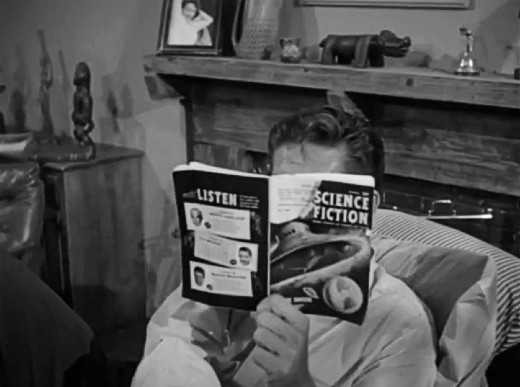
Screenshot - Dan (Robert Fuller), reads a science fiction magazine; The Brain from Planet Arous, 1957
Dan catches up on the er, um, scientific literature.

The sci-fi pulps of the early-to-mid 20th century were notorious for featuring lurid stories and cover art of bug-eyed monsters threatening curvaceous females. The Brain from Planet Arous is solidly in this camp, featuring a brain monster with glowing eyes and almost unlimited powers lusting after poor, confused Sally after he has infiltrated her fiancé’s body.

For an advanced brain creature that is supposedly all intellect, Gor is pretty inept at covering his tracks and posing as a human. When Gor/Steve suddenly shows up at Sally’s place, the best he can come up with is the dubious story of a futile search and Dan running off to Vegas. He doesn’t even bother to conceal Dan’s body, leaving it in the cave for Sally and her father to find.

Gor also seems unconcerned about blowing his cover by nearly ripping Sally’s clothes off in their first encounter. It’s understandable that a creature who has spent his whole life as nothing but pure intellect would be eager to try out his new body, but it seems a little strange for an evil mastermind to get distracted from his mission of world domination by falling for the charms of a fairly ordinary, albeit attractive, earth woman.

And charmed he most definitely is. Later, still pretending to be Steve, Gor drives Sally out to an overlook to take in the lights of the city sprawled out in the valley below. In an expansive mood, and bragging like a teenager trying to puff himself up in front of his best girl, he promises Sally the world… literally:

Gor: "That’s our world out there Sally, yours and mine."
Sally: "Really? All of it?"
Gor: "If you want it. … I can give it to you, believe me!"

It’s obvious that when occupying a body, Gor can access the memories and even some of the personality quirks of the host in order to pose as a human, but it’s not clear how much influence the suppressed host has on the occupier. Maybe a lot, given Gor’s infatuation.

Whatever the dynamic, the Gor/Steve hybrid is much more exciting than Steve alone. After experiencing her first kiss with the new, occupied Steve, Sally looks like she’s ready to pass out before exclaiming, “You never kissed me like that before!” Gor returns the favor later on when he muses that “She gives me a very strange, very new elation!” If only Gor wasn’t so dead set on conquering the world, they might have made a wonderful threesome.
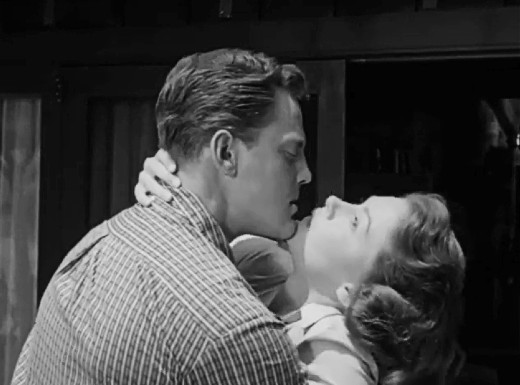
Screenshot - John Agar and Joyce Meadows in The Brain from Planet Arous, 1957
Gor has a lot of catching up to do after a lifetime without a body.

The whole conquering the world thing also raises a question or two. It appears that Gor has deliberately chosen to land at Mystery Mountain because of its nearness to the White Sands nuclear testing grounds. Additionally, inhabiting the body of Steve, a nuclear scientist, will get him access to the inner sanctum of the country’s’ nuclear defense establishment.

But for some reason he just sits in the cave he’s blasted out of the mountain and waits for Steve to come to him (how he knows it will be a valuable nuclear scientist and not just some ordinary lunkhead is another mystery).

To add insult to ridiculousness, Gor doesn’t want access to the nuclear testing facility to appropriate the weapons, but rather to demonstrate to the gathered officials that his telekinetic powers are far more powerful than their measly atom bombs, and that they have 24 hours to assemble representatives from the world’s major powers to hear his ultimatum.

If I were Gor, I’d cut out the middleman (sorry Steve), fly directly to Washington D.C., obliterate something showy, like the Washington monument, and then issue my ultimatum on national TV. But I guess Gor didn’t want to be seen as some low-grade knock-off of the venerated Klaatu. And he wouldn’t have been able to partake of some of those, ahem, earthly pleasures that floating brains don’t get to experience very often.

But, let’s face it, all this nitpicking violates the first law of watching so-bad-they’re-good sci-fi movies: just turn off your brain and enjoy the show.
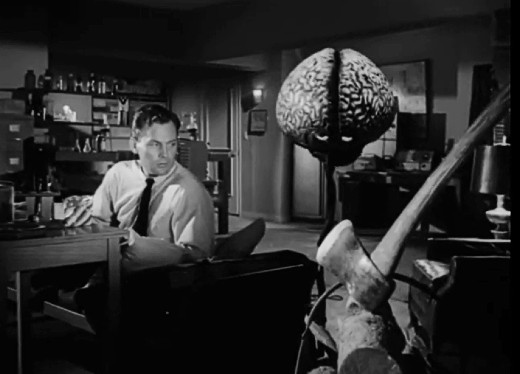
Screenshot - climactic scene, The Brain from Planet Arous, 1957
Steve tries to do the math in his head: Gor in a solid, vulnerable state +
the fissure of Rolando + a sharp axe = ?

The Brain from Planet Arous is cheap, even by ‘50s sci-fi standards, but you’ve got to admire the audacity of trying to make a movie about evil brains and world domination on a budget so tight that you can almost hear the screech of the producers being separated from their nickels and dimes as you watch it unfold.

Speaking of producers, Jacques Marquette, who was best known as a cinematographer, but who started out producing low-budget sci-fi movies like The Brain from Planet Arous and that most iconic example of ‘50s sci-fi cheese, Attack of the 50 foot Woman, was interviewed by B movie historian Tom Weaver about his early gigs. Marquette good naturedly addressed the inspiration for the story and the cost-cutting involved in the production:

Where did your idea for Brain come from?
It was a story which I had sort of halfway stolen from Amazing Stories, I used to read that, Astounding Science Fiction, all of those -- I loved science fiction. One of them ran a story about a guy on the beach in the summer, and this thing came out of the ocean, went up into his foot and took him over.

What was your budget on Arous?
The budget, as I recall, was about fifty-eight thousand dollars. I did all the optical effects in the camera; otherwise, it would have cost probably five hundred dollars for one effect.

What do you remember about the brain prop?
We told the people who were going to make it what we wanted, and that we wanted lights inside. It was made of plastic and held up with wires. Later on, after we finished the picture, my kids got a hold of it and put on a show. They’d get other kids together, charge ‘em five cents and put on a show with the brain in there. [laughs].
[Weaver, Tom. Attack of the Monster Movie Makers, McFarland, 1994; pp. 197-198]

In the interview Marquette also mentions the silver-coated contact lenses that star John Agar wore for the scenes in which Steve, under Gor’s control, demonstrates his awesome powers. In yet another Weaver interview, Agar acknowledged enjoying the opportunity to play a kind of Jekyll-and-Hyde role, but the contact lenses were a big challenge:

“I’ll tell you one thing, that picture was a very painful experience for me. When that alien being took over my body, they inserted these full contact lenses in my eyes. They’d painted ‘em silver and they forgot that that doggone paint would chip off. Every time I blinked, some of that silver would come off the lens and it was like having sand in my eyes.”
[Weaver, Interviews with B Science Fiction and Horror Movie Makers: Writers, Producers, Directors, Actors, Moguls and Makeup, McFarland, 1988; p. 10]

Yikes! Despite the pain of having flecks of silver paint in his eyes, Agar gives it his all, laughing maniacally in classic melodramatic fashion as he terrorizes the world.
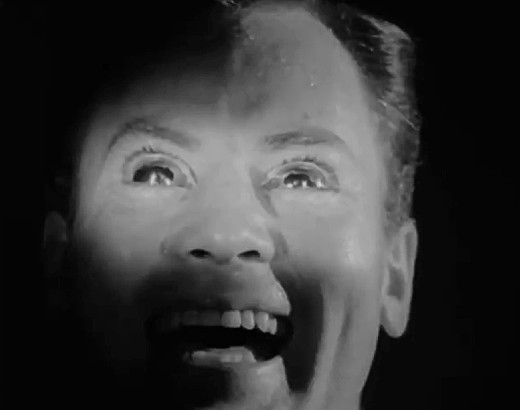
Screenshot - Steve (John Agar) is possessed by the evil brain Gor, The Brain from Planet Arous, 1957
Prerequisites for world domination:
Awesome telekinetic powers - check
Maniacal laugh - check
Rad silver-coated contact lenses - ouch!

In the early part of his career Agar snagged roles in several prestige A pictures -- John Ford’s Fort Apache (1948) and She Wore a Yellow Ribbon (1949), and Allan Dwan’s Sands of Iwo Jima (1949) prominent among them -- but he will forever be remembered for grade-B sci-fi cheese like The Brain from Planet Arous. At best a middling actor, his ultimate career path from A pictures to Bs and even Zs (e.g., Zontar: The Thing from Venus, 1967 and Curse of the Swamp Creature, 1968) was perhaps a foregone conclusion. Later on, he expressed no remorse about being associated with those pictures, and was just grateful for the opportunity to entertain people (see my write up of The Hand of Death elsewhere on the blog).

Gor’s and Steve’s main squeeze, Joyce Meadows, made just a handful of films, but like many actors of her generation, she kept busy making guest appearances in every nook and cranny of TV from the ‘50s through the ‘90s.

Director Nathan Juran is a sci-fi movie hall of famer, with a number of classics and near-classics on his resume: The Deadly Mantis (1957), Twenty Million Miles to Earth (1957), Attack of the 50 Foot Woman (1958), The 7th Voyage of Sinbad (1958), and First Men in the Moon (1964). Toward the end of his career, he directed multiple episodes of such popular Irwin Allen TV shows as Voyage to the Bottom of the Sea, The Time Tunnel, Lost in Space and Land of the Giants.

As for the merits of The Brain from Planet Arous, I’ll let yet another venerable B movie historian, Bill Warren, have the final say:

“In doing research for this film, I was startled to find that several reviews called the plot ‘conventional.’ Though the film is conventionally made, the premise is truly bizarre, anything but ‘conventional.’ The idea is too grandiose for the budget level, and it’s silly throughout, but at least it’s imaginative and unusual.”
[Warren, Keep Watching the Skies! American Science Fiction Movies of the Fifties, Volume II, McFarland, 1986; p. 33.]

Where to find it: DVD | Streaming 

November 23, 2021

Not so Good Cop, Very Bad Cop: Shield for Murder

Poster - Shield for Murder (1954)
Now Playing: 
Shield for Murder (1954)


Pros: Fine performances by Edmond O’Brien and Carolyn Jones; Memorable dialog.
Cons: O’Brien as an older, cynical cop is an unlikely boyfriend for the young and beautiful Marla English.

Barney Nolan (Edmond O’Brien) has been a cop for too long. As a former beat patrolman and now a detective, he’s seen it all, every nook and cranny of the seamy underside of life, and he wants out. Or is it that some rotten part of his soul has always been attracted to the city’s underbelly, and he’s finally had it seeing his own ugliness reflected back at him day after day? Whatever the reason, he’s so desperate to chuck it all, he’s willing to commit cold blooded murder and hide behind his detective’s shield to get away with it.

Nolan finds out through the grapevine that a bookie will be delivering a particularly rich payout -- $25,000 worth -- to his bosses on a certain evening. Nolan ambushes the man in a dark alley, shoots him in the back, relieves the body of the cash, then fires two shots in the air to attract attention. When Nolan’s colleagues arrive, including his partner on the detective squad, Mark Brewster (John Agar), he tells them that the bookie ran when he tried to arrest him, and he accidentally hit the man when he fired warning shots.

Barney Nolan (Edmond O'Brien) commits murder in Shield for Murder (1954)
"Whoa Barney, take it easy, that tickles!"

Brewster’s expression betrays his skepticism at Nolan’s sketchy story, but Nolan is his mentor, responsible for bringing him on the force, and Brewster wants to believe. Nolan’s boss, Captain Gunnarson (Emile Meyer), is exasperated -- the man has a history of shooting first and asking questions later -- but in the absence of any witnesses, he has no choice but to back his problematic detective.

It looks at first like Nolan is in the clear, but his problems have only started. The loot’s owner, mob boss Packy Reed (Hugh Sanders) has hired two goons to track down the money, and they’ve zeroed in on the obvious suspect, the last man to see the bookie alive. To add to the crooked cop’s troubles, there was a witness -- an elderly deaf mute who saw everything from his tenement apartment window. But worst of all, Nolan’s dogged partner can’t shake his doubts over Nolan’s account of the shooting.

Even as the web of reckoning draws tighter around the beleaguered cop, he has dreams for his blood money -- to buy a tract house in the suburbs and escape with his girlfriend Patty (Marla English) from the corruption and grime of the big city.

At first, Patty isn’t sure what to think as Nolan drags her from the sleazy lounge where she’s working to show her the new home that’s to be their picket-fenced salvation. He’s got it all figured out for the two of them, and no crime boss or suspicious police colleagues are going to stand in his way. There’s a very subtle shot of the couple standing at the entrance of the model home as Nolan fishes out the front door key from its hiding place. A wooden trellis is in the foreground, the slats making it seem as if the two are trapped behind the bars of a jail cell.

Patty is swept away at the prospect of living in a brand-spanking new home with all the modern conveniences. But before long she will come to realize the heavy price of that suburban dream.

Marla English and Edmond O'Brien, Shield for Murder, 1954
Patty and Barney dream of life in the suburbs with a Frigidaire and a console TV.

One of the film’s implausibilities is the odd couple of Barney and Patty. Even taking into account the tendency of people with low self-esteem to make bad dating choices, they are a particularly mismatched pair. She is young and attractive, with her whole life ahead of her. He is middle-aged, overweight, cynical and controlling. The disparity is all the more striking when later in the film, Patty is being interviewed by the handsome and upright Detective Brewster -- you can’t help but think “she picked Barney over this guy?!”

But Shield for Murder does reveal a hint of goodness in Nolan that hasn’t quite rotted away. In a telling scene, a uniformed cop brings a juvenile delinquent into the precinct. Nolan brusquely waves the cop off, telling him to “go home and beat your wife.”

Faced with a brash, sneering teenager who seems determined to ruin his life, Barney sentimentally tries to bond with him and scare him straight at the same time:

“See that detective over there? [Pointing to Brewster]. “You know what I told him? … I told him the next time he wants to rob a store, to come here and talk to me, cops know how it’s done. I also told him that if he got caught again, I’d personally see that he was locked up until he was old and grey. I’ll make you the same bargain. [Reaching into his wallet and giving the kid some cash] “Here, pay for those things [the stolen items] and take them home.”

As Nolan’s plans for a new life in suburbia start to go up in smoke, he struggles to maintain his facade of rough-edged goodness, and he retreats to a bar to nurse his anxieties. As he’s glowering over his drink, a lonely alcoholic woman (played to perfection by Carolyn Jones) sidles up to him with a unique pick-up angle:

“Do you know what’s wrong with mirrors in bars? Men always make hard eyes at themselves. [Pauses] Do you know there’s a people in the jungle that believes a mirror steals your spirit away? [Looking in the bar mirror] Maybe it’d do me some good, my mother always said I had too much spirit.”

She has it only half right. Barney freely sold his soul for the price of a tract home, and now he can’t look at himself in the mirror. She has the misfortune of seeing the real man beneath the smirk when Packy’s goons show up at the bar. Nolan loses it and furiously pistol whips the men to the horror of the patrons. (In another subtle but neat touch, after Nolan has beaten the goons and he gives one last look at Jones’ character, grinning comic theater masks are visible on the wall behind him, as if they've been watching the performance and are smiling in approval.)

Edmond O'Brien and Carolyn Jones, Shield for Murder, 1954
"Have you heard this one? A cop, a priest and Morticia Addams walk into a bar..."

When the jig is finally, irretrievably up and Nolan’s fellow cops are looking to arrest him for murder, he crashes into Patty’s apartment and desperately tries to get her to drop everything and run away with him. Self-pity and denial pour out:

“For sixteen years I’ve been a cop, Patty. For sixteen years I’ve been living in dirt, and take it from me, some of it’s bound to rub off on you. You get to hate people, everyone you meet. I’m sick of them, the racket boys, the strong arms, the stoolies, the hooligans… I’m through with them all! Maybe this jam will turn out for the best after all. Patty, you and I will go away, get a fresh start somewhere. I’ve got the money… [Pauses, realizing he’s admitting to having stolen the money] … I had some saved… hurry Patty, will ya?!”

Having dug a grave-sized hole for himself, Nolan figures there’s nothing to do but keep digging. Spiraling from a rough-edged cop who’s been at it too long to the poster’s tagline of “a dame-hungry killer-cop” running “berserk” is fascinating to watch, and Edmond O’Brien gives it his sweaty, scowling all.

Over the course of a 40+ year career, Edmond O’Brien made the most of his doughy, “everyman” image, earning a best supporting actor Oscar for his role as Oscar Muldoon in The Barefoot Contessa (1954), and appearing in such diverse films as The Hunchback of Notre Dame (1939; his film debut), 1984 (1956), The Man Who Shot Liberty Valance (1962), Seven Days in May (1964) and The Wild Bunch (1969).

O’Brien was Mr. Film Noir in the decade between the mid ‘40s and mid ‘50s, appearing in several of the most highly regarded films in the genre including The Killers (1946; with Burt Lancaster and Ava Gardner), White Heat (1949; with James Cagney), and D.O.A. (1950; playing a nondescript accountant who solves his own murder). In Between Midnight and Dawn (1950), he also plays a cynical cop, but unlike Shield, his character gets to redeem himself.

Edmond O'Brien at the climax of Shield for Murder, 1954
Barney realizes too late that there's more to life than guns and money.

Although Shield for Murder was the last of O’Brien’s noirs, it was also a first for him  -- his first directing gig. O’Brien had become interested in behind-the-scenes work, and after Shield he formed a production company with his brother Liam, a playwright.

He explained in an interview, “Some [actors] don’t care about producing. All they’re interested in is acting, and that’s fine. But others, like [John] Wayne and [Burt] Lancaster have picked up enough technical knowledge and ideas on writing, directing and camera techniques to do a great job. They went out of their way to learn. So have I. My intention, eventually is to work myself out of acting.” [Karen Burroughs Hannsberry, Bad Boys: The Actors of Film Noir, McFarland, 2003, p. 500]

Despite his intentions (and thankfully for film posterity), O’Brien went on acting, and found only time to direct a couple of TV episodes in the late ‘50s, and one feature, Man-Trap, in the early ‘60s.

John Agar (Brewster) made his film debut in a minor role in John Ford’s Fort Apache (1948), then quickly graduated to second leads opposite John Wayne in She Wore a Yellow Ribbon (1949) and Sands of Iwo Jima (1949). Shortly after Shield for Murder, Agar’s career took a turn into B sci-fi movie territory starting with Universal-International’s Revenge of the Creature in 1955, followed by Tarantula and The Mole People for the same studio in 1957. Even cheesier and cheaper movies quickly followed after that -- The Brain from Planet Planet Arous (‘57), Attack of the Puppet People (‘58) and Invisible Invaders (‘59) -- and the die was cast.

Shield for Murder was Marla English’s first credited film role. She made only a relative handful of movies, but ‘50s sci-fi aficionados affectionately remember her from the strange and surreal The She-Creature (1956).

Marla English and John Agar in Shield for Murder, 1954
"Come on Patty, I've got something Barney hasn't got -- a contract with Universal-International."

And then there’s Carolyn Jones. Ms. Jones is in only one scene, but it’s such a poignant one that she stands out among all the other cast members as the sad, lonely alcoholic who distracts Nolan, if only for a moment, from his descent into hell. Actors often overdo the word slurring and awkward gestures when trying to portray alcoholics. Jones hits all the right notes of a long-time drinker who has acclimated to the stuff and puts on a pretty good show, but ultimately can’t hide her quiet desperation. The two of them are trying to run away from themselves, but in different ways. 

Jones had a very active career in TV and movies from the early ‘50s through the early ‘80s, but she is best remembered as Morticia in The Addams Family (1964-66).

Shield for Murder is a solid, sometimes brutal noir, enhanced by fine performances from O’Brien and Jones, and featuring more than a few memorable lines of dialog courtesy of screenwriters Richard Alan Simmons and John C. Higgins.

Where to find it: YouTube | Amazon Prime  

March 2, 2021

Amazing Animal People #3: The Mole People

Amazing Animal People trading card #3: The Mole People, 1956

The mutant humanoid underground dwellers known as The Mole People are slaves to a lost civilization of Sumerian albinos living in caverns beneath a remote mountain in Asia. They do the heavy manual labor for the effete Sumerians, including gathering the main food staple, mushrooms. Even though they are crucial to keeping the place running, the poor brutes are whipped, abused and exploited at every turn by the humans.

When a team of archaeologists discovers the hidden civilization and have to battle for their lives to keep from being sacrificed to a Sumerian god, the cunning Mole People seize the opportunity to rebel against their oppressive masters.

Funanimal Fact: One of the stars of The Mole People, John Agar, once told an interviewer that he was not impressed with the film’s script:

“Yeah, I remember too that there was some silly dialogue in The Mole People, and I went to [producer] Bill Alland and told him, ‘Bill, people don’t say things like this.’ He said something to the effect that he paid a guy a lot of money to write that dialogue, and I said, ‘Well, you got cheated!’”

He also revealed how the effect of men being dragged underground by the mole people was achieved:

“They put a rubber mat down over a hole in the floor; the mat had an X-shaped slit in it. They covered it with some kind of light material -- it could have been styrofoam -- that was supposed to be earth or gravel. Even when someone was being pulled down through from below, the earth was held up -- a lot of it could not fall through at once. The remaining earth would then cover up where they went through.” [Tom Weaver, Interviews with B Science Fiction and Horror Movie Makers, McFarland, 1988, p. 8]


Still from The Mole People, 1956
"What's the matter Bob, you're as white as a ghost!"

Animal Crack-up (click on the text to see the punchline):

How do you get a mole to stop digging?


Don't miss these other Amazing Animal People!

Don't miss these other Amazing Animal People:
Lota from Island of Lost Souls | Paula Dupree, Captive Wild Woman

April 3, 2012

The Fine Line Between Superhero and Monster

Hand of Death (1962)

Sci-fi, Horror, Tragic Lab Accident
If myths can tell us a lot about the people and cultures that created them, and comic books are a form of myth-making, then can we better understand ourselves by reading comic books? (Okay, even if you concede that comic books themselves aren't quite as big as they used to be, you also have to concede that they are still enormously influential in our popular culture-- witness all the recent movies and video games based on comics or graphic novels.)

To me, superhero comics (and by extension, the movies based on them) are the purest form of contemporary myth. The superhero presents us with the ultimate self-revealing question:  if you had the power (super strength, super speed, you name it), what would you do with it? Who would you be then? What kinds of wrongs would you right? Would you be in the service of the 1%, or the 99%? Or would you just use your powers for your own benefit, and start down the road into supervillain territory?

Just like real life, some heroes are made (Captain America in a wartime experimental lab), some are self-made (Batman), some are born that way (the X-Men), and some stumble into it by accident (Spiderman from a radioactive spider bite; the Flash from lightning striking lab chemicals).

Movie poster
Scientist Alex Marsh's fate in Hand of Death is the stuff of superhero legend, but the decisions he makes once he acquires his power turn him into a monster instead. Right from the very start, we know that somebody's gonna get hurt. A farmer pulls up to a remote country cabin in his pick-up to investigate what looks like a couple of dead sheep. Pretty soon, he slumps over next to the animals. In long shot, a couple of men in hazmat suits come out and carry the limp body into the cabin.

We quickly find out that neither the sheep or the man are dead, but temporarily paralyzed. Alex Marsh (John Agar) and his assistant Carlos (John Alonzo) quickly revive the farmer, who seems pretty good natured considering his close call. He tells them that he was fully conscious, but couldn't move a muscle. Naturally curious, he asks Dr. Marsh what's going on. Marsh brushes him off with the standard "it's classified government work" line.

Oh well, all's well that ends well. Uh huh. I realize it's 1962 and all that, but Marsh seems pretty cavalier about security and accident precautions at his lab. Back at the Research Institute in L.A., we're introduced to the head honcho, elderly, wheelchair-bound Dr. Ramsey (Roy Gordon), and the other two members of an awkward love triangle, Ramsey's attractive assistant Carol Wilson (Paula Raymond), and researcher Tom Holland (Stephen Dunne), who is competing with Marsh for Carol's affections.

After the accident with the farmer, Carol is worried about her boyfriend (and rightly so). But like all obsessed B movie scientists, Marsh is way too involved in his work to see the warning signs. He breathlessly tells his colleagues that he's on the verge of a breakthrough that will tip the balance of world power and potentially make nuclear war obsolete. He's almost perfected combining an hypnotic agent with a paralyzing nerve gas. Even after the armies and population of the enemy country recover from the gas, they'll still be in an hypnotic state that the occupiers can take advantage of.

Carol protests that Alex's work is immoral and dangerous. She cautions him that his mentor Dr. Ramsey ended up in a wheelchair by not taking sufficient precautions in his work. "That was years ago, they weren't as careful back then," Alex responds glibly. Famous last words!

After his accident, Dr. Marsh passes out and has nightmares
Those aren't visions of sugarplums dancing
in Alex Marsh's head.
Back at the remote desert location, Marsh's assistant is worried too. The mice they work with keep ending up dead. Obsessed with creating a weapon that might put an end to war, he dismisses Carlos' concerns just as casually. The good doctor should have listened to Carol and Carlos, or at least called in OSHA to inspect his lab, because that night, tragedy strikes. Exhausted by all the long days he's put in, Marsh falls asleep at a table. As he wakes up and stretches out his arm, he accidentally knocks a beaker over, and some of the gas escapes. Choking, he tries to stop it up, but it's too late.

He collapses on a cot with images of lab equipment swirling around his head (we see this through a simple double exposure process). When he wakes up, he has a huge hangover. Carlos shows up at the lab, remarking how it looks like Marsh has been out in the sun all weekend. Marsh tells him about the accident, and speculates that he's not dead because of the immunity he's built up by being exposed to very low doses over months of work. Carlos is adamant that they report the accident. When the obsessed Alex grabs his assistant by the arm, he discovers a new "superpower" -- the ability to kill by mere touch (aka "Hand of Death").

Comparison of Alex Marsh and The Fantastic Four's Thing
Pop quiz: which is Dr. Marsh after the accident,
and which is The Thing from the Fantastic Four?
Dr. Alex Marsh stands at that crucial juncture that all potential superheroes and supervillains face-- do I use my powers for good or evil? This being a very low budget sci-fi movie from the early '60s, he takes a third path-- that of a B movie monster. The death of his assistant was clearly an accident, and there's still time to redeem himself, but Marsh's brain must have also been affected, because he proceeds to soak the lab and body with gasoline and light a match to it all. He drives off as the lab goes up in flames. (Okay, so I acknowledge that using this particular power for good might present challenges, but considering that everything that he touches blackens and dies, he might at least be fun at barbecues!)

Over the course of next 40 minutes or so, a desperate Marsh inadvertently kills some innocent bystanders, seeks an antidote from his colleagues at the Institute, swells up to hideous proportions (with his skin turning black and cracked like a man covered by cooling lava), terrorizes his girlfriend Carol, and generally makes a mess of things. (The next victim after Carlos is a gas attendant played by Joe Besser, whose biggest claim to fame was joining the Three Stooges for a number of shorts in the late '50s.)

Two scenes particularly stand out. In one scene Marsh, now bloated and hideous, stumbles along a beach just outside of Los Angeles. In the foreground we see a little boy playing, as the creature comes ever closer. Marsh topples over in a faint, and the boy (played by Butch Patrick, who would later earn notoriety as Eddie in The Munsters TV show) ambles over to see what's going on. More curious than frightened, the boy tentatively reaches out to the unconscious thing, but is called home by his mother just in the nick of time (see the clip below). (The scene is reminiscent of the innocent girl playing with Karloff's monster in the original Frankenstein, although the outcome is happier in Hand of Death.)

Carol is confronted by a monstrous thing that was once her beau
A frightened Carol (Paula Raymond) tries to calm down
the monstrous thing that her boyfriend has become.
In the other effective scene, Marsh finds the beach house of his colleague and romantic rival Tom, where Carol just happens to be staying. Terrified, she hides in a closet as the grunting, moaning monster-man pounds at the door. After a few seconds, a misshapen silhouette appears at one window, and then another.

Here's something else that's amazing-- after doing this blog for over a year and a half (and posting dozens of times), this is the first time I've mentioned the sturdy, dependable B movie actor John Agar. In my post on The Colossus of New York I wrote that it seemed like supporting actor Robert Hutton was in half of all the B sci-fi movies made in the '50s and early '60s. If Hutton was in half of all those films, Agar was in the other half. John's short marriage to Shirley Temple after WWII earned him a quick contract with David O. Selznick. He started out playing supporting roles in a number of A-list John Wayne movies, then quickly settled into B westerns and sci-fi programmers (and of course TV).

Genial and unassuming, John is the face of '50s sci-fi for many fans like me. In the '60s and '70s, he showed up again and again on TV courtesy of the various "Creature Feature"-type movie packages, and provided hours of good, cheap thrills:  Revenge of the Creature (1955), Tarantula (1955), The Mole People (1956), The Brain from Planet Arous (1957), Attack of the Puppet People (1958), Journey to the Seventh Planet (1962)… and the list goes on.

John was one of those rare actors who didn't mind being associated with low-budget sci-fi:
I don't resent being identified with B science fiction movies at all. Why should I? Even though they were not considered top of the line, for those people that like sci-fi, I guess they were fun. My whole feeling about working as an actor is, if I give anybody any enjoyment, I'm doing my job, and that's what counts.  (IMDb.)
Beautiful Paula Raymond had a long and rewarding career, mainly in TV. Her biggest sci-fi role was in one of my all-time favorites, The Beast from 20,000 Fathoms (1953), playing a typical role for the time, an attractive female scientist / assistant.

Director Gene Nelson enjoyed a very interesting career in front of as well as behind the camera. I cover him in more depth in my post on The Atomic Man (1955).

Once thought to be lost, Hand of Death was unavailable for decades on TV or video. It shows its ultra-low budget in more ways than one, but it's interesting for a couple of well-staged scenes, the effective monster makeup, and some "cameos" by folks like Joe Besser and Butch Patrick. It's available on DVD-R from a number of sites specializing in hard-to-find horror and sci-fi-- here's one.


Davey (Butch Patrick) has a close encounter with the thing that used to be Alex Marsh (John Agar):