Showing posts with label Time Travel. Show all posts

April 27, 2023

2024 Lies in Wait Beyond the Time Barrier

Poster - Beyond the Time Barrier (1960)
Now Playing:
Beyond the Time Barrier (1960)


Pros: Creative location shooting and use of repurposed state fair exhibit halls; A fairly unique explanation for its dystopian setting
Cons: Gets bogged down with a lot of pseudo-scientific dialog; Some of the principal actors are as stiff as dept. store mannequins

Many thanks to Barry at Cinematic Catharsis and Gill at Realweegiemidget Reviews for coming up with the Futurethon event and inspiring their fellow bloggers to explore the future through movies. If you haven’t already, check out their sites for links to more cinematic prognostications.

So here I am in the futuristic year 2023, and I’m only now getting around to reviewing the film that provided the name (in part) for this blog. All I can say is that it’s about time. 2024, the year in which Beyond the Time Barrier is set, is almost upon us. If there is even the slightest possibility that the events depicted in the film are prophetic, then there is precious little time to prepare.

As a public service, Films From Beyond is breaking through the time barrier to present our near future as envisioned in the 1960 movie. Are these events highly improbable? Perhaps. Impossible? You be the judge.

Robert Clarke stars as Major William Allison, an Air Force test pilot who has been assigned to fly the X-80 rocket-plane to the edge of outer space. After firing the rocket engine and soaring to an altitude of 100 miles, the plane accelerates uncontrollably, and Allison loses contact with the base.

Lobby card - Robert Clarke in Beyond the Time Barrier (1960)
Put your tray tables up and fasten your seat belts -- 2024 is going to be a bumpy ride!

Once Allison gets control back and brings the plane in for a landing, he’s amazed to find that the base is completely deserted and in an extremely dilapidated state. Off in the distance he spots the ruins of a city, and next to that, weird structures, including huge towers with blazing lights illuminating the landscape.

As Allison approaches the structures, he’s hit with a paralyzing ray, whereupon figures in radiation suits trundle him off to an underground lair.

The major soon finds that he’s not in Kansas anymore. After being decontaminated in a giant glass enclosure and getting into a shoving match with some guards, he is introduced to the elderly leader known as The Supreme (Vladimir Sokoloff), his second-in-command, the Captain (Boyd “Red” Morgan), and The Supreme’s granddaughter Trirene (Darlene Tompkins).

Allison learns from The Supreme that he is a “guest” at The Citadel, a subterranean complex built as a haven from the hordes of violent mutants that roam the contaminated surface. The Supreme and the Captain are the only members of the Citadel that can hear and talk -- all the others, including Trirene, are deaf mutes as the result of a mysterious plague (although Trirene has the extrasensory ability to read minds). The major is mightily confused, not understanding how so much could have happened in the short time he was aloft in his rocket plane.

Screenshot - Major Allison (Robert Clarke) meets the rulers of The Citadel in Beyond the Time Barrier (1960)
"Excuse me, but I seem to have taken a wrong turn at the ionosphere..."

Allison’s troubles are compounded by the Captain, who is suspicious that he is some sort of spy. The major is thrown into a dungeon reserved for captured mutants, but is released a short time later when Trirene, who has taken a shine to the handsome pilot, convinces her grandfather that he’s no threat.

After gaining The Supreme’s confidence by way of Trirene, Allison is allowed to meet three other “guests” of the Citadel: Gen. Kruse (Stephen Bekassy), Prof. Bourman (John Van Dreelen) and Captain Markova (Arianne Ulmer), who, conveniently, can also hear and talk. It’s this crew that clues the major into the fact that he’s traveled into the 21st century -- 2024 to be exact.

Kruse explains that the notorious plague was caused by radioactive dust from above-ground atomic tests breaking down the atmosphere’s protective layers, allowing deadly cosmic radiation to blanket the earth. Much of the planet’s population was killed off, with most of the survivors ending up either sterile deaf mutes or ravening bald-headed mutants.

Like Allison, all three accidentally broke the time barrier traveling in spaceships that approached the speed of light, and ended up prisoners at the Citadel after crash landing. The Captain, not wanting to let their knowledge and expertise go to waste, put them to work developing a solar energy plant. Markova cattily suggests to the clueless major that his job is now to mate with Trirene, one of the few women left who isn’t sterile.

When the group learns that Allison left his plane at the base intact and ready to fly, their eyes light up. Bourman excitedly explains that there’s a chance that they can send Allison back to 1960, where he can prevent the plague from ever happening. The professor lays out a deceptively simple formula on a chalkboard: take the rocket-plane’s escape velocity and add the velocities of earth’s rotation, its orbit around the sun, and the solar system’s movement through space, and voila!, you’ve got the near-light speed you need to enter the fifth dimension and travel back through time! (Uh-huh...)

Screenshot - A lecture on time travel in Beyond the Time Barrier (1960)
"Pay attention class, there's going to be a quiz later."

Standing in the way of the plan is the paranoid Captain, who has surveillance devices everywhere and is not likely to just sit back and let his prisoner jet off to parts unknown. And then there’s the Kruse crew -- one or more of them may have plans of their own for the plane. Finally, there’s Trirene -- who wouldn’t be tempted to stay put and regenerate civilization with such a special, beautiful girl? (And that doesn’t even take into account the mutants, who are itching to burst from their confines and wreak vengeance on their cruel masters.)

Okay, rather than spoil the ending, let’s see what Beyond the Time Barrier got right about life in the roaring 2020s:

✔ The ruling elites live in luxurious enclaves surrounded by bleak ruins and decaying infrastructure.
✔ Xenophobia runs rampant.
✔ Draconian security measures and omnipresent surveillance keep everyone in line.
✔ The general rule is to shoot your ray gun first and ask questions later.
✔ Society’s undesirables (the mutants) are consigned to poverty and prison.
✔ Much of the population is mute and goes along with whatever the elites say.
✔ A well-meaning but doddering old man nominally rules over the whole mess.

And on the bright side:

✔ Solar power is an up-and-coming energy source.

What it got wrong:

✔ The Partial Nuclear Test Ban Treaty of 1963 prohibited all above-ground nuclear tests, which were the cause of Time Barriers’s cosmic radiation plague. (However, the plot point does prefigure the depletion of the ozone layer that became an issue in the ‘70s.)
✔ Interior design predominantly based on the equilateral triangle never caught on.
✔ Jumpsuits that made everyone look like 1950s gas station attendants never became mandatory work attire.

Screenshot - Futuristic landscape in Beyond the Time Barrier (1960)
Beyond the Time Barrier also predicted the advent of 5G cell towers... or maybe not.

The man responsible for Time Barrier's prophecies was Arthur C. Pierce. In addition to Time Barrier, Pierce wrote a number of B sci-fi scripts in the ‘50s and ‘60s, including The Cosmic Man (1959), Invasion of the Animal People (aka Terror in the Midnight Sun, 1959), The Human Duplicators (1965), Women of the Prehistoric Planet (1966) and The Navy vs. the Night Monsters (1966), among others (see my reviews of the first two films here and here). 

While Pierce never penned any true sci-fi classics, he had a knack for writing scientific-sounding dialog and tweaking familiar themes in unique ways (i.e., atomic testing degrading the earth’s protective atmosphere). On the downside, Pierce was a bit too enamored with pseudo-science; his movies were often bogged down by characters laboriously mansplaining cracked science concepts (like Prof. Bourman’s chalkboard lecture on time travel and the speed of light).

While working on Time Barrier, Pierce created one very tense, dramatic scene that never made it into the script. In his memoir, Robert Clarke (who produced the film in addition to starring in it) recalled a story conference between the screenwriter and director Edgar G. Ulmer that became overheated:

“One day in the office at General Service Studios, Art [Pierce] turned in the umpteenth rewrite of one particular scene and once again Edgar seemed to be displeased, and he said something that provoked Art. I don’t remember Edgar’s comment, but it was like lighting a firecracker under Art. Edgar was seated at a desk and Art was sitting in a chair, doodling with a long yellow pencil. Something snapped in this poor, tormented writer’s mind: He jumped up out of his chair and leaned across Edgar’s desk and broke the yellow pencil in half right in front of Edgar’s nose. …
  It was a very dramatic moment, but later on, one could see the lighter side of it. Art was a conscientious and resourceful sci-fi writer who knew the necessary nomenclature and had done his homework on the technical aspects, but his dialogue wasn’t what Edgar was seeking and finally Art got fed up with Edgar’s goading. … The incident seemed to bother Edgar a little bit; I remember that later on, Edgar in his heavy Hungarian accent referred to Art as ‘This wrrriter who brrreaks his pencil in front of my face!’ But Edgar’s resentment soon passed; he was the type who let everything roll off his back.” [Robert Clarke and Tom Weaver, Robert Clarke: To “B” or Not to “B”, A Film Actor’s Odyssey, Midnight Marquee Press, 1996, p. 202]

No one, especially Ulmer, had time to hold a grudge. Beyond the Time Barrier and The Amazing Transparent Man were shot back-to-back at the same Texas location over the course of only two weeks (neither Pierce or Clarke were involved in the latter production).

These would be the last films Ulmer would direct on American soil. Savvy fans know Ulmer as one of the great B movie directors, with a resume that includes such cult classics as The Black Cat (1934; with Bela Lugosi and Boris Karloff), Bluebeard (1944; with John Carradine), Detour (1945; the low budget film-noir masterpiece with Tom Neal and Ann Savage), and The Man from Planet X (1951; also with Robert Clarke).

By the time Time Barrier and Transparent Man rolled around, Ulmer’s best work was behind him. As hinted by the story conference fracas, Ulmer was probably not greatly inspired by Time Barrier's script; he was content to shoot long, plodding scenes of dialog in stationary medium shots and call it a day. On the plus side, the veteran director managed to get his daughter Arianne the part of the duplicitous, femme-fatale-ish Capt. Markova.

Screenshot - Darlene Thompkins and Robert Clarke in Beyond the Time Barrier (1960)
Trirene and Major Allison relax after a hard day listening to incessant technobabble.

WARNING: SPOILERS ARE LURKING JUST BEYOND THE TIME BARRIER

The film manages to break through the boredom barrier at the climax, when Markova has treacherously let loose the imprisoned mutants and Allison is desperately trying to escape and get back to his plane. In the scenes where the maddened mutants chase down terrified Citadel dwellers, it’s obvious that the bare-bones production could only afford to outfit a handful of mutant extras with ratty clothes and ill-fitting skull caps. The extras are supplemented with mismatched stock footage of scruffy dungeon dwellers from Fritz Lang’s 1959 costume potboiler The Indian Tomb.

But the mutants' screams and shouts as chaos ensues are truly jarring, and you feel sorry for the poor Citadel denizens whose only fault was to blindly (and mutely) follow inept leaders. On top of that, the back stabbing comes fast and furious as various characters jockey to see who gets to ride on the rocket-plane back to their original time period.

For these and other scenes, Clarke and crew made great use of ready-made locations. The futuristic Citadel consisted of structures and exhibits left over from expositions held at Fair Park in Dallas, Texas. Carswell Air Force Base near Ft. Worth stood in for Major Allison’s home base, and a nearby abandoned WWII-era Marine Corps Air Base was utilized for the deserted 2024 ruins. [IMDb trivia]

When Clarke made Beyond the Time Barrier, he was hoping to become a B movie mogul. After appearing in the micro-budgeted sci-fi thriller The Astounding She-Monster (1957), he was astounded by how much money the threadbare production made at the theaters. He told himself he could do even better, and the result was The Hideous Sun Demon (1958), which Clarke wrote, produced, directed and starred in (see my reviews of She-Monster and Sun Demon). 

He took a print of Sun Demon to American International Pictures (AIP) in the hopes of securing a multiple picture distribution deal, but was turned down. On the rebound, he signed with a small outfit, Miller Consolidated Pictures, to do Beyond the Time Barrier. It wasn’t long after Time Barrier hit the theaters that the overextended company went under, and ironically, AIP ended up taking over distribution of the picture. After the dust settled, Clarke never saw a dime of profit from either Sun Demon or Time Barrier; all he had to show for his efforts was his $1,000 salary for acting in Time Barrier.
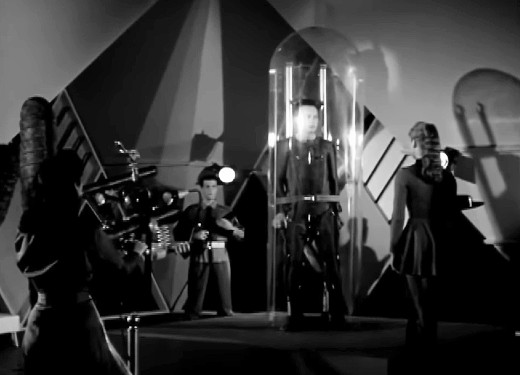
Screenshot - Major Allison (Robert Clarke) is taken captive in Beyond the Time Barrier (1960)
AIP executives hold Robert Clarke hostage while they run off with all the profits from Beyond the Time Barrier.

But Clarke was nothing if not resilient. In a interview with film historian Tom Weaver, Clarke insisted that he was grateful for his experiences behind the camera:

I would never say I was sorry because if I had not done it, I think I would have been sorry and would be saying that I wish I had tried it. It was an interesting experience. I wish, of course, that it had turned out more profitably and that it had led to other things that would have been more mainstream. With Roger Corman, pictures like these were stepping stones to bigger productions. But I took such a terrible bath with the bankruptcy on both Sun Demon and Time Barrier that I just felt there was no way to make another one and come out with anything. [Tom Weaver, Interviews with B Science Fiction and Horror Movie Makers, McFarland, 1988, pp. 90-91.]

If you decide to check out Beyond the Time Barrier, here’s hoping you’re as resilient as Robert Clarke and don’t regret your decision. Because, Prof. Bourman’s theories notwithstanding, most physicists insist that traveling back in time and undoing past actions is impossible.

Where to find it: Streaming #1 | Streaming #2 | DVD
January 30, 2014

Science Won't Save You

Poster - The Time Travelers (1964)
Now Playing: The Time Travelers (1964)

Pros: Inventive glimpses of future technology; Unusual ending illustrates a time travel paradox
Cons: Unoriginal, cookie-cutter plot; After a promising start, film bogs down with portentous dialog, dumb humor and a tour of an android factory that goes on way too long

With regard to the future, it’s hard to figure out what to be afraid of anymore. I’m pretty sure the country isn’t going to be overrun by angry jihadists determined to impose Sharia law on us. My blood runs cold (ironically) when I read about the scientific consensus on global warming, but it’s such a complex abstraction for most of us that it hardly registers in the cacophony of the great 24-hour media parade. And like many Americans, I don’t see the economy getting a whole lot better, especially on the jobs front, but hey, the guvmint and all those smart people at the NY Times and cable news say the recession has been over for several years now … time to get a haircut, get a job and move on.

I may not know exactly what to pin my worst fears on, but being an eternal pessimist, I just know that the future is going to be worse than the present – maybe by a little or maybe a lot, but worse for sure (not that the present is anything to crow about).

Cold war era duck and cover drill
What?! Another State of the Union address and the
Republicans' response? Time to duck and cover!
Time was, every red-blooded American knew exactly what to be afraid of: the Commies and their A-bombs. It was a much simpler, more auspicious time for stark, raving fear … and we liked it! We did duck and cover A-bomb drills in school, then came home and gathered around the old console TV to watch Walter Cronkite solemnly reciting what the nefarious Reds were up to in Cuba, Vietnam and other places we’d never heard of. On the weekends we’d go to the matinee or watch Creature Features to see the ravages of all-out atomic war in some cool sci-fi flicks. Good times!

One week there’d be astronauts returning from space to find the Earth blowed up real good (World Without End, 1956); the next, astronauts traveling to Mars would find the remnants of an alien civilization buried under radioactive rubble (Rocketship X-M, 1950). Then there were the here’s-how-it’s-all-gonna-go-down-day-after-tomorrow flicks whose atomic shocks hit a little too close to home: Five (1951), Invasion U.S.A. (1952), and Panic in the Year Zero! (1962), among others. And of course, there were always the pompous aliens warning us of complete annihilation if we continued our war-like ways. If they weren’t talking our ears off (The Day the Earth Stood Still, 1951; The Cosmic Man, 1959), they were taking the liberty of blowing up our warhead-capable spaceships to save us from ourselves (War of the Satellites, 1958).

The Time Travelers are about to have the portal close up on them
"Hey, what's this 100" flat screen doing
out here in the nuclear wasteland?"
Writer-director Ib Melchior’s Time Travelers encounter a pretty standard B movie post-apocalyptic world 100+ years into their future. The film is one of a large number of variations on a theme near-and-dear to sci-fi moviemakers of the era: modern day travelers/explorers/astronauts stumble upon a lost, isolated city/civilization/colony and bring new hope and vitality to it as they help the proud yet weak/corrupt/dying members fight off external threats in the form of mutants/dinosaurs/aliens, etc.

In fact, Time Travelers so closely parallels the earlier World Without End, it's easy for someone who's seen the two films to get them confused or to perhaps think that Travelers was a remake: both feature accidental time travel to a post-atomic war future; the explorers are chased by mutant humans into an underground sanctuary of science and civilization; the accidental visitors are at first wowed by the technological prowess of the colony; one of the male travelers falls for a cute but naive colonist; in spite of their technological wizardry, the constant mutant threat is grinding the colonists down, and they're succumbing to desperation and corruption; the visitors start to wear out their welcome, and one of the hosts plots to feed them to the wolves/mutants; as things come to a head and the emboldened mutants breech the colony's defenses, the comparatively unsophisticated but courageous visitors prove to be invaluable allies in fighting off the mutant threat. (See my write-up of World Without End here.)

Preston Foster as Dr. Von Steiner and John Hoyt as Dr. Varno
The 20th century scientist and the 21st century one are
grimly determined to save what's left of civilization.
For all their similarities, the two films differ from each other in subtle but important ways, to the point that they are very different in spirit. I much prefer the spirit of Ib's Time Travelers. While World Without End is by far the better looking and more polished film, the basic message is standard, loutish, '50s Red Scare stuff. The effete colonists' love of culture and desire to live in peace are fatal weaknesses in WWE. It's up to the 20th century guys in bomber jackets to save the day with bad-ass attitudes and homemade bazookas.

On the other hand, Melchior’s film is a sort of love letter to higher culture and all the amenities and technology trappings that go with it. If the film fails, it’s because it spends too much time touring the wonders of the nuclear wasteland sanctuary. The film meanders around as we see in minute detail how the android workers are assembled. Then we see how the cavern-dwellers (mainly the females) get their needed vitamin D in futuristic sun-tanning rooms (certain parts of the anatomy discreetly covered of course). Then we peek in on sanctuary nightlife as sensual Reena (Delores Wells) treats her new 20th century boyfriend Danny (Steve Franken) to a wild musical lightshow courtesy of the Lumichord! Next, the venerable Dr. Varno (John Hoyt), head of the colony council, demonstrates to the appreciative time travelers how they grow food in advanced hydroponic chambers. Then, the show-stopper — he reveals that the entire colony is preparing to take off in a sleek, needle-nosed starship for the Alpha Centauri system, where they’ve identified habitable planets with oxygen and plant life. (The humans will spend the long trip in suspended hibernation while the androids attend to the ship. One kicker—the slimy councilman Willard, played by Dennis Patrick, calculates that there won’t be enough supplies and rocket fuel to accommodate the extra 20th century guests. Uh oh!)

The starship is being readied for its trip to the Alpha Centauri system
"All aboard the Alpha Centauri express!"
By the time we’ve digested all of this, the atavistic parts of the brain are thinking, “hey, we haven’t seen the mutants in awhile… it’s about time for them to kick some colonist butt.” Screenwriter/director Melchior is clearly enamored of technology, and sees it as an unmitigated good in the right hands. In World Without End, the sensual Lumichord and tanning scenes might have been used as further proof of the colonists’ corruption and depravity. In Time Travelers, it’s proof that life can still be good, even in the middle of a nuclear wasteland, as long as there’s someone around to preserve culture and technology from barbarism and decay.

Of course in the long term entropy always wins. Ib’s storyteller instincts take over in the last part of his movie, as he unleashes the mutants upon the underground sanctuary to great effect. For all their hard work, the colonists’ science won’t save them, but perhaps there’s still time for a few survivors (hint, hint). I won’t give away the ending, which is wild and hallucinatory (and prefigures, to a degree, the ending of the much bigger budgeted and more celebrated 2001: A Space Odyssey).

The mutants attack at the climax of The Time Travelers
For these Walmart shoppers of the future,
every day is Black Friday.
Time Travelers writer/director Ib Melchior is primarily known for a handful of sci-fi B’s that have become cult favorites over the years. Melchior is such a fascinating character (as of this post he’s still going at the age of 96), that a biopic of his life would put some of his own wild-and-woolly sci-fi/fantasy pictures to shame:
"Losing his mother as a child and unable to live with his father, Lauritz (who as a world-famous tenor roamed the world), Ib, in the care of a housekeeper, was left more or less to survive on his own on the streets of Copenhagen, before he was enrolled in boarding school. During those early days, he grew fascinated with motion pictures and determined that some day he would create such miracles on his own.

Ib Melchior, Six Cult Films From the Sixties, BearManor Media, 2009
En route to that goal, he became an actor, a set designer, a singer, a stage manager, and a theatrical director. He embarked on activities that found him traveling across Europe, learning several languages, immigrating to the United States, and discovering a new thing called science fiction, the discovery of which was interrupted by World War II. Inasmuch as he spoke six languages and knew Europe intimately, he volunteered his services to the U.S. Army Counter Intelligence Corps, during which service he would master parachute jumping, fight the Nazis, capture a general, risk his life behind enemy lines, solve life-and-death cases, practice combat tactics and cryptography and survival techniques -- all under extreme circumstances. This resulted in his being decorated by three countries and invested as Knight Commander, awarded a Knight Commander Cross, and gave him material for a dozen best-selling novels based on his own experiences." [From the foreward by Robert Skotak, Six Cult Films From the Sixties: The Inside Stories by Writer/Director Ib Melchior, BearManor Media, 2009.]
Whew! It's enough to make you tired just thinking about it! Maybe we don't have it so bad in the here and now after all, and as for the future, well, at least we won't be fighting Nazis. And maybe, just maybe, we've dodged the all-out nuclear war bullet too. But you might want to take a look at The Time Travelers anyway, in case you ever have to survive in a barren, radioactive wasteland.


Where to find it:
Available online

Amazon Prime Instant Video


"Crash thru the time portal to the world of the future!"


Timely Bonus Coverage: The Time Tunnel (TV series, 1966 - 1967)
Editor's note: Continuing with the time travel theme, I asked my good friend and science fiction television enthusiast Doug Mappin if he would do some nostalgic mind traveling and contribute a piece on his favorite Irwin Allen-produced sci-fi series. Side note: Ib Melchior would come to rue the day he'd ever heard the name Irwin Allen. But that's a long, sad story for another day, and to my mind, doesn't detract from Allen's short-lived but highly regarded time travel series.

DVD cover art - The Time Tunnel (TV series, 1966 -1967)
In the 1960s, Irwin Allen was the Aaron Spelling of science fiction. In 1964, he launched a continuation of his 1961 film Voyage to the Bottom of the Sea. It recounted the exploits of the crew of the SSRN Seaview. A year later, he fixed his gaze (and tripped) on the stars with Lost in Space. In 1966, he looked to history books and wondered “what if we could travel to the past and the future?” and with that came my favorite (and shortest lived) of his four science fiction series (Land of the Giants in 1968), The Time Tunnel.

The Time Tunnel remains, to this day, my favorite of Allen’s four television series. Arguably, it has its flaws, but to me, it was the most intriguing.

The lively series was led by Dr. Tony Newman (James Darren) and Dr. Doug Phillips (Robert Colbert), two travelers trapped in a not yet perfected time machine. Back home the tunnel was headed by the scientific team of Lt. General Heywood Kirk (Whit Bissell), Dr. Raymond Swain (John Zaremba), Dr. Ann MacGregor (the lovely Lee Meriwether) and on occasion, the technician Jerry (Sam Groom). For 30 episodes, the series traveled to the time of the Bible, to the far future, to an attempt to assassinate President Lincoln (not the assassination), to Krakatoa, to Robin Hood, to the time of King Arthur and Merlin. My two favorite episodes dropped the travelers into two real time incidents of personal interest.

The Time Tunnel awaits a guinea pig.
"Go straight down that weird, circular hallway, take a left,
and the bathroom is right there. You can't miss it!"
In the pilot episode “Rendezvous with Yesterday,” it is revealed that a U.S. Senator has arrived to shut down Project Tic Toc after numerous failures to prove its worth. Rather than permit this, Tony sneaks into the complex in the stealth of darkness and propels himself into the past aboard none other than the RMS Titanic! A rescue attempt is formulated and Doug goes after him in the hopes of attempting to change the past and save the Titanic… and return to their own time, 1968. They fail and the two travelers are (for sake of the series) condemned to travel from place to place, time to time.

In a subsequent episode, the two are faced with the conundrum often posed by science fiction writers: “What if you met your ancestor in an earlier time?” In “The Day the Sky Fell In,” we learn that Tony was with his widowed father, a Navy Lt. Cmdr., when the Japanese launched the insidious sneak attack on Naval Station Pearl Harbor and the adjoining Hickam Field. In that period, Tony’s father would turn up missing, presumably killed in the attack.

I would posit this was one of the finest (if not THE), episode of the show. Unlike many of Allen’s other shows, this episode dwelled on the emotion rather than just “run, jump and shoot.” When Tony finds his father wounded by a dropped and yet undetonated bomb, Tony reveals to the Lt. Cmdr. that he is his son as the father dies in his arms after heroically warning the carrier fleet out-to-sea that the station is under attack. I defy anyone to have a dry eye at the end of this episode. This was not Irwin Allen’s normal MOD.

One of the great things about The Time Tunnel was many of the episodes were tailored to famous (or infamous) periods of history that had been previously recounted in big budget films. Allen raided the film vaults using footage to accentuate their stories. We got to see the Trojan Horse in all its glory on a budget that a television series could never have accommodated. It was great and yeah, at times, it was corny.

Montage of stills from The Time Tunnel TV series
The Time Tunnel lasted but a season and to me, was the one Irwin Allen production that was canceled long before its (pardon the pun) time, leaving its potential of historical adventure untapped. One interesting notation regarding the series: the travelers never once, in my recollection, questioned whether it would be appropriate to change the flow of time. In the two episodes I recounted above, both Tony and Doug made valiant attempts to warn the residing occupants of the time that danger was imminent. Both failed.

Of course, as was so typical of Allen’s series, with the good, there was the bad and the silly. We met numerous silver and green skinned aliens, with plans of dominion of the earth and of man. Thankfully, the series never fell to the lows that plagued Lost in Space.

Many fans, myself included, pined over the loss of the series and in 2002, a new pilot for the series was filmed. Unfortunately, the Fox Network failed to pick it up, deeming it too similar to Stargate SG-1, a claim I reject. It was a superior production, and while I don’t like some of the changes they made, it would have proved a worthy successor to its older parent. If you get the chance, look up the series on DVD, which incidentally includes two other time travel projects from Irwin Allen.

-- Doug Mappin


Where to find it:
Available on DVD

Oldies.com
Available online

IMDb Videos (Beta)


The catchy theme to The Time Tunnel...

May 21, 2012

The Future(s) Market

Terror from the Year 5000 (1958)

Sci-Fi; Time Travel; Mutant Markets
About a year ago the media trumpeted a story that a team of researchers in Hong Kong had definitively ruled out the possibility of time travel. Never missing an opportunity to be stupid and mean-spirited, many of the reporters dressed up their stories with quotes from supposedly bummed-out science fiction writers and fans, adding insult to injury with dumbsh*t tag lines like "Watching 'Back to the Future' will never be the same again…" (or even more egregiously: "Shengwang Du (the Hong Kong researcher): 1, sci-fi nerds: 0").  The absolute joy in smashing the dreams and visions of people who don't attend black tie dinners or suck up to wealthy elites and politicians for a living was palpable.

Lost in the joyful myth-busting was a line or two of fine print about how the research only disproved one particular theory of time travel, and that other avenues (specifically Stephen Hawking's theories involving wormholes) had not been ruled out. I'm no scientist, and the closest I've come to high-level physics is watching The Big Bang Theory, but even a casual reader of science history should know that you never say never. Sure enough, as soon as some bigwig pronounces that heavier than air flight is an impossibility, here come the Wright brothers. And of course, every few generations or so, a true genius like a Newton or an Einstein shows up on the scene and totally upends what the lesser lights of the scientific establishment just know in their heart of hearts to be true…

So take heart sci-fi nerds everywhere! Your spirit and imagination are the true foundations of scientific progress-- in spite of the cynicism and smugness of CNN reporters!

Movie poster
While you're waiting for that next great leap in scientific thinking, there are a lot of imaginative ideas that have been put on film. If you're a time travel fan like me, you might just want to travel to the past (via film of course) to see what the future holds. A while back I reviewed World Without End (1956), about time-traveling astronauts. In that case, the time traveling was the accidental result of Einstein's theory of time dilation at near-light speed.  The obscure Terror from the Year 5000 puts another spin on the concept, where earth-bound scientists play host to a time-traveler. The result is 66 minutes of ultra-low-budget campiness, with a couple of neat ideas that struggle to overcome the yard sale sets, discount special effects and wildly uneven acting.

In a remote part of Florida, Prof. Howard Erling (Frederic Downs), along with impetuous assistant Victor (John Stratton), lovely daughter Claire (Joyce Holden) and creepy groundskeeper Angelo (Fred Herrick), has retreated to an island estate to conduct experiments with a matter transporter (very reminiscent of The Fly, also released in 1958). Only in this case, the matter is transported across time, not space. It seems the test objects they've been sending through the machine are swapped for other objects that are sent back by unseen entities (people?) living far in the future. Impatient Victor wants to plow full steam ahead to test the machine's full capabilities, but the older and wiser Prof. urges caution (and is perhaps more than a little afraid of the unknown).

Claire's solution to the bickering is to bring a third party to the lab to help assess what the good Prof. and Victor have stumbled upon. She anonymously sends a figurine from the future to an archaeologist and former colleague of Erling's, Robert Hedges (Ward Costello), with a note suggesting he date it with the Carbon-14 method. Hedges is intrigued (and frightened) by two results: the Carbon-14 dating returns an astonishing negative number, dating it thousands of years into the future (a physical impossibility for such a test, but we'll let that go for now), and one of Hedges' assistants accidentally discovers that the figure is highly radioactive. Bewildered, but not ready to believe his old friend is trying to poison him with radioactivity, he hops on a plane for Florida.

Not realizing Claire had sent the statue to Hedges, Erling is surprised to see his old friend, but is relieved to have another scientist around to offer a "second opinion" on the project. Victor quietly seethes, seeing Hedges as a possible impediment to his own plans for the machine, and a rival for his fiancee Claire's affections (what the sophisticated, vivacious Claire sees in the immature, moody Victor is hard to fathom).

Victor stares into the time portal.
In this eerily-lit shot, Victor stares into the time portal.
One of the film's best scenes involves Erling and Victor demonstrating temporal transference to the skeptical Hedges. They put an ordinary bottle into the chamber, and after a process that looks like an ordinary 4th-of-July sparkler shooting off, the bottle is miraculously replaced by a shiny, futuristic-looking pitcher (which Erling handles with tongs due to the radioactivity). Hedges marvels at how the bottle has been "transformed." Not transformed, traded, retorts Erling.
Erling: Think Bob, throughout human history, what has been the first activity of explorers in any new region?
Hedges: Map-making I suppose.
Erling: No Bob, barter, trade.
Still doubtful that Erling and Victor are actually trading with human(oids) in the far future, Hedges proposes that they try exchanging something of his own, just to make sure there's no trickery involved. He fishes a Phi Beta Kappa key out of his pocket. After the "sparkler" does it work on the key, they take an ordinary-looking medallion out of the chamber. One side is blank, but on the other, Hedges sees two words spelled out in Greek: "Save Us."  The music swells as the three men knit their brows in wonderment.

Semi-convinced now, Hedges agrees with the Professor that they should take it slow until they know exactly what (and who) they're dealing with. The brash assistant Victor can barely contain himself-- he wants to contact the civilization on the other side of time and shower himself with fame and fortune… and if present day society benefits from its contacts with future humans, so much the better. You guessed it-- he conducts secret experiments on his own, and it all ends pretty badly.

Thanks to Victor's meddling, we get to see:
  •  A dead, three-eyed mutant cat sent special delivery from the future
  •  A mysterious, grasping arm that comes out of the time portal to slash at Victor
  •  A knock-down, drag-out fist fight between Victor and Hedges
  •  A gratuitous cheesecake shot of lovely Claire undressing in her bedroom
  •  The time exchange portal cranked up to full power by the obsessed assistant (the machine looks like somebody's hot water heater with a window in it, with coils coming out of it at odd angles)
  •  A mysterious, mutated human of the future who is surrounded by visible radiation, hypnotizes with her fingernails, and literally steals the face off of an unsuspecting nurse with a special mask
Unfortunately, all of this is a lot less interesting than it sounds. Some intriguing ideas are there, but the budget and crew (including most of the actors), are just not up to pulling it off. The acting ranges from wooden (Downs), to eccentric (at one point Costello, for no explicable reason, skips merrily part way down a corridor), to quite good (starlet Joyce Holden's career in B movies and TV started and ended in the '50s).

Salome Jens as the mutant woman from the future
The mutant woman from the future lectures the 1950s
humans about their terrible stewardship of the Earth.
Salome Jens appears in the last climactic minutes as the mutant from the future. Fortunately for Salome, most of her screen time is with the very attractive "stolen" face-- the filmmakers were wise to limit the perfectly awful mutant makeup (her "true" face) to a couple of brief shots. She even gets a chance to chew the scenery as she lectures the present day humans about the awful way they treated earth, precipitating environmental catastrophe and war, leading to a community of radioactive mutants.

Perhaps the best reason for looking up this obscure programmer is that it is apparently a first for filmed American science fiction. Bill Warren, in the 1986 edition of his book Keep Watching the Skies! American Science Fiction Movies of the Fifties, states that
This modest film is somewhat interesting for an imaginative premise, and is the first American feature film I know of to depict a time machine. Scientific time travel via machine turned up in some serials [in the '40s], and there was accidental time travel in World Without End.
He goes on to say:
Terror is only adequate in terms of production; a few of the actors do fairly good work; there's a hangdog air to the whole movie. Most audiences probably found it of little interest, but I don't think it deserves to be completely overlooked. It has some imagination in its conception and enterprise in its execution.
While I think "enterprise" is a bit too complimentary to describe its execution, there's no doubt about its imagination. The idea of using a time portal to trade with a future civilization is about as original as it gets. (Almost 30 years later, Steven Spielberg's 1980s TV show Amazing Stories featured David Carradine as a surly dirt farmer who stumbles upon an unseen people -- or group of things -- living deep under the earth. He trades with them via a deep, dry well and a pulley system. But then he gets greedy. "Thanksgiving" is one of the best episodes of the entire series.)

A DVD copy (sans sarcasm) is available from Movies Unlimited.