Showing posts with label John Carradine. Show all posts

May 28, 2025

What happens in Vegas, slays in Vegas: Horror under the neon lights

When people think of Las Vegas, “horror” usually isn’t the first thing that pops into mind. A lot of ‘G’ words like greed, gluttony, glitz, glamor and gangsters fit Sin City like a glove, but horror, not so much.

Vegas has had it share of real world horrors (and more than its share of the gun violence that plagues the U.S), but the bright, neon lights of a city that never sleeps would seem to be anathema to the supernatural denizens of the night that like to keep to the ink-black shadows.

Or so we thought until The Night Stalker, a super-powered vampire, preyed upon those other creatures of the night, inveterate gamblers, in 1972 Las Vegas. (The Night Stalker, written by Richard Matheson based on an unpublished novel by Vegas journalist Jeff Rice, was a smash hit, becoming the most watched TV movie of its time.)

Actually, The Night Stalker was not the first supernatural entity to plague Vegas on TV or movie screens. A couple of years before Barry Atwater’s vampire showed up in Sin City, a mummy and a were-jackal (!?) mixed it up under the neon lights. Frankenstein Meets the Wolf Man this was not, being a grade Z monster mash-up starring Anthony Eisley and John Carradine, who were Z movie stand-bys at this point in their careers.

Poster - The Mummy and the Curse of the Jackals (1969)

In The Mummy and the Curse of the Jackals (1969), Eisley plays Nevada-based archaeologist David Barrie, who retrieves two ancient Egyptian sarcophagi from a crashed plane in Lake Mead (?!), bringing them back to his ramshackle old house on the outskirts of Las Vegas to prepare them for an upcoming major archaeological conference in the big city (archaeologists like to let their hair down like everyone else).

One sarcophagus with a glass lid (uh-huh) contains the perfectly preserved body of the beautiful and alluring Princess Akana (Marliza Pons). The other contains the less than well-preserved remains of a plain old mummy (who was once a nobleman who wanted Akana for himself, and was buried alive to become her protector for all time -- hey mummy fans, sound familiar?).

Barrie is obsessed with Akana, fantasizing about reviving her and gaining worldwide fame by parading the Princess around at the conference. Little does he know that just by being in close proximity to Akana, the Curse of the Jackals takes effect, turning him into a ravening were-jackal by the light of the full moon.

It seems that the goddess Isis has plans for the revived Princess to bring the Old Time Religion, by force if necessary, to 20th century Sin City. In the meantime, the were-jackal and the mummy fight it out in the streets of Las Vegas to become the one, true love and protector of Akana.

Things I learned about Las Vegas from the film:

  • Casino managers look askance at rampaging mummies attacking their lounge performers.
  • Armed casino guards will not hesitate to fire shots in a crowded room in order to deter murderous mummies.
  • By 1969, Vegas visitors were so jaded, mummies and were-jackals shambling down the Strip elicited only bemused smirks.

Things I learned about ancient Egypt and its mythology:

  • You don’t have to be bitten by a were-jackal to become one -- mere proximity to a cursed princess is enough
  • Were-jackals need lots of naps between murderous rampages.
  • 4,000 years ago, Egyptians perfected air-tight plexiglass for sealing up and preserving their deceased nobility.
  • Egyptian mummies were supplied with handy oven mitts in case they needed to handle hot food in the afterlife.

Where to find it: Streaming

Even in 1969, shambling mummies were a dime a dozen on the Vegas Strip.

And then there’s Leprechaun 3 (1995), the third entry in the schlocky B horror franchise featuring the titular folk creature (Warwick Davis) who is significantly more ill-tempered and avaricious (not to mention homicidal) than his Lucky Charms cousin. In an inspired opening, a man who is somewhat worse for the wear -- sporting one eye, one leg and a missing hand -- unloads a “life-sized” statue of a leprechaun wearing a red medallion at a downtown Vegas pawn shop, warning the shop owner not to remove the medallion under any circumstances.

Of course the first thing the pawnbroker does is take the bejeweled piece off to inspect it, which, like removing a stake from a vampire’s skeleton, reanimates the vicious little bugger. And before you can say “faith and begorrah,” the little terror makes life a living hell for the pawnbroker, a naive college student stopping over in Las Vegas on his way to school, a second-rate lounge magician, the magician’s beautiful assistant, a sleazy casino manager, and the manager’s avaricious and ambitious female assistant.

Things I learned about Las Vegas from the film:

  • Las Vegas is about the only place in the world where stage magicians are still tolerated.
  • Casinos rig their gaming devices in order to cheat naive, under-age college students out of their tuition savings.
  • All casino managers are sleazebags with bad hairpieces who have nothing better to do all day than grope the help.

Things I learned about leprechauns:

  • Ruby medallions are to leprechauns like garlic is to vampires.
  • The bite of a leprechaun can turn you into a were-leprechaun.
  • Think twice about using a magic coin from a leprechaun’s stash to wish for an extreme makeover.

Where to find it: Streaming

Screenshot - the leprechaun (Warwick Davis) is on a rampage in Las Vegas in Leprechaun 3 (1995)
In Vegas, a leprechaun and his stash of gold are soon parted.

Poster - Vampire in Vegas (2009)
Finally, vampires rear their ugly heads under the neon lights in Vampire in Vegas (2009). 300-year-old vampire and fly-by-night Nevada industrialist Sylvian (Tony Todd) is growing tired of the vampire life and wants to branch out into politics by first capturing the governor’s mansion and then the White House. But, he needs to move around during the day, so he hires a glamorous biochemist (Delia Sheppard) to develop a daylight-tolerance serum.

The biochemist uses newly-turned vampires as guinea-pigs to test the serum in the desert outside of Las Vegas. The state police are called in to investigate reports of screaming young women exploding in the sun, but they spend most of the film running around in circles. Leave it to naive bridegroom-to-be Jason (Edward Spivak) to eventually uncover the nefarious plot when his clueless buddies haul him off to a Sylvian-owned private club for a bachelor party blow-out. When the industrialist vampire kidnaps Jason’s sweet, innocent fiance Rachel (Sonya Joy Sims) for more serum experimentation, Jason summons up untapped reserves of courage to save her from a fate worse than death.

Things I learned about Las Vegas from the film:

  • Hiking in the desert outside of the city runs the risk of running into mobsters or mad scientists disposing of bodies.
  • For bachelor parties, it’s best to avoid vampire-owned private clubs.
  • For a hungry vampire, a city that never sleeps is like a buffet that never closes.

Things I learned about vampires:

  • After hundreds of years, vampires get bored and like to mix things up by finding other forms of bloodsucking, like politics.
  • In Vegas, bodybuilders and exotic dancers are the familiars of choice for wealthy vampires.
  • Vampires can conveniently grow wings at a moment’s notice and teleport to wherever they want.

Where to find it: Streaming 1 | Streaming 2 

Screenshot - Tony Todd in Vampire in Vegas (2009)
When the temperature dips below 80 degrees, Las Vegans (vampires included) bundle up before going out.

March 31, 2023

Welcome to Day 1 of the "Favorite Stars in B Movies" Blogathon!

Blogathon banner - Orson Welles in Bert I. Gordon's Necromancy (1972)

It’s been over 12 years in the making... I started Films From Beyond in November 2010, and I’m only now getting around to hosting my first blogathon! I’m gratified that the theme of "Favorite Stars in B Movies" has proven to be so popular; the lineup for the next three days is an intriguing mix of star performances in a variety of B’s spanning six decades. And a couple of contributions will be overviews of B movie careers.

If you’re inspired to join in, it's not too late! See the Announcement page for guidelines, and feel free to share your link by emailing me, brschuck66@yahoo.com, messaging me on Twitter (@brschuck66), or using the comments on this page.

Many thanks to everyone who signed up and/or helped promote the blogathon on their sites or social media! You’ve made this first blogathon effort so much fun!

Before we get to today’s entries, here’s a favorite quote about working in B movies from a man who knew them well:

“I don't resent being identified with B science fiction movies at all. Why should I? Even though they were not considered top of the line, for those people that like sci-fi, I guess they were fun. My whole feeling about working as an actor is, if I give anybody any enjoyment, I'm doing my job, and that's what counts.” - John Agar

And now, without further ado, here's the first lineup of talented bloggers who have no reservations whatsoever writing about B movies and their stars:

(And don't miss these great blogathon posts: Day 2 | Day 3)

Gill at Realweegiemidget Reviews conjures up an early Ian Ogilvy film role in The Sorcerers (1967).

Screenshot - Boris Karloff and Ian Ogilvy in The Sorcerers (1967)

Rich at By Rich Watson remembers a pre-Rocky Sylvester Stallone in Roger Corman's Death Race 2000 (1975).

Screenshot - Sylvester Stallone in Death Race 2000 (1975)

At Maniacs and Monsters, Michael's catch-of-the-day is Joseph Cotten's performance in Island of the Fishmen (1979).

Screenshot - Joseph Cotten in Island of the Fishmen (1979)

Ruth at Silver Screenings puts out an all points bulletin for John Garfield in They Made Me a Criminal (1939).

Still - John Garfield in They Made Me a Criminal (1939)

Jo at The Last Drive In serves up generous portions of ham in her two-part look at the B movie career of John Carradine: Part 1 | Part 2.

Still - John Carradine in House of Dracula (1945)

Mike at Mike's Movie Room keeps tabs on Alan Ladd as he battles a violent gang in 13 West Street (1962).

Screenshot - Alan Ladd in 13 West Street (1962)

Christianne at Krell Laboratories finds the performances of Marie Windsor and Charles McGraw anything but marginal in The Narrow Margin (1952).

Screenshot - Charles McGraw and Marie Windsor in The Narrow Margin (1952)

That's all for now -- visit us tomorrow for more great posts!

February 27, 2021

Amazing Animal People #2: Captive Wild Woman

Amazing Animal People trading card #2: Paula Dupree, Captive Wild Woman, 1943

Mad endocrinologist Dr. Sigmund Walters (John Carradine) has been experimenting with transmuting animals into higher orders of species with glandular transplants. When he decides that he needs to experiment on larger animals, he arranges to have Cheela, a gentle gorilla, stolen from a local circus.

Walters is convinced that in order to transform Cheela into a human with true human emotions, a brain transplant is also needed. He sacrifices his insubordinate female lab assistant (Fay Helm) for the purpose, and voila!, sultry Paula Dupree (Acquanetta) is born.

The mad doctor brazenly introduces his new creation to the circus' animal trainer, Fred Mason (Milburn Stone), who originally captured Paula in her gorilla form. Paula immediately falls for Fred, even saving his life when a circus lion gets out of control. But when Paula finds out Fred has a beautiful fiancée (Evelyn Ankers), jealousy causes her to revert to her animal nature.

Funanimal Fact: Although Acquanetta (born Mildred Davenport in 1921) had been in a couple of other movies previously, Universal still decided to “introduce” her as Paula Dupree, “A New Sensation in Savagery,” in its marketing campaign. Captive Wild Woman was the first of a series of three films featuring the character -- two mediocre follow-ups, Jungle Woman (1944) and The Jungle Captive (1945) ran the franchise into the ground.

Acquanetta didn’t have a single line of dialog in Captive Wild Woman. Nonetheless, she found the experience exhilarating and exhausting:

“There was no preparation on my part, but I sat sometimes for two and a half hours being made up by a makeup artist. I think I had more emotional feeling, being made up for that, than anything I ever did, because it was exhausting. Edward Dmytryk [the director] and I had great rapport -- we dated briefly. I thought he was tremendous. Eddie gave me more freedom, I think, than other directors. I’ve always felt that I was never ‘me’ in movies -- do you know there was never a film where I was allowed to smile?” [Tom Weaver, Michael Brunas and John Brunas, Universal Horrors, The Studio’s Classic Films, 1931-1946, 2nd Ed., McFarland, 2007, p. 343]


John Carradine and Acquanetta in Captive Wild Woman, 1943
"That'll be two bits for the haircut and the shave, Miss Dupree."

Animal Crack-up (click on the text to see the punchline):

Why don't gorillas play poker?

Don't miss these other Amazing Animal People

Don't miss the first installment of the Amazing Animal People:
Lota from the Island of Lost Souls (1932)
and the full review of Captive Wild Woman right here on this site!

September 14, 2020

The Best Laid Plans of Not-So-Nice Madmen

We’re all waiting with bated breath as the world’s finest medical and scientific minds tirelessly work to come up with a vaccine for the coronavirus. When it happens, it will rank among humanity’s greatest medical achievements, right up there with Alexander Fleming’s discovery of penicillin and Jonas Salk’s polio vaccine.

The difference being that there will almost certainly not be an individual man or woman to point to as the latest hero of the 21st century (although no doubt some politicians will try to take credit). The complexity of the challenges and the resources needed to address them dictate that literal armies of brilliant minds work cooperatively and collectively, versus leaving it up to an eccentric lone wolf scientist burning the midnight oil in a secluded lab.

Still, Lon Chaney Jr. and Lionel Atwill, Man Made Monster (1941)
"It's okay doc, I'm feeling much better now... really I am!"

Society is deeply ambivalent when it comes to brilliant lone wolves. On the one hand, we say we cherish individualism, ambition and initiative, and yet also seem to be smugly satisfied when some modern-day Icarus flies too high and comes crashing back down to earth.

One of the purest expressions of that love-hate relationship is the B-movie mad scientist. Whether they’re busy stitching together body parts and animating them with life, or concocting serums that can turn human beings into mind-controlled zombies, there’s nothing more fascinating or more deserving of punishment than the mad doctor dabbling in things better left alone.

It seems as if we value intelligence up to a certain point -- then, when we’re confronted with extraordinary genius, we’re deeply suspicious that such a gift is a license to disregard the value of “normal” human life. The movies help us work out the conundrum and restore order to the universe, at least on celluloid.

The mad doctors and scientists profiled below -- represented by some of the greatest names in classic horror -- are all inheritors of the Frankenstein tradition of lonely brilliance, a tendency to flout society’s norms, and hubris bordering on a God-complex. They up the ante by being willing to experiment on live people; no digging up subjects from the local graveyard for them.

While the mad theories, serum formulas and lab equipment vary from film to film, some plot elements pop up time and again:

  • A brilliant but highly eccentric scientist is denounced and/or ostracized by his colleagues for his mad theories
  • Seething with resentment, he locks himself away in an isolated lab, often in a large, remote mansion, working round the clock to prove himself to the world
  • To anyone who will listen, the scientist compares himself to the great thinkers of history who were misunderstood in their day
  • An innocent woman -- a daughter, niece, sister or colleague -- initially stands by the beleaguered scientist, holding out a slim hope of redemption for him
  • The scientist is not just content to prove his discredited theory, but has to exact revenge on his disbelieving colleagues, even those who still respect him but don’t understand his mad obsession
  • A young man, the boyfriend or fiance of the scientist’s daughter/niece/colleague (and often a newspaper reporter), becomes suspicious and starts nosing around

Please note: Thanks to the amazing Embed-O-Magic process, the full-length movies shared on this page are queued to a clip illustrating each mad doctor’s peculiar modus operandi. If you want to see how he gets his just deserts for flouting the laws of humanity and Nature, you’ll have to watch the full movie.

"It's Magic!"


Boris Karloff in The Man Who Changed His Mind (1936)
The Man Who Changed His Mind
(aka The Man Who Lived Again, 1936)

The Man: Dr. Laurience (Boris Karloff)

The Plan: Dr. Laurience is a brain specialist whose eccentric theories got him kicked out of the research institute he was working at in Genoa. Now on his own, Laurience hires brilliant neurosurgeon Clare Wyatt (Anna Lee) to assist him with his experiments.

Laurience claims that he can “take the thought content from the mind of a living animal and store it as you would store electricity.” This content can then be transferred to another living being. To Clare’s amazement, he exchanges the minds of two chimpanzees, one gentle, the other fearful and aggressive.

Against his better judgment, the doctor takes up the offer of Lord Haslewood (Frank Cellier), a newspaper mogul and patron of the sciences, to relocate his equipment and experiments to Haslewood’s institute.

When Laurience presents his theories to a distinguished group of colleagues and is promptly ridiculed as a fraud, Haslewood fires the doctor and tells him that all his equipment and notes are the mogul’s property to do with as he sees fit. Laurience decides on the spot that he has the means to make the rich blowhard change his mind…


The Man: Dr. Paul Rigas (Lionel Atwill)

The Plan: When Dan McCormick (Lon Chaney, Jr.) becomes headline news as the sole survivor of a bus crash into power lines that electrocuted 5 other passengers, electro-biologists Dr. John Lawrence (Samuel S. Hinds) and Dr. Paul Rigas (Atwill) offer Dan room and board on Lawrence’s sprawling estate if he will agree to let the doctors examine him to find out why he is so immune to electricity (yes Virginia, there really is a branch of science called electro-biology).

Lawrence has a normal scientific curiosity with regard to Dan, but Rigas sees the potential for so much more: “I believe that electricity is life, that men can be motivated and controlled by electrical impulse supplied by the radioactivities of the electron. That eventually, a race of superior men can be developed, men whose only wants are… electricity!”

Lawrence’s niece June (Ann Nagel) and her fiance, newspaper reporter Mark Adams (Frank Albertson) are leery of Rigas. Adams sums up his impression of the doctor: “I bet he spent his childhood sticking pins in butterflies.”

While Lawrence is away at a scientific conference, Rigas pumps poor Dan with higher and higher doses of electricity in an effort to create an electro-man obedient to his will. When Lawrence returns and finds out what Rigas is doing, the madman must silence his colleague…


The Man: Dr. Cameron (George Zucco)

The Plan: Cameron’s mad theory -- that you can pass on the characteristics of animals to humans via blood transfusions -- has gotten him denounced by his colleagues and dismissed from his prestigious academic post.

When he succeeds in transforming his simple-minded gardener Petro (Glenn Strange) into a wolf-man, he imagines bringing together all his critics for an “I told you so” session:

“Just picture gentlemen, an army of wolfmen, fearless, raging, every man a snarling animal! My serum will make it possible to unloose millions of such animal men, men who are governed by one collective thought -- the animal lust to kill without regard to personal safety. Such an army will be invincible!”

But Cameron is not satisfied to just deliver tongue-lashings in his daydreams. He devises a diabolical plan to get his chief rival, Professor Blaine (Robert Strange), alone in a room with Petro, and have Blaine himself inject the handyman with the serum that turns him into a mindless killer…


Bela Lugosi and Minerva Urecal in The Ape Man (1943)
The Ape Man
(1943)

The Man: Dr. James Brewster (Bela Lugosi)

The Plan: Brewster, a famous gland expert but a sloppy scientist, uses himself as a guinea pig in his experiments and ends up as a hairy, hunched over human-ape hybrid. With the help of his colleague Dr. Randall (Henry Hall) and his sister Agatha (Minerva Urecal), he stages his own disappearance and hides out in the cellar of the family manor, desperately seeking a cure for his condition.

There is one hope, but there’s a catch. Human spinal fluid might help him return to his normal self, but it has to be harvested from living bodies, meaning instant death for the donor. When Randall draws the line at killing people, Brewster explodes in a fit of self-pitying rage: “It’s my life against somebody else’s -- I don’t want to live the rest of my life this way, and I WON’T!”

When a wisecracking reporter (Wallace Ford) and his photographer (Louise Currie) start snooping around the manor, the pressure is on. Brewster, with the aid of his pet gorilla, takes matters into his own hands to secure the precious spinal fluid…


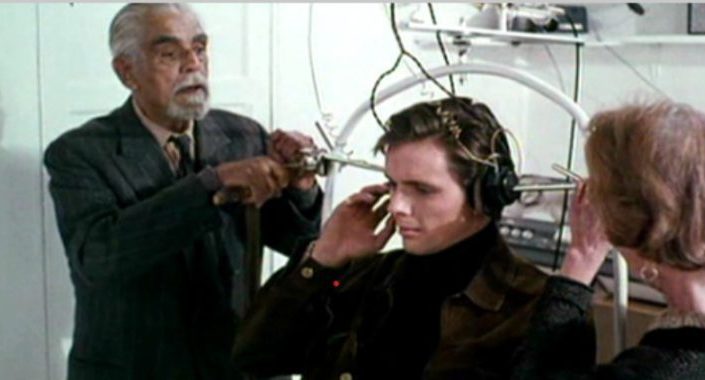
John Carradine and Myron Healey in The Unearthly (1957)
The Unearthly
(1957)

The Man: Dr. Charles Conway (John Carradine)

The Plan: Conway runs a private sanatorium in the middle of nowhere, where a number of people, including the beautiful but vulnerable Grace Thomas (Allison Hayes), are convalescing. They’ve been referred to the sanatorium by a duplicitous crony of Conway’s, Dr. Wright (Roy Gordon), to become unwitting guinea pigs in Conway’s secret experiments with glands (there are those glands again!) None have any family members who will notice if they go missing. Lobo (Tor Johnson), a hulking giant with the mind of a child (and a product of Conway’s experiments), is on hand to make sure the “patients” stay put.

In his research on human glands, Conway has found a way to “control the flow of vitamins” to them in order to create giants like Lobo, but he has also created a new artificial gland that in theory is the key to eternal youth: “I can prolong life for thousands of years, perhaps forever! Think of it, to be always, exactly as you are now. Suppose you could wake up every morning and see your face untouched by time!”

But to prove his theories, he needs a “completely sound physical specimen, mentally and physically perfect!” He thinks he has such a specimen in Mark Houston (Myron Healey), a fugitive criminal that Lobo found lurking around the property, and whom Conway has blackmailed into sticking around.

In the meantime, Conway continues to experiment on the other patients who have been lured to the house of horrors…

January 11, 2019

Lost in the Twilight Zone: Lesser Known Episodes, Part Two

Rod Serling presenting "The Howling Man," (1960) an episode of The Twilight Zone
Host Rod Serling introduces "The Howling Man"
In Part One, I saluted Rod Serling’s classic series for still going strong nearly 60 years after its initial air date. I looked at two episodes from the first season, that, while not usually celebrated as among the best of the series, are still to my mind minor classics and exemplify the uncanny, macabre mood for which The Twilight Zone is so well known.

One of them, “Elegy,” I don’t remember ever seeing before I stumbled upon it last year while perusing Netflix’s episode menu. “Elegy’s” peculiar premise and characteristic twist ending was the work of Charles Beaumont, whose 22 Twilight Zone scripts greatly contributed to the series’ dark, eerie feel.

In Part Two, I’ve picked two more Beaumont-authored episodes from the second season. They’re not in the same fan favorite league as “Eye of the Beholder” or “The Invaders” from season two, but they are wild and bizarre and very repeat-watchable.


This 5th episode of season 2 starts off like a conventional ghost story, with the pale, shaken protagonist, David Ellington (H.M. Wynant) speaking directly to the camera, relating what he admits is an unbelievable tale that happened to him years ago. He had been on a walking tour of central Europe shortly after WWI and had gotten caught in a fierce storm. In a neat segue, Ellington turns around to look out the window at a storm brewing outside.

In flashback, we see Ellington, soaked to the skin, stumbling toward a sprawling old hermitage. Banging on the door with his hands, he manages to summon a grim, bearded man with a long cloak and old-fashioned lantern who looks like a refugee from the set of The Ten Commandments. The man at first gruffly tells Ellington that they don’t admit visitors, but then takes pity on the distressed traveler and takes him to see the head man, Brother Jerome (John Carradine). As they walk through the corridors, Ellington is startled to hear an eerie howl, half animal and half human-sounding.

Jerome, with his long white hair and beard, shepherd’s staff and Biblical-era garments, looks like God himself. But Jerome has no mercy on the weary traveler -- when Ellington asks for shelter and food, Jerome insists that he leave immediately. Ellington, chilled and sick, turns to leave, stumbles a few paces, then falls to the floor in a faint.

H.M. Wynant and Robin Hughes in The Twilight Zone episode "The Howling Man," (1960)
The Howling Man is definitely going to trash
Jerome and his hermitage on Yelp.
After recovering from his blackout, Ellington follows the unearthly howls to a barred cell in the deep recesses of the hermitage. He’s startled to find a handsome prisoner in tattered rags who begs for Ellington’s help, claiming that Jerome and the brothers are all mad as hatters. He tells a harrowing tale of being captured by Jerome and held prisoner for simply kissing a girl in the local village square.

Ellington, not sure what to believe, confronts Jerome about the secret prisoner. At first denying he even exists, Jerome relents and tells the whole truth about the man they are holding. The story is even more fantastic than the prisoner’s. Ellington, his mind swirling, makes a fateful decision.

This Twilight Zone fairy tale has great fun with its gothic mix of lightning, thunder, weird howls, and dark, candle-lit sets. Veteran B movie actor John Carradine, with his deep, resonant voice and antique costume, is perfect as brother Jerome. He looks ready to lead the Israelites to the promised land. This was Carradine’s only appearance on the original show.

This too was H.M. Wynant’s (Ellington) only appearance on the series. His character is shaky, nervous and uncertain throughout. The camera emphasizes his chaotic state, at times in extreme close-up where we can see every drop of sweat on his forehead, and at other times in long shot, where his character seems to be swallowed up in the gloomy halls of the old hermitage. Incredibly, Wynant, who started his TV/film career in 1955 on the live Studio 57 show and has done just about every series you can think of, is still acting today, with a credit (on IMDb) for 2018!

English actor Robin Hughes, who looks like a poor man’s Errol Flynn, does a great job as the impassioned, persuasive prisoner. His job is all the harder, as he has to deliver his best lines from behind the bars of his cell. He also has a fun transformation scene towards the end that is reminiscent of Henry Hull’s in The Werewolf of London (1935). Hughes is the star of one of my favorite “forgotten” horror films of the ‘50s, The Thing That Couldn’t Die (1958) 

Underneath the High-Gothic hokiness, there is a modern psychoanalytic fable starring Ellington as humanity’s Ego, Brother Jerome as the Superego, and the prisoner as the Id. Whether in real life or in The Twilight Zone, you unleash him at your peril.


SPOILER ALERT: This episode is difficult to discuss in much depth without revealing important plot points. Proceed with caution.

“Shadow Play” adds a vicious twist to the age-old idea that life is all a dream. In the messed up head of Adam Grant (Dennis Weaver), life is a recurring nightmare in which the world and the people around him are merely set pieces in the strange, dark drama he must go through again and again.

The episode opens with a close-up of Grant in profile, seemingly sitting by himself in the darkness. As the camera pans back, the rest of the set suddenly lights up to reveal a courtroom. The jury is just returning from their deliberations. Grant is on trial for murder, but as the jury foreman declares him guilty of first degree murder, he stares off into space, chin in hand, oblivious.

At the judge’s repeated commands to stand up for sentencing, he wearily rises. As the judge imposes the ultimate penalty of death by electrocution, he at firsts laughs, then explodes in rage: “Not again, I won’t die again!” Before the guards can rush him out of the courtroom, he yells to a press reporter: “Tell the District Attorney he’s prosecuting himself, everybody in this building, … everybody in the world!”

On death row, Grant acts as if he’s seen it all before. When an old con (William Edmondson) in an adjoining cell advises him to stop imagining what the execution is going to be like, Grant, as if in a trance, describes the final minutes in great detail, from the colors of the doors and the execution room, to the feel of the electric chair seat, to the musty smell of the hood as they pull it over his head.

In a neat bit of gallows humor, just as Grant gets to the pulling of the switch, the scene jump cuts to the District Attorney’s home, where his wife has opened up the oven to check on two steaming steaks.

Grant’s bizarre behavior has wormed its way into the heads of the reporter, Paul Carson (Wright King), and the DA, Henry Ritchie (Harry Townes). Paul shows up at Ritchie’s house on the night of the execution, liquored up and clearly weirded out. His interviews with Grant have him doubting his own reality. He convinces the reluctant Ritchie to make a last minute visit to death row to talk to Grant himself.

Upon arriving, Ritchie is surprised to find out that Grant is expecting him. Ritchie gets more and more uncomfortable as Grant seems to know what he’s going to say before he says it. Grant sticks to his mad story that he is dreaming his own execution “night after night after night.” As Ritchie leaves, a desperate Grant chillingly calls after him, “I’m telling the truth Mr. Ritchie! Please, let me live and I’ll keep you alive, I’ll dream you every night, just like this…”

When Ritchie gets home, he finds a small but unnerving change to his reality -- one that Grant had predicted -- that leaves him speechless and very spooked.

With Beaumont’s clever script, you get two tortured souls for the price of one -- Grant, caught in an endless loop of nightmares, and Ritchie, who slowly comes to the chilling realization that his own comfortable world can be wiped out in the blink of an eye.

"Last meal? Hmmm, I can't decide between the mystery
meatloaf or the Spam sandwich..."
Grant’s nightmare worlds are built from scraps of memory. Another nice touch is that, even in the depths of the nightmare, Grant is fully aware of how rickety and superficial it is: the DA is an old teacher from grammar school, the clergyman who visits him before the execution is a pastor who died years before.

And, having no real world experience with courtrooms or death houses, the particulars of his tortured dreams are filled with cliches from prison movies he’s seen. He muses, “I got tried and sentenced the same day -- it doesn’t work like that. It’s like a movie. Real death houses aren’t like that, but I’ve never been in a real death house…. That’s my impression of it.”

But, in spite of the banal absurdity of it all, the horror is no less real. Or perhaps, it’s all the more horrible because it’s so absurd. Dennis Weaver’s performance is a gem. He deftly rides his character’s emotional roller-coaster from all-out panic to quiet desperation and back again.

By this point Weaver had already established some TV fame with his role of Chester on Gunsmoke, and of course would go on to even greater glory as McCloud in the 70s. But credit The Twilight Zone for really putting his talents to good use.

Weaver is ably supported by the other cast members, especially William Edmondson as Jiggs, another prison movie cliche pulled straight out of Grant’s mind. Jiggs is the grizzled death row veteran who at first tries to take the new guy under his wing, but as Grant continues to insist that the prison, the cells and everyone around him are figments of his nightmares, Jiggs snorts in derision at the madman.

Yet another plus for “Shadow Play” is the capable direction of John Brahm. The German born director was no stranger to strange films and TV. Before diving headlong into TV in the mid ‘50s, Brahm had helmed two well regarded thrillers, The Lodger (1944) and Hangover Square (1945), both starring the quietly menacing Laird Cregar. Brahm had an very productive TV career, directing episodes for all the usual suspects -- Alfred Hitchcock Presents, Thriller, The Outer Limits, Voyage to the Bottom of the Sea and The Man From Uncle, among others -- as well as 12 episodes of The Twilight Zone.

To my mind “Shadow Play” is the best of the Brahm lot, for its clever, mind-bending script and great performance by Dennis Weaver.

February 22, 2013

Mad Science Mayhem: The John Carradine Netflix Instant Watch Edition

The last time we discussed John Carradine on this blog, he was a mad doctor using human hormone secretions to turn a 600 pound gorilla into the beautiful and exotic Acquanetta (Going Ape Chic). It's impossible to neatly sum up the career of an actor who appeared in literally hundreds of movies and TV shows (not to mention the theater) over 6 decades, except to say the man worked… and worked… and worked. He worked in every genre, and no part however small, or production however meager, was beneath him. If, out of that immense body of work, John is best known for his horror and sci-fi outings, then that says something about the staying power of those genres. Cinematic horror and sci-fi are the modern equivalents of fairy tales for youngsters and adults. In the brave new 21st century, I suspect that few of us are so comfortable, sophisticated, or tech-obsessed that we've lost the fear of (or need for) the unseen thing lurking in the shadows. There's a little bit of the Grim(m) in all of us, so we naturally gravitate to fairy tales of science gone wrong, suspense, and horror.

While the archetypal mad doctor / scientist character is now seen as a quaint, amusing contrivance, it's no stretch to see why it was so prevalent in sci-fi and horror films of the 20th century. At the very same time that science was shrinking the world with new communications and transportation technologies, conquering diseases, and prolonging life, some of those same technologies were being used to wage world war and cause unimaginable pain, suffering and death. And in the 1950s, the ultimate application of science, the hydrogen bomb, threatened to end life and civilization as we know it. Is it any wonder that scientists in the movies were often portrayed as bat sh*t crazy?

John Carradine in The Invisible Man's Revenge (1944)
"Now this isn't going to hurt... much...": John Carradine
(wearing the lab coat) in The Invisible Man's Revenge (1944)
Perhaps more than any actor of his time, John Carradine personified the good science / bad science dichotomy. Here was a good-looking, urbane and sophisticated man who was seemingly always up to no good in the B's, trying to create an army of zombies for the Nazis in one, or kidnapping a street alcoholic and flash-freezing him for an experiment in suspended animation in another. For many moviegoers of the mid-twentieth century, John, and others like him (George Zucco and Lionel Atwill come immediately to mind), were the faces of science run amok: rational and sophisticated on the outside, mad and amoral on the inside.

In the 1940s alone, Carradine played doctors or scientists suffering from varying degrees of madness in 5 films:
He would return to the mad scientist role several more times in his career (and unfortunately, in productions that make some of his B movies of the '40s and '50s look like Gone With the Wind-- Ted V. Mikels' The Astro-Zombies, 1968 and Al Adamson's Blood of Ghastly Horror, 1972 being two of the more egregious examples). But it's no coincidence that the bulk of his mad scientist / doctor work occurred during the height of World War II. The Nazis had taken over a country that was widely considered to be at the top of the world pecking order in terms of culture and science. When these movies were made, they had turned a once high-minded culture and its science and technology to total war and genocide, and were well on their way to destroying themselves along with much of Europe and North Africa. With the American public clamoring to see such hubristic evil get its just deserts on their neighborhood movie screens, John got lots of work taking the fall in these celluloid fairy tales.

Lucky Netflix Instant Watch subscribers have a couple of Carradine's mad doctor flicks from the '40s at their disposal. While these are by no means great films and they scrape the bottom of the B production barrel (both are from Monogram Pictures, one of the lowly Poverty Row studios that hit its rickety stride in the '30s and '40s), the stories they tell are so off-the-wall and loopy that you might just be tempted to smile as they stream across your flatscreen.

Poster - Return of the Ape Man (1944)
Now Playing: Return of the Ape Man (1944)

Pros: Rare pairing of Carradine and Bela Lugosi; Harebrained Mad Scientist plots and dialog provide offbeat amusement
Con: Clumsily frenetic; Aimed at the lowest of common denominators

In Brief: The movie opens with a newspaper headline about the ongoing mysterious disappearance of a notorious "tramp." Cut to a laboratory, where professors Dexter (Bela Lugosi) and Gilmore (John Carradine) are removing a body from an odd-looking glass-walled chamber. They lay him out on a table, inject him with something, and pretty soon the man is sitting up and rubbing his head, to the obvious delight of the scientists. The subject, obviously the tramp of the newspaper story, wonders how long he was unconscious. Dexter and Gilmore just smile knowingly. Dexter gives him some money and sends him on his way. We learn that he'd been kidnapped by the unethical scientists four months previously, and had been frozen in suspended animation all that time.

Dexter, apparently the head scientist and the more dominant of the two, isn't satisfied with just flash-freezing hobos and reviving them. He wants to revive someone who's been frozen in the ice for hundreds, if not thousands, of years. So Dexter, with Gilmore in tow, mounts an Arctic expedition to find a frozen cave man. After months with nothing to show for it, Gilmore is ready to give up, telling the obsessed Dexter that the chances of finding what they're after are one in an million. At that exact moment, an avalanche reveals -- you guessed it -- a cave man entombed in ice.

Still - Frank Moran as the Ape Man, Return of the Ape Man (1944)
The "Ape Man" (Frank Moran) thinks about getting a haircut
as the mad doctors decide what to do with him.
After they revive the primitive man back at the lab ("It's alive!" Dexter exclaims, channeling Colin Clive from the original Frankenstein), Dexter starts stewing again. It's not enough to simply discover a frozen cave man, transport him back to civilization and restore him to life. He now wants to transplant the "rational" part of a modern man's brain into the cave man in a mad effort to give him the power of speech, but at the same time retain his memories and connections with his primitive life. Being the bright boy he is, Gilmore deduces that the scheme will require surgery on a living person -- "It would be murder!" he tells Dexter. "Murder is an ugly word," Dexter responds coldly, "I don't recognize it!"

Dexter is so keen to get on with his new project, that he selects his unwitting subject Steve (Tod Andrews) -- a law student and fiance of Gilmore's niece -- at a dinner party held at the Gilmore house. Gilmore notices Dexter's and Steve's absence just in time, and intercepts the professor before he can carve up Steve's brain. While Gilmore apparently had no qualms about kidnapping hobos and flash-freezing them, he draws the line at murdering people near and dear to him: "Science does not demand murder on its behalf!" he lectures the sullen Dexter, adding, "I believe you're quite mad!"

Undeterred, Dexter concocts a plan to trap an even better brain candidate. He succeeds in transplanting the brain mass into the "ape man," giving it the power of speech, but the brain augmentation does nothing to suppress the creature's killer instincts. The hairy humanoid goes on a rampage and leads Steve and the police on a mad chase through the city streets…

Mad Doctor Note #1: Return of the Ape Man sounds like a sequel, but it was simply Monogram's attempt to capitalize on one of their earlier Lugosi vehicles, The Ape Man (1943); while the characters and settings are different, they do share the common theme of mad science. Return gets pretty silly in the second half when Monogram's version of the Keystone Kops and Steve chase the "ape man" from the lab, to Gilmore's house, to a rundown theater (?!?), and back to the lab again. It does excel with ripe Mad Scientist dialog. One of the highlights is when Dexter sits off in a corner at Gilmore's dinner party, scowling at the other guests making small talk. "You know, some people's brains will never be missed!" he mutters.

Mad Doctor Note #2: Return of the Ape Man lists suave (and frequent B movie villain) George Zucco in the credits. According Richard Bojarski (The Complete Films of Bela Lugosi, Citadel, 1992), Frank Moran was supposed to play the pre-operation brutish cave man, and George Zucco was to play the more civilized, post-operative primitive man with an enhanced brain. Zucco pulled out before filming began with an unspecified illness (possibly after reading the script), and Frank ended up playing the part from beginning to end (the brain operation scarcely alters him). (Side note: the characters keep referring to Moran's character as an "ape man," and looking "more like ape than man." In actuality, Moran, dressed in tattered rags, looks only marginally hairier and rougher than the street bum that the good doctors experiment on at the beginning.)

Key Player: Like Carradine, Bela Lugosi kept popping up as a mad scientist throughout the mid-forties. In 1943's The Ape Man, he plays a scientist who turns himself into a half ape, half human hybrid, and spends the rest of the film desperately trying to find a cure. In Voodoo Man (1944), he plays an elegant doctor dabbling in voodoo to revive his beloved dead wife. And again, in 1945, he dons the mad doctor lab coat in the comedy-horror Zombies on Broadway. (Around that time he also took his turn playing the Frankenstein Monster in Frankenstein Meets the Wolf Man, 1943, and put on his Dracula cape for The Return of the Vampire, 1944.)

Lobbycard - The Face of Marble (1946)
Now Playing: The Face of Marble (1946)

Pros: A step up in production values; Atmospheric with some interesting lab scenes
Con: Chaotic, confusing mix of sci-fi, horror and fantasy with a touch of voodoo; Convoluted love triangle (actually, quadrangle) taxes the viewer's patience

In brief: On a dark and stormy night, brilliant surgeon Charles Randolph (Carradine) hauls the body of a drowned sailor found washed up on the beach back to the laboratory at his seaside mansion. In a lucky coincidence, Randolph and his assistant, Dr. David Cochran (Robert Shayne) have been experimenting with an electro-chemical process to bring the recently deceased back to life, and the sailor is a perfect candidate. In a scene obviously influenced by the Universal Frankenstein movies, the sailor is revived amid impressive arcs of electricity. But there's a side effect: the man's face is unnaturally rigid and pallid-- "a face of marble!" Cochran exclaims. The sailor rises zombie-like, only to be laid low again by a near direct lightning strike on the house. Randolph returns the body to the beach, reasoning that since he was dead already, no harm was done.

Randolph's young socialite wife Elaine (Claudia Drake) is on to her husband, and pleads with Cochran to convince Randolph to give up the risky experiments. It turns out she married the older man in gratitude after he saved her life with a delicate brain operation, but the marriage has soured, and the ruggedly handsome Cochran is quite the temptation. Elaine's creepy but loyal servant Maria (Rosa Rey) spies on the two, sees the affection that her mistress has for the younger doctor, and makes up her mind to bring the two together using her voodoo arts (specifically by placing a voodoo love doll under Cochran's pillow to get him to fall for Elaine). When Cochran, confused and irritated, throws the doll into a beaker of acid, the mortified Maria predicts that violent death will come to the house.

Meanwhile, the local police inspector and old friend of Randolph's, Norton (Thomas E. Jackson), comes calling. It seems an autopsy of the sailor found that the body had undergone a severe electric shock, and the doc's the only person for miles around who's been experimenting with electricity. Randolph fends him off by appealing to their friendship, but Norton remains deeply suspicious.

Spooked by his old friend's questions, Randolph decides to go back to experimenting with animals, specifically, his wife's even-tempered and loyal Great Dane Brutus. He persuades the reluctant Cochran to help him one more time. Randolph kills poor Brutus, then tries to revive him. At first, it looks like the experiment has failed, but then, shortly after leaving the lab, the doctors hear him barking. Returning to the lab, they encounter a very aggressive dog baring its fangs. Randolph shoots it with no effect, then they watch flabbergasted as Brutus turns transparent and jumps through a closed window.

Having killed his wife's dog and turned it into a spectral Hound from Hell, Randolph continues to put the screws to the wayward Elaine (perhaps consciously, perhaps not) by inviting Cochran's girlfriend, Linda Sinclair (Maris Wrixon), to stay at the house. Elaine is clearly not pleased that she has to entertain her rival for David's affections as a houseguest. But soon, the attractive blonde girlfriend is itching to leave after being visited in her guest room by the the snarling Brutus who seems to be able to materialize out of thin air. At this point, the movie throws so many plot contrivances at the poor viewer, that you could forgive him/her for thinking that scenes from 3 or 4 different movies had been edited together by mistake. Local farm animals are drained of their blood, a devious murder plot is hatched, the would-be murderer makes a tragic miscalculation, people as well as animals start turning into ghostly spectres, an innocent character is framed, and the accused makes a quick, but implausible, break from police headquarters to save the day. It's as if the screenwriter had fallen behind on his deadline and started smoking wacky tobacky midway through the job. It's a wild '40s B ride, if you can hang on.

Robert Shayne as Inspector Henderson, Adventures of Superman (TV show)
A dapper Robert Shayne from his
Adventures of Superman days
Key player: Robert Shayne is perhaps best remembered as Inspector Henderson from the '50s TV series Adventures of Superman with George Reeves. He was also busy in '50s sci-fi movies, among other things, appearing in Indestructible Man (1956) alongside Lon Chaney, Jr., Kronos (1957), The Giant Claw (1957), War of the Satellites (1958), and Teenage Caveman (1958). Shayne was signed by Warners Bros. as a contract player in the early '40s, but by the time of Face of Marble, was freelancing on his own. At this point he was undoubtedly having second thoughts about his career move. Tom Weaver, in his Poverty Row Horrors! Monogram, PRC and Republic Horror Films of the Forties (McFarland, 1993), quotes Shayne as saying that he was somewhat less than happy with the end product:
"After we had finished it, I went to see a preview of it over in South Los Angeles somewhere, with my wife and another couple. We were near the back of the house, and as this picture went along I hung my head, I was so embarrassed by it! Finally, when the thing was over, I got out into the lobby before anybody else did, and I was standing against a wall with my wife and this other couple. Two young ladies came out and stood against an opposite wall, and they did a double-take when they saw who I was. And one of them came over to me and said [wagging a finger], 'Mr. Shayne, you ought to be ashamed to be in a picture like that!'"
Still, time heals many wounds. What might have seemed embarrassing back in the '40s becomes good, campy fun decades later.

December 4, 2012

Going Ape Chic

Poster for Captive Wild Woman (1943)
Now Playing: Captive Wild Woman (1943)

Pros: Good performances by John Carradine and Fay Helm; Effective wild woman make-up
Cons: Weak script; Way too much inserted footage of wild animal tamer Clyde Beatty abusing lions and tigers, way too little of the wild woman

Some people are never satisfied. Since time immemorial, human beings have observed the grace, speed, agility and frightening power of animals, and found their own relatively hairless and weak bodies wanting. So they've dreamed of (or had nightmares about) beings with the intelligence of humans and the most coveted traits of animals. The ancient Egyptians had a whole panoply of gods associated with sacred animals. Interestingly, many of these gods and goddesses sported the heads of animals (but presumably kept their superhuman intelligence): Thoth, maintainer of the universe, was depicted variously with the head of an ibis or a baboon; Horus sported the head of either a falcon or a hawk; Annubis, the god most associated with mummification and the afterlife, commonly appeared jackal-headed; and the warrior-goddess Sekhment was appropriately equipped with a lioness' head.

The ancient Greeks turned this animal symbology on its head, so to speak, and came up with all sorts of hybrid man-animal and animal-animal combinations: Centaurs, Gorgons, Minotaurs, Furies and Sirens all featured some aspect of the human anatomy, while the Hippalectryon, the Chimera and the Manticore seemed to spring from some ancient game of Mad Libs featuring animal parts.

The dour Europeans of the Middle Ages took pagan animal worship and typically turned it into something evil -- the Great God Pan became his Satanic Majesty with goat legs and cloven hooves. Even with the Renaissance, the association of the animalistic with evil remained fixed in the mass psyche. The werewolf became a well-known symbol of the dark side of man.

In the late 19th century, H.G. Wells updated the old human=good, animal=bad trope with his novel The Island of Dr. Moreau (1896).  After being marooned for months with the wretched half-human, half-animal results of Moreau's cruel experiments, Edward Prendick returns to civilization only to be driven to near madness with his heightened awareness of the "animal" in even the most supposedly refined of men. Wells' modern fable struck a chord (or perhaps an atavistic instinct) sufficient to produce half a dozen film adaptations in the 20th century, and influence many more films, TV shows and even comic books.

Speaking of Mad Libs, Captive Wild Woman is the movie equivalent, combining a little bit of Wells, a little bit of Poe's Murders in the Rue Morgue, The Wolf Man, and even a teensy bit of Tarzan into a somewhat less-than-satisfying (and occasionally unintentionally funny) whole.  If the title sounds like a circus sideshow, it reflects both the circus setting and the fact that the movie was something of a sideshow for Universal at the time. It came smack dab in the middle of Universal's classic monster revival of the 1940s, but even though it was popular enough to spawn two sequels, Jungle Woman (1944) and The Jungle Captive (1945), subsequent years have not been kind to the wild woman's reputation. (It probably didn't help that the follow-ups were pretty wretched. While the original was released in 2009 as part of the Universal Horror: Classic Movie Archive collection, its shaggy, flea-bitten sequels never graduated from VHS to decent DVD releases.)

John Carradine as mad scientist Sigmund Walters
Sigmund Walters (John Carradine)
practices his mad scientist stare.
Captive starts out with the return of wild animal trapper/trainer Fred Mason (Milburn Stone of later Gunsmoke fame) from a two-year-long seagoing expedition to secure lions and tigers (but no bears) for his employer, the John Whipple circus (no relation to Mr. Whipple of Charmin bathroom tissue fame). An exuberant Fred brags to his girlfriend (and Mr. Whipple's secretary) Beth Colman (Evelyn Ankers) about all the animals he's captured for the circus, including a female gorilla named Cheela (obviously the feminine derivative of Cheetah). Shortly after he introduces the lively and intelligent ape to Beth, a poorly-secured box containing a tiger crashes to the dock, releasing its cargo. Fearless Fred shows off his quick thinking and animal control skills by grabbing a cane and a chair and single-handedly trapping the man-eater in a vacant dockside office.

With one crisis averted, Beth tells Fred that her sister Dorothy (Martha Vickers) is ill with a mysterious glandular disease. Sparing no expense, she's managed to get her sister into the Crestview Sanatorium, run by one of the world's leading endocrinologists, Dr. Sigmund Walters (John Carradine). In classic B horror form, as Beth tells Fred about the Sanatorium, the entrance is seen in flashback-- the wind is howling, leaves are blowing, strange shadows are playing across the Crestview sign, and the camera tracks back to reveal a creepy, haunted-looking place that no one in their right mind would get within 10 miles of.  But, she continues, her mind was set at ease when she picked up a medical journal in the lobby detailing the doctor's accomplishments at furthering "not one, but three separate attempts at racial improvement."  Okaaaayyyyy….. Not to worry Beth, Dr. Mengele, er, Dr. Walters is going to take good care of your sister…

Walters is indeed smooth and charming, and Beth takes such a shine to him that she invites him to take a behind-the-scenes tour of the circus. He joins Fred and the circus owner Mr. Whipple (Lloyd Corrigan) in watching the lions and tigers being rounded up and fed. A ruckus over at the gorilla's cage diverts their attention -- an inebriated animal handler (Paul Fix) is tormenting Cheela with a stick when she grabs him by the head through the cage bars. After Fred manages to get her to let him go, Whipple fires him on the spot. Fred demonstrates her amazing intelligence to the group, getting her to turn around for a back scratch and then shaking his hand. Walters is impressed, and we can almost see the gears turning in his head as he compliments the circus people on their find. He offers to buy Cheela, but Fred good-naturedly turns him down, explaining that the personable gorilla is "priceless."

Back at the sanatorium, the devious doctor complains to his assistant, Nurse Strand (Fay Helm) that the animals they're currently working with are inadequate for the lofty goals of his experiments. He tells Strand that he intends to take sex hormone secretions from Dorothy (supposedly a by-product of her disease!) and inject them into Cheela. After all, glands can "transform physical matter into any size, shape or appearance" (we all knew that, right?). When Strand protests that the authorities will never allow it, Walters chides her: "I see you're not truly a scientist at heart Miss Strand. The things we're trying to do… one must be daring."

Walters hires the fired animal handler to kidnap Cheela for his experiments. In the dead of night, the henchman gets Cheela, cage and all, into Walters' truck. When he demands his dough, Walters, with a cold, evil grin on his face, pushes the ex-circus man into the cage, where off-camera Cheela goes to work on him. Later, with the newspapers blaring headlines about a killer ape on the loose, Whipple is in a tizzy, telling Fred that if she attacks anyone else, the circus is done for. Fred nonchalantly tells him not to worry, that she'll show up sooner or later (huh???).

Meanwhile, after transfusing Dorothy's hormones into Cheela and turning her into an exotic-looking beauty, Walters exhibits a curious nonchalance of his own. When Strand once again protests that experimenting with animals is one thing, but that the operations are sapping the life out of Dorothy, Walters, looking puzzled, asks the nurse, "Why should a single life be so important?" As the indignant nurse lectures Walters that his fine mind has become warped and he's tampering with things "no man or woman should ever touch," he decides that a human cerebrum transplanted into the ape woman is just what's needed to complete the experiment, and Nurse Strand's will do very nicely. Ouch! So much for all those years of selfless service to the great man and his dream to create a race of supermen!

The unveiling of Dr. Walters' newest creation, Acquanetta.
Behold! The Bride of the Gorilla! (Oh wait, that was another B movie...)
In a scene just a little reminiscent of Bride of Frankenstein, Walters unwraps Cheela's bandages to reveal Acquanetta, Universal's newest starlet (more on her later). She looks absolutely fabulous for a creature who had been a highland gorilla just a few hours before. And thanks to Nurse Strand, she has both looks and brains. He immediately dubs her "Paula Dupree" (maybe the name of an old girlfriend?).

The audacious scientist decides to show off Paula to his new friends at the circus. The animals begin pacing and growling, and Whipple comments that they seem to be afraid of something. Fred has convinced his boss to let him work up a super-dangerous act with both lions and tigers (but no bears), and he's practicing with the snarling beasts when Walters and Paula show up. Suddenly a platform topples over and knocks Fred out cold. Paula runs into the cage and stares down a lion that was thinking of having Fred for a mid-day snack. Everyone is amazed at the girl's power over the big cats, and Fred excitedly talks his boss into hiring her for the act, to stand outside of the cage, keeping the beasts calm (or afraid) while Fred does his thing.

These best-laid plans go awry, however, when Paula/Cheela sees Fred embracing Beth. Even as a gorilla, Paula had had a thing for Fred, so she has a temper tantrum when she sees him with the beautiful blonde. As a result, Paula partially reverts back, looking somewhat like a fetching neanderthal. In her bestial state, she pays Beth a visit in the dead of night, stealthily advancing toward her bed. Beth wakes up in the nick of time, sees the dark, hairy humanoid looming at her, and lets out a healthy, patented-Evelyn Ankers scream. When the housemaid appears at the doorway, the ape woman goes after her, sparing the shivering Beth. The next day, the autopsy reveals that the housemaid was killed in exactly the same way as the drunken animal handler, by super-powerful hands that snapped the spinal cord at the base of the neck.

Things come to a head on a dark and stormy night. Even though Paula has gone missing, fearless Fred decides to go ahead with the lion and tiger act. Meanwhile, back at the lab, Paula is becoming more girl-illa by the minute. Walters decides she needs another donation of glandular secretions from Dorothy, but the hapless patient is finally wise to the demented doctor, and calls her sister to come rescue her. Will Fred survive in a cage full of lions and tigers (but no bears) without Paula's help? Will Dorothy be sacrificed to attain Walters' goal of creating a race of super gorilla-men?

Captive Wild Woman was released at a time when Universal was cranking out B programmers like sausages, many of them series like Sherlock Holmes and The Inner Sanctum mysteries (patterned after the popular radio show). These low-budget movies were the television of their time, serving up familiar, entertaining characters and plots to a war-weary public. It's testimony to the huge demand for such content that the studio tried to make a series out of the relatively weak Paula Dupree ape woman character.

Paula Dupree (Acquanetta) reverts back to her original gorilla self
Eat your heart out Larry Talbot!
Film snobs sniff at what Universal did in the '40s to the Laemmles' lovingly-crafted classic monsters, pairing and tripling them in the B movie equivalents of WWE SmackDowns, then, to add insult to injury, letting Abbott and Costello have a crack at them. I've found it's a lot more fun to ignore the snotty condescension and just enjoy them for what they are-- given the right frame of mind, things like Frankenstein Meets the Wolfman (1943), House of Frankenstein (1944), and Abbott and Costello Meet Frankenstein (1948) are wonderfully corny and entertaining.

Unfortunately, Captive Wild Woman takes more work to appreciate. There's a strange flashback and narration sequence toward the beginning that's just bad plot construction. Someone mistakenly thought that endless inserted footage of animals being abused by a whip-cracking animal tamer made for great entertainment (the footage was of famed circus performer Clyde Beatty, pulled from his 1933 film The Big Cage). Milburn Stone, at the time a ho-hum second banana for Universal's low budget programmers, makes a pretty weak (and puny) leading man. But worst of all, the monster (and beautiful Acquanetta herself) are given precious little film time between all the animal taming and the impassioned speeches about creating a race of supermen. She doesn't speak a single word in the whole film. As Paula her most dramatic moment comes when she silently stares down a man-eating lion. She has even less screen time as the ape woman who is regressing back to being a full-fledged gorilla (even though Jack Pierce's half-woman, half-gorilla makeup is pretty good).

Any B movie maker worth his or her salt knows that you lead with the monster, not relegate it to a minor sideshow attraction. The exotic Acquanetta was billed as the "Venezuelan Volcano," but by varying accounts she was either half-Arapaho, born on a reservation in Wyoming, or born in a working class neighborhood in Philadelphia. (Tom Weaver, et. al, Universal Horrors: The Studio's Classic Films, 1931 -1946, 2nd edition, McFarland, 2007.)
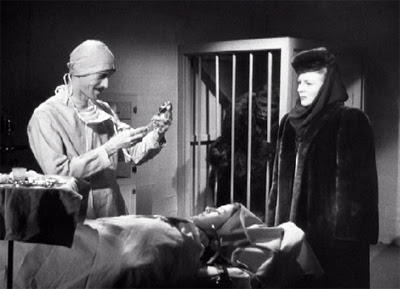
Walters (John Carradine) prepares for yet another dastardly operation
B movie inventory: Mad scientist? Check. Young woman in distress?
Check. Gorilla in a cage? Check. Evelyn Ankers? Check.
Director Edward Dmytryk helmed one of the great film-noirs, Murder My Sweet with Dick Powell, over at RKO around the same time he punched the clock for Universal on Captive Wild Woman (he later went on to direct such classics as Crossfire, 1947, The Caine Mutiny, 1954, and The Young Lions, 1958). What a difference a great script, a bigger budget, and true star power makes! He did, however, manage to get some pretty good performances out of Universal regulars Carradine and Fay Helm (nurse Strand). John had already acquired a reputation as a big ham, but in Captive he's dapper and charming when Walters is trying to get his mitts on the unsuspecting Dorothy, and then delivers just the right amount of mad intensity as he fulfills his dream of transforming a brutish gorilla into an alluring young woman. Helm has the dubious honor of delivering some of the more hoary, cliched lines in the film, yet does it with gusto. I can't think of another mad scientist's assistant in all of B movies that has such a conscience or objects as strenuously when she sees Science veering off into Evil. If the real world had had more Nurse Strands at the time, World War II might never have happened.

In an interview with Tom Weaver, Dmytryk related how Carradine's reputation had preceded him on the set:
He had always been kind of a ham. I hadn't known him personally, but I had [known of him] when he used to walk the streets of Hollywood, even in summertime, with a topcoat thrown over his shoulders Barrymore-style and wearing his Barrymore-style hat. He used to go down and try to get the attention of Doug Fairbanks and Charlie Chaplin at the Cinegrill, the little downstairs cafe at the Roosevelt Hotel… So I was really afraid of what he would do in Captive Wild Woman, but I had a little talk with him and I think we got a very controlled performance out of him for a mad scientist. [Ibid.]
Indeed! Carradine, and to a certain extent Fay Helm, ended up being the main attractions of the film, while poor, mute Acquanetta was effectively pushed aside. Still, Captive Wild Woman is a part of Universal's Silver Age of monsters, and it would be a shame for a true fan not to make her acquaintance.


Where to find it:
Available on DVD

TCM Shop


"Creature of evil, running amok, blazing a trail of fear-crazed horror!"