Now Playing: The Cry Baby Killer (1958)
Pros: Generally solid acting; several good moments of suspense and psychological drama; good jazz score
Cons: One of the more interesting characters disappears midway through; too much talk from the adults and not enough teen delinquency
This post is part of 'The Favorite Stars in B Movies' blogathon hosted by yours truly. Please check out the contributions from my fellow bloggers on a wide array of stars who appeared in B movies on their way up or down the career ladder, or who made Bs their own personal domain.
Superstars have to start somewhere. Sports stars typically prove themselves by grinding through a long succession of school, amateur and/or minor league programs. The path to movie stardom is more circuitous and subject to luck (that is, if you’re not part of an established Hollywood family), but over the years, B movies have helped serve as the minor leagues for aspiring stars.
“King of the Bs” Roger Corman has been producing movies since the mid-1950s. Once he perfected the art of making films quickly, cheaply and profitably, he reinvested the proceeds and leveraged his knowledge to become a sort of Hollywood minor league commissioner and film school director rolled into one.
The list of high-powered Hollywood icons who learned their craft on Corman productions is a long one. Among directors, such household names as Peter Bogdanovich, James Cameron, Francis Ford Coppola, Jonathan Demme, Ron Howard, and Martin Scorsese, among others, got invaluable early experience from “The Roger Corman Film School.”
Actors who got career boosts working for Roger include such luminaries as Charles Bronson, Sandra Bullock, David Carradine, Robert De Niro, Tommy Lee Jones and Sylvester Stallone.
In 2010 Corman received a long overdue honorary Academy Award for his “rich engendering of films and filmmaking.”
One of Roger’s most successful “engenderment” projects is Jack Nicholson, a 12 time Oscar nominee and 3 time winner. Although Corman helped jumpstart many acting careers that were already spluttering along, Nicholson was only 20 and had just one small TV part to his credit when he was picked for the title role in The Cry Baby Killer (Corman was executive producer and financed the film).
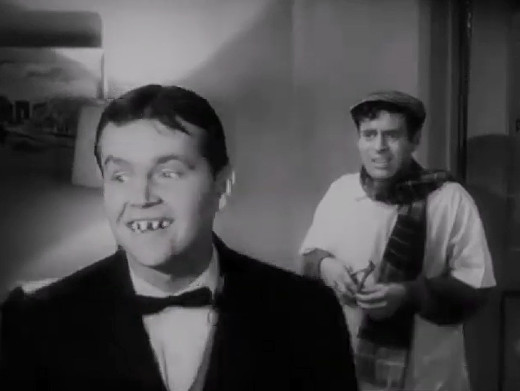 |
| Who knew this man would go on to collect all those Oscar statuettes? |
Cry Baby wasn’t the most auspicious of debuts -- the movie is only an hour long, and Nicholson spends most of his screen time pouting, scowling and waving a gun around. But it was the start of a productive relationship that saw Jack appearing in seven more Corman productions. In addition, under Roger’s tutelage Jack secured a producer credit for the western Ride in the Whirlwind (1966) and two writing credits, for Ride and the groundbreaking psychedelic exploitation film The Trip (1967).
Jack later summed up his work with Corman in typical Nicholsonian fashion: “He saved all of our careers. He kept us working when no one else would hire us. For this, we are all eternally grateful. For the fact that he was able to underpay us, he is eternally grateful.” [Philip di Franco, ed., The Movie World of Roger Corman, Chelsea House, 1979, p. 134.]
Corman may have wished he’d paid the cast of Cry Baby Killer even less -- it was the frugal producer’s first movie that failed to make a profit in its theatrical release (although it eventually recouped its costs with sales to TV).
Certainly all the elements of ‘50s drive-in popularity were there: a title character with James Dean-like angst, teen gang fights, gunplay, a tense stand-off with the cops in a hostage situation, and of course, adult squares looking on disapprovingly of the whole mess.
 |
Roger Corman (center) holds hearings on why Cry Baby Killer didn't earn more at the box office.
(Or is this his cameo as a U.S. Senator in Godfather II? Hmmm... I'll get back to you...) |
It’s hard to imagine in our current age of ubiquitous smartphones, social media and video games, but back in the day teens spent much of their free time engaging with the real world, and as a result had a lot more potential for getting into trouble.
Although the U.S. emerged from WWII more prosperous and powerful than ever, Americans spent much of the following decade finding things to be anxious about, from supposed communists in Washington and Hollywood, to the Bomb, to -- you guessed it -- teenagers that spelled Trouble with a capital T.
The “Greatest Generation” was resentful of youths who had the audacity to enjoy the freedoms and prosperity that had been bequeathed to them. Teenagers were the new anti-Boy Scouts: Untrustworthy, unhelpful, unfriendly, unkind, disobedient, sullen, cowardly and definitely not reverent.
Congress set about investigating the baleful influence of comic books, and religious zealots across the country denounced rock and roll as the Devil’s music designed to lead kids astray.
Hollywood jumped on the juvenile delinquent bandwagon with pictures like The Wild One (1953), The Blackboard Jungle (1955) and Rebel Without a Cause (1955). The problem, at least from the censorious adult perspective, was that in trying to maximize ticket sales, the studios made bad kids, exemplified by the likes of James Dean, positively glamorous (okay, maybe not so much in the screenshot below).
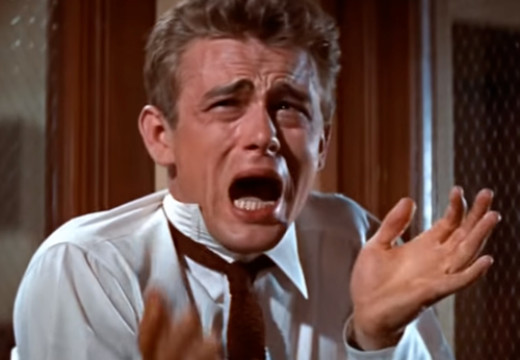 |
| James Dean paved the tearful way for teen anti-heroes like the Cry Baby Killer. |
Bad kids were so good for business that movie screens exploded with Untamed Youth (1957) Running Wild (1955) and committing Crime in the Streets (1956). And it wasn’t just the boys who were leading the charge into delinquency and degradation. Hot Rod Girl(s) (1956), High School Hellcats (1958) and various Girls on the Loose (1958) competed with the males to Live Fast, Die Young (1958) or else pay their debts to society as Reform School Girl(s) (1957).
Roger Corman was never one to let a hot topic go unexploited, and indeed, he dove into it with a vengeance, producing four teen-oriented films in 1957 alone: Rock All Night, Teenage Doll, Carnival Rock and Sorority Girl.
The next year Corman rode the crest of the teen wave with Hot Car Girl, Teenage Caveman (playing off the popularity of I Was a Teenage Werewolf and I Was a Teenage Frankenstein that had come out the year before), and of course, Cry Baby Killer.
Somehow, Jack Nicholson’s big screen debut ended up being the box office weakling in this gang. It may not have helped that the teen delinquency movie market was thoroughly saturated by this point. But Cry Baby has its share of problems beyond the obviously miniscule budget.
Jack plays Jimmy Wallace, an average teenager who gets beaten up in the opening scene by the school alpha male Manny (Brett Halsey) and his cackling cronies Joey (Ralph Reed) and Al (James Fillmore). Of course, the fight is over a girl, Carole (Carolyn Mitchell).
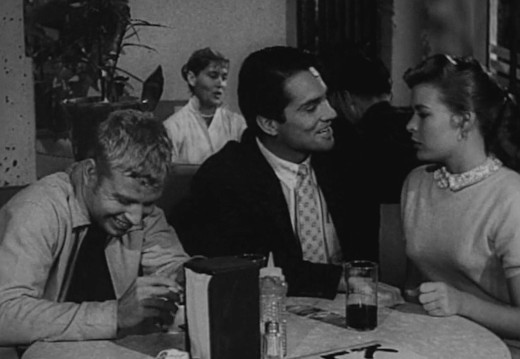
Jimmy’s friend Fred helps him get back on his feet while Manny takes his crew to the local diner, where he meets up with Carole. Manny holds court in the diner like the King of Teenland, and he has a cruel streak to match. He browbeats Carole into denouncing poor Jimmy as a punk while Joey eggs everyone on.
Jimmy shows up at the diner with Fred in tow to reclaim his girl Carole. When things look like they’re getting out of hand, the diner owner, Pete Gambelli (Frank Richards), barks at everyone to take it outside.
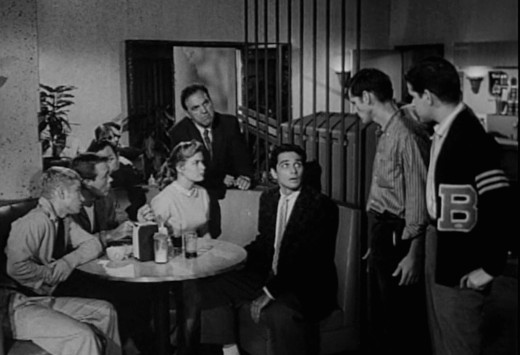 |
| Jimmy confronts Manny as he holds court at the diner. |
When the simmering confrontation turns into yet another fight, Jimmy grabs the gun that Al was wearing in his waistband, and off camera, shots ring out.
Policeman Glen Gannon (John Shay), who has been outside flirting with Julie (Lynn Cartwright), a waitress at the diner, confronts Jimmy, who is still holding the gun. At just the wrong time, a young mother with an infant (Barbara Knudson as Mrs. Maxton) exits the restrooms, and oblivious to the drama unfolding, walks into the standoff.
From the adjacent storeroom, Sam, the kitchen assistant (Smoki Whitfield), sees the woman’s dilemma and stealthily pulls her to safety into the building. Confused and scared, Jimmy refuses to throw down the gun and instead slowly backs into the storeroom and shuts the door.
Now Jimmy’s in a real fix -- he thinks he’s killed Manny and Al, and he’s backed himself into a corner as an accidental hostage-taker. The lives of an innocent man, woman and baby hang in the balance as the panicky young man grapples with what to do next.
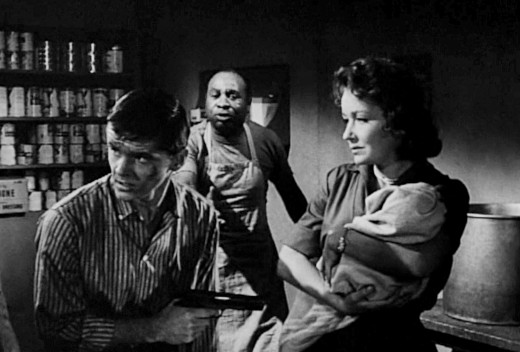 |
| "Will somebody please tell me today's diner specials?!" |
One of Cry Baby’s biggest problems is that its title character isn’t all that interesting. All we know about Jimmy is that he’s infatuated with Carole and he’s willing to get beaten up in desperate attempts to claim her as his girl. He’s somewhat scruffy looking and not all that bright. In the climactic standoff, he alternates between pouting and yelling at the woman to shut her baby up. Ultimately Nicholson would score a true breakout role in another low-budget youth picture, Easy Rider.
In contrast, Brett Halsey’s Manny is handsome, stylish (he wears a jacket and tie to his fights!), and self-assured to a fault. He has his own retinue of lackeys, and commands people and places with ease. He’s a mafia don, or maybe a Fortune 500 CEO, in the making. Even the middle-aged diner owner sucks up to Manny and looks the other way as he spikes his friends’ drinks with alcohol. He’s the privileged, amoral character you love to hate.
Instead of setting up a dramatic climactic clash between underdog Jimmy and his alphadog nemesis, Cry Baby dispenses with Manny mid-way through the film (we don’t even see him get carted off to the hospital after the gunshots), and introduces Jimmy to a new nemesis, a crying baby (which, come to think of it, gives a disturbing new meaning to the title -- don’t worry, no babies were harmed in the plot or filming of this motion picture!).
 |
| "Of course I wear Pierre Cardin to all my gang fights - why do you ask?" |
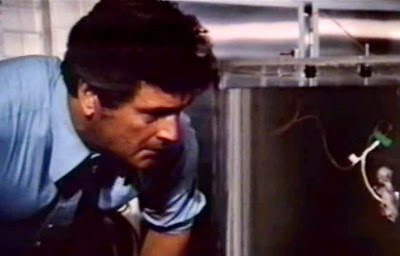
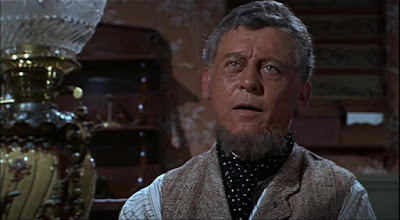
During the standoff, it’s the adults who steal most of the scenes. Upright, serious-as-death Lt. Porter (Harry Lauter) takes over the crime scene (and several of the film’s scenes) delivering fatherly advice to the innocent and a good old-fashioned throttling to the guilty, specifically Joey, whose smartass attitude is too much for the exasperated cop. Porter even reads the riot act to the slimy diner owner Gambelli, who he finds out was allowing Manny and his friends to sneak alcohol into the establishment.
But it’s Julie the world-weary waitress who delivers the film’s most searing indictment of youth culture. We learn from her conversations with patrolman Gannon that Julie is a widowed single mom who is barely scraping by. Mid-way through the stand-off, when she sees that Carole is only thinking of herself and whining about the possibility of going to jail, she delivers a zinger:
"I’ve been working in this dump for six months and I’ve seen a lot like you. You think because you’re 16 the world owes you something… well it doesn’t. You get what you work for, and you work to get Manny Cole! You’ll wind up in the gutter before you’re old enough to vote!"
It’s a powerful scene, but the film spends too much time on adults standing around bemoaning the “youth of today," slowing things down and distracting from the very real drama of the hostage situation.
In addition to the overly-long scenes of Lt. Porter interviewing witnesses and Julie chatting up the lonely bachelor cop, there’s a lot of business around the carnival atmosphere that develops as the standoff plays out. Several of Corman’s regulars show up as onlookers. Ed Nelson, who plays a TV reporter, had already made a half dozen Bs for Corman, including Rock All Night, Teenage Doll and The Brain Eaters, and would make several more before becoming a fixture on TV. (Corman himself makes a blink-and-you'll-miss-it appearance as the TV truck flunky).
Two other Corman regulars, Bruno VeSota and Leo Gordon, appear intermittently as a pair of chuckleheads kibitzing with the crowd and impatiently waiting for something bad to happen. Gordon, who is credited with Cry Baby’s story as well as co-writer on the screenplay, has a couple of choice lines, including a rant as he grabs the TV reporter’s microphone:
"I’ll tell you what I think mister, they oughta take these punk kids, throw ‘em in jail and throw away the key! My old man, if I did something wrong, he’d really sort me out!”
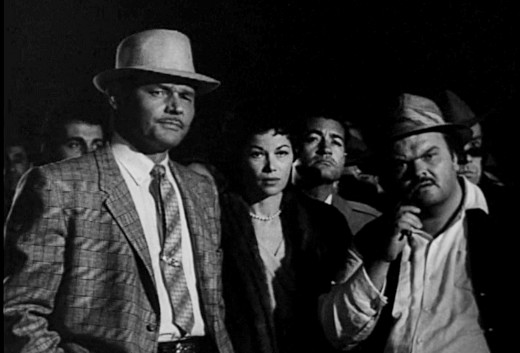 |
| Leo Gordon and Bruno VeSota do their poor man's Abbott and Costello routine. |
The line is especially ironic, considering that Gordon, who ended up with a couple hundred acting credits and dozens for writing, was an authentic tough guy (and presumed juvenile delinquent) who had served five years at San Quentin for armed robbery before getting his first acting break. One of his directors, Don Siegel, called him “the scariest man I have ever met!” [IMDb]
But apparently Gordon wasn’t scary enough to prevent his script from being messed with. Corman recalled being unpleasantly surprised when, upon returning from an overseas trip and checking in on the production, he was informed by his assistant that everything was great and they had “licked the script.”
"I said, ‘What do you mean, licked the script? It was a fine script. There was nothing wrong with that script.’ He [the assistant] said, ‘It had all kinds of problems. We’ve rewritten it totally and we solved all those problems.’ Well, they had wrecked the script, but were to begin shooting in two days. We put back a few things, but it was too late. The only good thing about the film was that Jack Nicholson made his debut in the picture and did a very nice job. …
Leo Gordon, who wrote the original script, had one good line. Playing a bystander, he said, ‘Teenagers -- we never had ‘em when I was a kid.’ I think that was true.’" [The Movie World of Roger Corman, p. 17]
Roger was definitely proud to have given Nicholson his feature film debut, but he’s a little too hard on the film. In spite of its problems, the acting is generally solid, and it has several good moments of suspense and psychological drama. Plus, the brass jazz score by Gerald Fried livens things up considerably (also of note is the title song "Cry Baby, Cry," which is quite an anthem for the bottom half of a drive-in double bill.)
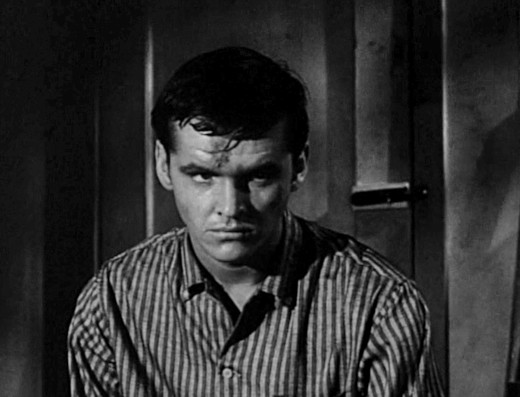 |
| Jack was on the verge of tears when he finally saw his paycheck for Cry Baby Killer. |
Cry Baby Killer could have been improved with more backstory for Jimmy (admittedly difficult for a 60 minute movie), and more of Manny, who is so delightfully bad that we’re sorry to see him get shot and disappear midway through. But hey, it was Jack’s party, and he got to cry like he wanted to.
Where to find it: Streaming 1 | Streaming 2