Pros: Great cast makes for a very believable family in crisis; Script cleverly keeps the source of the evil ambiguous; Stylish direction
Cons: The parents’ reaction to a family tragedy stretches credulity
When I found out that Gill over at Realweegiemidget Reviews was hosting a blogathon dedicated to the legendary TV impresario Aaron Spelling, I saw an opportunity to indulge my love of '70s and '80s TV movies, especially those of the horror and sci-fi varieties (of course!).
Even if you’ve never heard the name Aaron Spelling, if you’re of a certain age, you're very likely to have seen his work. Starting out as a writer in the mid-'50s, Spelling quickly moved into producing, and in the succeeding decades became almost an industry unto himself, producing hundreds of shows and TV movies. Starsky and Hutch? That’s a Spelling property. Charlie’s Angels? Check. The Love Boat? He was the real captain of the ship. The primetime soap Dynasty? Dynasty was his middle name.
Okay, so maybe you don’t know Aaron. How about Tori? Somehow Aaron found the time to have two children, one of whom, Tori, has something of her own legendary status in the Spellingverse. Tori started out doing small roles in some of her dad’s shows, eventually enjoying a lengthy recurring spot on Beverly Hills 90210. In addition to acting, she has also followed in her dad’s footsteps as a producer (and in the process grabbed a little of that mystical Kim Kardashian/Paris Hilton ability to be famous for being famous).
But I digress. This post is about one of the more effective TV horror movies of its era, from a man who started out as a pioneer and became a master of the genre. Most fans consider the debut of ABC’s Movie of the Week in 1969 to be the beginning of the great golden age of TV movies. The quick, cheap and original movies became a big hit with audiences and elevated ABC’s stature among the major networks.
Spelling eagerly exploited the new format and in 1970 alone produced such sci-fi and horror hits as The Love War (with Lloyd Bridges and Angie Dickinson), How Awful About Allan (with Anthony Perkins), The House that Would Not Die (Barbara Stanwyck) and Crowhaven Farm (Hope Lange and John Carradine).
Fast forward 12 years, and Aaron Spelling was sitting majestically atop the TV world as head of Aaron Spelling Productions. While the ABC Movie of the Week series was long gone and the TV movie golden age was waning, there were still 90 minute time slots to fill and Spelling was happy to oblige.
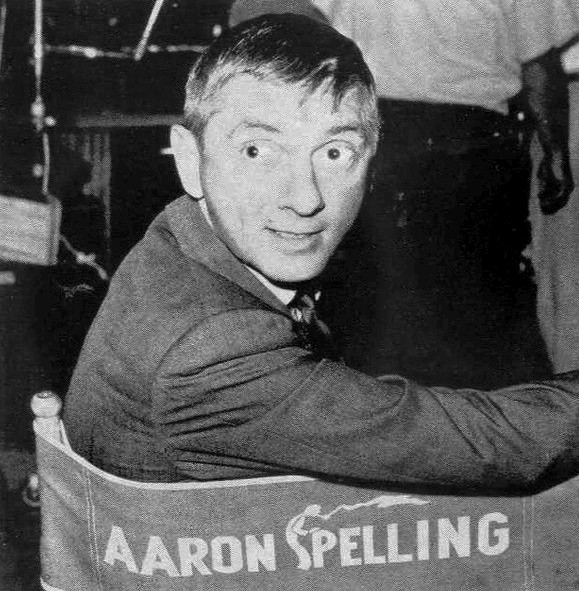 |
| Once upon a time, this man was the King of Half of Everything in TV land. |
For fans of supernatural horror (guilty as charged!), it was a great era because such films (as well as psychological horror) tended to be easy on expense accounts, and TV producers made a ton of them. They didn’t require big special effects budgets or complicated location shoots -- quite often, all you needed was a creepy looking house and a smattering of mid-level name actors and you were good to go.
As a result, we lucky fans kept getting gift after horrifying gift from the TV movie mill: A Taste of Evil (1971), Home for the Holidays (1972), Satan’s School for Girls (1972) and Cruise into Terror (1978) were just a few from Spelling’s shop in the '70s.
Don’t Go to Sleep (1982) didn’t stray far from the successful TV horror formula: as per usual, a family is menaced in their new home. However, several ultra-creepy scenes and a great cast led by Valerie Harper, Dennis Weaver and the always delightfully eccentric Ruth Gordon elevate this one several notches above the usual made-for-TV fare.
Phillip (Weaver) and Laura (Harper) are moving their all-American family (a boy and a girl) to a new home. Some past struggles are hinted at in the early going, but Phillip has a new job in the aerospace industry, and it seems the family is returning to normalcy.
There are some mild tensions -- Phillip is not thrilled that Laura’s sharp-tongued mother Bernice (Gordon) will be living with them -- but seemingly nothing that the family can’t deal with. Little do they know that the mother-in-law living arrangements will be the least of their worries.
In an early scene, more of the family’s recent tragic past is revealed when the boy, Kevin (Oliver Robins), spots his grandmother setting up multiple pictures of the oldest daughter, Jennifer (Kristin Cumming) on her dresser. He snottily reminds Bernice that there aren’t supposed to be any pictures of Jennifer -- who apparently has recently died -- in the house.
 |
| When grandma says she doesn't have any favorites, don't believe her. |
Under the surface brightness, the all-American family has some skeletons that threaten their bliss. It seems that Phillip and Laura can only deal with their grief by banishing any reminders of their deceased daughter, but that strategy is going to come back to haunt them.
At first, the youngest daughter Mary (Robin Ignico) is happy to have her own room in the new place, but quickly regrets it the first night when the wind whips up, tree branches tap on the window, and the dolls surrounding her bed seem to be moving surreptitiously in the shadows as a disembodied, rasping voice calls her name.
Soon, Mary is screaming, and when Phillip and Laura get to her room, they’re horrified to see Mary trapped in her canopy bed as it’s going up in flames. Dad quickly pulls Mary to safety and beats out the fire. A frayed lamp cord appears to be the culprit, but this isn’t the sort of house warming the family was expecting.
 |
| Mary hopes the pajamas she got last Christmas are fire retardant. |
We learn that even before the move, Mary was experiencing nightmares. The disembodied voice is now visiting her every night, and her screams for it to go away are fraying everyone’s nerves, but particularly Phillip’s (more on him later).
It doesn’t help that her bratty brother has decided Mary is gaslighting the family, and he concocts a plan to record spooky sounds on his tape recorder to further torment her. Bad move.
The nightly manifestations of the spectral voice soon give way to visits by Mary’s dead sister Jennifer (yikes!). Mary’s conversations with her sister are shot in soft focus, suggesting that she’s dreaming. There is a chilling disconnect between Jennifer’s angelic appearance in frilly dresses, and the words coming out of her mouth:
Jennifer: “They [the rest of the family] don’t want me to be here. They don’t miss me like you do. They don’t care.”
Mary: “But they loved you.”
Jennifer: “Not real love. Not like you do. They always loved you the most. I always hated that.”
Spooky Jennifer’s resentments take a grave turn (pun intended) when she starts encouraging Mary to “take care of” the other family members who want to keep them apart. And from that point in the film, taking care of business, Don’t-Go-to-Sleep-style, will involve such household items as a pet iguana, a frisbee, a plug-in radio, and (**GULP!**) a pizza cutter.
 |
| Mary discusses girl things with her big dead sister, like wreaking horrible vengeance from beyond the grave. |
They say that 80% of all serious accidents occur in the home, and much of Don’t Go to Sleep plays like an extended public service program from Hell on how dangerous even the most mundane household items can be. We think we know what’s going on with the “accidents,” but the film keeps the perpetrator(s) off-camera. Meanwhile, the escalating chaos allows Harper and Weaver to emote their hearts out.
At this point, both leads were well-established TV stars, not to mention TV movie veterans. In 1971 Weaver appeared as the beleaguered driver in the mother of all TV movie cult hits, Steven Spielberg’s Duel. At the same time, he was highly visible in the title role of McCloud, the duck-out-of-water New Mexico policeman temporarily assigned to NYC (part of the NBC Mystery Movie rotation with McMillan and Wife and Colombo).
Valerie Harper had arguably more visibility on ‘70s TV, first as Mary Richard’s friend Rhoda in The Mary Tyler Moore Show, then as the star of her own spin-off show, Rhoda, in the mid-late ‘70s. There were a few TV movie roles in that decade, but after Rhoda’s run they became a bigger part of her career. Another memorable TV horror outing came in 1988 with The People Across the Lake, co-starring Gerald McRaney.
The pair make the most out of a script that at the outset establishes a seemingly normal, happy family with a bright future, but that keeps pulling at the threads of a dark secret that eventually causes everyone and everything to fall apart.
 |
| Valerie Harper and Dennis Weaver put on a master acting class in Don't Go to Sleep (no kidding). |
One of the first clues that the family is not okay is the parents’ head-scratching insistence that no pictures or reminders of the elder daughter be displayed in the new home. This seems extremely implausible, even for the most grief-stricken of families. But a later flashback reveals that alcohol and a childish prank factored into the fatal accident, and everyone, including grandma, who kept the liquor flowing that night, is feeling at least a little guilty.
As Phillip, Weaver walks an acting tightrope, portraying a weak, frightened man without making him cartoonishly so. Early dialog hints that Phillip had a breakdown over the tragedy, lost his job, and only recently had gotten back on his feet. But his self-confidence has taken a blow, and Mary’s night terrors are not helping.
He’s so uncertain about his new job that he initially rejects Laura’s suggestion that they get Mary counseling, fearing that somehow word will get back to his bosses. As things begin to careen out of control again, Phillip drowns his sorrows in martinis -- the very thing that contributed to the original tragedy.
 |
| The 3 rules of TV horror real estate: location, location, location. |
Laura desperately tries to hold things together, but she’s no superheroine. In one particularly wrenching scene, Laura tearfully begs her husband to be stronger because she can’t do it all herself. Phillip blubbers in self-pity and denial. The scene is riveting and authentic, and Harper and Weaver are at the absolute top of their form.
But let’s not forget the kids. Any movie featuring children is only as good as the child actors, and they’re very good indeed. The movie is really Robin Ignacio’s, as Mary is at the heart of (or perhaps, the conduit for) the evil that has gripped the family. She is a perfectly ordinary little girl, cute, but not saccharine sweet, and very believable as she struggles with the darkest of forces.
Towards the end, as emotional trauma and survivor’s guilt set in, Mary becomes guarded and morose, but at the same time she’s like a psychological chess master in parrying her doctor’s attempts at getting her to open up. Dr. Cole, played to subtle perfection by Robert Webber, soon realizes that something very disturbing is lurking behind the sullen little girl facade.
 |
| "Note: Does not play well with others and does not like my antique toy collection." |
Props too to Kristin Cumming, who is as prim and cute as an American Girl doll, and whose warm, big sister smile masks the casually evil words coming out of her mouth during her nightly visits with Mary. Is she an avenging ghost, a demon, or a figment of Mary’s guilt-laden imagination? Well…
All this acting talent might have been wasted if not for the top-notch writing and directing by Ned Wynn and Richard Lang, respectively. Actor/writer Wynn drops hints, mostly through dialog, of the various skeletons in the family’s closet as he simultaneously ratchets up the suspense, first with disembodied voices, then spectral visits, and finally with a house in which death appears around every corner.
Director Richard Lang, who had already built a substantial resume directing TV shows and movies by the time Don’t Go to Sleep rolled around, seemingly respects the material too much to just go through the motions. Besides being an actor’s director, as evidenced by the bravura performances all around, his mix of unexpected close-ups, jump cuts and varying camera angles keeps the viewer almost as on edge as the characters in the film.
While made-for-TV horror continued to survive through the ‘80s, franchises like Halloween, Friday the 13th, and Nightmare on Elm Street that offered cheap and far bloodier thrills lured a new generation of horror fans back to theaters. More subtle chills tailored for TV -- especially of the supernatural variety -- fell by the wayside.
Fortunately, we have platforms like YouTube and Tubi to help us rediscover films like Don’t Go to Sleep that were made by craftsmen and women who used TV’s limitations to their advantage, creating genuine shudders instead of gross-out shocks. Who knew that a pizza cutter could be so terrifying? Or that Valerie Harper, no one’s idea of a scream queen, could belt one out with the best of them?
 |
| Wait for it... wait for it... now, SCREAM!!! |
Where to find it: Acceptable (but not great) streaming copies can be found here and here.
(For reviews of other vintage Aaron Spelling-produced TV movies, see my posts on The Love War, 1970, How Awful About Allan, 1970, and A Cold Night’s Death, 1973.)