June 17, 2026

The Little Old Horror Convention from Pasadena: Monsterpalooza 2026

Okay, so Monsterpalooza is not little (it features hundreds of vendors and exhibits and scores of celebrity guests and panels), nor is it old (unless you think 10 years is getting up there; it's been doing its thing in Pasadena since 2016). What it definitely is for me is accessible, being just a few hours drive from where I live. (For more background on the convention see my post from 2023.)

Photo - Monsterpalooza 2026 at the Pasadena Convention Center 

I'm not an inveterate convention goer like some people I know, but neither am I abstemious, having been to 4 horror and fantasy conventions since 2019.

Monsterpalooza skews to a relatively younger audience of 30 and 40 somethings, and it specializes in showcasing practical special effects and makeup, attracting a lot of artists and shops from the greater Los Angeles area.

This year's convention, held at the Pasadena convention Center on May 29-31, also catered to moldy old Monster Kids like myself, with a panel celebrating the 95th anniversary of Universal's Frankenstein and Dracula, a tribute to suit actor, superfan and original Monster Kid Bob Burns, and a talk on the career of Peter Lorre, among others.

Here are highlights from the panels and talks I managed to attend over the three day run (in chronological order):

Paul Williams

At the venerable age of 85, Oscar and Grammy winning composer, songwriter and actor Paul Williams looks like a spry, benevolent leprechaun who has just discovered a pot of gold and wouldn't mind sharing some of it. Williams did share some gold with the audience, in the form of stories from nearly six decades of involvement with the music and entertainment industries.

Williams touched on some very personal career highlights in the hour long interview and audience QandA. He quipped that working with Jim Henson and the Muppets on The Muppet Show and The Muppet Movie (1979) was like "being with a bunch of buddies in a tree house." He also poignantly described being inspired by the desert of the American Southwest, and the aspirations of a "land-locked" bird, in writing Gonzo's song, "I'm Going to go Back There Someday" for The Muppet Movie (at first Henson passed on the song, but then changed his mind and told Williams that he would create a scene for it).

Of course, this being Monsterpalooza, a couple of audience members were dressed up as the Phantom of the Paradise (1974), and questions about that production inevitably came up (Williams wrote the music for the film and co-starred as the villain). When asked what it was like working with the Phantom William Finley, Williams complimented his co-star on the pathos that Finley could express with just his one eye visible behind the mask he wore.

Williams also fondly recalled the time he went from the set of Battle for the Planet of the Apes (1973) to appear on the Tonight Show and engage with Johnny Carson in full Orangutan makeup and costume.


Sybil Danning

Austrian born Sybil Danning was the definitive B movie action heroine of the '80s. In that decade, the statuesque blonde star intimidated and fought opponents in outer space (Battle Beyond the Stars), ancient Rome (The Seven Magnificent Gladiators), the jungle (Jungle Warriors), and gritty urban streets (L.A. Bounty), among other things.

Danning talked about starting out as a model in the late '60s, which resulted in her screen debut as the folklore character Lorelei in a cheap German exploitation film. Just a few years later, she secured a role in the Richard Burton horror-thriller oddity Bluebeard (1972), as well as in Richard Donner's epic hits The Three Musketeers (1973) and The Four Musketeers (1974), where she became good friends with Geraldine Chaplin.

Although not realizing it at the time, Danning's role as the "Valkyrie" warrior Saint Exmin in Roger Corman's Battle Beyond the Stars would establish her credentials as an action heroine and typecast her for the next decade. She said Corman was great to work for, but he could be tough, especially when money was at stake -- he fired an actor who kept muffing his lines and causing retake after retake. She is also proud that her iconic performance inspired a Saint Exmin action figure (although to date, it's the only action figure based on one of her characters).

Danning also spoke of the great respect she had for Christopher Lee by the time they made Howling II: Your Sister is a Werewolf (they had made four films together prior to that, including the Donner Musketeer movies). The production was located in the former Czechoslavkia; when the director received his "werewolf" costumes from the producers in the U.S., he was dismayed to find recycled ape costumes from a Planet of the Apes movie. To transform the characters into werewolves, they had to improvise and painstakingly apply small hair appliances over the face and body to achieve the effect, which took hours. Danning reports Lee as being impressed by her stamina and professionalism in submitting to long hours in the makeup chair.

Photo - Sybil Danning appearance at Monsterpalooza 2026
Sybil Danning talks about her co-star Christopher Lee.


Bob Burns Tribute

Bob Burns, who passed away at the age of 90 last December, was a TV and film editor, a special effects designer and gorilla suit actor par excellence (one of his claims to fame was portraying Tracy the gorilla, the sidekick to Forrest Tucker and Larry Storch in the mid-70s TV show Ghostbusters). Bob and his wife Kathy were huge monster and sci-fi movie fans who used their industry connections to rescue props, set pieces and other paraphernalia that had been used in many productions over the years.

Bob and Kathy's famous basement collection included the armature used to animate the first King Kong, the time machine from the George Pal film, and the original wolf's head cane from The Wolf Man (1941), among other amazing finds.

A large panel of movie industry professionals, including makeup maestro and 7 time Oscar winner Rick Baker, paid affectionate tribute to Bob and Kathy as photo after photo of their joyful life, surrounded by human and monster friends, were projected on the backdrop screen. Baker related how he met the Burnses when he was just 13, and hung around with them so much that he considered them his second parents. Bob gave Rick encouragement even as others were saying how impossible it was going to be for him to get into the movie business.

Various panel members related how modest and generous Bob was, contributing a large amount of his time to helping out friends such as special effects and suit designer Paul Blaisdell on his creations, while taking no credit. They also related a story about Bob asking 20th Century Fox for some memorabilia from the Alien movies, and the studio responding by delivering a semi-truck full of props and sets to his door.

The panel also reminisced about how for many years Bob and Kathy would stage elaborate Halloween shows at their house, enlisting technicians, effects people and actors to help them recreate scenes from such films as The Exorcist, War of the Worlds, and Alien. Besides the basement museum, it was another fun, imaginative way for the Burnses to give back to their community.


Dracula and Frankenstein Turn 95

While much of Monsterpalooza is dedicated to later horror fare of the 90s and beyond, this year the organizers enlisted a panel to celebrate the 95th birthday of the Universal monsters that started it all. Julian David Stone, author of It's Alive (2022), a fictionalization of the making of Universal's Frankenstein, led the discussion with co-panelists Antonia Carlotta, host of the YouTube vodcast Universally Me and a descendant of Carla Laemmle, niece of Universal Head Carl Laemmle, and Scott Essman, director, producer, writer and film historian.

The wide-ranging discussion touched on a number of topics and intriguing facts surrounding the production of the the two films and the huge impact they had on the industry:

  • Carl Laemmle Sr. made Carl Junior head of Universal's film production at the tender age of 21.
  • The father was not a big fan of what came to be known as horror, but gave his son latitude to make his impact.
  • Lon Chaney Sr., who was a huge star of the silent era, was slated to appear as Dracula, but died before production could start. Lugosi, who had played Dracula on Broadway and added exotic sexual chemistry to the role, got the nod over more familiar and popular actors. 
  • Makeup artist Jack Pierce was disappointed when he found out that Lugosi would be doing his own makeup on the film, but he would soon have his chance to pull out all the stops in creating the look for the Frankenstein monster. 
  • Dracula was ground-breaking in that the title character was truly supernatural in origin; prior fright films and villains had been thoroughly grounded in the "real" world, with prosaic explanations for seeming supernatural events.
  • Frankenstein was originally slated to be directed by French expatriate Robert Florey with the new hit star Bela Lugosi as the monster. Stories circulated that Florey's test footage with Lugosi did not go well (none of the footage has survived). Meanwhile, Laemmle Sr. was so impressed by James Whale's success with Waterloo Bridge (1931) that he promised him any project of his choosing, and Whale took on Frankenstein.
  • The story goes that Whale spotted Boris Karloff in the Universal commissary, on break from a small role in another movie, and quickly realized he had his monster.
  • When Jack Pierce and Boris Karloff were at an impasse as to how to make the monster appear more frightening, Karloff suggested making his eyelids droop more severely, and Pierce used mortician's wax to achieve the effect.
  • Frankenstein, which had its world premier in Santa Barbara toward the end of 1931, was an even greater hit than Dracula. Other studios realized they needed to jump on the bandwagon. Paramount, which had passed on Dracula, started production of Dr. Jekyll and Mister Hyde with Frederic March (who would win the Oscar for best actor for that role). 
  • MGM's Irving Thalberg reportedly demanded his writers come up with something more disturbing than Dracula. The result, Todd Browning's Freaks (1932), was too disturbing for 1930s audiences and ended up being a huge money loser for MGM (which promptly suppressed it for decades after).
Photo - Panel discussing the birth of the modern horror genre at Monsterpalooza 2026
Panelists discuss Universal's one-two punch of Dracula and Frankenstein in 1931.


Other Panels

  • Peter Lorre: Master of Menace. Karie Bible, tour guide at the Hollywood Forever cemetery (where Mr. Lorre is interred) and Dawn Fratini, film historian, gave a lively talk about the life and film career of one of the great character actors of the 20th century. They showed clips from some of his more notable films, including Fritz Lang's M (1931; featuring Lorre in a breakout role as a child murderer), The Beast with Five Fingers (1946), The Raven (1963), and an assortment of cartoons in which Lorre voiced characters based on his iconic looks. 
  • Planet Terror. Actor Freddy Rodriguez and FX master and actor Tom Savini reunited to reminisce about the making of the apocalyptic zombie movie. The 2007 film was produced by Quentin Tarantino and released on a double feature with Death Proof (starring Kurt Russell) to recreate the 1970s grindhouse theater experience. They played multiple clips from the movie, including one where Rodriguez whips a gun around at lightning speed, sharpshooter style (which Rodriguez said took months of practice to perfect). 
       Savini paid his co-star a great compliment, saying he was sure at the time that Rodriguez would become the next popular action hero, but the films flopped, much to the consternation of everyone involved. Savini speculated that the order in which the films were screened as a double feature, with frenetically-paced Planet Terror coming first, followed by Death Proof, a thriller that takes some time to ramp up the action, contributed to audiences rejecting both films.

The teeming crowds and enthusiastic panel audiences at the Pasadena Convention Center proved that the classic monsters could cohabitate with the likes of Michael Myers and Art the Clown, if only for a weekend.


Gallery of Monsterpalooza Photos

Photo - Monsterpalooza museum - Life size Ray Harryhausen creations
Ray Harryhausen's creations live again at the Monsterpalooza museum.

Photo - Monsterpalooza Museum - Creature from the Black Lagoon
This creature needs no introduction.

Photo - Monsterpalooza Museum - Bob Burn wax figure in his Tracy the Gorilla suit
A waxwork Bob Burns in his Tracy the Gorilla suit.

Photo - Monsterpalooza Museum - Busts inspired by the characters from The Comedy of Terrors (1963)
A Comedy of Terrors.

Photo - Makeup demonstration at Monsterpalooza 2026
Even monsters need to keep up with their social media accounts.

May 26, 2026

Dead Guys & Dolls: The Dead Don't Die

Cover art - The Dead Don't Die (1975)
Now Playing:
The Dead Don't Die (TV Movie; 1975)


Pros: Creates an atmosphere of darkness and dread in various spots; Some well-executed, spooky sequences.
Cons: The film's protagonist is miscast, and some veteran actors are wasted in small roles; awkward use of clunky expository dialog.

Okay, so I'm a sucker for the made-for-TV horror and sci-fi movies of the 70s. Life was good back then -- my parents broke down and got a color TV, so I could enjoy my favorite late night horror hosts, The Ghoul and Hoolihan and Big Chuck, in living color as they broadcast from the great metropolis of Cleveland.

When I wasn't looking forward to the hosted horror shows, the networks were tantalizing me with their movie of the week offerings that so often included horror, mystery-thrillers and sci-fi. The network execs had finally figured out that broadcasting movies in prime time could be lucrative, and by the early '70s, their own made-for-TV features were capturing eyeballs and in some cases generating eye-popping ratings. For example, as the vampire Janos Skorzeny was draining the blood of Las Vegans in the original airing of The Night Stalker in 1972, he was also racking up a 33.2 rating and 54 share -- monstrously large ratings almost unheard of for scripted TV at the time. Fortunately, the Night Stalker's success guaranteed that there would be many more TV fright features to come.

When I started this blog with the mission to revisit the nearly forgotten B horror and sci-fi flicks of my misspent youth, made-for-TV fright fare was in the mix, but my go-to titles were the generally low hanging fruit of things already in my DVD collection or readily available in cheap public domain collections. Over the years, the list of TV movies available on demand has grown exponentially, especially on YouTube (and with an honorable mention nod to Tubi). It's almost to the point that if you can remember it, you can watch it -- just don't expect a pristine copy in all cases. As a result, I've been wandering the made-for-TV corridors more and more: sample some of the posts here.

FYI, the subject of today's post is not one of those movies I recall fondly from my days in front of the Magnavox console TV. Somehow, The Dead Don't Die flew over my head, under my radar, and around whatever TV guide I was using, because I was completely unaware of the existence of this movie until recently. To further obscure matters, it shares a title with with the very peculiar Jim Jarmusch zombie film starring Bill Murray and Adam Driver (itself rapidly receding from collective memory, as it did not connect with audiences).

I think I was looking up the Jarmusch film when I stumbled, zombie-like, across a reference to the 1975 film and became intrigued. The cast was certainly interesting, with veterans Ray Milland, Ralph Meeker and Joan Blondell, eye candy in the persons of Linda Cristal and George Hamilton, and the always creepy character actor Reggie Nalder mixing things up in a horror tale set in 1930s Chicago.

"What's not to like?" I thought to myself (readers of this blog will probably understand, if not necessarily members of the population at large). Well, to trot out a time-worn cliche, the result is somewhat less than the sum of its parts. Some of the parts are reasonably effective and atmospheric, but we'll get to that in short order.

George "Crispy Colonel" Hamilton plays Don Drake, a sailor who has taken leave to visit his brother, who unfortunately is on death row for the murder of his wife. Before being executed in Old Sparky, the brother (Jerry Douglas) swears his innocence and gets Don to promise that he will find the real murderer and clear his name.

Don is no private investigator, but reasonably, he starts his quest at the scene of the crime -- the Loveland Ballroom, where brother Ralph and his wife had been participating in a dance marathon, and where he had been found passed out in a back room next to his wife's body.

The ballroom owner Jim Moss (Ray Milland) is cooperative and sympathetic, even giving Don the money that his brother had earned in the competition. Something seems off however, when one of the near walking dead marathon contestants drops in a heap on the floor, and Moss roughly tells his attendants to get her out of there before genially resuming his conversation with Don. (For the uninitiated, dance marathons that lasted for days on end were an exploitative fad in the grim days of the the Great Depression, with desperate contestants willing to literally run themselves into the ground for the slim hope of winning prize money. They figure prominently in the celebrated novel and film adaptation of They Shoot Horses, Don't They?. The backdrop of the marathon in The Dead Don't Die helps set up its dark atmosphere and prefigures later developments.)

Screenshot - Ray Milland and George Hamilton in The Dead Don't Die (1975)
Don Drake (George Hamilton) has a conversation with ballroom owner Jim Moss (Ray Milland) as dance marathon contestants shuffle around like zombies in the background.

Moss sends Don on his way by suggesting he track down Frankie, the trainer who found Ralph with his wife's body -- although Frankie has mysteriously disappeared. At Ralph's gravesite, Don is shadowed by a mysterious and beautiful woman dressed in black. As Don is dining at his hotel, the mystery woman, Vera LaVelle (Linda Cristal), approaches Don and begs him to leave Chicago immediately for his own good. As they're conversing, Don glances out the window and sees what he thinks is his brother Ralph standing in the street.

Screenshot - Linda Cristal in The Dead Don't Die (1975)
Linda Cristal as Vera LaVelle looks absolutely funereal. 

Don rushes outside, following Ralph to a shop door, where he disappears. Don barges into the place, an antiques shop, where he is confronted by an old woman, Levenia (Joan Blondell) and the creepy-looking shop owner Perdido (Reggie Nalder). They insist no one came into the shop. Convinced they're hiding something, Don struggles with Perdido, who hits his head hard as the pair fall to the floor. Levenia insists Don has killed Perdido, and while he's looking for signs of life, the woman brains him with a lamp.

Don regains consciousness at Vera's place. The next morning, Don discovers Vera hurriedly packing to leave. She pulls a gun on him, which he grabs. Vera tells the disbelieving sailor that he is in grave danger from Varek, a voodoo zombie master who is enslaving the dead for his own evil purposes.

When Don insists upon meeting Varek, the pair take a cab to a funeral home (an appropriate enough place for a zombie-maker to hang out). The attending undertaker has never heard the name Varek, but directs Don to a room where Perdido's body is on display. As Don approaches the body in the casket, a hideous, rasping voice that seems to be coming from the body identifies itself as Varek, whereupon  the corpse reaches out and grabs Don by the throat.

Tearing himself away, Don is aghast as the dead (?) Perdido climbs out of the coffin and shambles toward him. The panicked man fires several shots into Perdido, to no avail, and then flees the room. 

Screenshot - Reggie Nalder in The Dead Don't Die (1975)
Perdido (Reggie Nalder) decides to get up and greet the mourners at his own funeral.

Don breathlessly reports the strange events to Lt. Reardon (Ralph Meeker) at the local police station, who wearily decides he has to check it out. At the antiques shop Don is shocked to see that Perdido is very much alive and kicking. Reardon figures he's got a nutcase on his hands.

WARNING: Before you scroll zombie-like to the next paragraph be aware that there are spoilers ahead.

Before all is said and done and the last zombie has stopped shambling, our intrepid protagonist

  • has another encounter with Vera, who tells him that she is one of Varek's zombies sent to kill him, but she has broken the Master's spell by falling in love;
  • travels with Moss to the cemetery where Ralph is buried to dig up his body;
  • is saved from another zombie attack by Frankie the trainer, who reveals that it is he who actually killed Ralph's wife while under Varek's spell;
  • finally confronts the Zombie Master in an abandoned warehouse (that also doubles as a zombie cold storage unit), and learns of his plan to use a zombie army to take control of the city and eventually the world.
Screenshot - Ray Milland menaces the hero in The Dead Don't Die (1975)
Ray Milland makes a wardrobe and attitude adjustment for the final act of the film.

If this sounds to you like an overheated Poverty Row B programmer on the order of something like King of the Zombies (1941), with a mad zombie-maker hell bent on world domination, you're not far off. The Dead Don't Die also indulges in a few film noir cliches, including a protagonist on a mission to clear a loved one's name, and a femme fatale who can't decide whether to kill him or kiss him. The plethora of scenes that take place in the dead of night further enhances the noirish atmosphere. 

The 1930s setting is somewhat curious -- the plot could just have easily fit into a contemporary setting. One wonders if the producers had ready access to period sets and costumes and chose the time period to set it off from the other TV movies that were being churned out. On the other hand, the Depression-era dance marathon, with its weary, desperate contestants shuffling like zombies around the dance floor, nicely foreshadows events to come.

Screenshot - Jerry Douglas as an angry zombie in The Dead Don't Die (1975)
Don's unjustly executed brother Ralph (Jerry Douglas) is somewhat miffed at being used as an unwitting pawn.

Unfortunately, fighting against the film's dark atmosphere is the casting of George Hamilton, whose fabulous California tan sticks out like a bronzed sore thumb in a night world populated with pallid zombies. Hamilton could be effective with the right material -- see my post on The Power (1967 -- but in this he wears a constant pained expression as he stumbles around, dazed and confused (at least his pencil mustache fits with the time period).

Playing coy with the villain role is veteran Ray Milland, who won an Oscar for his portrayal of an alcoholic in The Lost Weekend (1945), and in The Dead Don't Die portrays a madman drunk on power. Milland was one of those actors who didn't know how to quit working, and consequently over the years appeared in many beloved B horror and sci-fi movies, including X: The Man with the X-Ray Eyes (1963; see my post here) and The Thing with Two Heads (1972), among many others. 

The director, Curtis Harrington, recalled how he offered on the set to burnish Milland's image, but the old pro would have none of it:

"Ray Milland was well past his Academy Award-winning days, but I felt very privileged to work with such a distinguished actor. He was still very handsome and would have looked even more so if he had allowed us to put a toupee on him. But his attitude was the he should be accepted as he was, so he played the part entirely bald. He was open to accepting whatever parts came his way at this point in his career. He told me that he had been talking to his friend James Stewart, who expressed envy at the fact that Ray was working and he was not. James Stewart was still the bigger star, and I doubt anyone would have had the temerity to offer him a part in an ordinary television show." [Curtis Harrington, Nice Guys Don't Work in Hollywood: The Adventures of an Aesthete in the Movie Business, Drag City Incorporated, 2013, p. 172.]
Screenshot - Don Drake (George Hamilton) looks on in horror at the finale of The Dead Don't Die (1975)
Don Drake finally gets it: the dead really don't die.

Harrington also employed two other veterans, Joan Blondell and Ralph Meeker, presumably for their name value, but both are wasted in bit parts. Joan is just an appendage to Reggie Nalder's character Perdido, but at least as an actress whose heyday was in the '30s, she fits into the period ambience.

Meeker, who was so intense as PI Mike Hammer in Kiss Me Deadly (1955), is reduced 20 years later to playing a stereotypical Irish cop whose function is to give the protagonist the stinkeye when he insists that there are dead guys walking around. 

Whatever chills The Dead Don't Die manages to conjure up is entirely due to boogeyman Reggie Nalder's presence. The Austrian-born actor suffered facial burns as a young man, which contributed to a distinctive, gaunt look that made him a natural for certain parts, especially menacing ones. Nalder appeared in a small but key role in Hitchcock's The Man Who Knew Too Much (1956), and is perhaps best known for his work in the infamous exploitation film Mark of the Devil (1970), as well as for the Nosferatu-like vampire in the mini-series Salem's Lot (1979).

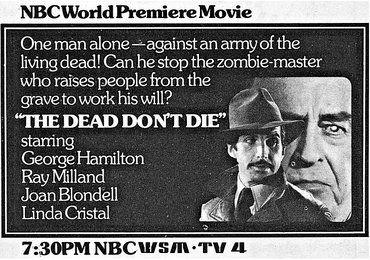
Image - Original newspaper had for The Dead Don't Die (1975) - courtesy of www.robertbloch.net
My heart would leap for joy when I saw ads like this.

For better or worse, Nalder didn't need much makeup to look like a walking corpse. The scene in which Varek's rasping voice seems to be coming from Perdido's dead body lying in the coffin, its mouth stretched back in a deathly rictus, induces real goosebumps. Knowing a good thing when they saw it, the producers recycled Perdido footage in a later nightmare sequence, which ends with a hackneyed shot of a hand breaking through the cemetery dirt to clutch Don's ankle.

Less effective in her part is leading zombie lady Linda Cristal. She starts out mysterious and enigmatic, but the Argentinian actress struggles with her thick accent in relating her incredible and complicated backstory to the disbelieving protagonist. Her character's final exit should have been one of the film's highlights, but crude practical effects and editing veer it into unintentional comedy. Let's just say that the scene brings new meaning to the phrase, "smoldering looks."

Suspense and horror master Robert "Psycho" Bloch wrote the teleplay from his short story. With its clueless, meandering protagonist and clunky expository dialog that slows down the proceedings, the film is not a highlight in the esteemed author's resume. Bloch would go on to contribute better material to such classic TV anthology shows as Boris Karloff's Thriller, Alfred Hitchcock Presents, Hammer's Journey to the Unknown, Night Gallery, and Tales from the Darkside, among others. Bloch himself quipped, "Two years later we [Curtis Harrington] teamed up again for another TV movie, The Dead Don't Die. Maybe they don't but the show did." [RobertBloch.net]

The film may not have been a hit at the time, but over the years it has refused to die, clawing itself out of the grave of forgotten TV movies and into places like YouTube with the help of appreciative fans. If only for corpse-like Reggie Nalder menacing some familiar veteran actors, you should check it out.

April 28, 2026

The Great Hammer-Amicus Antiques Expo

Regular readers of Films From Beyond are no doubt aware of the bizarre universe that parallels our own, where monsters are the norm (and not just members of the ruling class). Every once in awhile, yours truly is privileged to see through the fragile membrane that separates our universes and report back via this blog -- see my previous reports here and here.

Graphic image: Logo for The Hammer-Amicus Antiques Expo
Recently I scored a sensational exclusive: the transcript from the pilot episode of the Hammer-Amicus Antiques Expo, which unfortunately was not picked up by the network in its alternate universe and never saw any further development.

Inspired by this universe’s Antiques Roadshow from PBS, the Expo (or HAAE) invited select participants caught up in the frightful events documented by various Hammer and Amicus films to share their antique finds with the co-hosts, who were uniquely qualified to assess the cultural significance and value of the items. Collectors in-the-know have searched far and wide for a copy of the show’s tape, the original of which is thought to have been reused for an episode of Hammer's This Old House of Horror.

The videotape itself is likely lost to the ages, but after countless hours scouring eBoo, Eeksy and the darkest corners of the Dark Web, I finally secured a transcript of the episode, dog-eared and dusty, but nonetheless complete. Judge for yourself whether or not the monsterverse is immeasurably poorer because the Expo failed to become a full-fledged series.

Jimmy Sanguinarius: Welcome to this debut episode of the Hammer-Amicus Antiques Expo! I'm your host, Jimmy Sanguinarius, and please give a round of applause to my co-host, Robert Black!

Bob: Just call me Bob, Jimmy.

Jimmy: Okay Bob Jimmy! [Winks at Bob] Before we get rolling with our first frightful find, a bit of background. Bob and I are certified MADD - that's Macabre Antiques Dealers and Distributors for the uninitiated. We're here to help our guests uncover the bone-chilling back stories of their finds, and assess their meaning and worth on the open market.

Bob: I'd like to add that I'm excited to be here, and...

Jimmy: First up we have Mr. Van Helsing...

Van Helsing: Doctor Van Helsing.

Jimmy: Doctor Van Helsing. So Doc, what's your specialty?

Van Helsing: I am a doctor of vampirology. I study the scourge of the unholy undead who drink the blood of the living to sustain their infernal existence, and I use that knowledge to eradicate them and their hideous evil from the face of the earth!

Jimmy: Okaaaay... So Doc, what did you bring us?

Van Helsing: These silver candlesticks literally saved my life. I recently tracked down the most cunning and evil vampire of them all, Count Dracula, to his remote castle. We faced off in the Ballroom, and it was not going well for me until I seized upon the idea to tear open the window curtains to let in the dawn's light. Then I picked up the candlesticks, forming a cross -- vampires hate the symbol of our lord and savior -- which repelled him, backing him up into the cleansing light, whereupon he promptly disintegrated. So to me, these are priceless.

Jimmy: [Picking up one of the candlesticks] Okaaaay... first off Doc, these aren't silver, they're pewter, and fairly crude at that. Top grade silver candlesticks will usually have the initials of the silver smith etched into the underside of the base. [Turning one of the candlesticks over] This one says "Made in China," and there's a tag here reading "Property of Hammer Studios."  But all is not lost. These might fetch upwards of 10 bucks at a movie memorabilia auction. But I understand how they might be priceless to you. [Van Helsing's face falls].

Screenshot - Climactic scene from Horror of Dracula (1958)
"Careful Van Helsing, you're going to scratch that priceless set of candlesticks!" (Horror of Dracula, 1958)

Pewter prop candlesticks: $10

Jimmy: Okay then Bob, who's our next guest?

Bob: Well Jimmy...

Jimmy: Oh, I see someone has brought a human skull for us to examine -- cool! Let's have the owner of this fine specimen introduce himself.

Maitland: I'm Doctor Christopher Maitland...

Jimmy: Whoa, another doctor! Well Bob, I guess we don't have to ask if there's a doctor in the house if somebody faints at the sight of that skull! [Audience laughter]

Maitland: Actually, I'm a doctor of anthropology, as well as a connoisseur of the macabre and esoteric like yourselves.

Jimmy: I don't suppose you're an expert on vampires like our last guest..., wait a second this couldn't be the skull of that Count Dracula fellow, could it?

Maitland: Er, no, but someone just as notorious! This is the skull of none other than Donatien Alphonse François de Sade, the Marquis de Sade!

Jimmy: Oh wait, that's that French guy who invented sadism, am I right?

Bob: To be precise Jimmy, the term "sadism" comes from...

Jimmy: [Picking up the skull] So Doc, how did you come by this bad boy?

Bob: Careful there Jimmy, that skull is reputed to be possessed by the foul spirit of the Marquis de Sade, and is said to haunt and terrify anyone who comes in contact with it, to the point of madness... or even death!

Jimmy [carefully examining the skull]: He seems pretty harmless now... [Grinning] They say the eye sockets are the windows to the soul. So, what's up Doc?

Maitland: Er, uh, one of my associates took it off the hands of a collector who, shall we say, was ready to part with it.

Jimmy: How convenient! But Doc, you're looking a bit run down. I don't suppose you're anxious for someone else to take it off your hands?

Maitland: Well, I have been troubled by persistent nightmares that seem very real. And it doesn't help that some people I know have been dying recently...

Jimmy: Well, maybe we can turn that frown upside down. I don't see any "Made in China" tags on it, so that's a positive. I know quite a few collectors who would give their right arms, and maybe a few other body parts, to own the legit skull of the notorious Marquis, even with its cursed reputation. It could even be worth a cool million...

[Maitland breaks into a broad smile]

Jimmy: ... provided you came into possession of it legally, and you have all the documents proving its authenticity. [Maitland's face falls. Jimmy holds up the skull again.] Alas, poor Maitland, I knew he might be disappointed! 

Screenshot - Peter Cushing in The Skull (1965)
"Here's looking at you kid!" (The Skull, 1965)

Skull of the Marquis de Sade: $0 - $1 million

Jimmy: Okay, Bob, we have time for one more guest -- who's it gonna be?

Bob: Jimmy, next up is Edward Charlton, and he's brought an item for us to reflect upon.

Jimmy: Ho ho, good one Bob! I see a cloudy antique mirror that looks like it could have come from a haunted house.

Charlton [sniffing contemptuously]: This piece is quite old and unique, a magnificent example of the Rococo style. I got it for a literal steal at a local curio shop. [Smiling wanly] But you're right about its appearance. Some friends and I were inspired to perform a seance after I acquired it.

Jimmy [sizing himself up in the mirror]: And how did that go?

Charlton: Well, er, we tried but couldn't summon up any interesting spirits. Some at the seance were a bit jumpy though.

Jimmy [staring into the mirror]: Either I've gotten a lot paler and have developed deep circles under my eyes, or there's some sort of entity living in this thing.

Bob [looking at he mirror over Jimmy's shoulder]: You're right Jimmy, there's a very agitated, malevolent spirit inside the mirror. It seems to be saying something... [Pauses] Uh oh, it says it wants to be freed from the mirror, and needs sacrifices -- human sacrifices -- to rejoin the world of the living.

Jimmy: Oh, that's a bummer Ed! That's gonna bring down the price at auction, and on top of that, you'll probably have to divvy up the proceeds with the entity. [Charlton's face falls] But you still might get a hundred bucks from a collector who doesn't believe in murderous ghosts that live in mirrors.

Screenshot - "The Gatecrasher" segment of From Beyond the Grave (1974)
"So, if you buy the mirror I'll throw in this cool ceremonial knife..." ("The Gatecrasher" segment of From Beyond the Grave, 1974)

Antique mirror: $100

Jimmy: Well, that's all the time we have today. On behalf of Bob Black and myself, thanks to everyone for coming, and keep an eye out for those frightful antique finds -- you never know when we might roll into your town in the dead of the night!

This post was originally going to be part of the fifth Hammer-Amicus Blogathon hosted by Gill at Realweegiemidget Reviews and Barry at Cinematic Catharis, but I couldn't get my act together in time. Check out their sites and the blogathon from last year (click the image below):

Banner image - The Hammer-Amicus Blogathon V

March 21, 2026

Staying After Hours jn The Twilight Zone

It's March once again, time to do some Spring cleaning on the cobwebs of your mind and celebrate, along with blogathon host Terence Towles Canote at A Shroud of Thoughts, all those classic TV episodes that entranced us, entertained us, and even inspired us.

"Inspiring" isn't too strong a word in describing Rod Sterling's The Twilight Zone, as it came along at just the right time for Boomer Monster Kids like myself, stimulating their sense of wonder, giving a slew of future star actors some unique, meaty roles, and showing the way for a new generation of fantasy authors and filmmakers.

Screenshot (IMDb) - Rod Serling in "The After Hours," season one episode of The Twilight Zone

Also inspiring was the way in which Sterling and his stable of writers could take elements and objects of ordinary middle class life, add a twist or two, and come up with intelligent, albeit sobering and often macabre, commentaries on the human condition.

The beauty of the series was that the lessons were often seamlessly woven into a dark tapestry of imagination that seemed far removed from any kind of forced social messaging. It's the kind of schooling through entertainment we could use more of today.

The Twilight Zone did its thing so well that it still.has a hold on the popular imagination over six decades later. Indicative of its stature is the series' continued use for New Year's Day broadcast marathons, such as the the recent fest on the Heroes and Icons (H&I) channel. Even though episodes are available on demand at other locations, I went old school, pretending it was still the VCR era, and recorded a bunch of them for bingeing. Somehow, just setting up the recordings gave me a warm, nostalgic feeling.

I've written before on this blog about "lost" Twilight Zone episodes -- lost in the sense that I don't remember seeing them as a kid, and only (re)discovered them in the streaming era (see my posts here and here). Now that the New Year's recordings have run out, I've been sampling episodes from TUBI's on demand stash.

Now Playing: "The After Hours," season 1, episode 34 of The Twilight Zone, first aired June 10, 1960. Written by Rod Serling, directed by Douglas Heyes, and starring Anne Francis, Elizabeth Allen and James Millhollin.

One of the episodes that I binged recently, "The After Hours," is something I definitely remember from those halcyon days sitting in front of the black and white console TV. While it doesn't have the surprise gut punch of more celebrated TZ episodes, "After Hours" effectively establishes a dark and creepy atmosphere, only to end on an unexpectedly upbeat note (in a twisted fairy tale sort of way).

Anne Francis plays Marsha White, an attractive but nervous young woman who is hoping to get a gift for her mother at a busy downtown department store. After distractedly perusing items in various display cases, she heads for the elevator, which seems to be running slow, as there is a crowd of shoppers huddling in front of it.

Fortuitously, an adjacent elevator door opens, and an operator in a dapper uniform beckons to Marsha. Marsha informs him she's after something very specific -- a gold thimble -- to which he dryly responds that she wants the "specialties" department on the 9th floor. Except, after the door closes and it cuts to a close-up of the floor indicators above the elevator, we see there is no 9th floor!

The elevator doors open on a dimly lit, seemingly abandoned floor with empty, dusty display cases. Even as Marsha protests that "there's nothing here," the operator silently closes the doors, stranding her on the mysterious 9th floor.

As Marsha nervously looks around, a figure emerges from the shadows in the form of an elegantly dressed woman (Elizabeth Allen), who asks Marsha, "Can I show you something?" Oddly, the only piece of merchandise is the very gold thimble that Marsha was looking for. More suspicious still, the sales woman knows Marsha's name.

Marsha, increasingly nervous, only wants to pay for the gift and get out of there. As she heads for the elevator, the woman calls after her, "Marsha, are you happy?," as if they've known each other for years. When Marsha retorts that it's none of her business, she reacts strangely, throwing up her hands in exasperation, "Alright Miss White, suit yourself, it's none of my business!"

Screenshot (IMDb) - Anne Francis in "The After Hours," season one episode of The Twilight Zone

In the elevator, Marsha notices that the thimble she just bought is scratched and dented. The equally exasperated elevator operator drops her off at the Complaints dept. on the 3rd floor, where she proceeds to harass the management with her story of being sold damaged goods by a very odd sales woman on the non-existent 9th floor. Assistant manager Mr. Armbruster (James Millhollin), already a nervous type himself, has his hands full with the dissatisfied customer.

As Armbruster and his boss the store manager try to make sense of Marsha's story, she spies the very woman who sold her the thimble, who is standing across the room, her back turned to her. Just as Marsha calls out, she gets a bad shock when a store employee literally picks up the mysterious sales woman, who turns out to be a very lifelike display mannequin.

Ready to faint, Marsha is deposited on a couch in a store office, while Armbruster complains about the young woman to another employee. As it nears closing time, both the nervous assistant manager and the employee are distracted by duties and forget about Marsha, who wakes up to find herself in an eerily still, shadowy room long after the store has closed.

If the 9th floor seemed odd, her present predicament is positively frightening, as the elevators aren't working and she's effectively locked in. The mannequins situated around the room certainly don't help ease her anxiety, and when she hears them calling out her name, she realizes in a panic that she's not in Kansas anymore, so to speak.

Screenshot (IMDb) - Anne Francis is menaced in "The After Hours," season one episode of The Twilight Zone

Many of the series' best episodes featured dark fairy tales superimposed on the most prosaic of mid-20th century settings, i.e., "After Hours'" downtown department store. The moment Marsha gets on the elevator, she, and we, know that something is very off, not the least of which is the stiff, laconic elevator jockey.

The deserted 9th floor ups the weirdness factor a notch or two, as does the materialization of the sales woman out of the shadows, as if she's not just an employee, but a part of the very building itself. Her penetrating stare as she "helps" Marsha find her thimble, and her more vulnerable reaction of exasperation as Marsha retreats to the exit, combine to unsettle both the viewer and the story's protagonist.

But it's not just the sales woman who is odd. Marsha's quest for a gold thimble for her mother seems a bit peculiar (although you can never tell what a collector might obsess over). This is a strange object to be looking for in a bustling urban department store, which reinforces the folk tale quality of the story.

Sterling's script wisely interposes the comic relief of assistant manager Armbruster between the weirdness of the 9th floor and the terror of the shadowy Complaints department. Actor James Millhollin, with his doughy, everyman face and nervous ticks, perfectly captures a character who has neither the time, inclination or imagination to solve his problem customer's mystery. Armbruster is emblematic of the ordinariness of busy, everyday life that is in stark contrast to the haunted fantasy world that Marsha experiences when she becomes trapped in the deserted store.

On the other hand, the mannequins in "After Hours" represent a bridge from the prosaic world we all know to Marsha's nightmare world. They are the ultimate uncanny objects -- at a glance they look like real, honest-to-goodness people, but upon closer examination, the differences become more than a little unnerving, especially in the stillness of the night.

Japanese robot expert Midi Mashahiro called the instinctive repulsion toward things that appear almost but not quite human the "uncanny valley." (Michael Dylan Foster, The Book of Yokai, University of California Press, 2024, p. 105.) Recently, AI generated "people" have taken over from mannequins and robots in plumbing the depths of the valley, resulting in a good deal of public backlash.

"After Hours" exploits that natural repulsion, effectively raising goosebumps when night falls on the department store and its spooky denizens. But by the conclusion, Serling is winking at us, turning the lights on after figuratively yelling "Boo!" and transforming shudders into a sense of wonder. What if something made to be so very lifelike could actually capture the essence of life, if even for a short time? And what if, like in any society, there were rules for using that gift?

Screenshot (IMDb) - Marsha (Anne Francis) is shocked to see that the strange sales woman is in reality a mannequin in "The After Hours," season one episode of The Twilight Zone

In The Twilight Zone Companion, author Marc Scott Zicree has high praise for the people who helped Serling turn his ordinary department store into a dark fantasy world. Zicree credits director Douglas Heyes with making "use of a wide variety of shots to create tension: long shots of silhouetted figures, closeups of Anne Francis's feet as she walks down darkened aisles, shots through pebbled glass of her face -- and through all of this, the camera is almost always in motion, as though it were itself a character, nervously stalking."

As for Anne Francis, at the time of this episode, her iconic appearance in Forbidden Planet (1956) was behind her, and her starring role in in the trailblazing TV show Honey West was several years in the future. Zicree sings her praises: "No amount of visual flair could make this episode work without a strong central presence, and this is where the contribution of Anne Francis comes in. ... There's an energy about her and a freshness, an individuality."

He also quotes Francis herself as saying, "I still have people who walk up to me and say 'The favorite show that I ever saw was that ["After Hours"].' It did make a mark, it did make an impression." (Marc Scott Zicree, The Twilight Zone Companion, 3rd Edition, Silman-James Press, 2018, pp. 117-118.)

Credit too goes to actress Elizabeth Allen for making a big impression in a small part as the enigmatic sales woman on the 9th floor. Her strange familiarity helps build the atmosphere of unease and mystery. (See also my post about Allen's contribution to the creepy Thriller episode "The Grim Reaper.")

All this talent coalesced into the making of a unique modern fairy tale of an unseen world within a world, one of the better episodes of the series.

Banner image - The 12th Annual Favourite TV Show episdoe blogathon hosted by A Shroud of Thoughts