Showing posts with label Horror of Dracula (1958). Show all posts

April 28, 2026

The Great Hammer-Amicus Antiques Expo

Regular readers of Films From Beyond are no doubt aware of the bizarre universe that parallels our own, where monsters are the norm (and not just members of the ruling class). Every once in awhile, yours truly is privileged to see through the fragile membrane that separates our universes and report back via this blog -- see my previous reports here and here.

Graphic image: Logo for The Hammer-Amicus Antiques Expo
Recently I scored a sensational exclusive: the transcript from the pilot episode of the Hammer-Amicus Antiques Expo, which unfortunately was not picked up by the network in its alternate universe and never saw any further development.

Inspired by this universe’s Antiques Roadshow from PBS, the Expo (or HAAE) invited select participants caught up in the frightful events documented by various Hammer and Amicus films to share their antique finds with the co-hosts, who were uniquely qualified to assess the cultural significance and value of the items. Collectors in-the-know have searched far and wide for a copy of the show’s tape, the original of which is thought to have been reused for an episode of Hammer's This Old House of Horror.

The videotape itself is likely lost to the ages, but after countless hours scouring eBoo, Eeksy and the darkest corners of the Dark Web, I finally secured a transcript of the episode, dog-eared and dusty, but nonetheless complete. Judge for yourself whether or not the monsterverse is immeasurably poorer because the Expo failed to become a full-fledged series.

Jimmy Sanguinarius: Welcome to this debut episode of the Hammer-Amicus Antiques Expo! I'm your host, Jimmy Sanguinarius, and please give a round of applause to my co-host, Robert Black!

Bob: Just call me Bob, Jimmy.

Jimmy: Okay Bob Jimmy! [Winks at Bob] Before we get rolling with our first frightful find, a bit of background. Bob and I are certified MADD - that's Macabre Antiques Dealers and Distributors for the uninitiated. We're here to help our guests uncover the bone-chilling back stories of their finds, and assess their meaning and worth on the open market.

Bob: I'd like to add that I'm excited to be here, and...

Jimmy: First up we have Mr. Van Helsing...

Van Helsing: Doctor Van Helsing.

Jimmy: Doctor Van Helsing. So Doc, what's your specialty?

Van Helsing: I am a doctor of vampirology. I study the scourge of the unholy undead who drink the blood of the living to sustain their infernal existence, and I use that knowledge to eradicate them and their hideous evil from the face of the earth!

Jimmy: Okaaaay... So Doc, what did you bring us?

Van Helsing: These silver candlesticks literally saved my life. I recently tracked down the most cunning and evil vampire of them all, Count Dracula, to his remote castle. We faced off in the Ballroom, and it was not going well for me until I seized upon the idea to tear open the window curtains to let in the dawn's light. Then I picked up the candlesticks, forming a cross -- vampires hate the symbol of our lord and savior -- which repelled him, backing him up into the cleansing light, whereupon he promptly disintegrated. So to me, these are priceless.

Jimmy: [Picking up one of the candlesticks] Okaaaay... first off Doc, these aren't silver, they're pewter, and fairly crude at that. Top grade silver candlesticks will usually have the initials of the silver smith etched into the underside of the base. [Turning one of the candlesticks over] This one says "Made in China," and there's a tag here reading "Property of Hammer Studios."  But all is not lost. These might fetch upwards of 10 bucks at a movie memorabilia auction. But I understand how they might be priceless to you. [Van Helsing's face falls].

Screenshot - Climactic scene from Horror of Dracula (1958)
"Careful Van Helsing, you're going to scratch that priceless set of candlesticks!" (Horror of Dracula, 1958)

Pewter prop candlesticks: $10

Jimmy: Okay then Bob, who's our next guest?

Bob: Well Jimmy...

Jimmy: Oh, I see someone has brought a human skull for us to examine -- cool! Let's have the owner of this fine specimen introduce himself.

Maitland: I'm Doctor Christopher Maitland...

Jimmy: Whoa, another doctor! Well Bob, I guess we don't have to ask if there's a doctor in the house if somebody faints at the sight of that skull! [Audience laughter]

Maitland: Actually, I'm a doctor of anthropology, as well as a connoisseur of the macabre and esoteric like yourselves.

Jimmy: I don't suppose you're an expert on vampires like our last guest..., wait a second this couldn't be the skull of that Count Dracula fellow, could it?

Maitland: Er, no, but someone just as notorious! This is the skull of none other than Donatien Alphonse François de Sade, the Marquis de Sade!

Jimmy: Oh wait, that's that French guy who invented sadism, am I right?

Bob: To be precise Jimmy, the term "sadism" comes from...

Jimmy: [Picking up the skull] So Doc, how did you come by this bad boy?

Bob: Careful there Jimmy, that skull is reputed to be possessed by the foul spirit of the Marquis de Sade, and is said to haunt and terrify anyone who comes in contact with it, to the point of madness... or even death!

Jimmy [carefully examining the skull]: He seems pretty harmless now... [Grinning] They say the eye sockets are the windows to the soul. So, what's up Doc?

Maitland: Er, uh, one of my associates took it off the hands of a collector who, shall we say, was ready to part with it.

Jimmy: How convenient! But Doc, you're looking a bit run down. I don't suppose you're anxious for someone else to take it off your hands?

Maitland: Well, I have been troubled by persistent nightmares that seem very real. And it doesn't help that some people I know have been dying recently...

Jimmy: Well, maybe we can turn that frown upside down. I don't see any "Made in China" tags on it, so that's a positive. I know quite a few collectors who would give their right arms, and maybe a few other body parts, to own the legit skull of the notorious Marquis, even with its cursed reputation. It could even be worth a cool million...

[Maitland breaks into a broad smile]

Jimmy: ... provided you came into possession of it legally, and you have all the documents proving its authenticity. [Maitland's face falls. Jimmy holds up the skull again.] Alas, poor Maitland, I knew he might be disappointed! 

Screenshot - Peter Cushing in The Skull (1965)
"Here's looking at you kid!" (The Skull, 1965)

Skull of the Marquis de Sade: $0 - $1 million

Jimmy: Okay, Bob, we have time for one more guest -- who's it gonna be?

Bob: Jimmy, next up is Edward Charlton, and he's brought an item for us to reflect upon.

Jimmy: Ho ho, good one Bob! I see a cloudy antique mirror that looks like it could have come from a haunted house.

Charlton [sniffing contemptuously]: This piece is quite old and unique, a magnificent example of the Rococo style. I got it for a literal steal at a local curio shop. [Smiling wanly] But you're right about its appearance. Some friends and I were inspired to perform a seance after I acquired it.

Jimmy [sizing himself up in the mirror]: And how did that go?

Charlton: Well, er, we tried but couldn't summon up any interesting spirits. Some at the seance were a bit jumpy though.

Jimmy [staring into the mirror]: Either I've gotten a lot paler and have developed deep circles under my eyes, or there's some sort of entity living in this thing.

Bob [looking at he mirror over Jimmy's shoulder]: You're right Jimmy, there's a very agitated, malevolent spirit inside the mirror. It seems to be saying something... [Pauses] Uh oh, it says it wants to be freed from the mirror, and needs sacrifices -- human sacrifices -- to rejoin the world of the living.

Jimmy: Oh, that's a bummer Ed! That's gonna bring down the price at auction, and on top of that, you'll probably have to divvy up the proceeds with the entity. [Charlton's face falls] But you still might get a hundred bucks from a collector who doesn't believe in murderous ghosts that live in mirrors.

Screenshot - "The Gatecrasher" segment of From Beyond the Grave (1974)
"So, if you buy the mirror I'll throw in this cool ceremonial knife..." ("The Gatecrasher" segment of From Beyond the Grave, 1974)

Antique mirror: $100

Jimmy: Well, that's all the time we have today. On behalf of Bob Black and myself, thanks to everyone for coming, and keep an eye out for those frightful antique finds -- you never know when we might roll into your town in the dead of the night!

This post was originally going to be part of the fifth Hammer-Amicus Blogathon hosted by Gill at Realweegiemidget Reviews and Barry at Cinematic Catharis, but I couldn't get my act together in time. Check out their sites and the blogathon from last year (click the image below):

Banner image - The Hammer-Amicus Blogathon V

October 31, 2023

Happy Hammerween!

Happy Hammer-ween from Films From Beyond the Time Barrier!

Films From Beyond's house has been transformed into the House of Hammer for Halloween. To paraphrase an old saying, "When all you have is a Hammer, everything looks like a horror movie."

Halloween display featuring Mego Hammer horror film figures

So, what's your favorite Hammer horror?

"What evil hath science wrought?"


"The chill of the tomb won't leave your blood for hours... after you come face-to-face with DRACULA!"


The Mummy (1959)

"Torn from the tomb to terrify the world!"


"Only The Lord Of The Dead Could Unleash Them!"


"What strange power made her half woman - half snake?"

February 14, 2022

Monsters Crash the Valentine's Day Party

Once upon a time, the relentless marketing campaign we call Valentine’s Day was not content to just colonize the adult world, but insinuated its way deep into the nation’s schoolrooms.

At my elementary school, as Valentine’s Day got closer, paper cut-out hearts would proliferate on the classroom bulletin board, and the whole place seemed to be infused with various shades of red and pink.

When the day rolled around (or the Friday before if the holiday fell on a weekend), the unthinkable happened. Kids came to class with the cardboard shoe boxes they (or their moms) had decorated the night before and plopped them down on their desks, ready for the Great Valentine Exchange.

At the appointed time, we’d shuffle around the room, stuffing cheap five-and-dime tear-off valentines into each other’s boxes. Some kids got shorted, some popular kids got fancy hand-made cards, and there was always a kid or two who forgot to bring anything. But we liked it. (Of course, trying to do something like that today would result in apoplectic parents, tumultuous school board meetings, lawsuits, firings and all kinds of social chaos.)

Being a monster kid, I took the opportunity to turn Valentine’s Day into Halloween-lite, and was always on the look-out for monster-themed cards. Fortunately in the ‘60s, the popularity of local TV Creature Features meant that there were numerous choices. Like these:

Universal Monster valentines by Norman Saunders, circa 1966.

In honor of those wonderfully gaudy, cheap monster valentines of yesteryear, Films From Beyond presents a new line, updated for the times we live in (sort of).

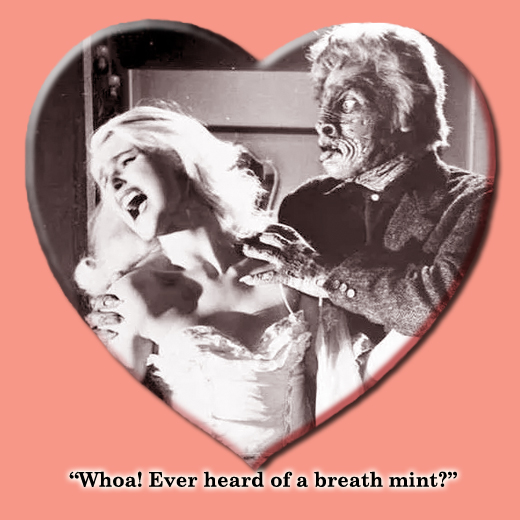
"Whoa! Ever heard of a breath mint?" Atom Age Vampire, 1960

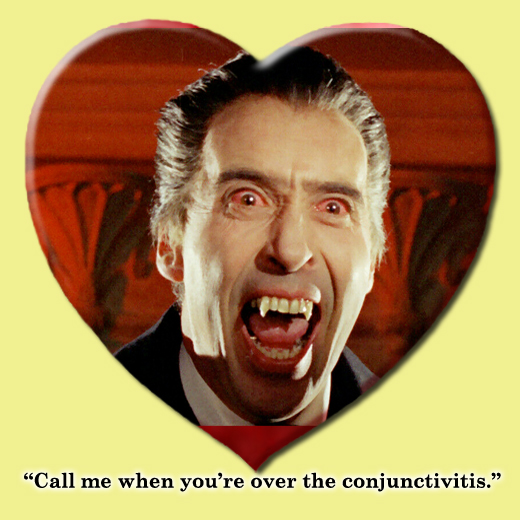
"Call me when you're over the conjunctivitis." Horror of Dracula, 1958

Godzilla and King Kong decided to move in together, but all the places they looked at were too small. King Kong vs. Godzilla, 1963

Ted tried to impress Isabel with his mastery of shadow puppetry. The Mad Ghoul, 1943

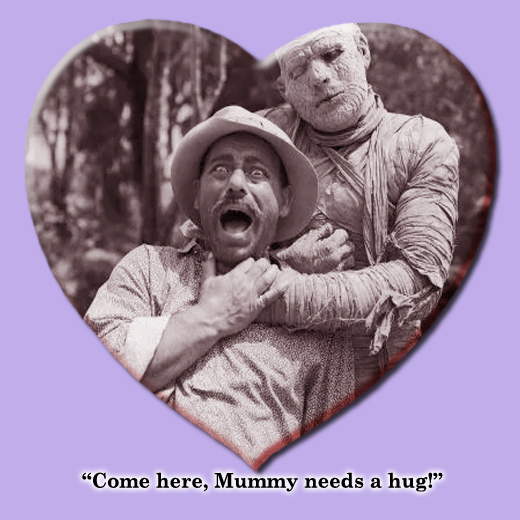
"Come here, Mummy needs a hug." The Mummy's Curse, 1944


April 15, 2012

My Movie Year: 1958

My Movie Year organized by Fandango Groovers Movie Blog
Organized by Fandango Groovers
This post is one of dozens put up today by movie bloggers who were asked to pick their favorite movie year and back it up with five outstanding examples. To see what years and titles other bloggers have picked, click on over to Fandango Groovers Movie Blog.

1958: Dwight Eisenhower is well into his second term as president; America's first successful satellite, Explorer I, is launched into orbit; Elvis Presley is inducted into the army; Pan Am is the first airline to fly a Boeing 707 jetliner across the Atlantic; the National Aeronautics and Space Administration (NASA) is born; The Beatles (then called the Quarrymen), have their first recording session; the nuclear submarine U.S.S. Nautilus becomes the first vessel to cross the North Pole underwater; the newly formed NASA launches its first spacecraft, Pioneer I; television gets its own patron saint, Saint Clare, courtesy of Pope Pius XII; Michael Jackson and Bruce Campbell are born.

1958 was not a great year for movie ticket sales. Throughout the '50s, Hollywood tried to compete with that nasty new kid on the block -- television -- with innovations and gimmicks designed to lure people out of their living rooms and back into theaters: 3D, widescreen formats such as Cinerama and CinemaScope, and even cheap carnival sideshow-type stunts like William Castle's "Emergo" (for House on Haunted Hill, 1959). In spite of all these efforts, U.S. domestic box office receipts declined from $1,376 million in 1950 to a comparatively paltry $958 million in 1959. Over the same period, TV ownership exploded from 20% of all American households in 1950 to over 90% in 1959.

One bright spot for the movie industry was the youth market. The decade saw teenagers come into their own as a potent consumer force. And one place they loved to hang out was the local "passion pit," i.e., the drive-in theater. While traditional movie theaters and ticket sales were declining, drive-in theaters mushroomed from under 1,000 nationwide in 1948 to over 5,000 in 1958. The industry responded with a seemingly endless of stream of drive-in, double-bill fare aimed at non-discriminating teens with some extra change in their pockets. While their parents stayed home and watched Ed Sullivan, Perry Como, Gunsmoke, and an almost endless array of Westerns on their console TVs (7 out of the top 10 TV shows in 1958 were westerns), the kids were piling into Fords and Chevys and motoring down to the local drive-in to see cheap, entertaining stuff like The Blob, The Fly, Fiend Without a Face, Monster on the Campus, I Married a Monster From Outer Space, Frankenstein's Daughter, War of the Colossal Beast, and many, many others.

While I dearly love '50s sci-fi movies, and 1958 may be the most prolific year of all for these types of films, true greatness was also showing up in theaters that year. Of my five picks for the best of 1958, three are enshrined in the National Film Registry, two are on my personal top 10 favorites of all time list, one is a personal top 10 horror favorite, one is a top 10 fantasy favorite, and all are outstanding, memorable representatives of their respective genres. They were not the top grossing films of the year, but they have held up far better than the more popular releases of the day, and will entertain for many more years to come.


Horror of Dracula poster
Following hard on the heels of Hammer's wildly successful Curse of Frankenstein (1957), this second Hammer pairing of Peter Cushing and Christopher Lee revived interest in period Gothic horror, propelled tiny Hammer Studios to the forefront of the horror film industry, and cemented both actors' reputations as icons of the genre. The film's impact and influence are hard to overestimate:
Christopher Lee emerged from his earlier monster make-up [Curse of Frankenstein] to take on the role which would make him eternally world-renowned; his portrayal of Count Dracula would be so definitive that whenever people thought of Dracula, they envisioned Lee. His image, darkly virile and sexually charged, lips glossed with bright blood, virtually revolutionized the global horror movie industry. Peter Cushing played the Count's perennial nemesis, the eminent vampirologist Dr. Van Helsing, armed with crucifixes, garlic flowers and other paraphernalia of his rather generalized trade. Again filmed in opulent color, the film was far more explicit than the earlier Bela Lugosi version… [The film] remains probably the finest example of the classic Hammer style and combines the talents of the leading players and key production personnel who would go on to make that style world-famous. It has often been described as the best vampire film ever made, a fitting testament to its incredible initial impact. (House of Horror: The  Complete Hammer Films Story, Jack Hunter, ed. Creation Books, 2000)


7th Voyage of Sinbad poster
I remember seeing Jurassic Park in 1993 and simply being awed by the CGI technology that could bring dinosaurs to such realistic, terrifying life. In spite of advancements in the art, CGI fails to impress anymore, and the endless parade of sci-fi, fantasy and horror films that use (and overuse) it now tend to elicit yawns instead of wonder. Today's filmmakers make the same mistake over and over -- they think technology and special effects can compensate for poor scripts and mediocre acting.

7th Voyage was my introduction to the awesome stop-motion animation of Ray Harryhausen. It was the 4th collaboration of the visual effects master and producer Charles H. Schneer, but the first pure fantasy project that allowed Harryhausen to really show off his genius. As a kid, I was as awed by Harryhausen's wonderful creations -- the Cyclops, the giant two-headed Roc, the skeletal swordsman, and the ancient dragon -- as I was later by Star Wars' battlecruisers and Death Star, and still later by Jurassic Park's dinosaurs. With its wondrous stop-motion mythological beasts, a fast-paced, engaging story, personable characters in exotic costumes, and a rousing score by Bernard Herrmann, 7th Voyage still enchants and delights, and is simply one of the best fantasy films of all time.


Touch of Evil poster
Genius is a word that's lost much of its meaning from overuse. But I think it's safe to say that Orson Welles was an honest-to-goodness genius, at least as far as film is concerned. It's one thing to invent a whole new film grammar with something like Citizen Kane (1941), but to make Chuck Heston believable as a Mexican narcotics agent? Now that takes true genius!

To make things even more interesting, we have good ol' Chuck to thank for this extremely worthy member of the Welles canon. It seems Welles was originally slated only to act in the film, but Heston, who signed onto the project thinking that Welles would be directing too, insisted that Orson take over as director when he found out someone else was assigned. The rest, as they say, is history.

From the long, single-take opening scene in the Mexican border town, to Janet Leigh's creepy encounter with the motel clerk played by Dennis Weaver, to Welles' performance as a shambling, bloated, corrupt cop, Touch of Evil achieves a surreal, dreamlike quality that both disturbs and fascinates.

Welles was not a happy camper before, during or after the filming (he didn't like the title, and he sure didn't like Universal's final cut), but that didn't affect the critics' ultimate judgment of Touch of Evil as one of the last, great noirs of the classic era. The great man's original vision, and cut, of the film was finally released on DVD in 1999.


Man of the West poster
This western was a sort of swan song for two very important men of film: it was director Anthony Mann's last truly great film, and it was Gary Cooper's last great role. It is mature and invigorating and examines some big issues in a very entertaining way: Can we ever escape the past? Is loyalty always a noble thing? What exactly constitutes a family? In film scholar Jeanine Basinger's study of Anthony Mann (Wesleyan University Press, 2007), she quotes French filmmaker Jean-Luc Godard, who was single-handedly responsible for plucking Man of the West out of relative obscurity and establishing it as a classic of the Western genre:
I have seen nothing so completely new since-- why not? -- Griffith. Just as the director of Birth of a Nation gave one the impression that he was inventing the cinema with every shot, each shot of Man of the West gives one the impression that Anthony Mann is redefining the Western. It is, moreover, more than an impression, He does re-invent.
Basinger herself goes on to say:
The film, however, is something more than the usual matching of landscape, narrative, and character development. It incorporates the mythology of the western genre itself, and, ultimately the mythology of the hero. As if he were the hero of a Greek myth, Cooper makes a symbolic journey into self. He leaves the real world he inhabits and enters the evil underworld to confront the forces which would destroy him, forces which are clearly of and within him. He makes a journey with ghosts back into things buried and dead in his past, from civilization to noncivilization and back to redemption.
Man of the West is simply my favorite Western of all-time, and one of my favorites in any genre.


Vertigo poster
What was it about Jimmy Stewart that brought out the very best in directors? Some actors seem to pick and choose when they're going to be very, very good, and when they're going to be awful, but Jimmy was the prototypical reliable performer, and never disappointed. And for someone often identified with light comedy (The Philadelphia Story, 1940, The Shop Around the Corner, 1940), he pops up again and again in some of the greatest westerns and suspense-thrillers of all time: Winchester '73 (1950), Broken Arrow (1950), The Naked Spur (1953), The Man Who Shot Liberty Valance (1962), Rear Window (1954), and of course, Vertigo.

Jimmy's portrayal of the haunted cop John "Scottie" Ferguson is arguably the best of his entire career, and Vertigo the best of Hitchcock's films. With the almost perfect casting of icy beauty Kim Novak as the living ghost (fortuitously, Kim replaced the pregnant Vera Miles almost at the last minute), Vertigo presents one of the more bizarre and disturbing "romances" in all of film. In Hitch, The Life and Times of Alfred Hitchcock (Pantheon Books, 1978), John Russell Taylor gets to the heart of Stewart's great performance, and of the film itself:
[In] Vertigo, the whole emotional situation is invested with a nightmarish intensity because its true nature is unacknowledged and its natural course diverted. The hero's passion for the girl in the second half of the film is perverse not because he continues hopelessly to love someone he believes dead-- bereavement is not such an unnatural situation -- but because he is incapable of reacting to a real, living woman until he has dominated her completely and transformed her, completely against her will, into the image of his lost love. In other words, he has chosen the fantasy over reality, and tried to transform reality into fantasy by the sheer force of his obsession.
We can't look away, because Scottie Ferguson's obsession has become ours. Film doesn't get much better than this.