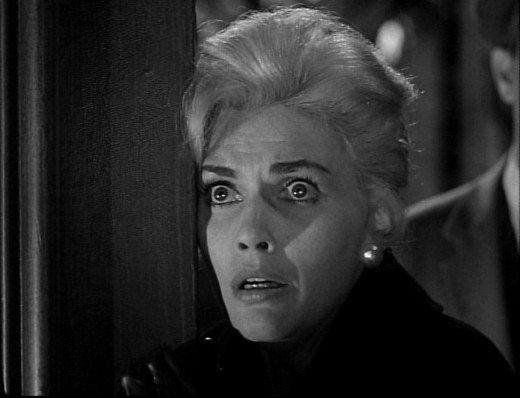
Showing posts with label Boris Karloff. Show all posts

October 24, 2025

Frozen with fear: The Man with Nine Lives

Poster - The Man with Nine Lives (1940)
Now Playing:
The Man with Nine Lives (1940)


Pros: In spite of the low budget and minimal sets, the film maintains great pace and suspense as it winds its way through plot twists and turns; Well acted all-around.
Cons: Scientific purists will guffaw at the script's crackpot take on cryogenics.

This post is part of the "Secret Places and Trippy Houses blogathon" hosted by Rebecca Deniston, whose not-so-secret online lair is the blog known as Taking Up Room. As Rebecca put it in her blogathon announcement,

“One of the most fascinating plot devices in storytelling, whether on the screen or in books, has to be the secret place, whether it’s a literal secret room or a weird house with secret passages, or maybe an underground city, or something that has gone unnoticed. It means that everyone who doesn’t know about these hidden places has to reset their thinking and look at the world differently, which is an interesting mental exercise.”

Not only does The Man with Nine Lives feature a secret passageway and chamber that holds the key to a tragic mystery, it features Boris Karloff as a medical researcher whose ability to look at the world differently is both his biggest strength and weakness.

But first, a bit of background (stop your groaning, this will only hurt a little bit!). We all know that dear Boris was vaulted to worldwide fame when, at the tender age of 43, he first portrayed the classic product of mad science, the Frankenstein monster.

In addition to two more stints as Frankenstein’s creation (Bride of Frankenstein, Son of Frankenstein), the 1930s saw him portraying monsters, both supernatural (The Mummy, The Ghoul, The Walking Dead), and human (The Black Cat, The Old Dark House, The Raven) to great acclaim.

But as Boris aged, producers flipped the script on him, keeping him in the same old familiar horror films, but increasingly making him the creator of mad science instead of its product. And Boris stepped into the roles as if he’d been dabbling with things better left alone all his life.

Many of the roles took advantage of the real life man -- gentlemanly and gracious -- and mixed in a lot of sympathy for the character along with menace:

  • In The Man Who Lived Again (1936), Karloff portrays an idealistic scientist dabbling in soul transference who is driven mad when everything he has worked for is upended by an unscrupulous patron.
  • In Before I Hang (1940), he’s a kindly physician sentenced to death row for a mercy killing who gets permission to experiment in prison on a new blood serum, with horrific results.
  • In Black Friday (1940), he’s a brain surgeon who saves the life of his professor friend by transplanting a portion of a gangster’s brain into the professor, with… horrific results.
  • In The Devil Commands (1941), he’s a grieving scientist who invents a means to communicate with his dead wife, with, you guessed it, horrific results.
Screenshot - Kravaal (Boris Karloff) mixing chemicals in The Man with Nine Lives (1940)
Boris had this mad doctor thing down cold.

Later, in 1945’s House of Frankenstein, the story that launched Karloff to fame and fortune came full circle when he played Dr. Gustav Niemann, who revives the Frankenstein monster (along with Count Dracula) for his own evil purposes. Still later, In Frankenstein 1970 (1958), he portrayed a descendant of the original Frankenstein who tries to create a new monster even as he hosts a Hollywood film crew at his castle.

1940’s The Man with Nine Lives gave Karloff, who had already experimented with invisible rays and partial brain transplants, a chance to tinker with yet another esoteric mad scientific discipline. In this outing, he plays Dr. Leon Kravaal, an early pioneer in the use of cryogenics (dubbed “frozen therapy” in the film) for treating aggressive diseases.

As the film opens, we’re introduced to medical researcher Tim Mason (Roger Pryor), who has gotten in trouble with his boss at the research hospital for overselling his new frozen therapy as a cure for cancer (the theory being that slowing down the body’s metabolism and functions through suspended animation will kill the bad cells, or something like that.)

Mason talks over his predicament with his trusty (and lovely) assistant Judith Blair (Jo Ann Sayers), speculating that if he could just talk to or get a hold of the notes of Dr. Kravaal, the preeminent pioneer in frozen therapy, he might be able to perfect his own techniques and prove the therapy’s virtues to the doubters.

Screenshot - Roger Pryor and Jo Ann Sayers in The Man with Nine Lives (1940)
Mason and Judith discuss marketing strategies for their new Frozen Therapy.™

The only problem is that Kravaal disappeared, along with a group of local men, 10 years ago in a remote town where he had taken up residence in order to conduct his research in peace.

But of course, medical research, especially mad medical research, waits on no man, disappeared or otherwise. Mason and Judith decide to travel to the remote town in the hopes of finding Kravaal’s laboratory and notes that might provide a breakthrough for Mason’s work.

In their quest, the intrepid duo stumble upon not one, but a veritable plethora of secret places. Let’s count them:

  1. The island. For maximum remoteness and to get away from the prying eyes of pesky skeptics, Kravaal had located his lab on an otherwise uninhabited island. A requisite superstitious local, the boat rental guy, tries to warn Mason and Judith off of going to the island, ominously telling them of the men who had headed over there and never returned.
  2. Kravaal’s ramshackle house on the island, which looks haunted enough to deter anyone except the most curious and ambitious of medical researchers and their eager assistants.
  3. The secret laboratory, which the brave pair only discover when Judith falls through rotten floor boards, enabling them to discover the stairs to a secret sub-basement.
  4. An ice-encrusted vault off of the lab, containing the frozen, but still living, bodies of Kravaal and the missing local men.

How's that for a laundry list of secret places in one little, unassuming B movie?

Screenshot - Kravaal's secret lab in The Man with Nine Lives (1940)
Fortunately Amazon delivers to secret remote islands, so Kravaal can keep his lab well-stocked.

In addition to all those secret places, The Man with Nine Lives packs an awful lot of mad scientific jargon, flashbacks, soulful monologues, fraught stand-offs, and who-will-survive suspense into its economical 74 minute runtime.

Even though most of the movie takes place in the claustrophobic confines of the secret lab and frozen vault, the pacing as one secret after another is revealed makes for a very satisfying, edge-of-your-seat watch.

Words can’t adequately convey all the twists and turns the plot takes in this tale of crackpot science, mysterious disappearances, and amazing resurrections (nor do I want to spoil the fun by revealing too much). Suffice it to say that Mason and Judith have stumbled on a frozen tableau of tragedy, involving a dedicated scientist trying to cure a dying man, and the man’s nephew and local officials convinced that the scientist has already killed his patient.

As a result of the confrontation, Kravaal and his persecutors are all frozen together in the secret vault with no one the wiser — effectively having disappeared for 10 years until their accidental discovery.

Screenshot - Kravaal's secret ice vault in The Man with Nine Lives (1940)
"Next time I'm getting a frost-free refrigerator!"

Luckily, they’re revived by trained medical professionals — Mason and Judith — who know what they’re doing. But the relief is short-lived as the passionate and single-minded Kravaal is convinced that he’s closer than ever to perfecting his work — and he’s got a whole lab full of human guinea pigs whom the outside world already considers dead. Bwwwwaahahaha!

Okay, that wasn’t fair — nowhere in the film does Karloff/Kravaal do a mad scientist’s maniacal laugh. Actually, The Man with Nine Lives fits very neatly into Karloff’s other roles from this period — that of a gentle, yet dedicated doctor/researcher/scientist whose work is misunderstood by plodding authorities and colleagues, with those misunderstandings (and Karloff’s dogged persistence in spite of it all) resulting in horrific consequences.

Of course, by this time dear Boris could do this sort of thing in his sleep, but it’s still fun watching him masterfully turning from a gentle (if highly dedicated) soul to a monomaniacal agent of destruction who is willing to sacrifice anyone and anything in his pursuit of mad science. (At one point he offhandedly tells Mason and Judith that “This work is worth a thousand lives like his [the nephew’s]).

Screenshot - Kravaal (Boris Karloff) ready to experiment on Judith (Jo Ann Sayers) in The Man with Nine Lives (1940)
"This won't hurt a bit!"

Karloff’s/Kravaal’s murderous intensity as he realizes he’s on the cusp of completing his life’s work is a thing to behold. Similarly intense are the performances of the supporting actors playing the arrogant and uncomprehending local authorities (plus the nephew) who intervened 10 years earlier with tragic results, and who wake up from their frozen slumber none the wiser, and far more vulnerable as they realize they’re in the clutches of a madman who views them as no more valuable than lab rats.

There’s a certain satisfaction in watching these self-righteous dullards — Stanley Brown as the nephew, John Dilson as DA Hawthorne, Hal Taliaferro as Sheriff Stanton, and Bryon Foulger as the Coroner — quake in their boots as they contemplate being sacrificed for science (and they’re so good at blubbering and quaking!).

Screenshot - Two of the local men start to realize the fix they're in - The Man with Nine Lives (1940)
"We're men dammit, not lab rats!"

Roger Pryor as Mason and Jo Ann Sayers as Judith also do a creditable job as the only two you want to root for — at times they seem to be channeling William Powell and Myrna Loy in their own Thin Man-like mystery (in this case, a “Frozen Man” mystery).

Behind the camera, journeyman director and B specialist Nick Grinde manages to extract maximum angst and suspense out of this odd, claustrophobic little film. Around the same time, Grinde also directed two of Boris’ better mad doctor Bs, The Man They Could Not Hang (1939) and Before I Hang (1940) — see my reviews of those two in the post “Hanging out with Boris.” (Somewhat oddly, Grinde would hang up his directing duties by the mid-forties, although he lived many decades after that.)

Screenwriter Karl Brown teamed with Grinde on the same trilogy of mad doctor films. The partnership was a salutary one, as they are among the most lively and unique of all of Karloff’s B pictures.

The three films would make a very entertaining Halloween marathon, and at only an hour and some change for each, that would still leave you time to bob for apples or go on a Halloween scavenger hunt. Just don’t get trapped in some mad doctor’s secret laboratory.

Screenshot - Kravaal (Boris Karloff) has his work interrupted by a delegation of locals in The Man with Nine Lives (1940)
Karloff deals yet again with uncomprehending idiots.

Where to find it: DVD | Streaming

March 24, 2023

William Shatner's Early Exploration of the Unknown: "The Grim Reaper"

It’s time once again for Films From Beyond to turn its attention to great TV of the past, inspired by Terence Towles Canote’s Favourite TV Show Episode Blogathon at A Shroud of Thoughts (tune in to Terence’s site for more posts on classic television from an impressive list of bloggers).

Years before William Shatner embarked on his five year mission to seek out new life and new civilizations as captain of the starship Enterprise, he explored the darkest recesses of the human mind (not to mention the paranormal) in a succession of sci-fi, fantasy and horror-related TV roles.

One of Shatner’s better known pre-Star Trek appearances is as jittery airline passenger Bob Wilson in the classic Twilight Zone episode “Nightmare at 20,000 Feet” (1963). I’ve covered it before on this blog but for those who missed it the first time: I was about eight or nine years old when I first encountered “Nightmare,” watching it in a darkened basement with my brother. When Wilson pulls back the window curtain next to his seat to see the gremlin goggling at him with his ugly mug pressed up against the pane, the two of us ran up the stairs yelling at the top of our lungs. (Somehow, that incident only fueled my fascination with the bizarre and grotesque. It must have been the adrenaline rush.)

Shatner had appeared in another classic Twilight Zone episode several years before. “Nick of Time,” (like "Nightmare," scripted by Richard Matheson), is a clever and uncanny examination of the power of suggestion. Don Carter (Shatner) and his wife are passing the time at a small town diner waiting for their car to be fixed. They start feeding coins into a fortune-telling machine, and discover that the gadget seems to have a chilling knack for predicting their near future. Soon, the couple are afraid to leave the diner as the diabolical machine holds them in its thrall through the “fortunes” it dispenses.

Screenshot - William Shatner in "Nick of Time," The Twilight Zone, 1960
-"Am I going to enjoy this episode of The Twilight Zone?"
-"Without a doubt."

The future starship captain also appeared in another sci-fi/fantasy series beloved by ‘60s monster kids, The Outer Limits. Shatner guest-starred in the episode “Cold Hands, Warm Heart” (1964) as an astronaut who, after returning from a mission to Venus, is having disturbing visions and undergoing strange physiological changes. Although the episode is slow-paced and one of the weaker of the series, it was still a harbinger of TV space missions to come.

Another couple of Shatner appearances in early ‘60s macabre TV are perhaps less well-known but are must-sees for discriminating fans. Back in October 2019, I wrote about my pleasure in finally securing the DVD box set of the Boris Karloff-hosted Thriller TV series (1960-1962), and reviewed two notable episodes, “Pigeons from Hell” (based on the eerie Robert E. Howard story) and “The Incredible Doktor Markesan,” featuring Boris himself as the titular character. This creepy and atmospheric series, still underrated to this day, started out specializing in Alfred Hitchcockian thriller stories, then quickly turned to supernatural horror mid-way through the first season.

Fortunately for Shatner fans, the actor guest-starred in two of the series’ more memorable supernatural episodes. In fact, his second appearance in Thriller came in “The Grim Reaper,” which is the second highest rated episode of the entire series in IMDb (an impressive 8.4 out of 10 stars).

Now Playing: "The Grim Reaper" (Episode of Boris Karloff’s Thriller TV Series, first aired June 13, 1961)

Pros: Competent cast delivers an excellent mid-century Gothic tale with a twist of black humor; Writing, direction, photography and music score are top-notch
Cons: May be a bit slow-moving and talky for 21st century sensibilities

“The Grim Reaper” tells the tale of a cursed painting by a mad artist that brings sudden, violent death to anyone who owns it. In a prologue sequence set in the 19th century, a grim-faced gentleman, M. Pierre Redin (Henry Daniell), is trying to convince the landlady of a run-down boarding house to let him into the room where his son, the artist Henri Redin, is staying. The landlady is spooked by her boarder, calling his work “evil,” and telling the elder Redin that Henri would often go to the cemetery to do his sketching.

When they finally open the door, they’re startled to find Henri's lifeless body hanging from the rafters, his latest masterpiece, a depiction of the Grim Reaper with grinning skull face and wicked-looking scythe, sitting on an easel as if in mute witness to its creator’s suicide.

Screenshot - Fifi D'Orsay and Henry Daniell in "The Grim Reaper," Thriller TV series, 1961
Henry Daniell was a mainstay of the Thriller series, appearing in 5 episodes.

After Boris Karloff’s signature introduction of the story and the players, we cut to the present day (1961 that is), where young, dapper Paul Graves (Shatner) is arriving at his aunt’s country estate. He does a double-take when he sees a shiny black hearse parked near one of the garages, and a name plate, “Graves-End” attached to the front entrance.

We soon learn that Beatrice Graves (Natalie Schafer) is a celebrated mystery writer with all the usual eccentricities, and that she came up with the hearse and tongue-in-cheek estate name to reinforce her public image.

Aunt Bea likes her martinis, her new part-time actor/full-time gigolo husband Gerald (Scott Merrill), her attractive personal secretary Dorothy (Elizabeth Allen) and her other possessions. But it’s Bea’s latest acquisition that has cast a pall around the house and prompted Paul's visit.

Sure enough, staring out from its place of honor on the wall of the library with its dead eye sockets is the Grim Reaper, as if patiently waiting to use its scythe on the inhabitants of its latest abode. To Bea, the painting is just another piece she got overseas to accentuate her house and her image.

But the painting is the reason for Paul’s visit; he’s worried for his aunt. Standing dramatically in front of the painting, and with the fireplace casting eerie shadows on the walls, Paul tells the assembled household residents that since the artist’s suicide, 15 of the painting’s owners have met unexpected and violent deaths. In every case, blood was seen on the blade of the Reaper’s scythe before the deaths. The group pooh-poohs the story, but right on cue, Paul hesitates, turns to look at the painting and haltingly touches it. With ominous violin music swelling, his hand emerges from the shadows, his fingers covered with blood!

Screenshot - William Shatner standing in front of the painting of the Grim Reaper, "The Grim Reaper," Thriller TV series, 1961
Paul pauses for dramatic emphasis in front of the cursed painting.

Of course, the curse is going to be fulfilled and someone is going to die. But what will be the engine of doom? Paul insists that he’s not concerned about his aunt’s money, but is he hiding his true motivations? Or will it be Gerald’s wandering eye for the beautiful Dorothy?

“The Grim Reaper” is one of 10 Thriller adaptations and/or stories credited to esteemed master of the macabre Robert Bloch, best known for his novel Psycho, which Alfred Hitchcock notoriously adapted to the screen in 1960. In the DVD commentary, one of the contributors observes that the episode is exemplary of the series’ best offerings that were “about the intrusion of some normal character into a remote location where something’s been wrong for a very long time.” [Commentary: Ernest Dickerson, Gary Gerani, Tim Lucas & David J. Schow, Thriller, Image Entertainment, NBC Universal, 2010, episode 37]

From Psycho to “The Grim Reaper” to “The Hungry Glass” (the other Bloch-Shatner Thriller  “collaboration”; see below), Bloch was all over the theme of denizens of the brightly-lit normal world stumbling into a very dark abnormal one, with dire consequences.

The commentators also mention that Bloch’s Reaper script was adapted from Harold Lawlor’s 1947 story “The Black Madonna” (Lawlor, like Bloch, was a frequent contributor to Weird Tales in the ‘30s and ‘40s.) In the original story, the cursed painting is of an eerie Madonna and Child. There is a scar on the Madonna’s face, and when it bleeds, it spells doom for whoever owns the painting.

Screenshot - Boris Karloff's introduction to "The Grim Reaper," Thriller TV series, 1961
"Someone is in mortal danger as sure as my name is Boris Karloff!" says William Henry Pratt.

Bloch’s adaptation ups the creepiness factor, changing the subject of the painting to Death itself, and logically making blood on the scythe the harbinger of doom (although there’s something to be said for the off-kilter eeriness of a Madonna image not just shedding tears, but bleeding stigmata-like).

Bloch also added the prologue of M. Redin finding the body of his son hanging in the loft. Not only does the prologue provide a creepy cameo for the venerable character actor Henry Daniell (whose own gaunt, death-mask of a face would be featured in 5 Thriller episodes), but it also sets the stage for Bloch’s mordant black humor.

After discovering the body of the young artist, M. Redin and the Landlady stare at the painting of the Grim Reaper. Redin solemnly remarks, “His last picture… and he finished it.” The landlady’s rejoinder: “Perhaps it finished him!”

Bloch inserts a number of quips into the first couple of acts, allowing the viewer to whistle past the graveyard (or the Grim Reaper) so to speak, as he sets up the suspense to follow.

When Paul first arrives, Beatrice airily invites him to “come in, we mustn’t let fresh air into the house!” Then, as Bea is leading him on a tour of the house, he quips, “Who designed this, Charles Addams?” (At this point the original Addams Family TV show was only a gleam in some TV executive’s eye, but the cartoons on which it was based were hugely popular.)

Gradually the witticisms fade away as the moods of the four main characters darken (a bleeding painting of Death will do that to you). Natalie Schafer as Beatrice is particularly notable. Vintage TV fans will recognize her as Mrs. Howell from Gilligan’s Island, who was always trying to bring a touch of class to the tropical island on which she was marooned.

Beatrice’s situation isn’t that far off from Mrs. Howell’s: she too is isolated (although voluntarily, and at a sprawling country estate with all the amenities), and deals with her boredom by collecting expensive art objects and husbands. At the beginning she is all frivolity, but by the end of the 2nd act she is morosely nursing a drink, telling Paul that “Death has no terrors for me,” and that as a mystery writer, “Death is just a business partner.”

Screenshot - William Shatner and Natalie Schafer in "The Grim Reaper," Thriller TV series, 1961
Beatrice contemplates her long-time business partner, Death.

It’s quite a performance, and wearing an elegant, black sequined evening dress, she comes off as a sort of anti-matter, dark universe doppelganger of the eternally entitled and optimistic Mrs. Howell.

The other three main cast members all have their moments as well. William Shatner gives a largely restrained and nuanced performance as Paul, who we quickly realize is holding something close to the vest. He does go over the top, Shatner-style, at two crucial moments, but hey, maybe the painting made him do it!

Scott Merrill as the husband doesn’t have much to do except be lounge-lizardy, but towards the end he has what the DVD commentators describe as one of the better acting moments of its type in the whole series (you’ll have to watch the episode to see what they mean).

Similarly, Elizabeth Allen is not much more than an attractive accessory (and possible red herring) until the climax, when she gets to show how convincingly horrified she can be.

The other stars of the episode are director Herschel Daugherty and director of photography Bud Thackery, who do a great job of methodically hemming in the characters and steering them to their fates with dramatic tight shots and growing shadows and darkness.

And then there’s Jerry Goldsmith, whose score effectively employs violins that serve at various key moments as a somber, moaning Greek chorus.

With “The Grim Reaper,” the Thriller series was at the top of its game, employing some of its very best talents to deliver one of the most chilling TV episodes of the era.

Screenshot - Elizabeth Allen in "The Grim Reaper," Thriller TV series, 1961
Dorothy is horrified by her employer's decorating tastes.

Where to find it: Streaming

Bonus mini-review: “The Hungry Glass,” first broadcast January 3, 1961

The first Thriller episode guest-starring William Shatner has several things in common with “The Grim Reaper”: It too features a haunted object (or in this case, objects); Robert Bloch had a hand in the writing (providing the story for Douglas Heyes to adapt); and Elizabeth Allen -- Dorothy in “The Grim Reaper” -- guest stars as well.

Shatner plays Gil Thrasher, a professional photographer who with his wife Marcia (Joanna Heyes), has quit the rat race of the big city and bought an old house on the New England coast. In typical ghost story fashion, the grizzled locals at the general store cryptically warn the couple of the place’s malignant reputation.

The gregarious real estate agent who sold the place to the Thrashers, Adam Talmadge (Russell Johnson) tells the couple of the house’s original resident, a young girl who had become addicted to looking at herself in the mirror. After a lifetime spent admiring her reflection, a nephew finally intervened and locked her away without her precious mirrors, where she died a raging madwoman. Since then, people have come to bad ends at the house in encounters with mirrors and glass. As a consequence, all the mirrors have been removed.

On cue, Gil sees a mysterious apparition in a window. The mystery deepens when Gil discovers an eerie, phantom-like face of a little girl in one of the photographs he took of the house. Gil and Marcia soon discover a secret room off of the attic in which all the missing mirrors are stored. When Talmadge and his wife Liz (Elizabeth Allen) join the Thrashers for a house-warming party on a dark and stormy night, you know all hell is going to break loose.

Screenshot - scene from "The Hungry Glass," Thriller TV series, 1961
Marcia takes a moment to reflect on the wisdom of buying a creepy haunted house.

Like “The Grim Reaper,” “The Hungry Glass” focuses on a handful of people grappling with a malignant supernatural force in an old dark house. There is a striking prologue featuring the reflection of a beautiful young girl in 19th century formal dress prancing and preening in a succession of ornate mirrors. The scene turns nightmarish when the camera pulls back to reveal that the source of the reflection is a hideous old crone.

The mirrors make another remarkable appearance mid-way through the episode, when the secret room is discovered. A shot of Marcia’s multiple reflections in dozens of old mirrors is both dazzling and ominous.

“The Hungry Glass” is one of a number of ghost stories that effectively plays on the uncanny nature of mirrors, especially in creepy old houses, and our ability to imagine dark forces that lurk behind the glass.

Where to find it: Streaming


October 27, 2020

Heinous Henchmen of Classic Horror #7

In the mid-19th century, cadavers for medical research and teaching are hard to come by. Dr. Wolfe "Toddy" MacFarlane (Henry Daniell; no relation to Todd MacFarlane), is a respected surgeon who has taken to teaching at a medical college in his advanced middle age. 

When a distraught mother approaches MacFarlane as a last resort to help her crippled young daughter, he at first refuses to help, telling her that if he conducted surgeries for everyone who came to him, he would have no time for teaching. 

Over drinks at a local tavern, MacFarlane's medical student assistant, Fettes (Russell Wade), and his supplier of cadavers, cabman John Gray (Boris Karloff) manage to get the doctor to change his mind, as the poor girl's condition will only worsen if she doesn't have an operation. Fettes is perplexed by the relationship between the esteemed doctor and the lowly cabman, with Gray being extremely familiar with the uptight MacFarlane and contemptuously calling him by the nickname Toddy.

The doctor needs a fresh cadaver to prepare for the girl's complex operation, and Gray is called in to supply one ASAP. MacFarlane will once more have to look the other way as Gray The Body Snatcher employs his extremely dubious methods for securing bodies.

Boris Karloff, Bela Lugosi and Henry Daniell in The Body Snatcher (1945)
MacFarlane: "Gray, I must be rid of you, you've become a cancer, a malignant,
evil cancer rotting my mind." 
Gray: "You've made a disease of me, eh Toddy?"


Boris Karloff as Cabman John Gray in The Body Snatcher, 1945


PERFORMANCE EVALUATION
DELIVERY MAN

Name:  John Gray           Date:   1945       

Supervisor:  Dr. Wolfe MacFarlane              

Category Unsatisfactory Satisfactory Excellent Comment
Work Productivity

X Gray and I go back a long way, and in all that time the employee has delivered dozens, if not hundreds, of bodies.
Work Quality

X The cadavers Gray delivers are invariably fresh and very suitable for teaching and research purposes.
Communication/
Work Relationships
X

I do wish Gray would stop calling me by that infernal nickname "Toddy."
Initiative
X
Is there such a thing as too much initiative? Gray should not be getting specimens from the "pre-deceased."
Dependability

XEvery time I turn around, Gray is there, pulling up to the delivery door with a fresh body, or frequenting my favorite tavern. He's nothing if not dependable.

Summary: I can live with the way Gray obtains the cadavers, but I can't stand it when he calls me Toddy in front of my colleagues and students.


Menacing shadow (Nosferatu)
Don't miss these other great henchmen!
Fritz (Frankenstein, 1931) | Morgan (The Old Dark House, 1932) | Sandor (Dracula's Daughter, 1936) | Jake (The Human Monster, 1939) | Ygor (Son of Frankenstein, 1939) | The Creeper (House of Horrors, 1946)

October 6, 2020

Heinous Henchmen of Classic Horror #2

This second installment of the series features Morgan (Boris Karloff), a butler employed by the highly eccentric Femm family. The Femms live in an Old Dark House in a remote corner of Wales. 

On a dark and stormy night, two sets of travelers seek shelter from floods and landslides at the Femm mansion. One look at Morgan should have tipped them off that it was better to take their chances in their cars outside.

Still, The Old Dark House, 1932
"Okay, it's a movie, 4 words, first word is..."

 
Heinous Henchmen of Horror #2 - Boris Karloff as Morgan, The Old Dark House, 1932


PERFORMANCE EVALUATION
BUTLER

Name:  Morgan           Date:   1932       

Supervisor:  Horace Femm              

Category Unsatisfactory Satisfactory Excellent Comment
Work Productivity X Morgan answers the door, cooks and serves food, and looks after the electrical generator.
Work Quality X When Morgan drinks too much he gets surly and violent; just the other night he upended the dinner table trying to get to a houseguest.
Communication/
Work Relationships
X My sister and I constantly have to repeat ourselves; since the employee is mute, he can only grunt at us.
Initiative X The only time Morgan takes any initiative is when he is chasing one of the houseguests.
Dependability X We rely on the employee NOT to let our insane elder brother out of his room, but Morgan takes a perverse delight in freeing him from time to time.

Summary: Morgan is an uncivilized brute. Sometimes he drinks heavily. Dark and stormy nights set him going, and once he's drunk, he's rather dangerous.

September 14, 2020

The Best Laid Plans of Not-So-Nice Madmen

We’re all waiting with bated breath as the world’s finest medical and scientific minds tirelessly work to come up with a vaccine for the coronavirus. When it happens, it will rank among humanity’s greatest medical achievements, right up there with Alexander Fleming’s discovery of penicillin and Jonas Salk’s polio vaccine.

The difference being that there will almost certainly not be an individual man or woman to point to as the latest hero of the 21st century (although no doubt some politicians will try to take credit). The complexity of the challenges and the resources needed to address them dictate that literal armies of brilliant minds work cooperatively and collectively, versus leaving it up to an eccentric lone wolf scientist burning the midnight oil in a secluded lab.

Still, Lon Chaney Jr. and Lionel Atwill, Man Made Monster (1941)
"It's okay doc, I'm feeling much better now... really I am!"

Society is deeply ambivalent when it comes to brilliant lone wolves. On the one hand, we say we cherish individualism, ambition and initiative, and yet also seem to be smugly satisfied when some modern-day Icarus flies too high and comes crashing back down to earth.

One of the purest expressions of that love-hate relationship is the B-movie mad scientist. Whether they’re busy stitching together body parts and animating them with life, or concocting serums that can turn human beings into mind-controlled zombies, there’s nothing more fascinating or more deserving of punishment than the mad doctor dabbling in things better left alone.

It seems as if we value intelligence up to a certain point -- then, when we’re confronted with extraordinary genius, we’re deeply suspicious that such a gift is a license to disregard the value of “normal” human life. The movies help us work out the conundrum and restore order to the universe, at least on celluloid.

The mad doctors and scientists profiled below -- represented by some of the greatest names in classic horror -- are all inheritors of the Frankenstein tradition of lonely brilliance, a tendency to flout society’s norms, and hubris bordering on a God-complex. They up the ante by being willing to experiment on live people; no digging up subjects from the local graveyard for them.

While the mad theories, serum formulas and lab equipment vary from film to film, some plot elements pop up time and again:

  • A brilliant but highly eccentric scientist is denounced and/or ostracized by his colleagues for his mad theories
  • Seething with resentment, he locks himself away in an isolated lab, often in a large, remote mansion, working round the clock to prove himself to the world
  • To anyone who will listen, the scientist compares himself to the great thinkers of history who were misunderstood in their day
  • An innocent woman -- a daughter, niece, sister or colleague -- initially stands by the beleaguered scientist, holding out a slim hope of redemption for him
  • The scientist is not just content to prove his discredited theory, but has to exact revenge on his disbelieving colleagues, even those who still respect him but don’t understand his mad obsession
  • A young man, the boyfriend or fiance of the scientist’s daughter/niece/colleague (and often a newspaper reporter), becomes suspicious and starts nosing around

Please note: Thanks to the amazing Embed-O-Magic process, the full-length movies shared on this page are queued to a clip illustrating each mad doctor’s peculiar modus operandi. If you want to see how he gets his just deserts for flouting the laws of humanity and Nature, you’ll have to watch the full movie.

"It's Magic!"


Boris Karloff in The Man Who Changed His Mind (1936)
The Man Who Changed His Mind
(aka The Man Who Lived Again, 1936)

The Man: Dr. Laurience (Boris Karloff)

The Plan: Dr. Laurience is a brain specialist whose eccentric theories got him kicked out of the research institute he was working at in Genoa. Now on his own, Laurience hires brilliant neurosurgeon Clare Wyatt (Anna Lee) to assist him with his experiments.

Laurience claims that he can “take the thought content from the mind of a living animal and store it as you would store electricity.” This content can then be transferred to another living being. To Clare’s amazement, he exchanges the minds of two chimpanzees, one gentle, the other fearful and aggressive.

Against his better judgment, the doctor takes up the offer of Lord Haslewood (Frank Cellier), a newspaper mogul and patron of the sciences, to relocate his equipment and experiments to Haslewood’s institute.

When Laurience presents his theories to a distinguished group of colleagues and is promptly ridiculed as a fraud, Haslewood fires the doctor and tells him that all his equipment and notes are the mogul’s property to do with as he sees fit. Laurience decides on the spot that he has the means to make the rich blowhard change his mind…


The Man: Dr. Paul Rigas (Lionel Atwill)

The Plan: When Dan McCormick (Lon Chaney, Jr.) becomes headline news as the sole survivor of a bus crash into power lines that electrocuted 5 other passengers, electro-biologists Dr. John Lawrence (Samuel S. Hinds) and Dr. Paul Rigas (Atwill) offer Dan room and board on Lawrence’s sprawling estate if he will agree to let the doctors examine him to find out why he is so immune to electricity (yes Virginia, there really is a branch of science called electro-biology).

Lawrence has a normal scientific curiosity with regard to Dan, but Rigas sees the potential for so much more: “I believe that electricity is life, that men can be motivated and controlled by electrical impulse supplied by the radioactivities of the electron. That eventually, a race of superior men can be developed, men whose only wants are… electricity!”

Lawrence’s niece June (Ann Nagel) and her fiance, newspaper reporter Mark Adams (Frank Albertson) are leery of Rigas. Adams sums up his impression of the doctor: “I bet he spent his childhood sticking pins in butterflies.”

While Lawrence is away at a scientific conference, Rigas pumps poor Dan with higher and higher doses of electricity in an effort to create an electro-man obedient to his will. When Lawrence returns and finds out what Rigas is doing, the madman must silence his colleague…


The Man: Dr. Cameron (George Zucco)

The Plan: Cameron’s mad theory -- that you can pass on the characteristics of animals to humans via blood transfusions -- has gotten him denounced by his colleagues and dismissed from his prestigious academic post.

When he succeeds in transforming his simple-minded gardener Petro (Glenn Strange) into a wolf-man, he imagines bringing together all his critics for an “I told you so” session:

“Just picture gentlemen, an army of wolfmen, fearless, raging, every man a snarling animal! My serum will make it possible to unloose millions of such animal men, men who are governed by one collective thought -- the animal lust to kill without regard to personal safety. Such an army will be invincible!”

But Cameron is not satisfied to just deliver tongue-lashings in his daydreams. He devises a diabolical plan to get his chief rival, Professor Blaine (Robert Strange), alone in a room with Petro, and have Blaine himself inject the handyman with the serum that turns him into a mindless killer…


Bela Lugosi and Minerva Urecal in The Ape Man (1943)
The Ape Man
(1943)

The Man: Dr. James Brewster (Bela Lugosi)

The Plan: Brewster, a famous gland expert but a sloppy scientist, uses himself as a guinea pig in his experiments and ends up as a hairy, hunched over human-ape hybrid. With the help of his colleague Dr. Randall (Henry Hall) and his sister Agatha (Minerva Urecal), he stages his own disappearance and hides out in the cellar of the family manor, desperately seeking a cure for his condition.

There is one hope, but there’s a catch. Human spinal fluid might help him return to his normal self, but it has to be harvested from living bodies, meaning instant death for the donor. When Randall draws the line at killing people, Brewster explodes in a fit of self-pitying rage: “It’s my life against somebody else’s -- I don’t want to live the rest of my life this way, and I WON’T!”

When a wisecracking reporter (Wallace Ford) and his photographer (Louise Currie) start snooping around the manor, the pressure is on. Brewster, with the aid of his pet gorilla, takes matters into his own hands to secure the precious spinal fluid…


John Carradine and Myron Healey in The Unearthly (1957)
The Unearthly
(1957)

The Man: Dr. Charles Conway (John Carradine)

The Plan: Conway runs a private sanatorium in the middle of nowhere, where a number of people, including the beautiful but vulnerable Grace Thomas (Allison Hayes), are convalescing. They’ve been referred to the sanatorium by a duplicitous crony of Conway’s, Dr. Wright (Roy Gordon), to become unwitting guinea pigs in Conway’s secret experiments with glands (there are those glands again!) None have any family members who will notice if they go missing. Lobo (Tor Johnson), a hulking giant with the mind of a child (and a product of Conway’s experiments), is on hand to make sure the “patients” stay put.

In his research on human glands, Conway has found a way to “control the flow of vitamins” to them in order to create giants like Lobo, but he has also created a new artificial gland that in theory is the key to eternal youth: “I can prolong life for thousands of years, perhaps forever! Think of it, to be always, exactly as you are now. Suppose you could wake up every morning and see your face untouched by time!”

But to prove his theories, he needs a “completely sound physical specimen, mentally and physically perfect!” He thinks he has such a specimen in Mark Houston (Myron Healey), a fugitive criminal that Lobo found lurking around the property, and whom Conway has blackmailed into sticking around.

In the meantime, Conway continues to experiment on the other patients who have been lured to the house of horrors…

July 13, 2020

Hanging out with Boris

The condemned man stands before the court of popular opinion, his head held high, his dignity still intact. A hush falls over the assembled witnesses as the sentence is pronounced:
“William Henry Pratt, also known as Boris Karloff, for the crime of scaring us silly by portraying the Frankenstein monster in three movies and searing the creature’s terrible image into our minds, the court condemns you to act in low-budget horror films for the rest of your natural life. May God have mercy on your actor’s soul.”
There is a mischievous gleam in the unrepentant man’s eyes as he addresses the court:
“[W]hat is typing? It is a trademark, a means by which the public recognizes you. Actors work all their lives to achieve that. I got mine with just one picture. It was a blessing.” [IMDb bio: personal quotes]
Later, surrounded by reporters, he reminisces,
“My dear old monster. I owe everything to him. He's my best friend.” [IMDb]
Boris was not one to complain about being consigned to B movie “jail.” Instead, he realized how spectacularly lucky he was that the role of his “dear old monster” led to a lifetime of secure, reliable work and worldwide fame.

Still - Court room scene, The Man They Could Not Hang (1939)
Boris explains to the court why he's grateful for being sentenced to B movie jail.

Karloff was already 44 when lightning struck Frankenstein’s lab in 1931, jump starting the monster and the gentle Englishman’s career. After his last stint as the monster in Son of Frankenstein in 1939, he largely eschewed the heavy make-up to portray more down-to-earth, human menaces -- sometimes consciously evil, sometimes unwitting facilitators.

Boris was one of those types who seemed to have been born old. In the late ‘30s and early ‘40s, he was a 50-something actor who often played characters 10 or even 20 years older than his actual age.

Naturally, the shadow of Frankenstein loomed large over his career at this point. He was tapped again and again to play a doctor or scientist dabbling in things man was not meant to know.

With Karloff’s shock of white hair and craggy features, he was a natural for this new scientific film career. The studios would often outfit him with wire rim glasses to complete the scholarly look. Coupled with Boris’ gentle lisp, the effect was to often make his characters sympathetic even as their work led to mayhem and murder.

Between 1935 and 1945, Karloff had more mad scientist gigs than you could shake a beaker at:
  • The Invisible Ray (1936) - A scientist goes on murderous rampage after being poisoned by radiation 
  • The Man Who Lived Again (1936) - A brilliant but unstable doctor creates mayhem with his mind transference experiments 
  • Black Friday (1940) - A doctor gets more than he bargained for when he transplants part of the brain of a gangster into the brain of a gentle college professor 
  • The Man with Nine Lives (1940) - Things go south when the medical establishment condemns the cryogenic experiments of a well-meaning doctor 
  • The Ape (1940) - A doctor resorts to murder to obtain the spinal fluid he needs to treat polio cases 
  • The Devil Commands (1941) - A scientist devises a bizarre electrical contraption to communicate with the dead 
  • House of Frankenstein (1945) - A demented doctor escapes from prison and revives Count Dracula and Frankenstein’s monster to take revenge on the town officials who condemned him
Predictably, in their attempts to push scientific and ethical envelopes, Karloff’s obsessed doctors would often run afoul of the legal establishment. But the seemingly gentle, elderly men of science were often hard to kill, judicially or extra-judicially.

Two of Karloff’s mad doctor movies stand out because they begin with the courts coming down like a ton of bricks on his characters for their overzealous experiments, with the mad, homicidal fun taking off from there.

Poster - The Man They Could Not Hang (1939)
Now Playing: The Man They Could Not Hang (1939)

Pros: More stylishly directed and photographed than most Bs of the era; Good acting; The climactic revenge sequence is well-conceived and suspenseful.
Cons: The revenge plan goes awry fairly quickly, leaving only a modest body count.

Boris plays Dr. Henryk Savaard, a brilliant but ethically challenged doctor who has developed an artificial heart that can restore the dead to life. When he enlists a healthy young medical student volunteer to be gassed to death then restored to life (!!), the doctor’s nurse (who is also the young man’s fiance) loses her nerve and calls in the police to stop the mad experiment. Tragically, the cops barge in and take Savaard away before he can bring the student back.

At his dramatic trial, Savaard, incensed that such plodding dullards would interrupt his work, blames the police, the medical examiner and the nurse for the student’s death. On the stand, he patiently tries to explain how his technique of stopping a patient’s heart and then reviving him again could revolutionize complicated surgeries:
"To operate on a living body, is like trying to repair a motor while it’s still running. But with a motor you can turn the power off, you can take it apart, find out what’s wrong, replace the worn and broken parts... it can be put back together and made to run just as good as new. … Our first great objective is the replacement of vital organs that have worn out. And with the body scientifically dead, the surgery in such operations is simple. But the real secret lies in the pumping of an artificial bloodstream through the body by means of a mechanical heart until the life functions pick up their own rhythm."
The jury and the court reject the good doctor’s auto mechanics theory of medicine, and he is sentenced to hang. After he is executed, prison officials blithely allow Savaard’s assistant Lang (Byron Foulger) to claim the body and take it back to the lab, where he fixes the doctor’s broken neck and restores him to life with the mechanical heart.

Still - Boris Karloff in court in The Man They Could Not Hang (1939)
If looks could kill, the prosecutor would be a pile of ash.

Re-animated and righteously angry, Savaard sets about to exact his revenge. When a plucky reporter, “Scoop” Foley (Robert Wilcox) notices that the jurors from the trial are hanging themselves at an alarming rate, he figures something’s up (well yeah…)

Foley and the major trial participants -- the judge, the prosecutor, the jury foreman, the medical examiner and the skittish nurse, among others -- end up at the doctor’s mansion, lured by phony telegrams.

Savaard reveals himself to the startled assemblage, and proceeds to toy with them like a gaunt cat playing with trapped mice, ominously informing them, “If I decided to kill all of you tonight, who would believe I had done it?”

Soon, the group realizes they are trapped in the dining room, with an electrified floor-to-ceiling grill barring the main exit and steel shutters preventing escape through the windows. Name cards on the dining table specify the order in which each person will be killed, as well as the exact time.

Their only hope is Savaard’s innocent daughter Janet (Lorna Gray), who shows up at the mansion well after Savaard’s diabolical plan for revenge has kicked into high gear.

The Man They Couldn’t Hang packs a lot of mad doctor ideas, lab paraphernalia and a fiendishly diabolical revenge plan into its spare 65 minute runtime. Savaard’s idea of temporarily killing his patients in order to more effectively operate on them is fascinating and stupendously cracked at the same time.

The doctor’s mechanical heart is indeed an elegant-looking piece of equipment, with two large glass “chambers” and a plethora of tubing to circulate the life-restoring fluid. Karloff is especially good in the courtroom scene, alternately calmly explaining his theories to the jury, and then becoming maniacally intense as he condemns the fools who interrupted his work.

"So Lang, remind me again what barking mad scheme this is. I've
done so many I can't keep 'em all straight."

We’re even treated to a fly-on-the-wall look at the jury’s deliberations, as a couple of hold-outs sympathetic to the doctor cause frustration for their fellow jurors. They eventually relent, but I couldn’t help thinking that if Savaar’s lawyer had somehow arranged to show the jury the elegant artificial heart, they might have been moved to acquit (and it would have been a much less interesting movie).

The elaborate trap Savaard sets for his judicial tormentors plays out very suspensefully. The sequence owes a bit to old dark house conventions, where the unwary prospective victims are summoned to their doom, but the means of that doom are elaborate, cunning and cruel, more reminiscent of the fiendish machinations of an exotic villain like Fu Manchu (which Karloff played in 1932’s The Mask of Fu Manchu).

The anxiety is heightened by Savaard’s disembodied voice emanating from the mansion’s intercom, calmly informing his involuntary guests whose turn it is to die. An ornate clock in the dining room ticks down the minutes and seconds to the next murder. Dick Curtis as the jury foreman gives it his all as a particularly agitated victim. When his turn is announced, the sweat beads on his face, his eyes bulge, and he bobs his head around like a chicken as he desperately tries to find a way out.

Still - The jury foreman is marked for death in The Man They Could Not Hang (1939)
"Hello, Domino's? Can you tell the delivery person to slip the pizza down the chimney?"

Nick Grinde’s
direction is uncommonly stylish for a knock-off B movie. He makes liberal use of worm’s eye shots to create a sinister, oppressive mood, and bird’s eye shots to emphasize the prospective victims’ helplessness against an unseen, almost god-like executioner watching their every move.

One knock on the movie is that time constraints prevent Savaard’s diabolical plans from going very far. We get a taste of Savaard’s cruel deceit and ingenious methods for bumping people off, and then it’s on to serving the vengeful doctor his just deserts. Some horror fans (perhaps most) will feel a bit cheated.

According to Richard Bojarski and Kenneth Beals (The Films of Boris Karloff, Citadel Press, 1974), “The film’s success encouraged Columbia to sign Karloff for several more films in the same theme, launching the actor onto his second ‘crazed scientist’ cycle which lasted until Karloff returned to the stage in early 1941.” [p. 144]

Some of that success was undoubtedly due to the then public notoriety of a real mad scientist, Dr. Robert Cornish. 
“The biochemist attracted publicity during the thirties by restoring dead dogs back to life after gassing them with nitrogen gas. Cornish also tried to obtain permission to restore life to executed convicts in order to further test his theories. But he did not obtain the opportunity to do so.” [Bojarski & Beals, p. 144]
Yikes! Thankfully, there is no record of Cornish exacting a fiendish revenge on the disbelieving authorities who frustrated his plans for human experimentation.

Regardless of the inspiration, The Man They Couldn’t Hang is a cracking good, well-paced horror-thriller, one of the best of Boris’ crazed scientist pictures.


Poster - Before I Hang (1940)
Bonus Review: Before I Hang (1940)

Pros: Karloff turns in a very solid performance in a more sympathetic role.
Cons: The murders are repetitive and relatively lacking in excitement or suspense.

A year later and Boris is back in court, answering for yet another death connected to unconventional medical experiments. This time, Boris is Dr. John Garth, a kindlier, less arrogant version of his previous role, who is nonetheless on trial for his life. Garth had tried to reverse the aging process in a dying man through a revolutionary new blood serum, but was forced to perform a mercy killing after the experiments failed and the patient was in unbearable pain.

Apparently back then they executed people for anything more severe than unpaid parking tickets, so naturally Garth has to die. While Garth is cooling his heels on death row, the prison doctor (Edward Van Sloan) talks the incredibly permissive warden into letting Garth continue the experiments with his assistance until the execution date.

Right before he’s scheduled to be executed, Garth injects himself with the serum in the hopes that the prison doctor can get usable data even after he’s dead. The governor’s pardon comes through with only minutes to spare, but Garth collapses and is taken to the infirmary.

When Garth comes to, he’s amazed to find that he no longer needs his thick glasses, and his prison friends remark that he looks twenty years younger. There’s just one catch. In order to make the new batch of serum, they had to draw blood from a condemned murderer.

Still - Prison laboratory scene, Before I Hang (1940)
Garth and his assistant put the final touches on their Visible Man model.
Show of hands: who had one as a kid?

In a Jekyll and Hyde moment, Garth kills the prison doctor, but another inmate is blamed. He becomes a free man, obsessed with the idea of inoculating his wealthy and accomplished friends against the ravages of old age. But every time he tries to perform the procedure, blind, murderous instincts take over.

It’s deja vu all over again for another of Boris’ patented mad doctor / hangin’ pictures:
  • Released by Columbia Pictures - ✓
  • Directed by Nick Grinde - ✓
  • Dramatic courtroom scene - ✓ (even the judge is the same, played by Charles Trowbridge) 
  • Small-minded, uncomprehending judicial and medical authorities - ✓
  • Death sentence by hanging - ✓
  • Loyal, loving daughter - ✓ (played by Evelyn Keyes) 
  • Crazy lab equipment - ✓ (in this case, a half-lifesize replica of the human body with a working heart and circulatory system) 
  • Bodies start piling up post-trial - ✓
For all its similarities, Before I Hang lacks the cracked energy of its immediate predecessor. The revenge plot of The Man They Couldn’t Hang is fiendishly complex, and the victims’ desperate attempts to escape and protect each other from sudden death add greatly to the suspense. In contrast, Garth’s murders are repetitive and not all that exciting. The well meaning doctor contacts old friends, tries to convince them to try the anti-aging serum, and when they balk, murderous instincts (born of contaminated blood!) take over. Lather, rinse, repeat.

Still - Boris Karloff in Before I Hang (1940)
Dr. Garth can't remember if he came to his friend's house
to save his life or to kill him.

The elderly victims are seemingly incapable of defending themselves, making the scenes even more anti-climactic. In the previous film, Savaard becomes a cold, calculating, remorseless villain who makes you wonder what he’ll do next. Garth is well meaning but clueless, and knocks off his colleagues in a fugue state with comparatively little muss or fuss. One has you on the edge of your seat, the other, not so much.

Still, Before I Hang is worth watching for another solid Karloff performance, one that allows him to ride an emotional roller coaster, from regret at not being able to complete his life’s work, to joy at being pardoned, to remorse and despair as he realizes what he has done. And while the murders are somewhat sedate, the emotions that play out on his face in just those scenes are worth the price of admission.

In their entry on the film, Bojarski and Beals quoted a contemporaneous review from the New York Post:
“No matter how well Boris Karloff starts out, he ends up bad… The picture is fanciful pseudo-science which builds to an exciting murder orgy. Poor Boris. Once a movie murderer, always a movie murder.” [p. 166]
The Post reviewer needn’t have felt sorry for Boris. As he murdered his way through movie after movie, he was laughing all the way to the bank.

Where to find them: The Man They Could Not Hang and Before I Hang are included on Mill Creek’s Boris Karloff Collection, available here.