Showing posts with label Elizabeth Allen. Show all posts

March 21, 2026

Staying After Hours in The Twilight Zone

It's March once again, time to do some Spring cleaning on the cobwebs of your mind and celebrate, along with blogathon host Terence Towles Canote at A Shroud of Thoughts, all those classic TV episodes that entranced us, entertained us, and even inspired us.

"Inspiring" isn't too strong a word in describing Rod Sterling's The Twilight Zone, as it came along at just the right time for Boomer Monster Kids like myself, stimulating their sense of wonder, giving a slew of future star actors some unique, meaty roles, and showing the way for a new generation of fantasy authors and filmmakers.

Screenshot (IMDb) - Rod Serling in "The After Hours," season one episode of The Twilight Zone

Also inspiring was the way in which Sterling and his stable of writers could take elements and objects of ordinary middle class life, add a twist or two, and come up with intelligent, albeit sobering and often macabre, commentaries on the human condition.

The beauty of the series was that the lessons were often seamlessly woven into a dark tapestry of imagination that seemed far removed from any kind of forced social messaging. It's the kind of schooling through entertainment we could use more of today.

The Twilight Zone did its thing so well that it still.has a hold on the popular imagination over six decades later. Indicative of its stature is the series' continued use for New Year's Day broadcast marathons, such as the the recent fest on the Heroes and Icons (H&I) channel. Even though episodes are available on demand at other locations, I went old school, pretending it was still the VCR era, and recorded a bunch of them for bingeing. Somehow, just setting up the recordings gave me a warm, nostalgic feeling.

I've written before on this blog about "lost" Twilight Zone episodes -- lost in the sense that I don't remember seeing them as a kid, and only (re)discovered them in the streaming era (see my posts here and here). Now that the New Year's recordings have run out, I've been sampling episodes from TUBI's on demand stash.

Now Playing: "The After Hours," season 1, episode 34 of The Twilight Zone, first aired June 10, 1960. Written by Rod Serling, directed by Douglas Heyes, and starring Anne Francis, Elizabeth Allen and James Millhollin.

One of the episodes that I binged recently, "The After Hours," is something I definitely remember from those halcyon days sitting in front of the black and white console TV. While it doesn't have the surprise gut punch of more celebrated TZ episodes, "After Hours" effectively establishes a dark and creepy atmosphere, only to end on an unexpectedly upbeat note (in a twisted fairy tale sort of way).

Anne Francis plays Marsha White, an attractive but nervous young woman who is hoping to get a gift for her mother at a busy downtown department store. After distractedly perusing items in various display cases, she heads for the elevator, which seems to be running slow, as there is a crowd of shoppers huddling in front of it.

Fortuitously, an adjacent elevator door opens, and an operator in a dapper uniform beckons to Marsha. Marsha informs him she's after something very specific -- a gold thimble -- to which he dryly responds that she wants the "specialties" department on the 9th floor. Except, after the door closes and it cuts to a close-up of the floor indicators above the elevator, we see there is no 9th floor!

The elevator doors open on a dimly lit, seemingly abandoned floor with empty, dusty display cases. Even as Marsha protests that "there's nothing here," the operator silently closes the doors, stranding her on the mysterious 9th floor.

As Marsha nervously looks around, a figure emerges from the shadows in the form of an elegantly dressed woman (Elizabeth Allen), who asks Marsha, "Can I show you something?" Oddly, the only piece of merchandise is the very gold thimble that Marsha was looking for. More suspicious still, the sales woman knows Marsha's name.

Marsha, increasingly nervous, only wants to pay for the gift and get out of there. As she heads for the elevator, the woman calls after her, "Marsha, are you happy?," as if they've known each other for years. When Marsha retorts that it's none of her business, she reacts strangely, throwing up her hands in exasperation, "Alright Miss White, suit yourself, it's none of my business!"

Screenshot (IMDb) - Anne Francis in "The After Hours," season one episode of The Twilight Zone

In the elevator, Marsha notices that the thimble she just bought is scratched and dented. The equally exasperated elevator operator drops her off at the Complaints dept. on the 3rd floor, where she proceeds to harass the management with her story of being sold damaged goods by a very odd sales woman on the non-existent 9th floor. Assistant manager Mr. Armbruster (James Millhollin), already a nervous type himself, has his hands full with the dissatisfied customer.

As Armbruster and his boss the store manager try to make sense of Marsha's story, she spies the very woman who sold her the thimble, who is standing across the room, her back turned to her. Just as Marsha calls out, she gets a bad shock when a store employee literally picks up the mysterious sales woman, who turns out to be a very lifelike display mannequin.

Ready to faint, Marsha is deposited on a couch in a store office, while Armbruster complains about the young woman to another employee. As it nears closing time, both the nervous assistant manager and the employee are distracted by duties and forget about Marsha, who wakes up to find herself in an eerily still, shadowy room long after the store has closed.

If the 9th floor seemed odd, her present predicament is positively frightening, as the elevators aren't working and she's effectively locked in. The mannequins situated around the room certainly don't help ease her anxiety, and when she hears them calling out her name, she realizes in a panic that she's not in Kansas anymore, so to speak.

Screenshot (IMDb) - Anne Francis is menaced in "The After Hours," season one episode of The Twilight Zone

Many of the series' best episodes featured dark fairy tales superimposed on the most prosaic of mid-20th century settings, i.e., "After Hours'" downtown department store. The moment Marsha gets on the elevator, she, and we, know that something is very off, not the least of which is the stiff, laconic elevator jockey.

The deserted 9th floor ups the weirdness factor a notch or two, as does the materialization of the sales woman out of the shadows, as if she's not just an employee, but a part of the very building itself. Her penetrating stare as she "helps" Marsha find her thimble, and her more vulnerable reaction of exasperation as Marsha retreats to the exit, combine to unsettle both the viewer and the story's protagonist.

But it's not just the sales woman who is odd. Marsha's quest for a gold thimble for her mother seems a bit peculiar (although you can never tell what a collector might obsess over). This is a strange object to be looking for in a bustling urban department store, which reinforces the folk tale quality of the story.

Sterling's script wisely interposes the comic relief of assistant manager Armbruster between the weirdness of the 9th floor and the terror of the shadowy Complaints department. Actor James Millhollin, with his doughy, everyman face and nervous ticks, perfectly captures a character who has neither the time, inclination or imagination to solve his problem customer's mystery. Armbruster is emblematic of the ordinariness of busy, everyday life that is in stark contrast to the haunted fantasy world that Marsha experiences when she becomes trapped in the deserted store.

On the other hand, the mannequins in "After Hours" represent a bridge from the prosaic world we all know to Marsha's nightmare world. They are the ultimate uncanny objects -- at a glance they look like real, honest-to-goodness people, but upon closer examination, the differences become more than a little unnerving, especially in the stillness of the night.

Japanese robot expert Midi Mashahiro called the instinctive repulsion toward things that appear almost but not quite human the "uncanny valley." (Michael Dylan Foster, The Book of Yokai, University of California Press, 2024, p. 105.) Recently, AI generated "people" have taken over from mannequins and robots in plumbing the depths of the valley, resulting in a good deal of public backlash.

"After Hours" exploits that natural repulsion, effectively raising goosebumps when night falls on the department store and its spooky denizens. But by the conclusion, Serling is winking at us, turning the lights on after figuratively yelling "Boo!" and transforming shudders into a sense of wonder. What if something made to be so very lifelike could actually capture the essence of life, if even for a short time? And what if, like in any society, there were rules for using that gift?

Screenshot (IMDb) - Marsha (Anne Francis) is shocked to see that the strange sales woman is in reality a mannequin in "The After Hours," season one episode of The Twilight Zone

In The Twilight Zone Companion, author Marc Scott Zicree has high praise for the people who helped Serling turn his ordinary department store into a dark fantasy world. Zicree credits director Douglas Heyes with making "use of a wide variety of shots to create tension: long shots of silhouetted figures, closeups of Anne Francis's feet as she walks down darkened aisles, shots through pebbled glass of her face -- and through all of this, the camera is almost always in motion, as though it were itself a character, nervously stalking."

As for Anne Francis, at the time of this episode, her iconic appearance in Forbidden Planet (1956) was behind her, and her starring role in in the trailblazing TV show Honey West was several years in the future. Zicree sings her praises: "No amount of visual flair could make this episode work without a strong central presence, and this is where the contribution of Anne Francis comes in. ... There's an energy about her and a freshness, an individuality."

He also quotes Francis herself as saying, "I still have people who walk up to me and say 'The favorite show that I ever saw was that ["After Hours"].' It did make a mark, it did make an impression." (Marc Scott Zicree, The Twilight Zone Companion, 3rd Edition, Silman-James Press, 2018, pp. 117-118.)

Credit too goes to actress Elizabeth Allen for making a big impression in a small part as the enigmatic sales woman on the 9th floor. Her strange familiarity helps build the atmosphere of unease and mystery. (See also my post about Allen's contribution to the creepy Thriller episode "The Grim Reaper.")

All this talent coalesced into the making of a unique modern fairy tale of an unseen world within a world, one of the better episodes of the series.

Banner image - The 12th Annual Favourite TV Show episdoe blogathon hosted by A Shroud of Thoughts

March 24, 2023

William Shatner's Early Exploration of the Unknown: "The Grim Reaper"

It’s time once again for Films From Beyond to turn its attention to great TV of the past, inspired by Terence Towles Canote’s Favourite TV Show Episode Blogathon at A Shroud of Thoughts (tune in to Terence’s site for more posts on classic television from an impressive list of bloggers).

Years before William Shatner embarked on his five year mission to seek out new life and new civilizations as captain of the starship Enterprise, he explored the darkest recesses of the human mind (not to mention the paranormal) in a succession of sci-fi, fantasy and horror-related TV roles.

One of Shatner’s better known pre-Star Trek appearances is as jittery airline passenger Bob Wilson in the classic Twilight Zone episode “Nightmare at 20,000 Feet” (1963). I’ve covered it before on this blog but for those who missed it the first time: I was about eight or nine years old when I first encountered “Nightmare,” watching it in a darkened basement with my brother. When Wilson pulls back the window curtain next to his seat to see the gremlin goggling at him with his ugly mug pressed up against the pane, the two of us ran up the stairs yelling at the top of our lungs. (Somehow, that incident only fueled my fascination with the bizarre and grotesque. It must have been the adrenaline rush.)

Shatner had appeared in another classic Twilight Zone episode several years before. “Nick of Time,” (like "Nightmare," scripted by Richard Matheson), is a clever and uncanny examination of the power of suggestion. Don Carter (Shatner) and his wife are passing the time at a small town diner waiting for their car to be fixed. They start feeding coins into a fortune-telling machine, and discover that the gadget seems to have a chilling knack for predicting their near future. Soon, the couple are afraid to leave the diner as the diabolical machine holds them in its thrall through the “fortunes” it dispenses.

Screenshot - William Shatner in "Nick of Time," The Twilight Zone, 1960
-"Am I going to enjoy this episode of The Twilight Zone?"
-"Without a doubt."

The future starship captain also appeared in another sci-fi/fantasy series beloved by ‘60s monster kids, The Outer Limits. Shatner guest-starred in the episode “Cold Hands, Warm Heart” (1964) as an astronaut who, after returning from a mission to Venus, is having disturbing visions and undergoing strange physiological changes. Although the episode is slow-paced and one of the weaker of the series, it was still a harbinger of TV space missions to come.

Another couple of Shatner appearances in early ‘60s macabre TV are perhaps less well-known but are must-sees for discriminating fans. Back in October 2019, I wrote about my pleasure in finally securing the DVD box set of the Boris Karloff-hosted Thriller TV series (1960-1962), and reviewed two notable episodes, “Pigeons from Hell” (based on the eerie Robert E. Howard story) and “The Incredible Doktor Markesan,” featuring Boris himself as the titular character. This creepy and atmospheric series, still underrated to this day, started out specializing in Alfred Hitchcockian thriller stories, then quickly turned to supernatural horror mid-way through the first season.

Fortunately for Shatner fans, the actor guest-starred in two of the series’ more memorable supernatural episodes. In fact, his second appearance in Thriller came in “The Grim Reaper,” which is the second highest rated episode of the entire series in IMDb (an impressive 8.4 out of 10 stars).

Now Playing: "The Grim Reaper" (Episode of Boris Karloff’s Thriller TV Series, first aired June 13, 1961)

Pros: Competent cast delivers an excellent mid-century Gothic tale with a twist of black humor; Writing, direction, photography and music score are top-notch
Cons: May be a bit slow-moving and talky for 21st century sensibilities

“The Grim Reaper” tells the tale of a cursed painting by a mad artist that brings sudden, violent death to anyone who owns it. In a prologue sequence set in the 19th century, a grim-faced gentleman, M. Pierre Redin (Henry Daniell), is trying to convince the landlady of a run-down boarding house to let him into the room where his son, the artist Henri Redin, is staying. The landlady is spooked by her boarder, calling his work “evil,” and telling the elder Redin that Henri would often go to the cemetery to do his sketching.

When they finally open the door, they’re startled to find Henri's lifeless body hanging from the rafters, his latest masterpiece, a depiction of the Grim Reaper with grinning skull face and wicked-looking scythe, sitting on an easel as if in mute witness to its creator’s suicide.

Screenshot - Fifi D'Orsay and Henry Daniell in "The Grim Reaper," Thriller TV series, 1961
Henry Daniell was a mainstay of the Thriller series, appearing in 5 episodes.

After Boris Karloff’s signature introduction of the story and the players, we cut to the present day (1961 that is), where young, dapper Paul Graves (Shatner) is arriving at his aunt’s country estate. He does a double-take when he sees a shiny black hearse parked near one of the garages, and a name plate, “Graves-End” attached to the front entrance.

We soon learn that Beatrice Graves (Natalie Schafer) is a celebrated mystery writer with all the usual eccentricities, and that she came up with the hearse and tongue-in-cheek estate name to reinforce her public image.

Aunt Bea likes her martinis, her new part-time actor/full-time gigolo husband Gerald (Scott Merrill), her attractive personal secretary Dorothy (Elizabeth Allen) and her other possessions. But it’s Bea’s latest acquisition that has cast a pall around the house and prompted Paul's visit.

Sure enough, staring out from its place of honor on the wall of the library with its dead eye sockets is the Grim Reaper, as if patiently waiting to use its scythe on the inhabitants of its latest abode. To Bea, the painting is just another piece she got overseas to accentuate her house and her image.

But the painting is the reason for Paul’s visit; he’s worried for his aunt. Standing dramatically in front of the painting, and with the fireplace casting eerie shadows on the walls, Paul tells the assembled household residents that since the artist’s suicide, 15 of the painting’s owners have met unexpected and violent deaths. In every case, blood was seen on the blade of the Reaper’s scythe before the deaths. The group pooh-poohs the story, but right on cue, Paul hesitates, turns to look at the painting and haltingly touches it. With ominous violin music swelling, his hand emerges from the shadows, his fingers covered with blood!

Screenshot - William Shatner standing in front of the painting of the Grim Reaper, "The Grim Reaper," Thriller TV series, 1961
Paul pauses for dramatic emphasis in front of the cursed painting.

Of course, the curse is going to be fulfilled and someone is going to die. But what will be the engine of doom? Paul insists that he’s not concerned about his aunt’s money, but is he hiding his true motivations? Or will it be Gerald’s wandering eye for the beautiful Dorothy?

“The Grim Reaper” is one of 10 Thriller adaptations and/or stories credited to esteemed master of the macabre Robert Bloch, best known for his novel Psycho, which Alfred Hitchcock notoriously adapted to the screen in 1960. In the DVD commentary, one of the contributors observes that the episode is exemplary of the series’ best offerings that were “about the intrusion of some normal character into a remote location where something’s been wrong for a very long time.” [Commentary: Ernest Dickerson, Gary Gerani, Tim Lucas & David J. Schow, Thriller, Image Entertainment, NBC Universal, 2010, episode 37]

From Psycho to “The Grim Reaper” to “The Hungry Glass” (the other Bloch-Shatner Thriller  “collaboration”; see below), Bloch was all over the theme of denizens of the brightly-lit normal world stumbling into a very dark abnormal one, with dire consequences.

The commentators also mention that Bloch’s Reaper script was adapted from Harold Lawlor’s 1947 story “The Black Madonna” (Lawlor, like Bloch, was a frequent contributor to Weird Tales in the ‘30s and ‘40s.) In the original story, the cursed painting is of an eerie Madonna and Child. There is a scar on the Madonna’s face, and when it bleeds, it spells doom for whoever owns the painting.

Screenshot - Boris Karloff's introduction to "The Grim Reaper," Thriller TV series, 1961
"Someone is in mortal danger as sure as my name is Boris Karloff!" says William Henry Pratt.

Bloch’s adaptation ups the creepiness factor, changing the subject of the painting to Death itself, and logically making blood on the scythe the harbinger of doom (although there’s something to be said for the off-kilter eeriness of a Madonna image not just shedding tears, but bleeding stigmata-like).

Bloch also added the prologue of M. Redin finding the body of his son hanging in the loft. Not only does the prologue provide a creepy cameo for the venerable character actor Henry Daniell (whose own gaunt, death-mask of a face would be featured in 5 Thriller episodes), but it also sets the stage for Bloch’s mordant black humor.

After discovering the body of the young artist, M. Redin and the Landlady stare at the painting of the Grim Reaper. Redin solemnly remarks, “His last picture… and he finished it.” The landlady’s rejoinder: “Perhaps it finished him!”

Bloch inserts a number of quips into the first couple of acts, allowing the viewer to whistle past the graveyard (or the Grim Reaper) so to speak, as he sets up the suspense to follow.

When Paul first arrives, Beatrice airily invites him to “come in, we mustn’t let fresh air into the house!” Then, as Bea is leading him on a tour of the house, he quips, “Who designed this, Charles Addams?” (At this point the original Addams Family TV show was only a gleam in some TV executive’s eye, but the cartoons on which it was based were hugely popular.)

Gradually the witticisms fade away as the moods of the four main characters darken (a bleeding painting of Death will do that to you). Natalie Schafer as Beatrice is particularly notable. Vintage TV fans will recognize her as Mrs. Howell from Gilligan’s Island, who was always trying to bring a touch of class to the tropical island on which she was marooned.

Beatrice’s situation isn’t that far off from Mrs. Howell’s: she too is isolated (although voluntarily, and at a sprawling country estate with all the amenities), and deals with her boredom by collecting expensive art objects and husbands. At the beginning she is all frivolity, but by the end of the 2nd act she is morosely nursing a drink, telling Paul that “Death has no terrors for me,” and that as a mystery writer, “Death is just a business partner.”

Screenshot - William Shatner and Natalie Schafer in "The Grim Reaper," Thriller TV series, 1961
Beatrice contemplates her long-time business partner, Death.

It’s quite a performance, and wearing an elegant, black sequined evening dress, she comes off as a sort of anti-matter, dark universe doppelganger of the eternally entitled and optimistic Mrs. Howell.

The other three main cast members all have their moments as well. William Shatner gives a largely restrained and nuanced performance as Paul, who we quickly realize is holding something close to the vest. He does go over the top, Shatner-style, at two crucial moments, but hey, maybe the painting made him do it!

Scott Merrill as the husband doesn’t have much to do except be lounge-lizardy, but towards the end he has what the DVD commentators describe as one of the better acting moments of its type in the whole series (you’ll have to watch the episode to see what they mean).

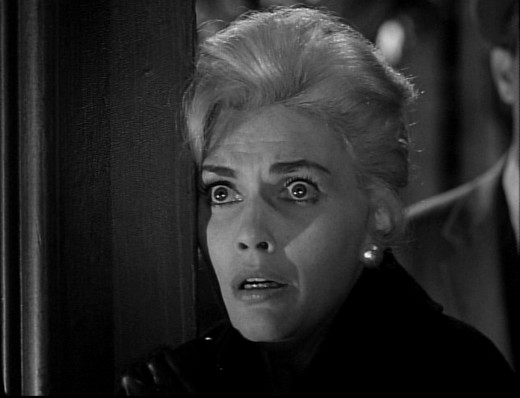
Similarly, Elizabeth Allen is not much more than an attractive accessory (and possible red herring) until the climax, when she gets to show how convincingly horrified she can be.

The other stars of the episode are director Herschel Daugherty and director of photography Bud Thackery, who do a great job of methodically hemming in the characters and steering them to their fates with dramatic tight shots and growing shadows and darkness.

And then there’s Jerry Goldsmith, whose score effectively employs violins that serve at various key moments as a somber, moaning Greek chorus.

With “The Grim Reaper,” the Thriller series was at the top of its game, employing some of its very best talents to deliver one of the most chilling TV episodes of the era.

Screenshot - Elizabeth Allen in "The Grim Reaper," Thriller TV series, 1961
Dorothy is horrified by her employer's decorating tastes.

Where to find it: Streaming

Bonus mini-review: “The Hungry Glass,” first broadcast January 3, 1961

The first Thriller episode guest-starring William Shatner has several things in common with “The Grim Reaper”: It too features a haunted object (or in this case, objects); Robert Bloch had a hand in the writing (providing the story for Douglas Heyes to adapt); and Elizabeth Allen -- Dorothy in “The Grim Reaper” -- guest stars as well.

Shatner plays Gil Thrasher, a professional photographer who with his wife Marcia (Joanna Heyes), has quit the rat race of the big city and bought an old house on the New England coast. In typical ghost story fashion, the grizzled locals at the general store cryptically warn the couple of the place’s malignant reputation.

The gregarious real estate agent who sold the place to the Thrashers, Adam Talmadge (Russell Johnson) tells the couple of the house’s original resident, a young girl who had become addicted to looking at herself in the mirror. After a lifetime spent admiring her reflection, a nephew finally intervened and locked her away without her precious mirrors, where she died a raging madwoman. Since then, people have come to bad ends at the house in encounters with mirrors and glass. As a consequence, all the mirrors have been removed.

On cue, Gil sees a mysterious apparition in a window. The mystery deepens when Gil discovers an eerie, phantom-like face of a little girl in one of the photographs he took of the house. Gil and Marcia soon discover a secret room off of the attic in which all the missing mirrors are stored. When Talmadge and his wife Liz (Elizabeth Allen) join the Thrashers for a house-warming party on a dark and stormy night, you know all hell is going to break loose.

Screenshot - scene from "The Hungry Glass," Thriller TV series, 1961
Marcia takes a moment to reflect on the wisdom of buying a creepy haunted house.

Like “The Grim Reaper,” “The Hungry Glass” focuses on a handful of people grappling with a malignant supernatural force in an old dark house. There is a striking prologue featuring the reflection of a beautiful young girl in 19th century formal dress prancing and preening in a succession of ornate mirrors. The scene turns nightmarish when the camera pulls back to reveal that the source of the reflection is a hideous old crone.

The mirrors make another remarkable appearance mid-way through the episode, when the secret room is discovered. A shot of Marcia’s multiple reflections in dozens of old mirrors is both dazzling and ominous.

“The Hungry Glass” is one of a number of ghost stories that effectively plays on the uncanny nature of mirrors, especially in creepy old houses, and our ability to imagine dark forces that lurk behind the glass.

Where to find it: Streaming