Showing posts with label Donald Pleasence. Show all posts

May 2, 2025

Dr. Kildare takes up a sword: The Count of Monte-Cristo

Poster - The Count of Monte-Cristo (TV movie, 1975)
Now Playing:
The Count of Monte-Cristo (1975)


Pros: Intriguing cast of familiar ‘70s faces headed up by Richard Chamberlain; Kate Nelligan makes the most of her feature film debut; Looks opulent for a TV movie
Cons: Tony Curtis seems to be phoning it in; A few clunker lines roll less than lyrically off the tongues of the actors

When I learned of the Adventure-a-thon hosted by Gill at Realweegiemidget Reviews and Barry at Cinematic Catharsis, I knew I wanted to get in on the action (and adventure) of their new blogathon, but couldn’t make up my mind about a title.

Then came the news of Richard Chamberlain’s passing, and I knew immediately that I wanted to pay tribute to this versatile actor who in the course of his prolific career starred in quite a few rousing adventure movies.

I remember occasionally sitting down with the family to watch broadcasts of Dr. Kildare, which was Chamberlain’s first recurring TV role (and which, along with Ben Casey, set impossibly high standards for the healthcare industry, with glamorous doctors who would do anything and everything for their suffering patients).

Who knew that a little over a decade later, Chamberlain would turn in his stethoscope for a rapier sword in Richard Lester’s The Three Musketeers (1973), and thereafter become one of the great action-adventure heroes?

With his breakout success as Aramis in the Lester film, Chamberlain swashbuckled his way through three more Alexandre Dumas adaptations in the '70s: The Four Musketeers: Milady’s Revenge (1974), The Count of Monte-Cristo (1975) and The Man in the Iron Mask (1977). (Please note: I'm going with the spelling of 'Monte-Cristo' according to the 1975 movie poster and the IMDb page.)

But the man’s action-adventure career didn’t end there. Starting in the late ‘70s, Chamberlain appeared in several high profile mini-series, including Centennial (1978-79), James Clavell’s Shogun (1980) and The Thorn Birds (1983), garnering prime-time Emmy nominations for the last two.

Screenshot - Richard Chamberlain as Aramis in The Three Musketeers (1973)
Dr. Kildare is ready to operate!

More screen action followed in the ‘80s when he was tapped to play H. Rider Haggard's adventure hero Allan Quatermain in King Solomon’s Mines (1985) and Allan Quatermain and the Lost City of Gold (1986) -- a clear attempt to capitalize on the huge popularity of the Indiana Jones franchise.

The Alexandre Dumas adaptations were a big part of Chamberlain’s '70s workload. Sandwiched between his roles as Musketeer Aramis and the Man in the Iron Mask, Chamberlain’s turn as The Count of Monte-Cristo allowed him to travel thespically from the depths of despair to the heights of hubris and self-righteousness (not to mention, he absolutely rocks a 19th century Silver Fox look).

For those needing a refresher on The Count of Monte-Cristo (I confess I was hazy on the plot until watching this adaptation), it’s a classic story of betrayal and revenge. Chamberlain plays Edmond Dantes, first mate of a ship whose captain dies enroute back to Marseilles, but not before entrusting a secret note obtained from Elba (where Napoleon is exiled) to Dantes.

Dantes is to deliver the sealed message to a M. Noirtier, who, unknown to the sailor, is a supporter of Napoleon. Upon the ship’s arrival in Marseilles, life is looking up for Dantes, who expects to be given a ship of his own, and to marry the beautiful Mercedes (Kate Nelligan in her first movie role).

Screenshot - Richard Chamberlain and Kate Nelligan in The Count of Monte-Cristo (1975)
The Fickle Finger of Fate is about to tap both of these young lovers.

But Dantes’ life is soon upended by two secretive and jealous rivals: Mercedes’ cousin Fernand Mondego (Tony Curtis) covets Mercedes for himself, and a fellow merchant sailor, Danglars (Donald Pleasence), is jealous of Dantes’ rapid ascension to captaincy. The pair, in the company of another disgruntled sailor, write an anonymous note to Marseille’s crown prosecutor, De Villefort (Louis Jourdan), accusing Dantes of being a Bonapartist.

The day before Dantes is to be wed, De Villefort arrests him and demands the secret note, still unopened (and its contents unknown to Dantes). De Villefort realizes that the conspiratorial message is addressed to his own father, M. Nortier De Villefort, and in the current political climate he will be toast if word gets out that his father is a Bonapartist.

Screenshot - The three conspirators write their letter in The Count of Monte-Cristo (1975)
"Alexa, how do you spell 'Bonapartist'?"

De Villefort glibly assures Dantes that he is completely innocent and will only be detained overnight for administrative purposes. However, to Dantes’ dismay, he soons finds himself on a boat to the dreaded island prison of Chateau D’If, to be locked up and forgotten.

Years later, an emaciated, hairy and bedraggled Dantes, pacing his dank cell and almost beyond the point of no return with regard to his sanity, is startled when he hears a weird scraping noise, and is confounded to discover that another prisoner, Abbe Faria (Trevor Howard), has dug a tunnel straight into Dantes’ cell.

Faria, an irrepressible polymath, has spent years upon years tunneling to what he hoped was the prison’s seawall, but due to a miscalculation, has ended up at his fellow prisoner’s cell. Trevor Howard, a tough, grizzled character actor and mainstay of action adventure pictures and dramas after notable roles in Brief Encounter and The Third Man in the '40s, is nearly unrecognizable under all the hair and grime. But his appearance is a highlight of the film.

Screenshot - Trevor Howard and Richard Chamberlain in The Count of Monte-Cristo (1975)
"Hey Abbe, have you got a match?"
"Yeah, your face and a donkey's behind!"

While Dantes was spending years pacing his cell, Faria was forging digging tools from bits of metal, devising an ingenious sundial on the wall of his cell, tracking the movements of the stars and planets, and contemplating questions in philosophy and theology. He hasn’t let the years of solitary confinement dull his senses -- quite the opposite. Faria is quick to note the irony of their situations: he was imprisoned because of his opposition to Napoleon, and Dantes because of his supposed support.

In addition to sanity-saving companionship, Faria imparts three invaluable gifts to Dantes: the application of cui bono? reasoning to figure out who was responsible for Dantes’ imprisonment, a map to unimaginable treasure located on the island of Monte Cristo, and, upon expiring from old age, an opportunity for Dantes to escape from Chateau D’If.

As the guards prepare to remove Faria in a body bag, Dantes takes advantage of a momentary distraction to drag his friend’s body into the tunnel and wrap himself up in the bag, which is hastily thrown into the ocean.

With the treasure map in hand, Dantes embarks on the next phase of his life -- one of fabulous wealth, which fuels a mission of revenge.

Screenshot - Dantes (Richard Chamberlain) finds the treasure in The Count of Monte-Cristo (1975)
All that glitters is not gold -- precious stones and pearls do that too.

The Count of Monte-Cristo makes a grand entrance as he emerges from shadowy antechambers for his introduction to French high society. Unlimited wealth goes a long way in cleaning up a hairy, louse-ridden political prisoner, his all-white hair carefully coiffed, offsetting his trim dark beard and elegant black ensemble.

Over the years of his imprisonment, Dantes’ betrayers have risen high, representing diverse pillars of French society: Danglars is a wealthy banker, Mondego a pompous military man and presumptive war hero who has had a son with Mercedes (now grown into a young man), and De Villefort is as powerful as ever as the royal prosecutor.

Dantes masterfully exploits each man’s darkest secrets and character weaknesses in bringing them down. He lures Danglars into a risky investment in Spanish bonds, then bankrupts the greedy banker by feeding him bad insider information. Next is De Villefort, who gets his comeuppance when he prosecutes Andrea Benedetto (Carlo Puri), a confederate of the Count’s, for the death of Caderousse (another of the conspirators against Dantes, played by Alessio Orano). In court, Benedetto reveals nasty secrets about Villefort that lead to his ruination in full view of the shocked spectators.

Screenshot - Richard Chamberlain as The Count of Monte-Cristo (1975) makes his first appearance.
If looks could kill, Dantes' enemies would be nothing but ash heaps.

Finally, Dantes buys a prominent newspaper, which he uses to expose Mondego’s sordid past -- the officer had betrayed and murdered an ally, Ali Pasha, stolen his fortune and sold his daughter into slavery. When Dantes shows up at the military inquiry into Mondego, the two antagonists quickly end up crossing swords, with the stiff-necked members of the military court shouting at them to desist, to no avail. (Up to this point the Count had been a behind-the-scenes manipulator. At least this climactic duel afforded Chamberlain the opportunity to show off more of the skilled swordsmanship he demonstrated in the Richard Lester films.)

Dante’s three main antagonists distinguish this version of Dumas’ tale. For a man who looked like a nondescript accountant, Donald Pleasence got very good at playing villains, often ones who hid their evil under a mask of ordinariness. Nearly a decade before Monte-Cristo, he gained huge exposure playing the very extraordinary Bond villain Blofeld in You Only Live Twice (1967). Not long after Monte-Cristo, Pleasence got a career boost as Dr. Loomis, psychiatrist and monster-hunter, in the original Halloween (1978), and would follow that up with four more appearances in the subsequent popular franchise.

His character Danglars combines an almost nauseating unctuousness with a quiet ruthlessness in pursuing profit (a good combination for success in our times as well as Dumas’). However, Danglar’s willingness to blindly follow the investment advice of his perceived superior, the Count, proves his fatal undoing.

Screenshot - Donald Pleasance as Baron Danglars in The Count of Monte-Cristo (1975)
Danglars likes the finer things in life, but it's all about to go bust.

The Count faces another Bond villain, Louis Jourdan, as the royal prosecutor De Villefort (although Jourdan’s turn as Roger Moore’s nemesis in Octopussy was a few years down the road). Jourdan was the epitome of suaveness and courtliness, always adding an element of class to whatever he was in. He was especially effective as a villain, distracting his marks with old-world charm and sophistication even as he was plotting his heinous acts. (As such, he turns in a great performance as the titular character in the almost forgotten TV movie Count Dracula from 1977.)

True to form, Jourdan’s De Villefort is all smiles and silken reassurances that Dantes will only have to spend a night in custody -- all a formality of course -- even as he is arranging to have the unwitting Dantes carted off to spend the rest of his life in a dank dungeon.

In the courtroom scene, De Villefort is full of arrogant self-assurance as he walks into the Count’s trap. As the tables quickly turn and his dark secrets are revealed, the man's breakdown in full public view is all the more spectacular for his former smug confidence.

Screenshot - Louis Jourdan as De Villefort in the climactic courtroom scene of The Count of Monte-Cristo (1975)
"Why I oughta....!!!"

Tony Curtis as Mondego is, well, Tony Curtis. The only clue to the passage of time when Mondego meets up with Dantes as the Count is a dramatic streak of white in his hair. Curtis’ natural boyish charm (even in middle age) is on full display here, which highlights his character’s self-satisfaction -- after all, Mondego is a decorated war hero with a beautiful wife and handsome, strapping son. But the Count soon wipes the smirk off his face, as well as wiping up the floor with him in the climactic sword fight.

Feature film newcomer Kate Nelligan as Mercedes has a lesser role, but makes the most her great dramatic moment, when, realizing the real identity of the Count, she appeals to whatever humanity Dantes has left after her son, trying to uphold the dignity of the Mondego family, challenges him to a duel. Before the decade was out, Nelligan would secure the role of Lucy Westenra in the bodice-ripping, heart-throbbing Frank Langella version of Dracula (1979).

Screenshot - Climactic sword fight between Dantes and Montego in The Count of Monte-Cristo (1975)
"My name is Inigo Montoya. You killed my father. Prepare to die." Oops, wrong movie!

Chamberlain is impressive as the Count, wearing his cool, impassive mask over Dante’s seething thirst for revenge. He even manages ripe lines like “I shall move like the Sword of the Lord with a terrible swiftness,” without venturing into unintentional comedy. He’s at his absolute best in the late scenes with his lost love Mercedes, as it dawns on him that for all his wealth he’s still broken, and revenge has not made him whole:

Dantes: "That was simple justice, madam, and believe me it brought me no joy. But now my task's accomplished. I've no particular place in the world, no strong desire in life... but to make amends where I've hurt the innocent."
Mercedes: "Avenging angels may not ask forgiveness of their victims."
Screenshot - Kate Nelligan and Richard Chamberlain in The Count of Monte-Cristo (1975)
Mercedes mourns the soul-death of her dear Edmond.

This version of Dumas’ tale, produced by the UK’s ITC Entertainment, was originally envisioned as a mini-series, but ultimately it was sold to NBC as a TV movie (although it did see theatrical release in parts of Europe). As in any adaptation, some characters and scenes from the novel don’t make it to the screen, and others are given short shrift. Some details are altered, e.g., the fates of Danglars and Mondego are switched. [Wikipedia] And, the sword fight between Dantes and Mondego at the climax is not in the novel -- but it was a good call to add it.

Like its namesake sandwich the Monte Cristo, the 1975 movie serves up generous portions of acting ham and cheesy dialog, but it’s so well made and sumptuous-looking, and the veteran cast so endearing, that, even with all the other adaptations floating around out there, it’s worth gobbling up, er, looking up.

Public domain image - Wikimedia Commons - Monte Cristo sandwich
Much like the sandwich, The Count of Monte-Cristo is a sumptuous feast for the eyes with a gooey, cheesy center.

Where to find it: Streaming 1 | Streaming 2

October 28, 2022

Who's minding the asylum?: Alone in the Dark

Poster - Alone in the Dark, 1982
Now Playing:
Alone in the Dark (1982)


Pros: Great cast led by Donald Pleasence, Jack Palance and Martin Landau; Good building of tension; Lots of sly black humor
Cons: Casting two familiar actors in the maniac roles somewhat undermines the characters’ menace

Even though the end of October is my busiest time during my favorite season, when I saw that fellow bloggers Gill from Realweegiemidget Reviews and Barry from Cinematic Catharsis were hosting a Donald Pleasence blogathon, I couldn’t turn down the opportunity.

I first encountered Mr. Pleasence when my parents took me to see The Great Escape at the fancy cinema in the big city. In this great WWII epic set in a German prisoner of war camp, Pleasence plays Blythe, an unassuming little man that no one would look twice at -- except that he is a master forger, and the men planning their escape from the camp need his help creating ID papers. Ironically, he was very prepared for the role. During the war Pleasence was a crew member on an RAF bomber that was shot down over France, and he spent time in just such a camp.

For my next encounter, I stood in a long line at the local downtown theater to see You Only Live Twice (naturally, this was before the era of multiplexes). Pleasence’s turn as the Bond super villain Blofeld is memorable. Blofeld, his face hidden behind a screen, strokes his beautiful Persian cat as he orders his minions around in a quest for world domination. Later on, the reveal of his scarred face is worthy of a horror film, and You Only Live Twice immediately became my new favorite movie (not that I needed any excuse to like James Bond movies at that age).

Somehow, this diminutive, soft-spoken, professorial-looking man could play the most endearing, gentle person in one film and then make your blood run cold the next. Speaking of blood running cold, while Pleasence was by no means a horror specialist, he made his fair share of horror films, enough for at least a couple of Halloween film festivals.

Donald Pleasence as Blofeld in You Only Live Twice, 1967
Blofeld suddenly realized that in his haste
to blackmail world leaders, he forgot
to pick up more kitty litter.

One of his earliest and best horror roles was as the slimy Mr. Hare in The Flesh and the Fiends (1960), the creepiest retelling of the infamous Burke and Hare story that you’ve never heard of (see my review here). In the early ‘60s, guest shots on such spooky TV series as One Step Beyond, The Twilight Zone and The Outer Limits indicated his potential for creepy roles.

By the early ‘70s, the horror roles became more numerous. Pleasence played an inspector in the claustrophobic cult horror Death Line (aka Raw Meat, 1972), then a mad doctor in The Freakmakers (aka The Mutations, 1974). Along the way were memorable appearances in the anthology fright fests Tales that Witness Madness (1973) and From Beyond the Grave (1974). Whether he was playing good guys or villains, he always lent an aura of class to these low-budget films.

Pleasence is perhaps best remembered for his role as Dr. Loomis, Michael Myer’s attending psychiatrist and grim adversary in the Halloween film franchise. Although horror movies traditionally have portrayed psychiatrists as hopelessly naĂŻve and easily duped by the depraved psychopaths they’re treating, Loomis is famously clear-eyed and adamant in the original Halloween: “I spent eight years trying to reach him, and then another seven trying to keep him locked up, because I realized that what was living behind that boy's eyes was purely and simply... evil.”

A few years after uttering that severe judgment, Pleasence would play yet another psychiatrist in a horror film, only this time his character, Dr. Leo Bain, would be the complete opposite of Loomis -- idealistic and naĂŻve to a deadly fault.

Like many slasher films, Alone in the Dark (1982) operates in a Dirty Harry kind of world where do-gooders who believe criminals can be reformed and lunatics can be cured (or at least controlled) are setting themselves up to be lambs to the slaughter.

The slaughterers in this case are a quartet of psychos who occupy the third floor of an institution run by Dr. Bain. Bain doesn’t like the loaded term “asylum,” preferring to call his institution “The Haven.”

Donald Pleasence as Dr. Bain in Alone in the Dark, 1982
The New Age psychiatrist in his natural habitat.

Bain’s Haven is home to all kinds of crazies, er, um ill people, but the boys on the third floor are psychopaths with a history of murder and mayhem. “Fatty” Elster (Erland van Lidth) is an obese child molester. John “The Bleeder” Skaggs (Phillip Clark), who doesn’t like to show his face, is a strangler who gets severe nosebleeds when he kills. Byron “Preacher” Sutcliff (Martin Landau) is a former minister who believes he’s on a mission from God, and has a tendency to burn down churches with people inside them. The leader of the group, Hawkes (Jack Palance), is a grizzled war veteran with a severe case of homicidal post-traumatic stress disorder.

As Bain is giving a tour to his newest staff doctor, Dan Potter (Dwight Schultz), he explains that the state authorities were at first nervous about Bain keeping these dangerous inmates, but let it go when he installed electric sensor-operated steel shutters that allow the men to roam the floor, but are activated if they try to leave their confines. Later, the third floor orderly Ray Curtis (Brent Jennings) confides to Potter that all that separates him (and the outside world) from these men is electricity. He also warns the new doctor that Hawkes is convinced that Potter killed his predecessor, Dr. Merton, who left The Haven to take another position.

Potter brushes off Curtis’ warning about Hawkes, chalking it up to a typical inmate’s delusion. But, unlike the smugly confident Dr. Potter, we know just where this is heading -- the power is going to go off, the third floor inmates will escape, and there will be hell to pay.

Jack Palance as Col. Hawkes in Alone in the Dark, 1982
"DR. POTTER!! ... Happy...trails..."

Coming out in 1982, Alone in the Dark rode the wave of slasher films that followed in the wake of the surprise hits Halloween (1978) and Friday the 13th (1980). Slashers seemed like a natural fit for a Zeitgeist molded by Vietnam, Watergate, oil shortages, stagflation and rising crime, where trust in authorities and a society that could keep us safe and secure was at an all-time low. Slasher films taught us that no place was safe, not small towns, big cities, summer camps, sorority houses… zip, zero, zilch. Even Reagan’s “Morning in America” couldn’t tamp down these exceedingly dark films.

Alone in the Dark is a classic artifact of its time, and a relentless indictment of it: authorities are incompetent and clueless, and society is just one power blackout away from savage chaos.

Exhibit #1 in the list of indictments is Dr. Bain. Bain is the ultimate touchy-feely, new-agey intellectual who doesn’t seem to be living on the same planet as the rest of humanity. He tells Potter that the Haven’s inmates aren’t patients, but rather “voyagers taking a journey into the innermost reaches of the psyche.”

Bain values the voyagers’ welfare to the point that he is oblivious to the dangers they pose to the outside world. He indulges the firebug “Preacher” by giving him matches, which the man promptly uses to light his coat on fire and swing it wildly around.

Later, after Hawkes & crew have made their escape and are racking up a body count, Bain frets that the men are “still disturbed by their escape,” and their violence is “a cry of pain.” In another bit of black humor, Bain tries to phone Potter’s home, but the line has been cut. He argues with the operator, who can’t convince him the line is out. When she ends the call with a sarcastic remark, Bain mutters to himself “Now she’s got a serious problem!” In playing the part absolutely straight, Pleasence manages to elicit a bit of sympathy for a character that is otherwise dangerously out-of-touch.

More deserving of sympathy is Dr. Potter, whose decision to take a new job at the Haven turns out to be the worst of his life. Moving your family to a new place is hard enough without the homicidal inmates at your new workplace deciding that you’ve killed their beloved doctor, and then being set free by a freak power blackout to stalk you and your loved ones.

Bain and Potter on the grounds of The Haven, Alone in the Dark, 1982
Bain and Potter discuss the wisdom of giving matches to pyromaniacs.

Even before that particular sh*t hits the fan, Potter is stressed after his tour of the facilities and observance of Dr. Bain’s decidedly unique methods for handling the residents. His wife Nell (Deborah Hedwall) is skeptical, flippantly asking “Why can’t you just get an office and treat neurotics like a normal person?”

To add insult to injury, Potter's neurotic, needy sister Toni (Lee Taylor-Allen) is visiting for the week, and, dressed in a punk outfit and pink hair, she insists on dragging her brother and sister-in-law to a punk rock concert headlined by The Sick F*cks (a real band, it turns out). The only member of the family who seems unaffected by all the turmoil is the Potter’s young daughter Lyla (Elizabeth Ward), who calls her parents by their first names and has the grating self-confidence of a precocious pre-teen.

It’s while the group is at the concert that the power goes out. Potter is grateful for the reprieve from the musical stylings of the Sick F*cks, but little does he know that the outage has set in motion a chain of events that will end up with he and his family holed up in their house, trying to dodge crossbow arrows and hunting knife blades wielded by another band of truly sick f*cks.

Living in our current age of anxiety, it’s easy to forget that there have been other periods when popular opinion held that we were well and truly screwed. In addition to Dr. Bain’s questionable authority -- it’s tempting to think that he’s not a real doctor, but one of the inmates running the asylum -- Alone in the Dark depicts a world that is ready to crumble into chaos at a moment’s notice.

The blackout turns the quiet little town into a seething mass of rioters and looters. When Hawkes and his band arrive in town in their stolen car, they’re completely in their element. Hawkes looks around at the cars on fire and the broken store windows and beams with satisfaction, like a victorious general surveying the battlefield. As the inmates join a crowd of looters at the sporting goods store and help themselves to all kinds of knives and weapons, they’re barely noticed in all the confusion.

The maniacs loot the local sporting goods store, Alone in the Dark, 1982
The boys help themselves to sale items at the local sporting goods store.

It’s probably no coincidence that the two most colorful Haven escapees are an ex-military man and an ex-preacher. Along with Bain representing medical science, Hawkes and Sutcliff are highly dubious representatives of their respective institutions. Alone in the Dark suggests that not only are the inmates running the asylum, they’re threatening to run the whole world.

But Bain, Hawkes and Sutcliff aren’t the film’s only digs at contemporary society. At one point, as the Potters are trying to deal with the consequences of the blackout, an announcer on the radio playing in the background reads a press release from the local nuclear power station denying any responsibility for the power outage (corporate speak for “we’re as guilty as hell, but just try to prove it!”). That's Toni's cue to be “helpful” once again and drag sister-in-law Nell to a huge protest at the plant.

She only manages to get Nell and herself jailed for disturbing the peace. And through parental miscommunication, Lyla is home alone. Uh-oh!

Alone in the Dark does a masterful job of ratcheting up the tension, slowly at first, with the “something’s not quite right here” tour of The Haven, to the maniacs casing the Potter’s home (the Preacher pretends to be a telegram messenger, and Fatty poses as Lyla’s babysitter), to the all-out assault on the family at the climax.

Martin Landau, Erland van Lidth and Jack Palance in Alone in the Dark, 1982
The boys enjoy a ride around town.

Along the way, in addition to the sly commentary, it also has fun with slasher tropes (or should I say, plot elements that were soon to become tropes in the ‘80s). There’s the classic clueless babysitter who, after making sure the kid is asleep, invites her boyfriend over to fool around. The writers set up a clever bit of misdirection when she hears strange sounds, and insists that the boyfriend check out the bedroom closet.

The stellar, high-profile cast, especially Jack Palance and Martin Landau, is the film’s biggest asset and at the same time its biggest weakness. Palance, no matter the role, always looked like he was ready to explode at any moment, and is a perfect fit for the hand-grenade-without-a-pin that is Hawkes. And when Landau breaks into his wide-eyed, evil-Joker smile, he sends chills up the spine.

But the atmosphere of dread that Alone in the Dark takes pains to cultivate is undercut by making the characters a little too familiar, what with their background stories and recognizable faces. By contrast, the unseen killer in the original Friday the 13th is a complete surprise at the end, and Halloween’s Michael Myers is an evil enigma, a “shape” behind a rubber mask.

This was not the only horror film Palance and Landau would make together. A couple of years earlier, the two appeared in Without Warning (1980), a low-budget sci-fi/horror film featuring a Predator-like alien hunting humans in the woods.

Martin Landau puts on his best maniacal smiley face in Alone in the Dark, 1982
"Heeeerrrrrrrrrrre's Byron!"

Both would go on to score dark horse supporting actor Oscar wins, Palance for City Slickers (1991) and Martin Landau for Ed Wood (1994). And of course, Donald Pleasence would become a fixture as Loomis in one of the most successful horror film franchises of all time.

Alone in the Dark was writer-director Jack Sholder’s first feature, and it’s quite a debut. In the next few years he made two more minor cult favorites, A Nightmare on Elm Street 2: Freddy’s Revenge (1985) and The Hidden (1987), then settled into directing TV movies and episodes.

When I found out about the blogathon and was perusing Donald Pleasence’s IMDb resume for a good Halloween choice (excluding the Halloween movies, which others have written about extensively), Alone in the Dark jumped out at me because I had no recollection of ever seeing it or even reading about it. I’m not a big fan of slasher movies, but I’m at least aware of the classics and some of the also-rans in the genre, so stumbling across an unknown (to me) horror film starring not only Donald, but Jack and Martin as well was a Pleasence surprise (sorry, I couldn't help myself).

Usually in these cases, the reason I’ve never heard of a film is because it’s so bad even bad movie lovers have steered clear over the years. Since Alone in the Dark is very good, it remains a mystery how it evaded my attention all this time. Thanks to Gill and Barry and their Devilishly Delightful Donald Pleasence blogathon for indirectly steering me to this great find!

The Potters react with horror as the maniacs surround the house - Alone in the Dark, 1982
Alone in the Dark is a good reminder that it pays to be prepared for emergencies
like power blackouts and/or homicidal maniacs invading your home.

Where to find it: DVD/Blu-ray | Streaming

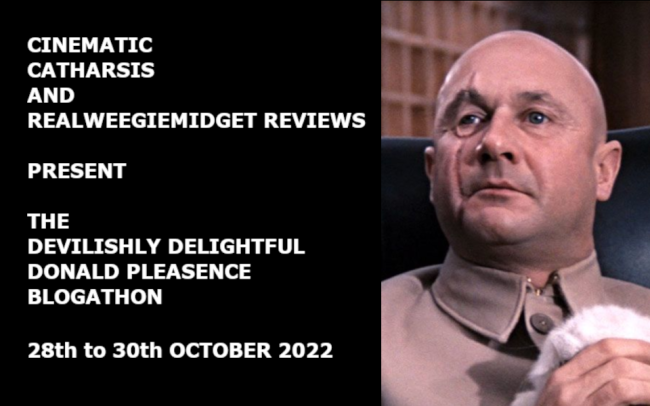
The Devilishly Delightful Donald Pleasence Blogathon

April 23, 2022

Will the real monster please stand up? The Flesh and the Fiends

Now Playing:
The Flesh and the Fiends (1960)


Pros: Atmospheric direction and cinematography; Masterful acting
Cons: A false note somewhat spoils the ending

The Flesh and the Fiends tells the grim but true tale of two Irish immigrants living in early 19th century Edinburgh, Scotland who discover that there’s good money to be had supplying the local medical academy with cadavers, but can’t be bothered to dig up the bodies from graveyards like other body snatchers. So they decide to hurry up the dying process in still-breathing neighbors in order to get top dollar (make that guineas) for the freshest possible corpses.

After watching the movie, I Googled to see if cadavers are still being used in medical schools (although I’m visiting the doctor more often as I get older, I’m not exactly well-informed on current medical science ). Surely in 2022, with access to the kind of computing power and virtual reality programs that we have, there’s no more need for actual cadavers?

Well, yes and no (and don’t call me Shirley). According to an article published by the Advisory Board (an organization that provides research and insights to the healthcare industry), the use of cadavers in medical education has been going on for nearly a thousand years. They’re still being used today, but the cost of acquiring, maintaining and ultimately burying donated or unclaimed bodies is becoming prohibitive, and like many things these days, there’s a shortage.

Many schools are switching to virtual reality, which gives students “a more realistic view of living organs,” and allows them to examine the organs from every angle. On the downside, “it can be difficult to develop a depth perception of a virtual body, and students [aren’t] able to see the natural anatomical variations that occur in bodies.” Nevertheless, the article quotes one expert as predicting that cadaver use will be history within ten years. [“Will cadavers in medical schools soon be a thing of the past?” Advisory Board website, https://www.advisory.com/daily-briefing/2019/10/03/cadavers, Oct. 3, 2019]

Back in 1820s Edinburgh where The Flesh and the Fiends is set, the nearest thing to virtual reality was the Magic Lantern, an early forerunner of the slide projector. Anatomy lessons were conducted with real-dead corpses, a lot of them not-so-fresh, and the less said about how they were obtained, the better.

Vintage Visible Man model kit
If only they'd had The Visible Man back then...

The murderous William Burke and William Hare were well-placed to take advantage of a situation in which the medical sciences were beginning to flourish, but resources like fresh cadavers for the training of doctors were in short supply.

The Flesh and the Fiends is faithful to the main facts of the notorious case (and even to some small details). It was a sort of passion project for John Gilling, who provided the story, co-wrote the screenplay and directed. In the late ‘40s, Gilling wrote the screenplay for The Greed of William Hart (aka Horror Maniacs: 1948), based on Burke and Hare and played for maximum melodrama by lead actor Tod Slaughter.

Censors at the time wouldn’t allow the guilty parties' names to be used, but for some reason did allow a couple of their victims their real names. By 1960, Gilling was able to use the names of all the principal historical figures, but Burke and Hare still couldn’t appear in the film’s title.

While The Greed of William Hart was a melodramatic vehicle for a corny old stage actor and movie villain, Gilling turned the remake into a dark examination of British working class ghettos and rigid class differences in an age that was also characterized by rapid industrialization and progress in the sciences.

One of the stars of the era’s scientific progress was Dr. Robert Knox, who by the time of the Burke and Hare murders was an esteemed member of the Royal Society of Edinburgh who had helped set up a major school of anatomy at the College of Surgeons. He was famous for his frequent and lively lectures and dissection demonstrations.

Peter Cushing as Dr. Knox lecturing in The Flesh and the Fiends, 1960
Dr. Knox (Peter Cushing) and his assistant "Bones" McCoy lecture
to a rapt audience of medical students.

But the supply of cadavers for his demonstrations was never a sure thing. The law at the time stipulated that only the bodies of those who had died in prison, committed suicide, or were orphans (and presumably dead) could legally be used for such purposes. With such limitations, demand outstripped supply, so Knox and his fellow anatomists turned to body snatchers, also known as resurrection men (or resurrectionists), who took advantage of a loophole in the law: although disturbing a grave or stealing from a body were illegal, actually making off with the body itself was not a crime, since the dead don’t belong to anyone. (Huh.)

The times being what they were, with good, living wages rarer than hen’s teeth, body snatchers nonetheless dug up many a fresh grave, the law be damned. And of course, Dr. Knox and many of his colleagues turned a blind eye to the means by which cadavers ended up on their dissection tables.

Speaking of blind eyes, one of the details of the historical case that The Flesh and the Fiends pays particular attention to is the scarred left eye of Dr. Knox. The real Knox had contracted smallpox as an infant, resulting in a damaged eye and facial scarring. Beyond the obvious symbolism of turning a literal blind eye to what was going on, the disfigurement, which affects only half of the doctor’s face, also reinforces the doctor’s dual, “two-faced” nature; on the one hand, passionately wanting to advance the cause of medical science presumably for the good of all, but at the same time not seeming to care if members of the “lower classes” get hurt in the process.

The Flesh and the Fiend’s Dr. Knox is portrayed by Peter Cushing, who was fresh off of starring roles in Hammer’s game-changing technicolor Gothic horrors The Curse of Frankenstein (1957), Horror of Dracula (1958), and Revenge of Frankenstein (1958). Cushing must have felt a blast of deja vu: with Knox’s tunnel-visioned passion for science, proclivity for cutting up bodies, and blithe indifference to the human costs of his work, the esteemed doctor is a close cousin to Baron Frankenstein.

The similarities between Knox and Dr. “Stein” in The Revenge of Frankenstein are particularly striking. Both are brilliant and charismatic. Knox’s lectures are standing-room only, where the students hang on his every word. Frankenstein, who has reinvented himself as Dr. Stein, is one of his adopted town’s leading citizens, operating a clinic for the poor while simultaneously entertaining the town’s upper crust matrons, who practically swoon over the handsome, urbane doctor.

Both doctors are envied and resented by their parochial colleagues, and in turn, both are openly contemptuous of the small-minded mediocrities who are afraid of change and unwilling to pay the price of progress.

Dr. Knox (Peter Cushing) discusses the merits of body-snatching with his colleages, The Flesh and the Fiends, 1960
Dr. Knox schools his unimaginative colleagues on the costs of scientific progress.

If anything, Knox is more aggressively dismissive of prevailing morality than Revenge’s Frankenstein. In an early scene, Knox defends the practice of body snatching in a debate with a a group of his staid colleagues, including a minister:

Knox: “I tell you gentleman, medicine is being driven underground. The law yields to us the body of a criminal when he is caught and hanged. [W]e have to wait a very long time for justice to unravel itself. Meanwhile, the resurrectionist plies a very useful trade.”
Minister: “I agree you doctors need bodies for dissection, but to condone the violation of graves by these ghouls…”
Knox: “I neither condone or condemn… I accept. Is the feeding of worms more sacred than the pursuit of truth?”

Cushing himself remarked on the similarity of the two characters: “Now it seemed to me that Knox and 'Frankenstein' had a lot in common. The minds of these exceptional men were driven by a single desire: to inquire into the unknown. Ahead of their time, like most great scientists, their work and motives were misunderstood." [Christopher Gullo, In All Sincerity, Peter Cushing, Xlibris, 2016, p. 139]

While The Flesh and the Fiends was not a Hammer production (more on that later), the distributors were not above exploiting Cushing’s new status as a Hammer horror icon and putative monster. In a couple of the film’s posters, Cushing’s/Knox’s face with its deformed left-eye completely dominates the other images. In one (illustrated at the top of the page), his good eye is voyeuristically turned toward an inset image of a woman in working-class attire who is either being menaced or helped -- it’s not clear which -- by a wealthy looking man dressed in a black. In another (below), the face stares menacingly out from the poster, as if sizing up the viewer for possible use on his dissection table.

Half-sheet poster - The Flesh and the Fiends, 1960

One could easily be excused for thinking that this is the face of a ghoul for whom (to paraphrase the movie’s tagline) murder is a business. In contrast, the real ghouls, Burke and Hare (played by George Rose and Donald Pleasence respectively), are scarily ordinary, and not given much prominence in the posters.

They start out the movie as a couple of work-averse layabouts with nothing more pressing to think about than the next meal. Burke has middle class pretensions -- he and his wife run a boarding house -- but he’s worried that the meager income may not be enough to stave off the need to do actual **GULP!** work. Hare seems to have no other occupation than to be attached at the hip to Burke, and to proudly sport the latest fashions from the 1820s equivalent of Goodwill.

When an elderly resident at Burke’s boarding house dies on him still owing rent, Hare comes up with the bright idea of selling the body to Knox, which they rationalize as a posthumous way for the old man to settle his debts. The payout is more than the debt, and pretty soon the lure of easy money spurs them to be more proactive and not wait for people to expire naturally.

The real horror is in the casualness with which they dispatch their meal tickets. After they smother a drunk old woman in one of the boarding rooms, Hare doffs his hat in mock mourning: “I’m sure the old girl’s better off. She had nowhere to go… it must be a terrible thing when you’re old…” Burke’s wife (Renee Houston) is no better, keeping watch while the men go about their evil business, and expressing more concern about the tidiness of her house than the murders being committed in it.

Peter Cushing, George Rose and Donald Pleasence in The Flesh and the Fiends, 1960
Knox can barely contain his revulsion at having to deal with Burke and Hare.

The section of Edinburgh in which they live is a rabbit-warren of dark, narrow alleyways and dingy tenements. As the men work their murderous trade, their surroundings become increasingly dark and gloomy, and the shadows the two cast seem like representations of their black souls. With each murder, Hare becomes more animated and boisterous, his eyes positively shining. He is a dancing imp at the side of the slow-witted, ponderous Burke, urging him on. It’s a great performance.

The only relief from the gloom and squalor on the poor side of town is the tavern, which is brightly lit and teeming with people desperately laughing, drinking and carousing. Knox sends his assistant, struggling medical student Chris Jackson (John Cairny), to the tavern to pay Burke and Hare the balance owed from one of their deliveries.

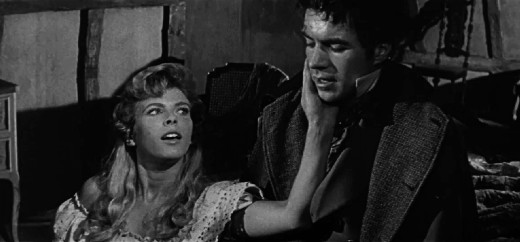
A proverbial fish out of water, Jackson gets himself beaten up trying to defend the honor of one of the tavern girls, beautiful Mary Patterson (Billie Whitelaw). The two are from completely different worlds. Jackson, who is despairing of ever finishing the medical program, finds solace in the arms of the alluring but coarse girl. Mary is flattered by the attention of a real gentleman, but deep down knows that there’s no chance for them.

In a heart-rending scene, Jackson takes Mary out for a stroll in the park, but to his dismay the two run into Knox’s colleague Dr. Geoffrey Mitchell (Dermot Walsh) and Knox’s niece Martha (June Laverick). Mary tries a little too hard to impress, and the smiles and cheer turn to slight frowns and embarrassed silence as class differences become painfully apparent. Back at Mary’s place, she vents her humiliation at Chris, who lamely professes that he is not ashamed of her. Mary is quickly mollified, and turns to what she knows best -- sex -- to smooth things over.

Billie Whitelaw and John Cairney in The Flesh and the Fiends, 1960
"I can teach you more than you'll learn at college..."

WARNING: SPOILERS AHEAD

There is no happy ending for the star-crossed lovers, and by film’s end they’ve paid a very steep price for not staying in their social lanes.

As the evidence mounts that Burke and Hare’s deliveries are a little too fresh, Knox maintains a poker face, only showing his humanity at the very end when it’s impossible to look the other way. It’s maddening from the perspective of a normal, caring human being, but very believable from the standpoint of an obsessed scientist who is all about his work, and Cushing plays it to perfection.

The climax of The Flesh and the Fiends is pure Universal Frankenstein, with torch-carrying townspeople hunting down the monsters through dark, twisting streets. The film’s major false note comes at the very end, when a contrite Knox, having escaped legal judgement and still wanting to pass on his expertise to the next generation of physicians, enters the lecture hall, thinking that it will be empty. Instead, he’s surprised to see it’s filled with appreciative students. Knox is so humbled and inspired, he begins his lecture with Hippocrate’s advice to physicians to “first, do no harm.” (The real Knox did not get off quite so easily. While it's true that in the immediate aftermath of the murders his classes were more popular than ever, his career nonetheless suffered and he was ultimately expelled from the Royal Society and his school was shut down.)

Ugh. Order has been restored, the class system is still firmly in place, and worst of all, an upper class monster is redeemed, while Edinburgh’s poor, when they aren’t murdering one another, are mostly portrayed as scheming, uncaring wretches or members of an unthinking mob. Still, there’s Mary, beautifully played by Billie Whitelaw, who upholds the dignity of the non-privileged classes. While certainly not perfect, she is smart and willing to sacrifice her own happiness and aspirations to try to save Chris Jackson from himself.

George Rose, Donald Pleasence and Billie Whitelaw in The Flesh and the Fiends, 1960
You do not want to attract the attention of these "gentlemen."

ALL CLEAR FOR SPOILERS

The Flesh and the Fiends rode the Gothic horror renaissance that Hammer jump-started with The Curse of Frankenstein and Horror of Dracula. It was produced by partners Monty Berman and Robert S. Baker, who kept busy in the late '50s making Blood of the Vampire (1958; see the review elsewhere on this site), The Trollenberg Terror (aka The Crawling Eye, 1958) and another horror film ripped from the pages of history, Jack the Ripper (1958). 

By 1960, Burke and Hare had inspired, along with The Greed of William Hart, Val Lewton's and Robert Wise’s The Body Snatcher (1945; based on a Robert Louis Stevenson short story that in turn was inspired by the actual events). Since then, two movies titled Burke and Hare have been made, one in 1972 and the other, with Simon Pegg, in 2010. The Doctor and the Devils with Timothy Dalton, Jonathan Pryce and Twiggy (!!) premiered in 1985.

With its skillful direction, atmospheric cinematography and masterful acting (especially Billie Whitelaw, Donald Pleasence and Peter Cushing), The Flesh and the Fiends may be the best of the lot, and it’s certainly one of the UK’s better contributions to Gothic horror cinema of the mid-20th century.

Where to find it: Streaming | DVD / Blu-ray