My apologies for the infrequent posts on the blog -- I'm still in the middle of what has turned out to be a marathon move, hunkering down in a short-term lease apartment while going through all the paper work (and work work) of securing a more permanent abode. The tiny light I see at the end of this tunnel may be the shining light of future happiness or the great express train of life, but either way I'd be grateful for a quick resolution.
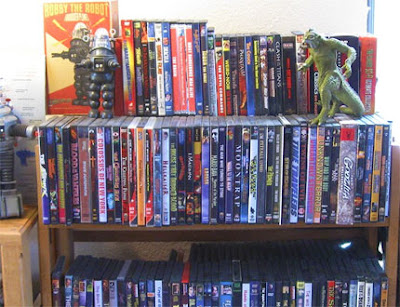 |
| "Hmmm... do I really want to pack up all that stuff and move it?" |
As I mentioned in an earlier post, packing up and moving all your Stuff (with a capital S) tends to focus the mind on priorities and what's really important in life. Lots and lots of stuff weighs down your body, your freedom, and your soul. After packing the umpteenth box with books and dvds, I've developed a much better appreciation for the great digital "anywhere, anytime, any device" revolution. Is it really the package -- the book, the disc -- that's important, or the content? Now, if only the content providers and the distributors could all just get along in a great, happy circle of cooperation and profit, while at the same time providing us needy consumers with reliable, stable, high speed access… what a wonderful world that would be! (On the other hand, as long as companies like Apple conspire with publishers to keep e-book prices high, and owners keep threatening to pull content from distributors like Netflix to wring that last penny out of their "intellectual" property, physical media will still be with us… and we'll continue to box it up and move it out.)
Another benefit of moving is that it motivates you to re-examine all those pesky entertainment/media subscriptions that seemed so necessary at the time, but like guests who've overstayed their welcome, are no longer charming and keep raiding your fridge and wallet for every last nickel and crumb. We started out subscribing to basic cable with the local monopoly, got tired of the constant price increases, then went with DIRECTV, and quickly got tired of the
vast content wasteland that that service delivered for a premium price. I had long since given up on the shouting, blathering, talking heads of the so-called "news" outlets, and found myself only watching baseball and the occasional TCM flick for DIRECTV's hefty price. Canceling hundreds of channels of nothing seemed like a no brainer.
 |
"You will subscribe to DIRECTV, you will watch it,
and you will enjoy it!" |
The only catch is, DIRECTV is harder to get rid of than a surly, 800 pound freeloading house guest. When I called to cancel, the customer (dis)service rep wanted to grill me about why I was taking such a drastic step. He was incredulous that anyone would willingly cancel their obviously superior service. But that was not the end. Since that fateful call, I've gotten numerous call backs from similarly incredulous customer reps wanting me to rethink and/or explain this clearly suspicious, un-American behavior. When I finally told one of them off and demanded that they stop harassing me (and to take my phone number out of their data banks), the vaguely threatening "We're sorry to lose you!" emails started up.
As if that weren't enough, they sent me a puzzle box in the form of a DVR recovery package with a pre-printed address label. The instructions clearly directed me to include the remote and the power supply along with the unit or face severe penalties, but of course, there was no room for them in the box, so I had to use an x-acto knife and my ingenuity to get them all in there. Now, I'm waiting for the "destruction of and/or misuse of DIRECTV shipping materials" charge to show up on my final bill.
 |
| "I'm sorry sir, cancelling your subscription is not an option." |
No doubt, this year or next will see the introduction of the "Early cancellation consumer terrorism" act in Congress, written by corporate lawyers and dutifully passed and signed into law by the chuckleheads and lackeys of Washington, D.C. I expect to be hauled off to a re-education camp (if I'm lucky!) to have my brain re-wired so that I can better appreciate the cornucopia of infotainment options that America's captains of mass communications have so laboriously developed. (When they come for me, I hope I'll be able to summon the same courage as
Number 6: "I am not a DIRECTV account number. I am a person. I will not make any deals with you. I've resigned. I will not be pushed, filed, stamped, indexed, briefed, debriefed or numbered. My life is my own. I resign.")
Until then, I will peruse some of the more interesting and esoteric selections from
Netflix instant watch, one subscription that I've kept. I know many people, especially those who want to see the latest blockbusters the moment they come out on video, have excoriated Netflix for its woeful instant watch catalog, but for someone of my eccentric and discriminating taste in film and television, instant watch is like Forrest Gump's box of chocolates. From Spanish language comedies to obscure British mysteries to classic TV from the '40s, '50s and '60s, Netflix rewards the open-minded viewer with an eclectic and vintage smorgasbord of entertainment and information, and all for a few measly bucks a month.
Recently, I discovered that season one of
One Step Beyond from 1959 is available on
Netflix instant. From an early age I gobbled up every book I could get my grubby little hands on that dealt with ghosts, flying saucers, ESP, and assorted other paranormal phenomena (no doubt stimulated by all the creature features I watched on the fuzzy black and white television). I read everything of
Brad Steiger's that I could find, and then voraciously consumed ghost hunter
Hans Holzer's books. Later, I got deep into UFO lore, with authors like physicist
Stanton Friedman and
Kevin Randle convincing me that where there was smoke there was probably fire with regard to alien visitation. These authors described a world, supposedly a real one, that was infinitely more varied, exciting and intriguing than the sleepy little midwestern college towns that constituted my world as a kid.
So, years later when I discovered episodes of
One Step Beyond on videotape, I was immediately hooked. The series, which debuted in January, 1959, featured dramatized stories of true-life paranormal events. The series' host, suave, cultured
John Newland, was almost the antithesis of gravelly-voiced, chain-smoking
Rod Serling, whose
Twilight Zone debuted that same year. Newland was smooth and confident and almost insouciant at times, telling viewers,
"What you're about to see is a matter of human record. Explain it? We cannot. Disprove it? We cannot. We simply invite you to explore with us the amazing world of the unknown, to take that … One Step Beyond …"
 |
"We invite you to explore with us the amazing
world of the unknown..." |
One Step Beyond ventured into nearly every aspect of paranormal phenomena with its 30 minute dramatizations: ghosts, out-of-body experiences, telepathy, telekinesis, precognition, doppelgangers, possession, transcendent visions, you name it. And like
The Twilight Zone, it featured up and coming actors and actresses who would soon become household names, as well as some of the very best character actors around: Cloris Leachman, Charles Bronson, Christopher Lee, Louise Fletcher, Robert Blake, Warren Beatty, Mike Connors, Elizabeth Montgomery, Donald Pleasence, etc.
The series lasted three seasons, from 1959 - 1961. The show was a little before my time -- I don't remember watching it when it was first broadcast, and I doubt my parents would have let me watch it at that young age. It was much later, in the '90s, when I discovered some of the series' "classic" episodes on tape. A few years ago I bought
Mill Creek's The Very Best of One Step Beyond with 50 of the series' 97 episodes, but was disappointed like many others to find that some of the discs were unplayable. So kudos to Netflix for securing the first season for instant watch (and I'm hopeful they'll soon add the other seasons).
The show was long on atmosphere, featuring tales of ordinary people reacting to bizarre events. As in any series, there are some snoozers and clunkers in the mix, but the best episodes are poignant psychological studies that evoke a sense of wonder (and some chills) at the incredible variety and mystery of life. They also provided an opportunity for some very capable actors and actresses to really show their stuff.
 |
Condemned prisoner John Marriott (Alfred Ryder) gets one
last shot of brandy before the execution. |
Case in point is episode 11,
The Devil's Laughter. This is one of the very best episodes of the entire series, partly because of the incredibly strange nature of the "true" story, but mostly due to character actor
Alfred Ryder's tour-de-force performance. Ryder plays John Marriott, sentenced to hang for the passion murder of his girlfriend. In the hours leading up to the hanging, Ryder/Marriott is all tics and bug eyes and breathless moaning. As he's offered a last brandy by the warden in a tin cup, he gulps it down, then grabs the bottle from the warden's hand and downs that too, grinning maniacally with this little act of defiance. On the steps of the gallows, he bucks and sways in panic and desperation. Unlike so many stoic condemned men in Hollywood movies, this is exactly how you would expect a real person to react in such a situation.
When the noose breaks, and he wakes up in his cell a new man, the contrast to the old panicky Marriott couldn't be greater. He boasts that when the executioner fixed the hood over his head,
something whispered in his ear and showed him exactly how he was going to die -- at the feet of a lion -- and nothing and no one will be able to change that fate, or kill him in any other way, no matter how hard they try. When the second hanging fails because the platform won't fall despite numerous attempts, the cackling, ebullient Marriott is released from prison by order of Parliament -- two execution attempts is suffering enough. With the Devil on his side, he figures he's beaten the world. After all, how likely is he to die at the feet of a lion in the middle of Victorian London? Indeed, another attempt to kill him, this time with a gun, fails as spectacularly as the hangings. But the supercilious small-timer will still keep his date with death…
 |
| Murderer John Marriott proves to be a hard man to kill. |
Although Ryder was also a veteran of radio and the stage, if you're a boomer who watched any TV in the '50s, '60s and '70s, you will probably recognize his distinctive features. He seemed to be all over the dial, constantly popping up in the TV shows that I loved as a kid:
The Outer Limits,
Star Trek,
The Alfred Hitchcock Hour,
Voyage to the Bottom of the Sea,
The Wild, Wild West,
The Man from U.N.C.L.E.,
The Invaders and many more.
Note: I've decided to expand the repertoire of this blog to include anthology TV shows like
One Step Beyond, especially now that many of these cathode ray tube classics are available online (and these episodes are, after all, nicely crafted short films). Look for more "Fabulous, Fantastic TV Shows of the '40s, '50s, and '60s" right here on this blog. (Like Fantastic Faceless Foes, it will be an "irregular" feature, i.e., as I get the time and inclination. But stay tuned … there's more to come.)
Where to find it:
Netflix Instant Watch
Oldies.com
Some things never change...


